Attorney-Verified  Power of Attorney for a Child Document for Kentucky

Attorney-Verified Power of Attorney for a Child Document for Kentucky

The Kentucky Power of Attorney for a Child form allows a parent or legal guardian to designate another individual to make decisions on behalf of their child. This legal document is particularly useful in situations where the parent is unable to care for the child temporarily. To ensure the well-being of the child, consider filling out the form by clicking the button below.

Article Guide

The Kentucky Power of Attorney for a Child form serves as a crucial legal document that allows a parent or legal guardian to designate another individual to make decisions on behalf of a child. This arrangement is often necessary when parents are unable to care for their child due to various circumstances, such as travel, illness, or other commitments. The form outlines the scope of authority granted to the appointed agent, which may include making decisions related to education, healthcare, and general welfare. It is important for the designated individual to understand their responsibilities, as they will be acting in the best interests of the child. The form must be completed and signed by the parent or guardian, and it typically requires notarization to ensure its validity. In Kentucky, this document is not only a practical solution for temporary guardianship but also provides peace of mind for parents knowing that their child's needs will be addressed in their absence.

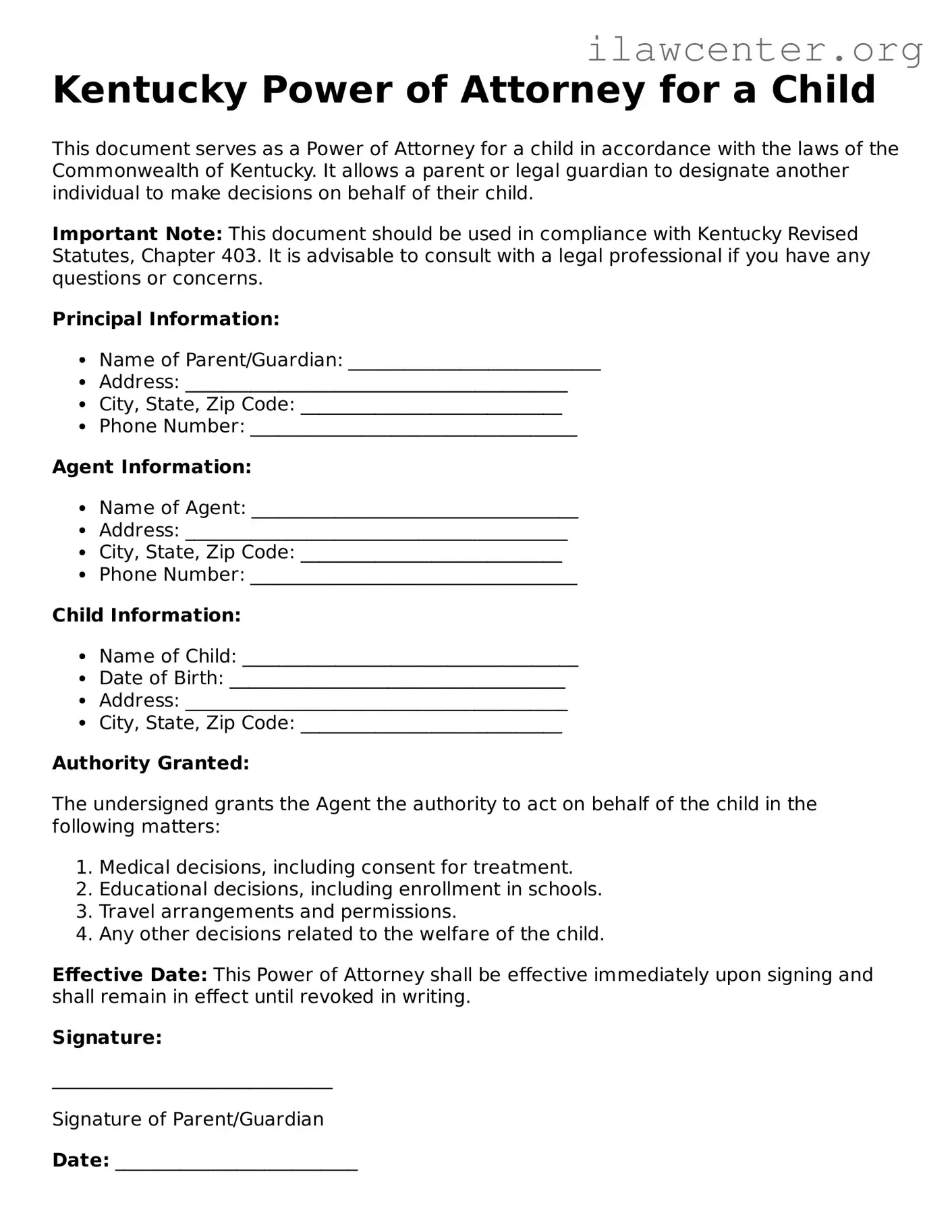
Kentucky Power of Attorney for a Child Preview

Kentucky Power of Attorney for a Child

This document serves as a Power of Attorney for a child in accordance with the laws of the Commonwealth of Kentucky. It allows a parent or legal guardian to designate another individual to make decisions on behalf of their child.

Important Note: This document should be used in compliance with Kentucky Revised Statutes, Chapter 403. It is advisable to consult with a legal professional if you have any questions or concerns.

Principal Information:

  • Name of Parent/Guardian: ___________________________
  • Address: _________________________________________
  • City, State, Zip Code: ____________________________
  • Phone Number: ___________________________________

Agent Information:

  • Name of Agent: ___________________________________
  • Address: _________________________________________
  • City, State, Zip Code: ____________________________
  • Phone Number: ___________________________________

Child Information:

  • Name of Child: ____________________________________
  • Date of Birth: ____________________________________
  • Address: _________________________________________
  • City, State, Zip Code: ____________________________

Authority Granted:

The undersigned grants the Agent the authority to act on behalf of the child in the following matters:

  1. Medical decisions, including consent for treatment.
  2. Educational decisions, including enrollment in schools.
  3. Travel arrangements and permissions.
  4. Any other decisions related to the welfare of the child.

Effective Date: This Power of Attorney shall be effective immediately upon signing and shall remain in effect until revoked in writing.

Signature:

______________________________

Signature of Parent/Guardian

Date: __________________________

Witness:

______________________________

Signature of Witness

Date: __________________________

Notary Public:

State of Kentucky, County of ________________

Subscribed and sworn before me this _____ day of ____________, 20__.

______________________________

Notary Public Signature

My commission expires: ______________________

PDF Form Characteristics

Fact Name Description
Purpose The Kentucky Power of Attorney for a Child form allows a parent or legal guardian to designate another adult to make decisions on behalf of their child.
Duration This power of attorney can be effective for a specific period, typically up to one year, but can be renewed or revoked at any time by the parent or guardian.
Governing Law The form is governed by Kentucky Revised Statutes, specifically KRS 403.300 to 403.340, which outline the laws regarding powers of attorney for minors.
Signature Requirements The form must be signed by the parent or guardian in the presence of a notary public to ensure its validity and legality.

Instructions on Utilizing Kentucky Power of Attorney for a Child

Filling out the Kentucky Power of Attorney for a Child form is an important step in ensuring that your child's needs are met when you are unable to be present. This document allows you to designate someone to make decisions on behalf of your child in various situations. Once you have completed the form, you will need to ensure it is signed and notarized to make it legally binding.

  1. Begin by downloading the Kentucky Power of Attorney for a Child form from a reliable source.
  2. Read through the entire form carefully to understand the information required.
  3. In the designated area, enter the full name of the child for whom you are granting power of attorney.
  4. Provide the child's date of birth and any other identifying information requested.
  5. Next, fill in your full name as the parent or legal guardian granting the power of attorney.
  6. Include your address, phone number, and any other contact information required.
  7. Designate the individual you are granting power of attorney to by entering their full name and relationship to the child.
  8. Make sure to provide the designated person's address and contact information.
  9. Review the sections regarding the scope of authority. Indicate what decisions the designated person can make on behalf of your child.
  10. Sign and date the form in the appropriate section to validate it.
  11. Have the form notarized by a licensed notary public. This step is essential for the document to be legally effective.

After completing these steps, keep a copy of the signed and notarized form for your records. Provide copies to the designated individual and anyone else who may need to reference it, such as schools or medical providers. This ensures that everyone involved is aware of the arrangements you have made for your child's care.

Important Facts about Kentucky Power of Attorney for a Child

What is a Power of Attorney for a Child in Kentucky?

A Power of Attorney for a Child in Kentucky is a legal document that allows a parent or guardian to grant another individual the authority to make decisions on behalf of their child. This can include decisions related to education, healthcare, and general welfare. It is particularly useful when parents are unable to care for their child temporarily due to travel, illness, or other circumstances.

Who can be designated as an agent in the Power of Attorney for a Child?

The agent designated in the Power of Attorney for a Child can be any responsible adult. This could be a relative, family friend, or trusted neighbor. However, it is crucial to choose someone who will act in the best interest of the child and can handle the responsibilities involved.

Do both parents need to sign the Power of Attorney for a Child?

In most cases, both parents should sign the document to ensure that both have consented to the arrangement. However, if one parent is unavailable or has sole legal custody, that parent may be able to execute the document alone. It is advisable to consult legal guidance to confirm the requirements based on individual circumstances.

How long is the Power of Attorney for a Child valid?

The Power of Attorney for a Child can be set for a specific duration or remain in effect until revoked. Parents should clearly state the effective dates in the document. If no expiration is specified, it may remain valid until the child reaches the age of majority or until the parent revokes it.

What responsibilities does the agent have?

The agent has the responsibility to act in the best interest of the child. This includes making decisions about education, healthcare, and other daily needs. The agent should keep the parents informed about significant decisions and any changes in the child's circumstances.

Can the Power of Attorney for a Child be revoked?

Yes, the Power of Attorney for a Child can be revoked at any time by the parent or guardian who created it. This can be done through a written notice stating the revocation. It is advisable to inform the designated agent and any relevant parties, such as schools or healthcare providers, about the revocation.

Is a notarized signature required for the Power of Attorney for a Child?

While Kentucky law does not explicitly require notarization for the Power of Attorney for a Child, having the document notarized can provide additional legal protection and clarity. Notarization helps verify the identities of the signers and can prevent disputes about the validity of the document.

What happens if the Power of Attorney for a Child is not in place?

If a Power of Attorney for a Child is not in place and a parent is unable to care for the child, the other parent may need to seek legal guardianship through the court system. This process can be time-consuming and may not provide immediate solutions for the child's care.

Where can I obtain a Power of Attorney for a Child form in Kentucky?

Power of Attorney for a Child forms can often be obtained from legal stationery stores, online legal service providers, or local government offices. It is advisable to ensure that any form used complies with Kentucky state laws and is tailored to the specific needs of the family.

Common mistakes

Filling out the Kentucky Power of Attorney for a Child form can be straightforward, but there are common mistakes that people often make. One significant error is failing to provide accurate information about the child. It is crucial to include the child’s full name, date of birth, and any other identifying details. Incomplete or incorrect information can lead to complications in legal matters.

Another mistake is not specifying the powers granted to the agent. The form allows for various powers to be assigned, and individuals sometimes leave this section vague. Clearly outlining the responsibilities and authority granted to the agent ensures that there is no confusion about what decisions they can make on behalf of the child.

People also frequently overlook the requirement for signatures. Both the person granting the power and the agent must sign the document. Additionally, a witness or notary may be needed, depending on the specific requirements. Neglecting this step can render the form invalid, which could create problems later.

In some cases, individuals fail to consider the duration of the power of attorney. It is essential to indicate how long the authority will last. Without this information, the agent may have indefinite power, which can be concerning for parents or guardians.

Lastly, many do not keep a copy of the completed form. After filling it out, retaining a copy is vital for future reference. This ensures that all parties involved have access to the document if needed. Keeping a record can help prevent misunderstandings and provide clarity regarding the arrangement.

Documents used along the form

When creating a Power of Attorney for a Child in Kentucky, several other documents may also be beneficial to ensure comprehensive care and legal authority. Each of these documents serves a unique purpose and can help clarify responsibilities and rights. Below is a list of commonly used forms and documents that often accompany a Power of Attorney for a Child.

  • Medical Authorization Form: This document allows designated caregivers to make medical decisions for the child in the event of an emergency or when the parent is unavailable.
  • Child Custody Agreement: This agreement outlines the terms of custody between parents or guardians, ensuring clarity on who has legal rights and responsibilities for the child.
  • Emergency Contact Information: A simple list of contacts, including family members, friends, or neighbors, who can be reached in case of an emergency involving the child.
  • School Authorization Form: This form grants permission for a designated person to enroll the child in school, attend parent-teacher meetings, and access academic records.
  • Travel Consent Form: If the child will be traveling, this document provides permission for the child to travel with a designated adult, especially if crossing state lines or international borders.
  • Health Care Proxy: This document designates someone to make health care decisions on behalf of the child if the parent or guardian is unable to do so.
  • Child Support Agreement: If applicable, this agreement outlines the financial responsibilities of each parent or guardian regarding the child's care and support.

Having these documents prepared alongside the Power of Attorney for a Child can provide peace of mind and ensure that all aspects of the child's care and legal representation are adequately addressed. It is always wise to consult with a legal professional to tailor these documents to your specific situation and needs.

Similar forms

The Power of Attorney for a Child form allows a designated individual to make decisions on behalf of a minor. This document is similar to several other legal forms that grant authority or responsibility over another person. Here are eight documents that share similarities with the Power of Attorney for a Child:

  • General Power of Attorney: This document allows one person to act on behalf of another in a broad range of matters, including financial and legal decisions, similar to how a Power of Attorney for a Child enables caretaking decisions for a minor.
  • Medical Power of Attorney: This form specifically grants someone the authority to make healthcare decisions for another individual. Like the Power of Attorney for a Child, it is crucial for ensuring that someone can make important decisions when the individual is unable to do so themselves.
  • Guardianship Agreement: A guardianship agreement designates an individual to care for a child when the parents are unable to fulfill that role. Both documents serve to protect the child's welfare and ensure proper care.
  • Child Custody Agreement: This legal document outlines the arrangements for the care and control of a child after parents separate or divorce. It parallels the Power of Attorney for a Child in that it addresses who is responsible for the child's upbringing.
  • Temporary Guardianship Form: This form allows a parent to grant temporary authority to another person to care for their child. It is similar in function to the Power of Attorney for a Child, focusing on the child's immediate needs.
  • Living Will: A living will outlines a person's wishes regarding medical treatment in situations where they cannot communicate. While it primarily focuses on healthcare, it shares the concept of decision-making authority during critical times.
  • Trust Agreement: This document establishes a legal entity to manage assets for beneficiaries, including children. Like the Power of Attorney for a Child, it involves a responsible party acting in the best interest of a minor.
  • Special Needs Trust: This type of trust is created to manage assets for individuals with disabilities without jeopardizing their eligibility for government benefits. It is similar to the Power of Attorney for a Child in that it aims to provide for a child's needs and future.

Dos and Don'ts

When filling out the Kentucky Power of Attorney for a Child form, it's essential to follow specific guidelines to ensure everything is completed correctly. Here’s a list of things you should and shouldn't do:

  • Do read the entire form carefully before starting.
  • Do provide accurate information about the child and the agent.
  • Do sign and date the form in the appropriate sections.
  • Do have the form notarized to ensure its validity.
  • Don't leave any sections blank; fill out all required fields.
  • Don't use outdated versions of the form; always check for the latest version.

Misconceptions

Many people have misunderstandings about the Kentucky Power of Attorney for a Child form. Here are six common misconceptions:

  1. It is the same as guardianship.

    Many believe that a Power of Attorney grants the same rights as guardianship. However, a Power of Attorney is typically temporary and does not sever parental rights.

  2. It can only be used in emergencies.

    Some think this form is only for emergencies. In reality, it can be used for various situations, such as travel or temporary care arrangements.

  3. Only parents can create a Power of Attorney.

    While parents often use this form, legal guardians or other relatives can also establish a Power of Attorney for a child.

  4. It must be notarized to be valid.

    Although notarization is recommended for authenticity, it is not strictly required in all cases. Witness signatures may suffice.

  5. It automatically expires after a certain time.

    Some believe that a Power of Attorney has a built-in expiration date. In fact, it remains valid until the specified end date or until revoked by the parent.

  6. It can be used for medical decisions.

    This form does not cover medical decisions unless explicitly stated. A separate medical Power of Attorney is needed for healthcare matters.

Key takeaways

Filling out and using the Kentucky Power of Attorney for a Child form can be straightforward, but it is important to understand the key aspects to ensure it is done correctly. Here are some essential takeaways:

  • The form allows a parent or guardian to designate another adult to make decisions on behalf of their child.
  • It is crucial to choose someone trustworthy, as they will have significant responsibilities.
  • The Power of Attorney can be limited to specific tasks or be broad in scope, depending on your needs.
  • Make sure to include the child's full name and date of birth on the form for clarity.
  • Both the parent or guardian and the designated agent must sign the form in the presence of a notary public.
  • Keep a copy of the completed form in a safe place and provide copies to the designated agent and any relevant parties.
  • The Power of Attorney can be revoked at any time by the parent or guardian, as long as they provide written notice.
  • It is advisable to review the form periodically to ensure it still meets your needs and reflects any changes in circumstances.
  • Be aware that this form does not grant custody; it only allows for temporary decision-making authority.
  • Consulting with a legal professional can help clarify any questions you may have about the form and its implications.

Understanding these key points can help ensure that the Power of Attorney for a Child form serves its intended purpose effectively and responsibly.