Attorney-Verified  Power of Attorney Document for Kentucky

Attorney-Verified Power of Attorney Document for Kentucky

The Kentucky Power of Attorney form is a legal document that allows one person to grant another the authority to act on their behalf in various matters, such as financial or medical decisions. This form is essential for ensuring that your wishes are honored when you are unable to make decisions for yourself. To take the next step in securing your interests, consider filling out the form by clicking the button below.

Article Guide

In Kentucky, the Power of Attorney (POA) form is an essential legal document that allows individuals to designate someone else to make decisions on their behalf. This can be particularly important in situations where a person may be unable to manage their affairs due to illness, absence, or other circumstances. The form typically covers various aspects, including financial decisions, healthcare choices, and real estate transactions. By using this document, you can ensure that your wishes are respected, even when you are not in a position to express them. It’s vital to understand the different types of POA available in Kentucky, such as durable, non-durable, and medical powers of attorney, as each serves a unique purpose. Additionally, the process of creating and executing the form requires careful consideration, including selecting a trustworthy agent and ensuring that all legal requirements are met. Understanding these components can help individuals navigate the complexities of legal decision-making, providing peace of mind for both the principal and the designated agent.

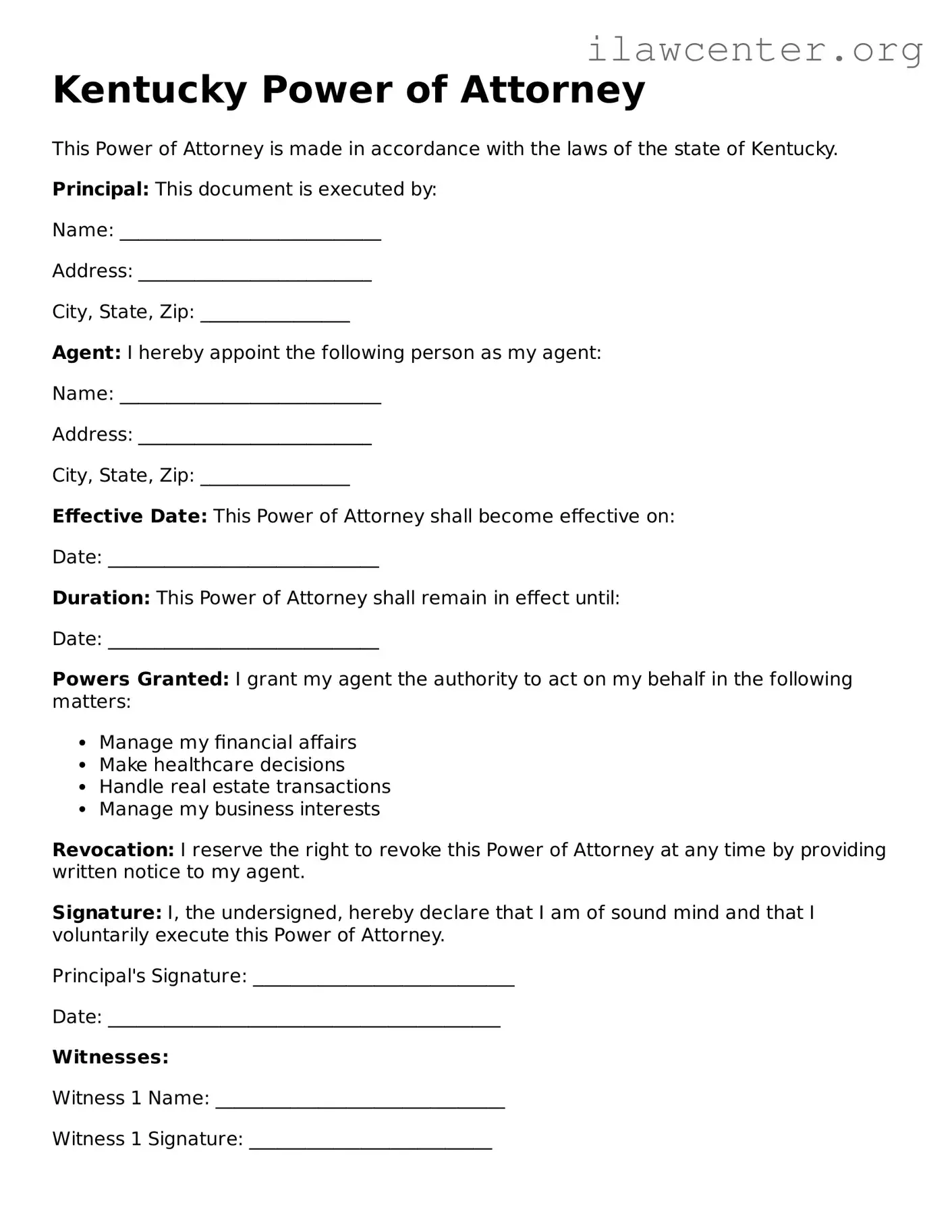
Kentucky Power of Attorney Preview

Kentucky Power of Attorney

This Power of Attorney is made in accordance with the laws of the state of Kentucky.

Principal: This document is executed by:

Name: ____________________________

Address: _________________________

City, State, Zip: ________________

Agent: I hereby appoint the following person as my agent:

Name: ____________________________

Address: _________________________

City, State, Zip: ________________

Effective Date: This Power of Attorney shall become effective on:

Date: _____________________________

Duration: This Power of Attorney shall remain in effect until:

Date: _____________________________

Powers Granted: I grant my agent the authority to act on my behalf in the following matters:

  • Manage my financial affairs
  • Make healthcare decisions
  • Handle real estate transactions
  • Manage my business interests

Revocation: I reserve the right to revoke this Power of Attorney at any time by providing written notice to my agent.

Signature: I, the undersigned, hereby declare that I am of sound mind and that I voluntarily execute this Power of Attorney.

Principal's Signature: ____________________________

Date: __________________________________________

Witnesses:

Witness 1 Name: _______________________________

Witness 1 Signature: __________________________

Date: ________________________________________

Witness 2 Name: _______________________________

Witness 2 Signature: __________________________

Date: ________________________________________

Notarization:

State of Kentucky

County of ________________________

Subscribed and sworn to before me this ______ day of __________, 20__.

Notary Public Signature: ______________________

My Commission Expires: ______________________

PDF Form Characteristics

Fact Name Description
Definition A Power of Attorney (POA) allows one person to make decisions on behalf of another.
Governing Law The Kentucky Power of Attorney is governed by KRS Chapter 457.
Types of POA There are different types, including durable, non-durable, and springing POA.
Durable POA A durable POA remains effective even if the principal becomes incapacitated.
Non-Durable POA A non-durable POA is only valid while the principal is competent.
Springing POA A springing POA becomes effective only upon the principal's incapacitation.
Principal's Authority The principal can grant specific or general powers to the agent.
Agent's Duties The agent must act in the best interest of the principal and follow their wishes.
Revocation The principal can revoke the POA at any time as long as they are competent.
Witness Requirement The Kentucky POA must be signed in the presence of a notary public or two witnesses.

Instructions on Utilizing Kentucky Power of Attorney

Filling out the Kentucky Power of Attorney form is an important step in designating someone to act on your behalf. Once completed, ensure that the form is signed and dated according to Kentucky law. You will then need to provide copies to your agent and any relevant institutions or individuals.

  1. Obtain the Kentucky Power of Attorney form from a reliable source.
  2. Read the form carefully to understand the sections you need to fill out.
  3. In the designated area, enter your full name and address as the principal.
  4. Provide the full name and address of the person you are appointing as your agent.
  5. Specify the powers you wish to grant your agent. This may include financial decisions, medical decisions, or other specific powers.
  6. Indicate the duration of the Power of Attorney. Decide if it is effective immediately or under certain conditions.
  7. Sign and date the form in the presence of a notary public.
  8. Ensure the notary public also signs and stamps the form, confirming its validity.
  9. Make copies of the signed and notarized form for your records and for your agent.

Important Facts about Kentucky Power of Attorney

What is a Power of Attorney in Kentucky?

A Power of Attorney (POA) in Kentucky is a legal document that allows one person, known as the principal, to appoint another person, called the agent or attorney-in-fact, to act on their behalf. This authority can cover a wide range of decisions, including financial matters, medical decisions, and property management. The principal can specify the extent of the agent's powers and can revoke the POA at any time, as long as they are mentally competent.

How do I create a Power of Attorney in Kentucky?

To create a Power of Attorney in Kentucky, you must complete a form that meets the state's legal requirements. The form should clearly state your name, the name of the agent, and the powers you are granting. It is advisable to have the document signed in the presence of a notary public to ensure its validity. After signing, keep the original document in a safe place and provide copies to your agent and any relevant institutions, such as banks or healthcare providers.

Can I revoke a Power of Attorney in Kentucky?

Yes, you can revoke a Power of Attorney in Kentucky at any time, as long as you are mentally competent. To do this, you should create a written revocation document that states your intention to revoke the previous POA. This revocation should be signed and dated, and it is best to notify your agent and any institutions that had a copy of the original POA. This ensures that all parties are aware of the change and that the agent no longer has authority to act on your behalf.

What happens if I become incapacitated and have not set up a Power of Attorney?

If you become incapacitated without a Power of Attorney in place, your family or friends may need to go through a court process to become your legal guardian or conservator. This process can be time-consuming and costly. By establishing a POA while you are still capable, you can ensure that your chosen agent can make decisions for you without the need for court intervention, thus providing you with peace of mind regarding your affairs.

Common mistakes

When filling out the Kentucky Power of Attorney form, individuals often encounter several common pitfalls. These mistakes can lead to confusion or even invalidate the document. Understanding these errors can help ensure that the form is completed correctly and serves its intended purpose.

One frequent mistake is failing to specify the powers granted. A Power of Attorney can be broad or limited, depending on the needs of the principal. If the powers are not clearly defined, the agent may not have the authority to act in certain situations. This ambiguity can create problems when decisions need to be made swiftly.

Another common error is neglecting to date the document. A Power of Attorney should always include the date it was signed. Without a date, it can be challenging to determine when the authority was granted, potentially leading to disputes or complications later on.

Some individuals mistakenly believe that the form only needs to be signed by the principal. However, witness signatures and notarization are often required for the document to be valid in Kentucky. Failing to include these elements can render the Power of Attorney ineffective.

Additionally, people sometimes overlook the importance of choosing the right agent. The agent should be someone trustworthy and capable of making decisions in the principal's best interest. Selecting an unqualified or unreliable person can lead to mismanagement of affairs.

Another mistake involves not reviewing the form thoroughly before submission. Errors in names, addresses, or other critical information can cause delays or complications. Taking the time to double-check the details can save a lot of trouble down the line.

Some individuals also fail to consider the potential for changes. Life circumstances can change, and so can the need for a Power of Attorney. It’s essential to keep the document updated and to revoke it if necessary. Ignoring this aspect can lead to outdated authority being exercised.

Furthermore, people often forget to discuss the Power of Attorney with their agent before completing the form. It’s crucial for the agent to understand their responsibilities and the principal’s wishes. A lack of communication can lead to misunderstandings and conflicts when the agent is called upon to act.

Lastly, some individuals mistakenly believe that a Power of Attorney is a one-time document. In reality, it may need to be revised or replaced as life situations change. Regularly reviewing the document ensures that it remains relevant and effective.

By being aware of these common mistakes, individuals can fill out the Kentucky Power of Attorney form with greater confidence. Taking the necessary steps to avoid these pitfalls will help ensure that the document serves its intended purpose effectively.

Documents used along the form

When creating a Power of Attorney (POA) in Kentucky, several other forms and documents may be necessary or beneficial to ensure comprehensive legal protection and clarity in decision-making. Below is a list of commonly used documents that often accompany a Power of Attorney.

  • Living Will: This document outlines an individual's wishes regarding medical treatment in situations where they may be unable to communicate their preferences. It provides guidance to healthcare providers and family members about end-of-life care.
  • Healthcare Proxy: Similar to a Power of Attorney, a healthcare proxy specifically designates someone to make medical decisions on behalf of another person if they are incapacitated. This ensures that medical choices align with the individual's values and wishes.
  • Durable Power of Attorney: This variation of the standard Power of Attorney remains effective even if the principal becomes incapacitated. It is essential for long-term planning and ensures that the designated agent can continue to act on behalf of the principal.
  • Financial Power of Attorney: This specific type of Power of Attorney grants authority to manage financial matters, such as banking, investments, and real estate transactions. It is particularly useful for individuals who may need assistance in managing their finances.
  • Affidavit of Acceptance: This document is often used by the agent to formally accept their role and responsibilities under the Power of Attorney. It may be required by financial institutions or other entities when the agent presents the POA.
  • Revocation of Power of Attorney: If an individual wishes to terminate a previously granted Power of Attorney, this document formally revokes the authority of the agent. It is crucial to notify all relevant parties of this change.
  • Property Transfer Documents: When transferring property or assets, additional documentation may be needed to legally effectuate the transfer. This can include deeds or titles that require the signature of the principal or agent.
  • Guardianship Petition: In cases where an individual may need a guardian due to incapacity, a petition can be filed in court to establish guardianship. This document is essential for legal oversight and protection of the individual’s rights.

In summary, while the Power of Attorney form is a critical document for delegating authority, these additional forms and documents can provide further clarity and protection. It is advisable to consider these options carefully and consult with a legal professional to ensure that all necessary documents are in place and appropriately executed.

Similar forms

The Power of Attorney form has similarities with several other legal documents. Each serves a specific purpose, often involving the delegation of authority or decision-making power. Here are six documents that share characteristics with the Power of Attorney:

  • Living Will: This document outlines an individual's wishes regarding medical treatment in situations where they cannot communicate their preferences. Like a Power of Attorney, it allows someone to make decisions on behalf of another person, focusing specifically on healthcare choices.
  • Healthcare Proxy: Similar to a Power of Attorney, a healthcare proxy designates someone to make medical decisions for another person. This document specifically addresses health-related matters, ensuring that a trusted individual can act when necessary.
  • Durable Power of Attorney: This is a specific type of Power of Attorney that remains effective even if the person becomes incapacitated. It provides ongoing authority to manage financial or legal matters, much like the general Power of Attorney.
  • Financial Power of Attorney: This document allows a designated person to handle financial matters on behalf of another. It is similar to a general Power of Attorney but focuses solely on financial decisions and transactions.
  • Trust: A trust involves designating a trustee to manage assets for the benefit of beneficiaries. Like a Power of Attorney, it allows one person to act on behalf of another, but it primarily deals with the management of property and finances.
  • Will: A will specifies how a person's assets should be distributed after their death. While it does not grant authority during a person's lifetime, it shares the intent of directing decisions regarding a person's estate, similar to how a Power of Attorney directs decisions while the person is alive.

Dos and Don'ts

When filling out the Kentucky Power of Attorney form, it's crucial to follow specific guidelines to ensure the document is valid and effective. Here’s a list of things to do and avoid:

  • Do read the entire form carefully before filling it out.
  • Do clearly identify the principal and agent with full names and addresses.
  • Do specify the powers you wish to grant to the agent.
  • Do sign the form in the presence of a notary public.
  • Do keep a copy of the signed document for your records.
  • Don't leave any sections blank; fill in all required fields.
  • Don't use vague language when describing powers.
  • Don't sign the form without understanding what you are authorizing.
  • Don't forget to date the document when signing.

Following these guidelines will help ensure that your Power of Attorney is completed correctly and is legally binding. Take the time to do it right.

Misconceptions

When discussing the Kentucky Power of Attorney form, several misconceptions often arise. Understanding these can help individuals make informed decisions regarding their legal rights and responsibilities. Here are five common misconceptions:

  1. A Power of Attorney is only for financial matters.

    This is not true. While many people associate Power of Attorney with financial decisions, it can also cover healthcare decisions, property management, and other legal matters. The scope of authority can be tailored to meet specific needs.

  2. Once a Power of Attorney is signed, it cannot be revoked.

    This misconception is incorrect. A Power of Attorney can be revoked at any time, as long as the principal is mentally competent. It is important to formally notify the agent and any relevant institutions to avoid confusion.

  3. Only lawyers can create a Power of Attorney.

    This is misleading. While it is advisable to consult a lawyer for complex situations, individuals can create a Power of Attorney on their own using state-approved forms. However, it is crucial to ensure that the document complies with Kentucky laws.

  4. All Power of Attorney forms are the same across states.

    This is false. Each state has its own specific requirements and forms for Power of Attorney. Kentucky has particular stipulations that must be followed, making it essential to use the correct form for the state.

  5. Having a Power of Attorney means giving up control over your affairs.

    This is a common fear, but it is not accurate. A Power of Attorney allows someone to act on your behalf, but you retain the right to manage your affairs as long as you are capable. The agent's authority is based on the terms set forth in the document.

By debunking these misconceptions, individuals can better navigate the complexities of the Kentucky Power of Attorney form and make choices that align with their personal and legal needs.

Key takeaways

When considering the Kentucky Power of Attorney form, there are several important aspects to keep in mind. Understanding these can help ensure that your intentions are clearly communicated and legally recognized.

  • Purpose: A Power of Attorney allows you to designate someone to make decisions on your behalf, especially regarding financial or medical matters.
  • Types: There are different types of Power of Attorney forms, including general, durable, and medical. Each serves a specific purpose.
  • Durability: A durable Power of Attorney remains effective even if you become incapacitated, while a non-durable one does not.
  • Agent Selection: Choose your agent wisely. This person will have significant authority and responsibility over your affairs.
  • Specific Powers: Clearly outline the powers you are granting. This can include managing bank accounts, making healthcare decisions, or selling property.
  • Revocation: You can revoke a Power of Attorney at any time as long as you are mentally competent. This should be done in writing.
  • Witnesses and Notarization: In Kentucky, your Power of Attorney must be signed in the presence of two witnesses or a notary public to be valid.
  • Legal Advice: It may be beneficial to seek legal advice when filling out the form to ensure that it meets your needs and complies with state law.
  • Accessibility: Keep copies of the completed Power of Attorney form in accessible locations, and inform your agent and family members where to find them.

By understanding these key points, individuals can navigate the process of creating and using a Power of Attorney more effectively, ensuring their wishes are respected and upheld.