Attorney-Verified  Prenuptial Agreement Document for Kentucky

Attorney-Verified Prenuptial Agreement Document for Kentucky

A Kentucky Prenuptial Agreement form is a legal document that outlines how a couple's assets and debts will be handled in the event of divorce or separation. This agreement can provide clarity and protection for both parties, ensuring that their financial interests are safeguarded. To get started on your own prenuptial agreement, fill out the form by clicking the button below.

Article Guide

In the heart of Kentucky, couples embarking on the journey of marriage often consider the importance of a prenuptial agreement. This legal document serves as a proactive measure, allowing partners to outline their financial rights and responsibilities before tying the knot. A Kentucky Prenuptial Agreement form typically includes essential aspects such as the identification of both parties, a detailed inventory of assets and debts, and provisions regarding property division in the event of a divorce. It may also address spousal support and other considerations unique to the couple's situation. By addressing these topics upfront, individuals can foster open communication and reduce potential conflicts in the future. Understanding the nuances of this agreement can empower couples to make informed decisions that align with their shared goals and values.

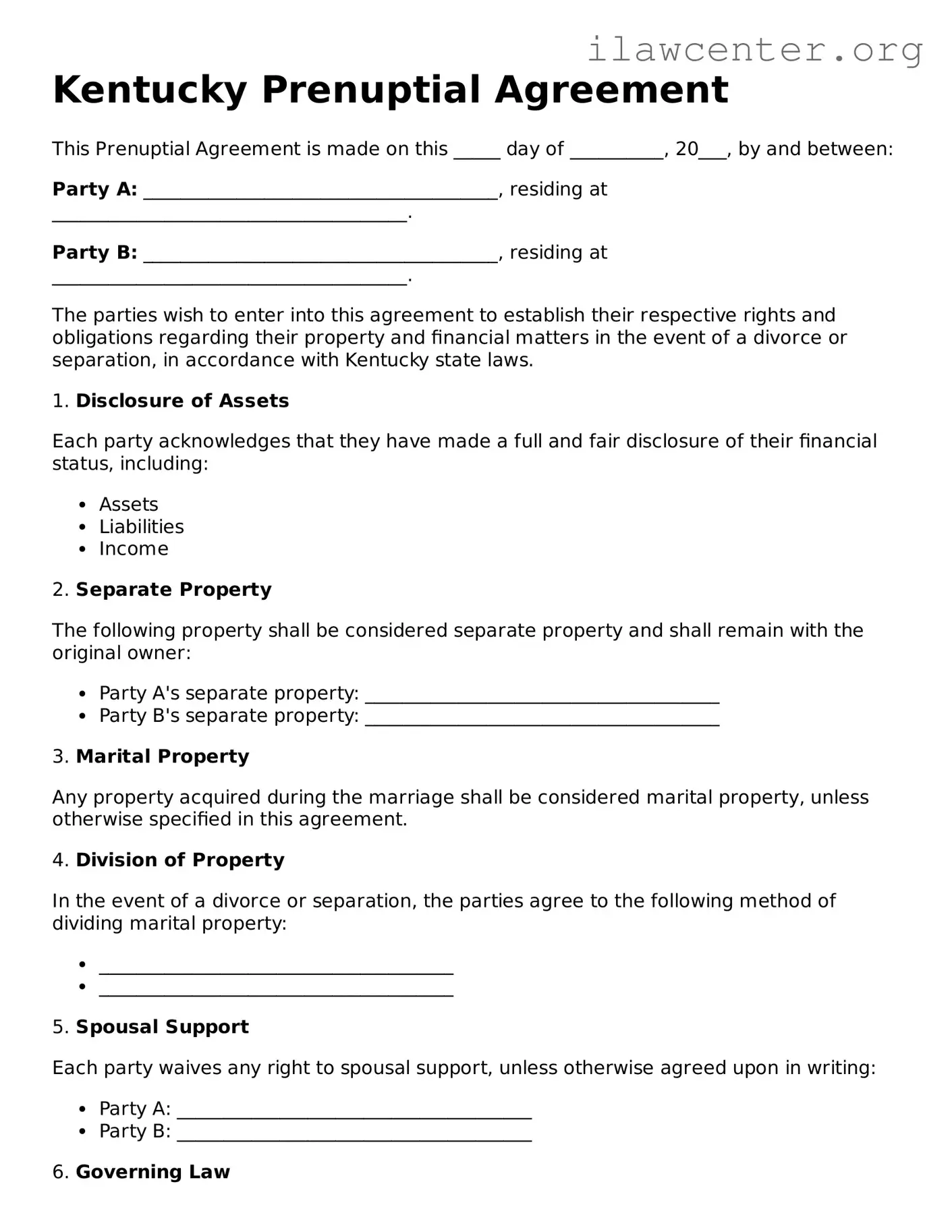
Kentucky Prenuptial Agreement Preview

Kentucky Prenuptial Agreement

This Prenuptial Agreement is made on this _____ day of __________, 20___, by and between:

Party A: ______________________________________, residing at ______________________________________.

Party B: ______________________________________, residing at ______________________________________.

The parties wish to enter into this agreement to establish their respective rights and obligations regarding their property and financial matters in the event of a divorce or separation, in accordance with Kentucky state laws.

1. Disclosure of Assets

Each party acknowledges that they have made a full and fair disclosure of their financial status, including:

  • Assets
  • Liabilities
  • Income

2. Separate Property

The following property shall be considered separate property and shall remain with the original owner:

  • Party A's separate property: ______________________________________
  • Party B's separate property: ______________________________________

3. Marital Property

Any property acquired during the marriage shall be considered marital property, unless otherwise specified in this agreement.

4. Division of Property

In the event of a divorce or separation, the parties agree to the following method of dividing marital property:

  • ______________________________________
  • ______________________________________

5. Spousal Support

Each party waives any right to spousal support, unless otherwise agreed upon in writing:

  • Party A: ______________________________________
  • Party B: ______________________________________

6. Governing Law

This agreement shall be governed by the laws of the State of Kentucky.

7. Amendments

This agreement may be amended only by a written document signed by both parties.

IN WITNESS WHEREOF, the parties have executed this Prenuptial Agreement on the date first above written.

______________________________
Party A

______________________________
Party B

______________________________
Witness

______________________________
Witness

PDF Form Characteristics

Fact Name Details
Definition A prenuptial agreement is a contract between two individuals before they marry, outlining the distribution of assets and responsibilities in case of divorce or separation.
Governing Law Kentucky Revised Statutes, Chapter 403 governs prenuptial agreements in Kentucky.
Enforceability For a prenuptial agreement to be enforceable, it must be in writing and signed by both parties.
Disclosure Requirement Both parties should fully disclose their assets and liabilities to ensure fairness and transparency.
Modification Parties can modify or revoke the agreement after marriage, but changes must be in writing and signed by both parties.
Legal Representation It is advisable for both parties to seek independent legal counsel before signing the agreement to ensure understanding and fairness.

Instructions on Utilizing Kentucky Prenuptial Agreement

Preparing a Kentucky Prenuptial Agreement involves careful consideration and attention to detail. This document outlines the financial and property rights of each party before marriage, helping to clarify expectations and protect individual assets. By following these steps, you can effectively complete the form.

  1. Begin by gathering personal information for both parties, including full names, addresses, and contact information.
  2. Clearly state the date of the agreement. This is essential for legal clarity.
  3. List all assets and liabilities for each party. Be thorough and honest to ensure transparency.
  4. Include provisions regarding property ownership. Specify how assets will be divided in the event of divorce or separation.
  5. Address any spousal support or alimony arrangements, if applicable. Clearly outline expectations.
  6. Consider including a clause for amendments. This allows for future changes to the agreement if circumstances evolve.
  7. Both parties should sign the document in the presence of a notary public. This step is crucial for the agreement's validity.
  8. Finally, ensure that each party retains a copy of the signed agreement for their records.

Important Facts about Kentucky Prenuptial Agreement

What is a prenuptial agreement in Kentucky?

A prenuptial agreement, often referred to as a "prenup," is a legal contract made by two individuals before they marry. In Kentucky, this agreement outlines the division of assets, debts, and other financial matters in the event of divorce or separation. It serves to protect the interests of both parties and can clarify expectations regarding financial responsibilities during the marriage.

Why should couples consider a prenuptial agreement?

Couples may consider a prenuptial agreement for several reasons. It can help protect individual assets acquired before the marriage, ensure clarity regarding financial responsibilities, and provide a framework for asset division if the marriage ends. Additionally, it can reduce conflict and uncertainty during a divorce, as the terms have already been agreed upon by both parties.

What should be included in a Kentucky prenuptial agreement?

A well-drafted prenuptial agreement in Kentucky typically includes provisions regarding the division of property, spousal support, and the handling of debts. Couples can also address how future income will be treated and whether certain assets will remain separate or become marital property. It is essential to be thorough and clear to avoid misunderstandings later on.

Are there any legal requirements for a prenuptial agreement in Kentucky?

Yes, Kentucky law requires that a prenuptial agreement be in writing and signed by both parties. Additionally, both individuals should fully disclose their financial situations, including assets and debts, to ensure fairness and transparency. It is advisable for each party to seek independent legal counsel to review the agreement before signing, as this can help prevent challenges to its validity in the future.

Can a prenuptial agreement be modified after marriage?

Yes, a prenuptial agreement can be modified after marriage, but both parties must agree to the changes in writing. This modification should also be signed and dated by both individuals to ensure its enforceability. It is important to keep in mind that any changes should be made with careful consideration and ideally with legal advice.

What happens if a prenuptial agreement is not enforced?

If a prenuptial agreement is not enforced, the court may not recognize its terms during divorce proceedings. This could lead to a situation where assets are divided according to state law rather than the agreed-upon terms in the prenup. Therefore, it is crucial to ensure that the agreement is properly drafted, signed, and adhered to by both parties.

How does a prenuptial agreement affect estate planning?

A prenuptial agreement can significantly influence estate planning. It can determine how assets are distributed upon death and clarify any rights to property. Couples should consider updating their wills and other estate planning documents to align with the terms of their prenup, ensuring that both parties' intentions are clearly expressed and legally binding.

Is a prenuptial agreement enforceable in court?

In Kentucky, a prenuptial agreement is generally enforceable in court, provided it meets specific legal requirements. These include being in writing, signed by both parties, and made with full financial disclosure. However, if the agreement is found to be unconscionable or if one party did not have adequate legal representation, a court may choose not to enforce it. Therefore, careful drafting and legal advice are essential.

How can couples ensure their prenuptial agreement is valid?

To ensure a prenuptial agreement is valid, couples should follow several best practices. They should engage in open and honest discussions about their financial situations, seek independent legal counsel, and ensure the agreement is in writing and signed by both parties. Additionally, it is wise to avoid any form of coercion or pressure when drafting the agreement, as this can undermine its validity.
Common mistakes

Filling out a Kentucky Prenuptial Agreement form can be a significant step in preparing for marriage, yet many individuals make common mistakes that can lead to complications down the road. One frequent error is failing to fully disclose all assets and debts. Transparency is crucial in these agreements. When one party does not reveal their financial situation completely, it can lead to disputes later on, potentially invalidating the agreement.

Another mistake is overlooking the importance of legal counsel. Some couples believe they can navigate the process on their own without professional guidance. While it may seem straightforward, a lawyer can provide valuable insights into state laws and help ensure that the agreement is enforceable. Without this expertise, couples might miss critical elements that could affect their rights and obligations.

Additionally, many people neglect to consider future changes in their circumstances. A prenuptial agreement should not only address current assets but also anticipate future acquisitions or changes in financial status. Failing to include provisions for these potential shifts can render the agreement less effective in protecting both parties’ interests as life progresses.

Another common error involves not having both parties sign the agreement voluntarily. If one party feels pressured or coerced into signing, it can lead to questions about the agreement’s validity. It’s essential that both individuals understand the terms and agree to them freely. This ensures that the document holds up in court if challenged.

Finally, couples sometimes forget to review and update their prenuptial agreements after significant life events, such as the birth of children or changes in financial status. Regularly revisiting the agreement allows couples to make necessary adjustments, ensuring that it continues to reflect their current situation. By avoiding these mistakes, individuals can create a stronger and more effective prenuptial agreement that serves their needs.

Documents used along the form

When preparing for a marriage in Kentucky, a prenuptial agreement is an important document that outlines the financial rights and responsibilities of each spouse. However, it is often accompanied by other forms and documents to ensure a comprehensive understanding of the couple's financial situation and legal obligations. Below are some of the key documents that may be used alongside a Kentucky Prenuptial Agreement.

  • Financial Disclosure Statement: This document requires both parties to provide a detailed account of their assets, liabilities, income, and expenses. Transparency is crucial in negotiations.
  • Postnuptial Agreement: Similar to a prenuptial agreement, this document is created after marriage. It addresses financial matters and can be used to modify terms set in the prenuptial agreement.
  • Separation Agreement: This document outlines the terms of separation between spouses, including asset division and support obligations. It may be used in the event of divorce.
  • Will: A will specifies how a person's assets will be distributed upon their death. Having a will ensures that both parties’ wishes are honored and can complement the financial arrangements made in a prenuptial agreement.
  • Power of Attorney: This legal document allows one spouse to make decisions on behalf of the other regarding financial and medical matters. It can be important for managing affairs if one partner becomes incapacitated.
  • Living Will: A living will outlines an individual’s preferences for medical treatment in case they cannot communicate their wishes. This document can be crucial for both parties in a marriage.
  • Trust Documents: If either spouse has a trust, these documents detail the management and distribution of assets held in the trust. They can provide additional layers of financial security.

Having these documents in place can help ensure that both parties enter the marriage with a clear understanding of their rights and responsibilities. This proactive approach can lead to a healthier and more transparent relationship.

Similar forms

  • Postnuptial Agreement: Similar to a prenuptial agreement, a postnuptial agreement is created after marriage. It outlines how assets will be divided in case of divorce or separation.
  • Separation Agreement: This document is used when a couple decides to live apart. It details the terms of their separation, including asset division and support obligations.
  • Divorce Settlement Agreement: This agreement is reached during divorce proceedings. It covers the division of property, debts, and any support payments.
  • Living Together Agreement: Also known as a cohabitation agreement, this document is for couples who live together but are not married. It outlines financial responsibilities and property rights.
  • Will: A will specifies how a person's assets will be distributed after their death. Like a prenuptial agreement, it addresses asset division but in the context of estate planning.
  • Trust Agreement: This document creates a trust to manage and distribute assets. It can be similar to a prenuptial agreement in that it outlines how assets are handled during a person's lifetime and after death.
  • Power of Attorney: While not directly about asset division, a power of attorney allows someone to make financial decisions on behalf of another. It can be important in managing assets, similar to the intentions of a prenuptial agreement.

Dos and Don'ts

When completing the Kentucky Prenuptial Agreement form, it is essential to follow certain guidelines to ensure the document is valid and effective. Below is a list of things to do and avoid during this process.

Things You Should Do:

  • Consult with a qualified attorney to understand the legal implications.
  • Be transparent about your financial situation, including assets and debts.
  • Discuss the agreement openly with your partner to avoid misunderstandings.
  • Ensure both parties have sufficient time to review the agreement before signing.
  • Sign the agreement in the presence of a notary public to validate it.

Things You Shouldn't Do:

  • Do not rush the process; take your time to consider all terms.
  • Avoid using vague language that may lead to confusion later.
  • Do not hide any assets or financial information from your partner.
  • Refrain from signing the agreement under pressure or duress.
  • Do not assume that a verbal agreement is sufficient; always document everything in writing.

Misconceptions

When considering a prenuptial agreement in Kentucky, it's important to separate fact from fiction. Here are some common misconceptions that many people have:

  1. Prenuptial agreements are only for the wealthy. Many believe that only those with significant assets need a prenup. In reality, anyone can benefit from a prenup, regardless of their financial situation. It can help clarify financial responsibilities and protect both parties.
  2. Prenups are only for divorce. Some think that prenuptial agreements are solely about preparing for a breakup. In truth, they can also help couples discuss and agree on financial matters, which can strengthen their relationship.
  3. Prenuptial agreements are not enforceable in court. There is a misconception that these agreements hold no legal weight. In Kentucky, if properly drafted and executed, prenuptial agreements are enforceable in court.
  4. You cannot change a prenuptial agreement once it is signed. Many believe that once a prenup is in place, it cannot be modified. However, couples can update or amend their agreements as their circumstances change, provided both parties agree.
  5. Prenups are only for heterosexual couples. This is a common myth. Prenuptial agreements are available to all couples, regardless of sexual orientation, and they can provide valuable protections for everyone.
  6. Prenuptial agreements are a sign of distrust. Some people view prenups as a lack of faith in the relationship. In reality, they can foster open communication about finances, which is essential for a healthy marriage.
  7. All assets must be disclosed for a prenup to be valid. While full disclosure is important, some believe that failing to disclose every single asset invalidates the agreement. In Kentucky, significant assets should be disclosed, but minor oversights may not necessarily void the prenup.
  8. Prenups can include anything. There is a misconception that a prenup can cover any topic. However, Kentucky law restricts certain provisions, such as child custody arrangements, which must be determined based on the child's best interests.
  9. Prenups are only necessary for second marriages. Some think that only individuals entering a second marriage need a prenup. In fact, first-time marriages can also benefit from these agreements, especially if one or both partners have significant assets or debts.

Understanding these misconceptions can help you make informed decisions about prenuptial agreements. Open communication with your partner and seeking legal advice can further clarify any concerns you may have.

Key takeaways

When considering a prenuptial agreement in Kentucky, it's important to understand the key aspects of the process. Here are ten essential takeaways:

  1. Purpose of the Agreement: A prenuptial agreement outlines how assets and debts will be divided in the event of divorce or death.
  2. Full Disclosure: Both parties must fully disclose their financial situations, including assets, liabilities, and income.
  3. Legal Age: Both parties must be of legal age to enter into a contract, which is 18 years in Kentucky.
  4. Voluntary Agreement: The agreement must be entered into voluntarily, without coercion or undue pressure from either party.
  5. Written Document: A prenuptial agreement must be in writing to be enforceable in Kentucky.
  6. Fair and Reasonable Terms: The terms of the agreement should be fair and reasonable at the time of signing.
  7. Independent Legal Advice: It is advisable for both parties to seek independent legal counsel to ensure their interests are protected.
  8. Signatures Required: Both parties must sign the agreement for it to be valid.
  9. Notarization: While not required, having the agreement notarized can add an extra layer of authenticity.
  10. Review and Update: Consider reviewing and updating the agreement periodically, especially after major life events such as the birth of a child.

Understanding these key points can help ensure that a prenuptial agreement serves its intended purpose effectively.