Attorney-Verified  Quitclaim Deed Document for Kentucky

Attorney-Verified Quitclaim Deed Document for Kentucky

A Kentucky Quitclaim Deed is a legal document used to transfer ownership of real estate from one party to another without any guarantees about the title's validity. This type of deed is often used among family members or in situations where the parties know each other well. If you're ready to fill out the form, click the button below.

Article Guide

In the realm of real estate transactions, understanding the various types of deeds is essential for both buyers and sellers. One such instrument is the Kentucky Quitclaim Deed, a legal document that facilitates the transfer of property rights from one party to another. Unlike other types of deeds, the quitclaim deed does not guarantee that the seller holds clear title to the property; instead, it simply conveys whatever interest the seller may have, if any. This makes it particularly useful in situations such as transferring property between family members, resolving disputes, or clearing up title issues. The form itself is relatively straightforward, requiring essential information such as the names of the parties involved, a description of the property, and the signatures of the grantor and grantee. While it may lack the assurances provided by warranty deeds, the quitclaim deed serves a vital role in the Kentucky real estate landscape, offering a quick and uncomplicated means of transferring property interests.

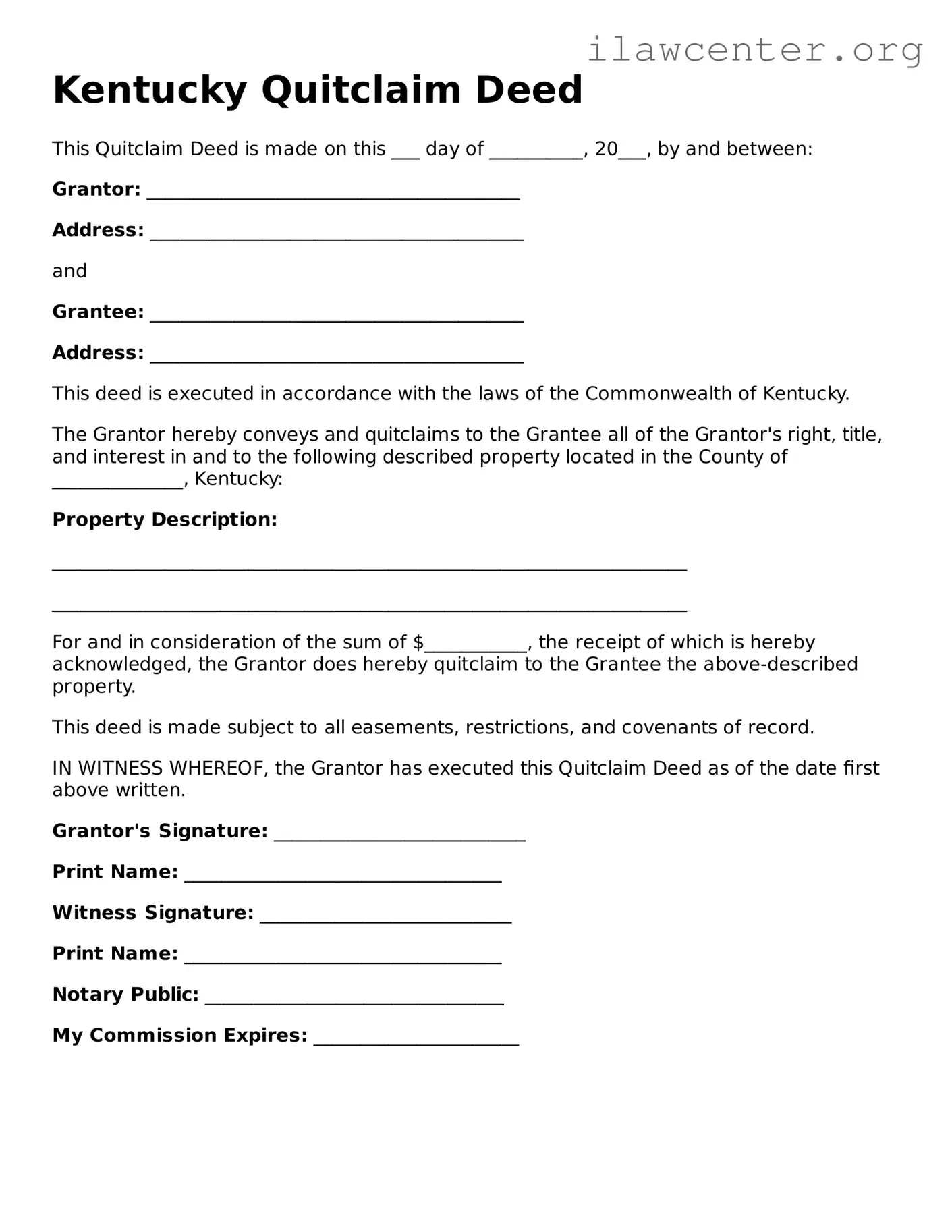
Kentucky Quitclaim Deed Preview

Kentucky Quitclaim Deed

This Quitclaim Deed is made on this ___ day of __________, 20___, by and between:

Grantor: ________________________________________

Address: ________________________________________

and

Grantee: ________________________________________

Address: ________________________________________

This deed is executed in accordance with the laws of the Commonwealth of Kentucky.

The Grantor hereby conveys and quitclaims to the Grantee all of the Grantor's right, title, and interest in and to the following described property located in the County of ______________, Kentucky:

Property Description:

____________________________________________________________________

____________________________________________________________________

For and in consideration of the sum of $___________, the receipt of which is hereby acknowledged, the Grantor does hereby quitclaim to the Grantee the above-described property.

This deed is made subject to all easements, restrictions, and covenants of record.

IN WITNESS WHEREOF, the Grantor has executed this Quitclaim Deed as of the date first above written.

Grantor's Signature: ___________________________

Print Name: __________________________________

Witness Signature: ___________________________

Print Name: __________________________________

Notary Public: ________________________________

My Commission Expires: ______________________

PDF Form Characteristics

Fact Name Description
Definition A quitclaim deed is a legal document used to transfer ownership of real estate from one party to another without any guarantees or warranties about the property title.
Governing Law The Kentucky Quitclaim Deed is governed by Kentucky Revised Statutes, specifically KRS Chapter 381.
Use Cases This type of deed is commonly used in situations such as transferring property between family members or clearing up title issues.
Consideration While a quitclaim deed can be executed for a nominal amount, it is not required to specify a monetary consideration.
Signature Requirements The deed must be signed by the grantor (the person transferring the property) in the presence of a notary public.
Recording To ensure public notice of the transfer, the quitclaim deed should be recorded with the county clerk in the county where the property is located.
Limitations Quitclaim deeds do not provide any protection against claims or liens on the property; the grantee assumes all risks associated with the title.
Tax Implications Transferring property via a quitclaim deed may have tax implications, including potential gift tax considerations if the transfer is made without adequate consideration.
State-Specific Requirements Kentucky law requires that the quitclaim deed must include the legal description of the property being transferred.

Instructions on Utilizing Kentucky Quitclaim Deed

After completing the Kentucky Quitclaim Deed form, you will need to file it with the appropriate county clerk's office. Make sure to keep a copy for your records. The next steps involve ensuring that the deed is properly recorded, which helps protect your ownership rights.

  1. Obtain the Kentucky Quitclaim Deed form. You can find it online or at your local county clerk's office.
  2. Fill in the names of the grantor (the person transferring the property) and the grantee (the person receiving the property). Make sure to use full legal names.
  3. Provide the property description. Include the address and any legal descriptions required, such as parcel numbers or lot numbers.
  4. Specify the consideration amount. This is the value exchanged for the property, even if it's a nominal amount.
  5. Sign the form in the presence of a notary public. The notary will verify your identity and witness your signature.
  6. Complete any additional required information, such as the date of execution and any witness signatures, if necessary.
  7. Make copies of the completed form for your records.
  8. Submit the original Quitclaim Deed to the county clerk’s office for recording. Pay any applicable recording fees.

Important Facts about Kentucky Quitclaim Deed

What is a Kentucky Quitclaim Deed?

A Kentucky Quitclaim Deed is a legal document used to transfer ownership of real property from one party to another without any warranties or guarantees regarding the title. This means that the grantor (the person transferring the property) is not assuring the grantee (the person receiving the property) that the title is free from claims or encumbrances. It is often used in situations where the parties know each other, such as family transfers or divorce settlements.

When should I use a Quitclaim Deed?

This type of deed is typically used in specific situations. Common scenarios include transferring property between family members, adding or removing a spouse from the title after marriage or divorce, or clearing up title issues. If you are unsure about the title’s status or if the property has significant value, it might be wise to consult a legal professional before proceeding.

How do I complete a Quitclaim Deed in Kentucky?

To complete a Quitclaim Deed in Kentucky, you will need to include specific information such as the names of the grantor and grantee, a legal description of the property, and the date of the transfer. It is crucial to ensure that the document is signed by the grantor in the presence of a notary public. Once completed, the deed must be filed with the county clerk’s office where the property is located to be effective.

Is a Quitclaim Deed the same as a Warranty Deed?

No, a Quitclaim Deed is not the same as a Warranty Deed. A Warranty Deed provides a guarantee that the grantor holds clear title to the property and has the right to transfer it. In contrast, a Quitclaim Deed offers no such assurances. Because of this, a Warranty Deed is generally preferred in transactions involving buyers who are unfamiliar with the seller.

Are there any tax implications when using a Quitclaim Deed?

Yes, there may be tax implications when using a Quitclaim Deed. While transferring property between family members often qualifies for exemptions, any transfer could potentially trigger gift tax considerations. It is advisable to consult with a tax professional to understand any potential liabilities or exemptions that may apply to your specific situation.

Can a Quitclaim Deed be revoked?

Once a Quitclaim Deed has been executed and recorded, it generally cannot be revoked unilaterally. However, if both parties agree, they can create another legal document to reverse the transaction. In some cases, a court may also intervene if there are grounds to challenge the deed, such as fraud or undue influence.

Do I need an attorney to prepare a Quitclaim Deed?
Common mistakes

When filling out the Kentucky Quitclaim Deed form, it is crucial to avoid common mistakes that can lead to complications. One frequent error is failing to provide complete and accurate information about the grantor and grantee. Both parties’ names must be clearly stated, along with their addresses. Omitting any details can cause delays in processing or even invalidate the deed.

Another mistake is not including a legal description of the property. A vague or incomplete description can lead to confusion about the property being transferred. It is essential to ensure that the description matches the property records precisely. This detail is vital for clarity and legal recognition.

Many individuals overlook the necessity of notarization. The Quitclaim Deed must be signed in the presence of a notary public to be legally binding. Failing to have the document notarized can result in the deed being rejected or deemed ineffective.

Additionally, people often forget to check for existing liens or encumbrances on the property. If there are outstanding debts or claims against the property, these issues should be addressed before completing the deed. Ignoring this step can lead to future legal disputes.

Another common error involves not recording the deed with the county clerk’s office after it is completed. Recording the deed is crucial for public notice and protects the rights of the new owner. Without this step, the transfer of ownership may not be recognized legally.

Lastly, some individuals fail to understand the implications of using a Quitclaim Deed. This type of deed does not guarantee that the grantor holds clear title to the property. It is essential to be aware of this limitation and consider whether a different type of deed might better serve your needs.

Documents used along the form

The Kentucky Quitclaim Deed is a valuable document for transferring property ownership. When engaging in a property transaction, several other forms and documents may be necessary to ensure a smooth process. Below is a list of commonly used forms that accompany the Quitclaim Deed in Kentucky.

  • Warranty Deed: This document guarantees that the seller holds clear title to the property and has the right to sell it. It provides more protection to the buyer than a quitclaim deed.
  • Property Transfer Tax Form: This form is often required by the state to report the transfer of property and calculate any applicable transfer taxes.
  • Affidavit of Consideration: This sworn statement outlines the purchase price of the property and may be needed for tax purposes.
  • Title Search Report: A document that provides information about the property’s ownership history, liens, and any claims against the title.
  • Closing Statement: This document summarizes the financial aspects of the transaction, including the sale price, closing costs, and any adjustments.
  • Power of Attorney: If someone is signing on behalf of the property owner, this document grants them the authority to act in the owner’s stead.
  • Homeowner's Association (HOA) Documents: If the property is part of an HOA, these documents outline the rules and regulations governing the community.
  • Disclosure Statements: Sellers may be required to disclose certain information about the property, such as known defects or issues that could affect its value.
  • Notarization Certificate: This document serves as proof that the signatures on the quitclaim deed and other related documents were properly notarized.

Understanding these forms can help ensure a successful property transfer. Each document plays a role in protecting the interests of both the buyer and the seller, making it essential to be familiar with them during the transaction process.

Similar forms

The Quitclaim Deed is a useful legal document that allows one party to transfer their interest in a property to another party. While it has its unique features, it shares similarities with several other documents. Here’s a list of nine documents that are similar to the Quitclaim Deed, along with a brief explanation of how they relate:

  • Warranty Deed: This document also transfers property ownership, but it provides a guarantee that the title is clear of any claims. Unlike a Quitclaim Deed, a Warranty Deed offers protection to the buyer.
  • Grant Deed: Similar to a Warranty Deed, a Grant Deed transfers ownership and includes assurances that the property hasn’t been sold to anyone else and is free from undisclosed liens.
  • Deed of Trust: This document secures a loan by using the property as collateral. While it doesn’t transfer ownership outright, it involves property interests and can be similar in context.
  • Bill of Sale: While typically used for personal property, a Bill of Sale transfers ownership. Like a Quitclaim Deed, it can be used when the seller does not warrant the condition of the item being sold.
  • Lease Agreement: This document allows a tenant to use a property for a specified time. It doesn’t transfer ownership but does grant rights similar to those of a property owner.
  • Power of Attorney: This document allows one person to act on behalf of another in legal matters, including the transfer of property. It can facilitate the use of a Quitclaim Deed.
  • Affidavit of Title: This document provides a sworn statement regarding the ownership of a property. It’s often used in conjunction with a Quitclaim Deed to clarify the seller’s interest.
  • Release of Lien: This document removes a lien from a property. While it doesn’t transfer ownership, it can be used alongside a Quitclaim Deed to ensure a clear title.
  • Partition Deed: This document is used when co-owners of a property want to divide their interests. It can function similarly to a Quitclaim Deed in transferring ownership interests among co-owners.

Each of these documents plays a role in property transactions and can be essential depending on the specific circumstances involved. Understanding their similarities and differences can help in making informed decisions about property ownership and transfer.

Dos and Don'ts

Filling out a Kentucky Quitclaim Deed form can seem daunting, but following some simple guidelines can make the process smoother. Here’s a list of things to keep in mind.

  • Do ensure that all names are spelled correctly. Accuracy is key to avoid future disputes.
  • Do include a legal description of the property. This helps clearly identify the property being transferred.
  • Do sign the form in front of a notary. This step is essential for the document to be legally binding.
  • Do check for any local requirements. Different counties may have specific rules regarding the deed.
  • Do keep a copy of the completed form for your records. It’s important to have documentation of the transfer.
  • Don't leave any sections blank. Incomplete forms can lead to delays or rejection.
  • Don't use outdated forms. Always ensure you have the most current version of the Quitclaim Deed.
  • Don't forget to include the date of the transfer. This helps establish a timeline for the transaction.
  • Don't skip the filing process. After signing, the deed must be filed with the appropriate county office.
  • Don't assume verbal agreements are enough. Everything must be documented in writing to be enforceable.

By following these guidelines, you can navigate the Quitclaim Deed process with confidence. Make sure to double-check your work, and consult a professional if you have any questions.

Misconceptions

When it comes to real estate transactions in Kentucky, the quitclaim deed often sparks confusion. Here are five common misconceptions about this form that can lead to misunderstandings:

  • Misconception 1: A quitclaim deed guarantees clear title.
  • Many believe that signing a quitclaim deed guarantees that the property title is free of any liens or claims. In reality, a quitclaim deed only transfers whatever interest the grantor has in the property, if any. It does not provide any warranties or guarantees about the title.

  • Misconception 2: Quitclaim deeds are only used between family members.
  • While quitclaim deeds are often used in family transactions, they are not limited to such situations. They can be used in various circumstances, including divorces, business partnerships, and even sales between strangers.

  • Misconception 3: A quitclaim deed is the same as a warranty deed.
  • This is a significant misconception. A warranty deed provides guarantees about the title, ensuring that the seller has the right to sell the property and that it is free from encumbrances. In contrast, a quitclaim deed offers no such protections.

  • Misconception 4: You don’t need to file a quitclaim deed with the county.
  • Some people think that simply signing a quitclaim deed is enough. However, for the transfer to be legally recognized, the deed must be filed with the appropriate county clerk’s office. Failing to do so can lead to disputes over property ownership.

  • Misconception 5: Quitclaim deeds are only for transferring ownership.
  • While they are often used for ownership transfers, quitclaim deeds can also be used to remove a person’s name from the title or to clarify interests in a property. This flexibility makes them useful in various legal situations.

Key takeaways

When filling out and using the Kentucky Quitclaim Deed form, consider these key takeaways:

  • Understand the Purpose: A quitclaim deed transfers ownership of property without guaranteeing that the title is clear. It's often used between family members or in situations where the parties know each other well.
  • Complete All Required Information: Ensure that all necessary details, such as the names of the grantor and grantee, property description, and signatures, are accurately filled in. Missing information can lead to complications.
  • Notarization is Essential: The deed must be signed in the presence of a notary public. This step is crucial for the deed to be legally valid.
  • File with the County Clerk: After completing and notarizing the quitclaim deed, it should be filed with the local county clerk's office. This step officially records the transfer of ownership.