Attorney-Verified  Small Estate Affidavit Document for Kentucky

Attorney-Verified Small Estate Affidavit Document for Kentucky

The Kentucky Small Estate Affidavit form is a legal document that allows individuals to settle the estate of a deceased person without going through the formal probate process, provided the estate meets certain criteria. This streamlined process can ease the burden on families during a difficult time, allowing for quicker access to assets. For those looking to navigate this process, filling out the form is an important step; please click the button below to get started.

Article Guide

When navigating the complexities of settling a loved one's estate, the Kentucky Small Estate Affidavit form can serve as a crucial tool for simplifying the process. Designed for estates with a value not exceeding $30,000, this form allows heirs to bypass the lengthy probate process, enabling them to claim assets more efficiently. The affidavit requires specific information, including the names and addresses of the decedent and heirs, as well as a detailed list of the estate's assets. Importantly, the form also necessitates a declaration that no other probate proceedings are pending. By utilizing this affidavit, heirs can gain access to bank accounts, real estate, and personal property without the burden of formal probate, making it an invaluable resource for families during a challenging time. Understanding the requirements and implications of the Kentucky Small Estate Affidavit can empower individuals to handle their loved one's affairs with greater ease and confidence.

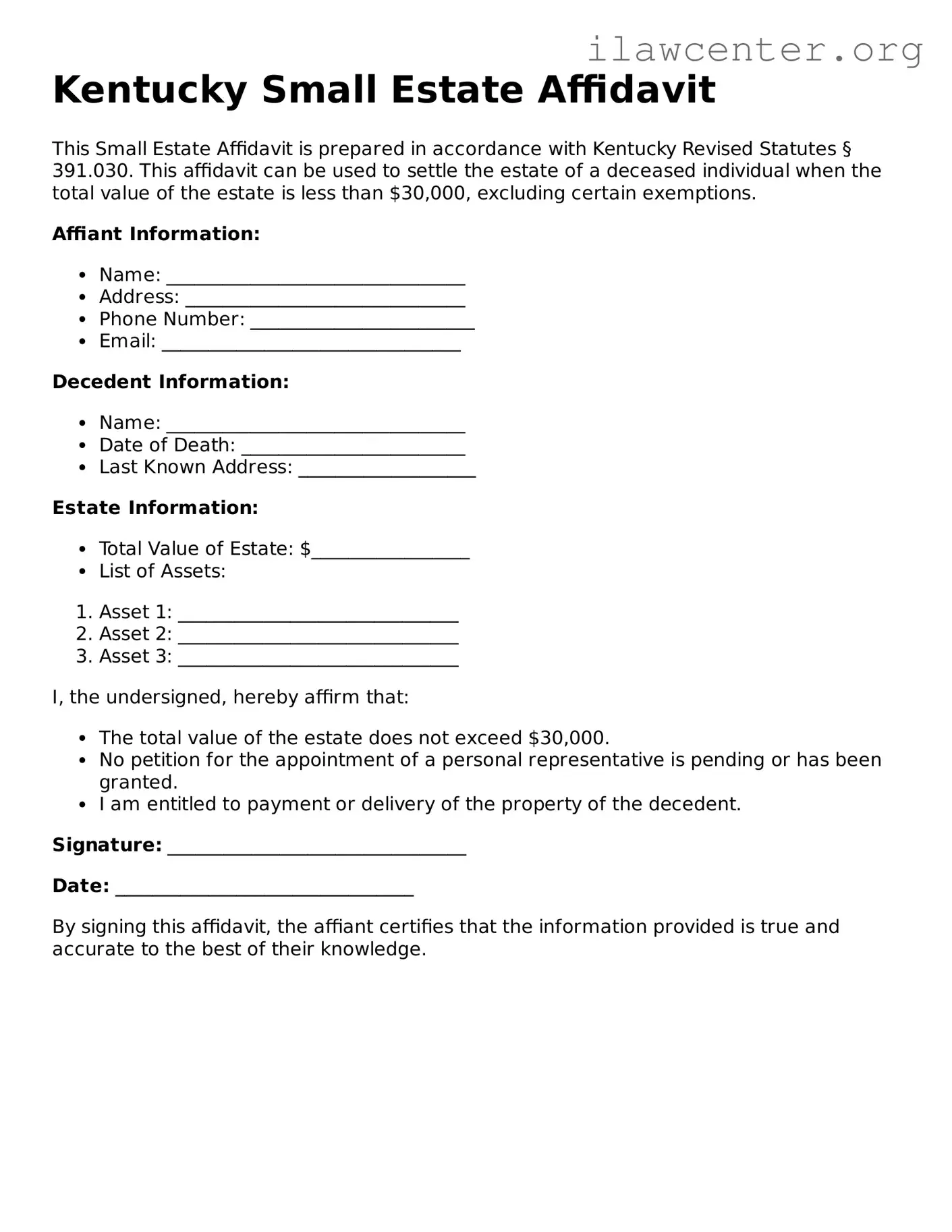
Kentucky Small Estate Affidavit Preview

Kentucky Small Estate Affidavit

This Small Estate Affidavit is prepared in accordance with Kentucky Revised Statutes § 391.030. This affidavit can be used to settle the estate of a deceased individual when the total value of the estate is less than $30,000, excluding certain exemptions.

Affiant Information:

  • Name: ________________________________
  • Address: ______________________________
  • Phone Number: ________________________
  • Email: ________________________________

Decedent Information:

  • Name: ________________________________
  • Date of Death: ________________________
  • Last Known Address: ___________________

Estate Information:

  • Total Value of Estate: $_________________
  • List of Assets:
  1. Asset 1: ______________________________
  2. Asset 2: ______________________________
  3. Asset 3: ______________________________

I, the undersigned, hereby affirm that:

  • The total value of the estate does not exceed $30,000.
  • No petition for the appointment of a personal representative is pending or has been granted.
  • I am entitled to payment or delivery of the property of the decedent.

Signature: ________________________________

Date: ________________________________

By signing this affidavit, the affiant certifies that the information provided is true and accurate to the best of their knowledge.

PDF Form Characteristics

Fact Name Description
Purpose The Kentucky Small Estate Affidavit allows individuals to claim assets of a deceased person without going through formal probate proceedings.
Eligibility To use this affidavit, the total value of the estate must be less than $30,000, excluding any real estate.
Governing Law The use of the Small Estate Affidavit is governed by Kentucky Revised Statutes (KRS) § 391.030.
Filing Requirement No court filing is necessary when using the Small Estate Affidavit, simplifying the process for heirs.
Who Can File Any heir or beneficiary named in the will, or a legal heir under state law, can file the affidavit.
Required Information The affidavit must include the deceased's name, date of death, and details about the assets being claimed.
Asset Types Common assets claimed include bank accounts, personal property, and vehicles.
Signature Requirement The affidavit must be signed by the individual filing it and may need notarization to validate the claims.
Limitations The Small Estate Affidavit cannot be used for estates that include real property or if there are outstanding debts exceeding the estate's value.

Instructions on Utilizing Kentucky Small Estate Affidavit

After you gather the necessary information, you’ll be ready to fill out the Kentucky Small Estate Affidavit form. This form will help you manage the estate of a deceased person without going through the full probate process. Make sure to have all relevant documents on hand, as you will need them to complete the form accurately.

  1. Obtain the Kentucky Small Estate Affidavit form. You can find it online or at your local courthouse.
  2. Fill in the name of the deceased person at the top of the form.
  3. Provide the date of death of the deceased.
  4. List the names and addresses of all heirs. Include their relationship to the deceased.
  5. State the total value of the estate. This should include all assets and property owned by the deceased.
  6. Indicate whether the estate has any debts. If there are debts, provide details about them.
  7. Sign the affidavit in the designated area. Make sure to do this in front of a notary public.
  8. Submit the completed form to the appropriate court. Check with your local court for any specific filing requirements.

Important Facts about Kentucky Small Estate Affidavit

What is a Kentucky Small Estate Affidavit?

The Kentucky Small Estate Affidavit is a legal document that allows individuals to claim assets of a deceased person without going through the lengthy and often costly probate process. This affidavit is specifically designed for estates that fall below a certain value threshold, making it a simpler option for those dealing with small estates.

Who can use the Small Estate Affidavit in Kentucky?

In Kentucky, any individual who is an heir or a beneficiary of the deceased can use the Small Estate Affidavit. This includes spouses, children, parents, and siblings. However, it’s essential that the total value of the estate does not exceed $30,000, excluding any liens or encumbrances.

What assets can be claimed using the Small Estate Affidavit?

Common assets that can be claimed include bank accounts, personal property, and vehicles. However, real estate cannot be transferred using this affidavit. If the estate includes real property, a different legal process must be followed.

How do I complete the Small Estate Affidavit?

To complete the Small Estate Affidavit, you will need to gather information about the deceased, including their full name, date of death, and details about their assets. You will also need to provide information about the heirs or beneficiaries. The affidavit must be signed in front of a notary public to be legally valid.

Is there a deadline for filing the Small Estate Affidavit?

There is no specific deadline for filing the Small Estate Affidavit, but it is advisable to do so as soon as possible after the death of the individual. Delaying the process may complicate matters, especially if there are outstanding debts or claims against the estate.

What if there are disputes among heirs regarding the Small Estate Affidavit?

If disputes arise among heirs or beneficiaries, it may be necessary to resolve these issues before proceeding with the Small Estate Affidavit. Open communication among family members can often help, but if disagreements persist, seeking legal advice may be beneficial to navigate the situation effectively.

Can I use the Small Estate Affidavit if there is a will?

Yes, you can still use the Small Estate Affidavit if there is a will, provided the estate meets the necessary criteria. However, if the will specifies a different method for distributing assets, it is essential to follow those instructions. Consulting with a legal professional can help clarify any uncertainties regarding the will and the affidavit process.
Common mistakes

Filling out the Kentucky Small Estate Affidavit form can be straightforward, but several common mistakes often lead to delays or complications. One significant error occurs when individuals fail to provide accurate information about the deceased. It is crucial to list the full name, date of birth, and date of death correctly. Any discrepancies can lead to challenges in validating the affidavit, potentially prolonging the estate settlement process.

Another frequent mistake is neglecting to include all the required signatures. The form mandates signatures from the heirs or beneficiaries. If even one signature is missing, the affidavit may be deemed incomplete. This can create unnecessary hurdles and may require additional time to rectify, causing frustration for all parties involved.

Many individuals also overlook the importance of correctly identifying the assets included in the estate. The affidavit must clearly list all assets that fall under the small estate threshold. Failing to do so can result in legal complications. It is essential to be thorough and ensure that all property, bank accounts, and personal belongings are accounted for to avoid potential disputes later.

Lastly, individuals often misinterpret the eligibility criteria for using the Small Estate Affidavit. Not all estates qualify for this simplified process. If the estate exceeds the specified value limits, the affidavit cannot be used. Understanding these parameters is vital to ensure that the correct procedures are followed from the outset. Taking the time to review the requirements can save significant time and effort.

Documents used along the form

The Kentucky Small Estate Affidavit is a useful tool for individuals managing the estate of a deceased person, particularly when the estate's value is below a certain threshold. Alongside this form, several other documents may be necessary to facilitate the process. Below is a list of common forms and documents that often accompany the Small Estate Affidavit.

  • Death Certificate: This official document verifies the death of the individual whose estate is being settled. It is typically required to prove the decedent's passing.
  • Will: If the deceased left a will, it serves as a guide for distributing assets. It may also clarify the decedent's wishes regarding their estate.
  • Affidavit of Heirship: This document establishes the rightful heirs of the deceased when no will exists. It helps confirm who is entitled to inherit the estate.
  • Inventory of Assets: A detailed list of the decedent's assets, this document helps determine the total value of the estate and ensures proper distribution.
  • Tax Returns: Previous years' tax returns may be required to assess any outstanding tax obligations or to provide a financial overview of the estate.
  • Notice to Creditors: This document informs creditors of the estate's opening, allowing them to make claims for any debts owed by the deceased.
  • Court Filing Fee Receipt: Proof of payment for filing the Small Estate Affidavit with the court is often necessary to complete the process.
  • Consent Forms: If there are multiple heirs, these forms may be needed to show that all parties agree to the terms outlined in the Small Estate Affidavit.

Gathering these documents can streamline the estate settlement process, ensuring that all legal requirements are met. By preparing in advance, heirs can navigate the complexities of estate management more efficiently.

Similar forms

The Small Estate Affidavit is a useful document for settling the affairs of a deceased person's estate without going through the lengthy probate process. Several other documents serve similar purposes in estate management and can be used in specific situations. Here are five documents that share similarities with the Small Estate Affidavit:

  • Will: A will outlines how a person's assets should be distributed after their death. Like the Small Estate Affidavit, it provides a clear plan for asset distribution, but it typically requires probate to be validated.
  • Letter of Administration: This document is issued by a court to appoint an administrator for an estate when there is no will. It serves a similar function to the Small Estate Affidavit by allowing the administrator to manage the estate's assets.
  • Trust: A trust is a legal arrangement where one party holds property for the benefit of another. Similar to the Small Estate Affidavit, a trust can help avoid probate and simplify the transfer of assets upon death.
  • Affidavit of Heirship: This document establishes the heirs of a deceased person. Like the Small Estate Affidavit, it can be used to transfer property without going through probate, especially when the estate is small.
  • Transfer on Death Deed: This deed allows property to be transferred directly to a beneficiary upon the owner's death. It functions similarly to the Small Estate Affidavit by bypassing probate for the transfer of specific assets.

Dos and Don'ts

When filling out the Kentucky Small Estate Affidavit form, it is important to follow certain guidelines to ensure the process goes smoothly. Below are ten things you should and shouldn't do when completing this form.

  • Do read the instructions carefully before starting.
  • Don't leave any required fields blank.
  • Do provide accurate information about the deceased's assets.
  • Don't include debts or liabilities of the deceased in the affidavit.
  • Do ensure that the affidavit is signed in front of a notary public.
  • Don't forget to include a copy of the death certificate.
  • Do check that all names are spelled correctly.
  • Don't submit the form without making a copy for your records.
  • Do file the affidavit in the appropriate court.
  • Don't rush through the process; take your time to review everything.

By following these guidelines, you can help ensure that your Small Estate Affidavit is completed correctly and efficiently.

Misconceptions

The Kentucky Small Estate Affidavit form is a useful tool for settling small estates without the need for formal probate. However, several misconceptions can lead to confusion. Here are four common misunderstandings:

  • It can be used for any estate size. Many people believe the Small Estate Affidavit can apply to all estates. In reality, this form is only applicable for estates valued at $30,000 or less, excluding certain assets like real estate.
  • All heirs must agree to use the affidavit. Some think that unanimous consent from all heirs is necessary to file the Small Estate Affidavit. While it is important to notify all heirs, only one heir can file the affidavit without needing everyone’s approval.
  • The process is automatic once the affidavit is filed. There is a belief that filing the Small Estate Affidavit automatically transfers assets. This is not true. After filing, the affidavit must be accepted by the institutions holding the deceased's assets for the transfer to occur.
  • Legal assistance is not needed. Many individuals assume they can complete the process without help. While it is possible to file the affidavit on your own, consulting with a legal professional can help avoid mistakes and ensure all requirements are met.

Understanding these misconceptions can help individuals navigate the process more effectively and ensure that they are making informed decisions regarding small estates in Kentucky.

Key takeaways

When dealing with the Kentucky Small Estate Affidavit form, there are several important aspects to consider. This form simplifies the process of settling an estate when the total value of the estate is below a certain threshold. Here are key takeaways to keep in mind:

  • The Small Estate Affidavit can be used if the total value of the estate is less than $30,000 for individuals or $60,000 for married couples.
  • This form allows heirs to claim assets without going through a lengthy probate process.
  • To use the Small Estate Affidavit, the deceased must have been a resident of Kentucky at the time of their death.
  • All heirs must agree to use the Small Estate Affidavit, and their signatures are required on the form.
  • It’s important to list all assets accurately, including bank accounts, real estate, and personal property.
  • The affidavit must be filed with the local court in the county where the deceased resided.
  • Once the affidavit is approved, it allows the heirs to collect the deceased's assets directly.
  • Consulting with a legal professional can help ensure that the form is filled out correctly and all requirements are met.