
Kentucky Tc 96 187 PDF Template

Kentucky Tc 96 187 PDF Template

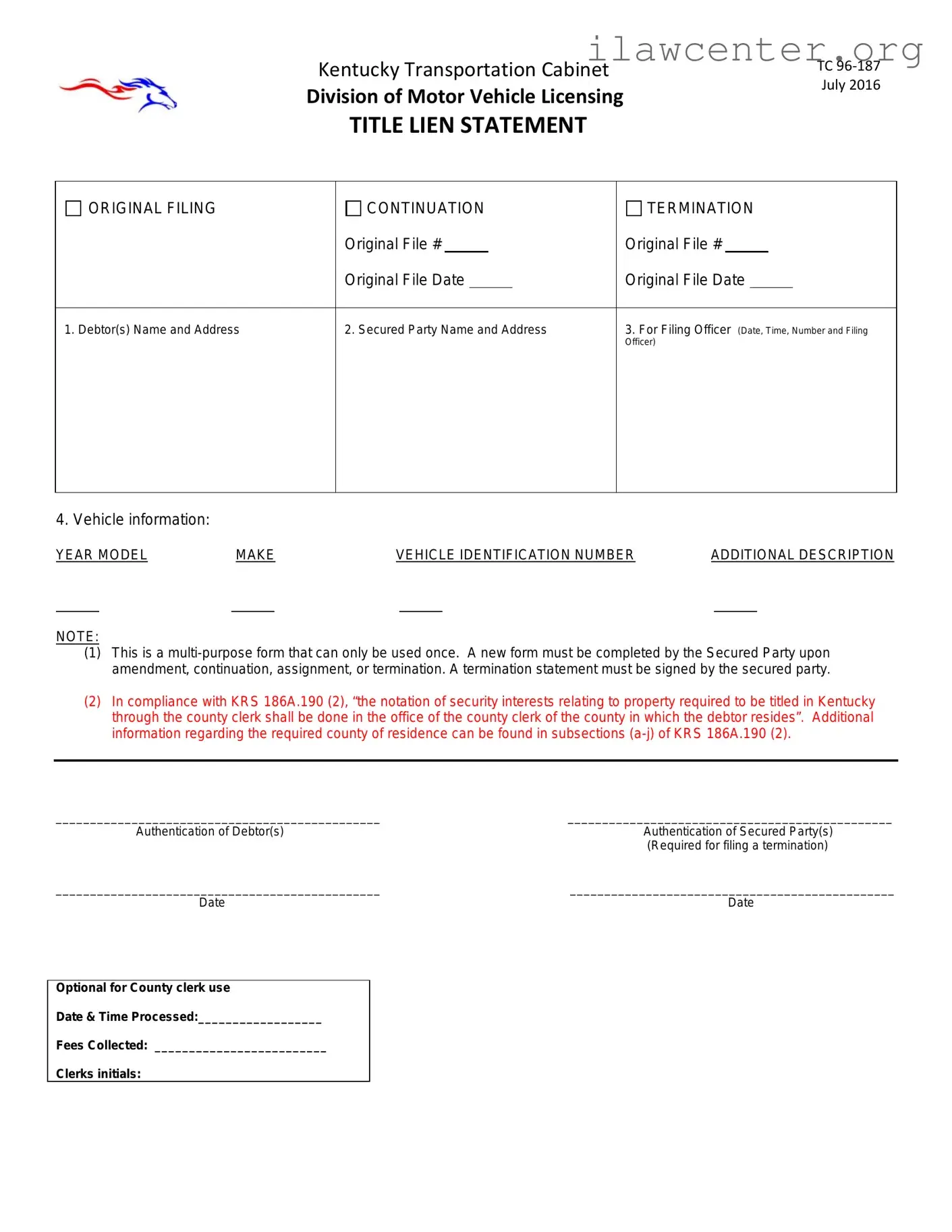
The Kentucky TC 96 187 form is a document used to file a title lien statement with the Kentucky Transportation Cabinet's Division of Motor Vehicle Licensing. This form serves multiple purposes, including original filing, continuation, and termination of a lien on a vehicle. To ensure compliance with state regulations, it is essential to complete this form accurately and submit it to the appropriate county clerk.

For assistance in filling out the Kentucky TC 96 187 form, click the button below.

Article Guide

When navigating the world of vehicle ownership and financing in Kentucky, understanding the intricacies of the Kentucky TC 96 187 form is essential. This form serves as a crucial tool for documenting title liens on vehicles, ensuring that all parties involved are protected and that their interests are formally recognized. It encompasses several key elements, including the names and addresses of both the debtor and the secured party, as well as vital vehicle information such as the year, model, make, and vehicle identification number. The form is designed for a single use, which means that any amendments, continuations, assignments, or terminations require a new filing. Additionally, it is important to note that the termination of a lien must be executed with the secured party's signature. Compliance with Kentucky Revised Statutes (KRS) 186A.190 is imperative, as it stipulates that security interests related to titled property must be recorded in the county clerk's office where the debtor resides. This ensures that all legal requirements are met and that the lien is properly documented within the state's framework. Familiarity with these aspects not only streamlines the process but also safeguards the rights of all involved parties.

Kentucky Tc 96 187 Preview


KentuckyTransportationCabinet
DivisionofMotorVehicleLicensing

TITLELIENSTATEMENT
TC96187
July2016
ORIGINAL FILING
CONTINUATION
Original File #
Original File Date
TERMINATION
Original File #
Original File Date
1. Debtor(s) Name and Address
2. Secured Party Name and Address
3. For Filing Officer
(Date, Time, Number and Filing
Officer)
4. Vehicle information:
YEAR MODEL MAKE VEHICLE IDENTIFICATION NUMBER ADDITIONAL DESCRIPTION
NOTE:
(1) This is a multi-purpose form that can only be used once. A new form must be completed by the Secured Party upon
amendment, continuation, assignment, or termination. A termination statement must be signed by the secured party.
(2) In compliance with KRS 186A.190 (2), “the notation of security interests relating to property required to be titled in Kentucky
through the county clerk shall be done in the office of the county clerk of the county in which the debtor resides”. Additional
information regarding the required county of residence can be found in subsections (a-j) of KRS 186A.190 (2).
_______________________________________________ _______________________________________________
Authentication of Debtor(s) Authentication of Secured Party(s)
(Required for filing a termination)
_______________________________________________ _______________________________________________
Date Date
Optional for County clerk use
Date & Time Processed:__________________
Fees Collected: _________________________
Clerks initials:

File Properties

Fact Name Details
Form Purpose The Kentucky TC 96-187 is used to document a title lien on a vehicle. It serves multiple functions including original filing, continuation, and termination of a lien.
Governing Law This form is governed by Kentucky Revised Statutes (KRS) 186A.190, which outlines the requirements for filing security interests in vehicles.
Filing Requirements The form must be completed by the secured party. It can only be used once for each lien, necessitating a new form for any amendments or terminations.
Debtor and Secured Party Information Both the debtor's and secured party's names and addresses must be provided on the form to ensure proper identification and processing.
Vehicle Information The form requires specific vehicle details, including the year, model, make, and vehicle identification number (VIN).
Authentication Requirement Authentication by both the debtor(s) and secured party(s) is required for filing a termination statement, ensuring accountability.
County Clerk Role According to KRS 186A.190 (2), the filing must be processed in the county clerk's office where the debtor resides, emphasizing local jurisdiction.

Instructions on Utilizing Kentucky Tc 96 187

Filling out the Kentucky TC 96 187 form requires careful attention to detail. This form is essential for documenting a title lien statement. After completing the form, it will need to be submitted to the appropriate county clerk’s office for processing.

  1. Begin by identifying the purpose of the form at the top. Choose between Original Filing, Continuation, or Termination.
  2. In the first section, provide the Debtor(s) Name and Address. Ensure that all names are spelled correctly and that the address is complete.
  3. Next, enter the Secured Party Name and Address. This should be the individual or entity that holds the lien.
  4. For the Filing Officer section, leave space for the date, time, filing number, and the filing officer's name. This will be filled out by the county clerk.
  5. In the Vehicle Information section, fill in the following details:
    • YEAR - the year the vehicle was manufactured.
    • MODEL - the model of the vehicle.
    • MAKE - the manufacturer of the vehicle.
    • VEHICLE IDENTIFICATION NUMBER - the unique VIN assigned to the vehicle.
    • ADDITIONAL DESCRIPTION - any other relevant details about the vehicle.
  6. Remember to review the notes provided on the form. This includes understanding that the form can only be used once and that a new form must be completed for any amendments or terminations.
  7. If you are filing a termination, ensure that the Authentication of Debtor(s) and Authentication of Secured Party(s) sections are signed and dated.
  8. Finally, leave the Date & Time Processed, Fees Collected, and Clerk’s initials sections blank for the county clerk to complete.

Important Facts about Kentucky Tc 96 187

What is the Kentucky TC 96-187 form used for?

The Kentucky TC 96-187 form is primarily used to file a lien statement on a vehicle. This form allows secured parties to officially document their interest in a vehicle, ensuring that they have legal rights to the asset in case of default by the debtor. It can also be used for continuation or termination of an existing lien.

Who needs to fill out the TC 96-187 form?

The form needs to be completed by the secured party, which is typically a lender or financial institution that has provided a loan for the purchase of the vehicle. The debtor, who is the individual or entity borrowing the funds, must also provide their information on the form.

What information is required on the TC 96-187 form?

Key information needed includes the names and addresses of both the debtor and the secured party. Additionally, details about the vehicle such as the year, model, make, and vehicle identification number (VIN) must be included. This information is essential for accurately identifying the vehicle associated with the lien.

Can the TC 96-187 form be reused for multiple filings?

No, the TC 96-187 form is a one-time-use document. If there are any amendments, continuations, assignments, or terminations needed, a new form must be completed. This ensures that each filing is accurately documented and tracked.

What happens if I need to terminate a lien?

To terminate a lien, the secured party must complete the TC 96-187 form and sign it. This termination statement indicates that the secured party no longer has a claim on the vehicle, and it must be filed with the appropriate county clerk. It is crucial for both parties to maintain accurate records of this process.

Where should the TC 96-187 form be filed?

The form must be filed in the office of the county clerk where the debtor resides, in compliance with Kentucky law. This ensures that the lien is properly recorded and accessible to anyone who may need to verify the information in the future.

What is the significance of the filing officer's information on the form?

The filing officer's information, including date, time, and filing number, serves as an official record of when the lien was filed. This information is important for establishing priority in the event of multiple liens on the same vehicle.

Are there any fees associated with filing the TC 96-187 form?

Yes, there are fees associated with filing the TC 96-187 form. These fees vary by county and must be paid at the time of filing. It is advisable to check with the local county clerk's office for the exact amount required.

What should I do if I have more questions about the TC 96-187 form?

If you have additional questions or need further assistance, it is recommended to contact the local county clerk's office or consult a legal professional. They can provide guidance tailored to your specific situation and ensure that all necessary steps are taken correctly.

Common mistakes

Filling out the Kentucky TC 96 187 form can seem straightforward, but several common mistakes can lead to complications. One frequent error is providing incomplete or incorrect information in the Debtor(s) Name and Address section. It is crucial to ensure that the name matches official identification documents. Missing or misspelled names can cause delays or even rejection of the filing.

Another common mistake involves the Secured Party Name and Address. Just like with the debtor's information, any inaccuracies can lead to issues. Ensure that the secured party's name is spelled correctly and that the address is complete. Omitting essential details can result in a failure to properly record the lien.

People often overlook the importance of the Vehicle Information section. Failing to provide the correct year, model, make, and vehicle identification number (VIN) can lead to significant problems. The VIN, in particular, must be accurate, as it uniquely identifies the vehicle. A simple typo can create confusion or invalidate the lien.

Many individuals also forget to sign the form where required. The Authentication of Debtor(s) and Authentication of Secured Party(s) sections must be completed for the form to be valid. A missing signature can lead to the rejection of the filing, requiring the process to be restarted.

Additionally, some filers neglect to consider the filing officer's details. The For Filing Officer section should include the date, time, number, and name of the filing officer. Omitting this information can result in delays or complications in processing the form.

Another mistake is using the form for multiple purposes. The TC 96 187 is a multi-purpose form that can only be used once. If there is a need for an amendment, continuation, assignment, or termination, a new form must be completed. Attempting to use the same form for different purposes can lead to confusion and errors.

People often misunderstand the requirement for a termination statement. If a lien is being terminated, the secured party must sign the appropriate section. Failing to do so can result in the lien remaining active, which may not reflect the current status of the vehicle.

Finally, some filers do not pay attention to the fees associated with the filing. The Fees Collected section should be completed accurately. Neglecting to include the correct fee can delay processing and lead to additional complications.

Documents used along the form

The Kentucky TC 96-187 form is essential for documenting title liens on vehicles. However, several other forms and documents often accompany it during the filing process. Understanding these related documents can streamline the process and ensure compliance with state regulations.

  • TC 96-186: Title Application - This form is used to apply for a new vehicle title in Kentucky. It includes information about the vehicle and the owner.
  • TC 96-187A: Lien Release - This document is filed to release a lien on a vehicle once the debt has been satisfied. It must be signed by the secured party.
  • TC 96-188: Assignment of Lien - Used when the secured party assigns their interest in the lien to another party. This form must be completed to officially transfer the lien rights.
  • KRS 186A.190: Kentucky Revised Statute - This statute outlines the legal requirements for filing security interests in vehicles. It serves as a reference for compliance.
  • TC 96-189: Affidavit of Ownership - This form is used to declare ownership of a vehicle when the title is lost or not available. It helps establish legal ownership.
  • TC 96-190: Duplicate Title Application - This application is submitted to obtain a duplicate title if the original is lost, stolen, or damaged.
  • TC 96-191: Notice of Security Interest - This document serves as a public notice of a security interest in a vehicle. It helps protect the secured party's rights.
  • TC 96-192: Bill of Sale - A bill of sale is used to document the sale of a vehicle. It includes details about the buyer, seller, and vehicle.

Being familiar with these forms will aid in navigating the complexities of vehicle title liens in Kentucky. Proper documentation is crucial for protecting the interests of both debtors and secured parties.

Similar forms

The Kentucky TC 96 187 form serves a specific purpose in the realm of vehicle title liens. However, it shares similarities with several other documents used in the context of secured transactions and vehicle ownership. Here is a list of nine documents that are comparable to the TC 96 187 form, along with an explanation of how they are similar:

  • UCC-1 Financing Statement: This document is filed to perfect a security interest in personal property. Like the TC 96 187, it identifies the debtor and secured party, and it must be filed with the appropriate office to establish the creditor's rights.
  • UCC-3 Financing Statement Amendment: Used to amend or continue an existing UCC-1 filing, this form shares the TC 96 187’s requirement for accurate identification of parties and the property involved, ensuring that any changes are officially recorded.
  • Title Application (Form TC 96-182): This form is used to apply for a vehicle title in Kentucky. It, too, requires detailed information about the vehicle and the owner, similar to the TC 96 187’s focus on vehicle identification and ownership.
  • Vehicle Registration Application: Like the TC 96 187, this document requires information about the vehicle and its owner. Both forms are essential for establishing legal ownership and rights over the vehicle.
  • Notice of Security Interest: This document serves to inform third parties about a security interest in a specific asset. It parallels the TC 96 187 in its role of notifying others of the secured party's claim on the vehicle.
  • Termination Statement (UCC-3): This is filed to terminate a previously filed UCC-1 statement. Similar to the termination aspect of the TC 96 187, it formally ends the secured party's claim on the collateral.
  • Power of Attorney for Vehicle Transactions: This document allows one party to act on behalf of another in vehicle-related matters. It shares the TC 96 187's focus on facilitating transactions and ensuring proper representation in the filing process.
  • Bill of Sale: This document transfers ownership of a vehicle from one party to another. Like the TC 96 187, it requires the identification of the parties involved and details about the vehicle, establishing a clear record of ownership.
  • Application for Duplicate Title: If a vehicle title is lost, this application allows the owner to request a replacement. It is similar to the TC 96 187 in that it deals with the title and ownership of the vehicle, ensuring that records are maintained accurately.

Dos and Don'ts

When filling out the Kentucky TC 96-187 form, it is important to follow specific guidelines to ensure accuracy and compliance. Here are ten things you should and shouldn't do:

  • Do provide accurate debtor and secured party names and addresses.
  • Do include the correct vehicle information, including year, model, make, and vehicle identification number.
  • Do ensure that the form is signed by the secured party if it is a termination statement.
  • Do complete the form in one sitting, as it can only be used once for a specific filing.
  • Do check the filing requirements for the county where the debtor resides.
  • Don't leave any required fields blank.
  • Don't use the same form for multiple transactions; a new form is necessary for amendments or continuations.
  • Don't submit the form without verifying the information for accuracy.
  • Don't forget to include the date and time processed by the county clerk.
  • Don't overlook the fees that may need to be collected at the time of filing.

Misconceptions

When dealing with the Kentucky TC 96 187 form, misunderstandings can lead to confusion and delays. Here are ten common misconceptions about this important document, along with clarifications to help you navigate the process more smoothly.

  1. It can be used multiple times. Many believe the TC 96 187 form can be reused for different transactions. However, this form is designed for a single use only. Each amendment, continuation, assignment, or termination requires a new form.
  2. Filing is optional. Some people think filing this form is optional. In reality, it is necessary for securing a lien on a vehicle in Kentucky. Not filing can jeopardize your security interest.
  3. Only the debtor needs to sign. A common belief is that only the debtor's signature is required. In fact, the secured party must also sign the termination statement for it to be valid.
  4. All vehicle information is optional. Many assume that providing detailed vehicle information is not essential. However, accurate details such as the year, model, make, and VIN are critical for proper identification of the vehicle.
  5. It can be filed anywhere in Kentucky. Some individuals think they can file the form at any county clerk's office. Instead, it must be filed in the county where the debtor resides, as specified by Kentucky law.
  6. There are no fees associated with filing. A misconception exists that filing this form is free. However, fees are typically collected during the filing process, and it's important to be prepared for this expense.
  7. Filing is a one-step process. Many believe that submitting the form is all that's needed. In reality, you must ensure that all required signatures and information are complete before submission to avoid delays.
  8. It’s the same as other lien forms. Some think the TC 96 187 is interchangeable with other lien forms. Each form serves a specific purpose, and using the wrong one can lead to complications.
  9. Only secured parties can complete the form. While secured parties play a crucial role, debtors also have responsibilities in completing and verifying the information on the form.
  10. Once filed, the lien cannot be changed. There’s a belief that once a lien is filed, it is permanent. However, amendments or terminations can be filed using the appropriate procedures to update or remove a lien.

Understanding these misconceptions can help ensure that you handle the Kentucky TC 96 187 form correctly. Taking the time to clarify these points will save you from potential issues down the road.

Key takeaways

When dealing with the Kentucky TC 96-187 form, understanding its purpose and proper usage is essential. Here are key takeaways to consider:

  • Multi-Purpose Form: The TC 96-187 is designed for various actions, including filing a lien, continuation, or termination of a lien.
  • Single Use: Each form can only be used once. If any changes occur, a new form must be filled out.
  • Debtor and Secured Party Information: Accurate names and addresses of both the debtor and the secured party must be provided.
  • Vehicle Details: Include specific vehicle information such as year, model, make, and vehicle identification number (VIN).
  • County Clerk Filing: The form must be filed in the county where the debtor resides, as per KRS 186A.190 (2).
  • Termination Statement: A termination must be signed by the secured party to be valid.
  • Authentication Required: Both the debtor(s) and secured party(s) must authenticate the form, especially for termination filings.
  • Processing Details: The county clerk will note the date, time, and fees collected upon processing the form.
  • Compliance with KRS: Familiarize yourself with KRS 186A.190 (2) for additional requirements regarding security interests.

Following these guidelines will help ensure proper completion and filing of the TC 96-187 form in Kentucky.