Konami Decklist PDF Template

Konami Decklist PDF Template

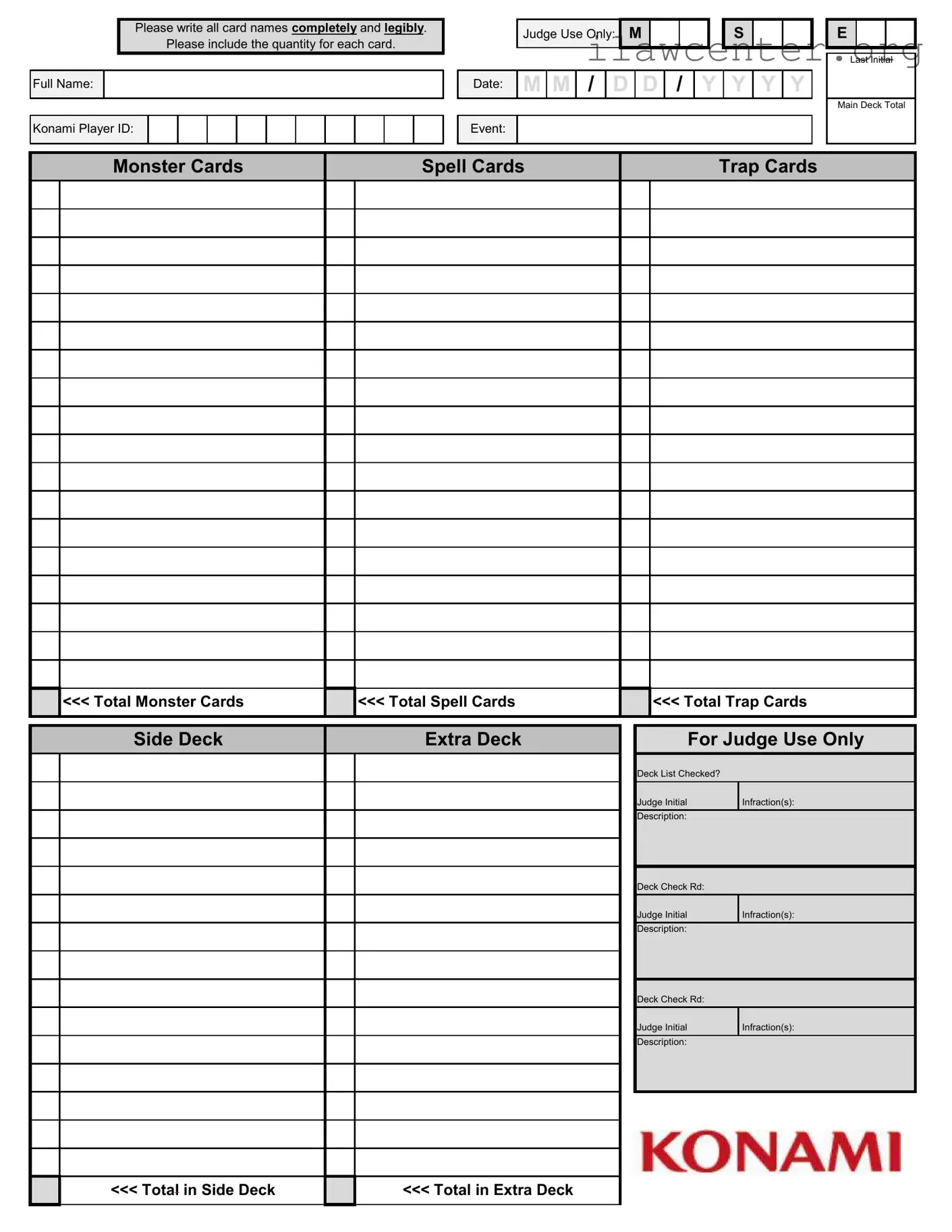
The Konami Decklist form is a document used in official tournaments to record the details of a player's deck. It requires players to list card names clearly and specify the quantity of each card included. For an accurate submission, ensure all information is complete and legible by filling out the form below.

Article Guide

The Konami Decklist form is an essential document for players participating in official events, ensuring that all deck information is accurately recorded and verified. This form requires players to list every card in their deck completely and legibly, alongside the quantity of each card. Personal details such as the player's full name and Konami Player ID must be included, along with specific event information and date. The form also features designated sections for judges, allowing them to record any infractions and check the deck list for compliance. Players must categorize their cards into three main types: monster cards, spell cards, and trap cards, with totals calculated for each category. Additionally, there are sections for the side deck and extra deck, which are crucial for strategic gameplay. By adhering to these guidelines, players contribute to a fair and organized competitive environment.

Konami Decklist Preview

<<< Total in Side Deck
Judge Initial
Judge Initial
Judge Initial
Judge Use Only: M S
Side Deck
<<< Total in Extra Deck
Description:
Deck Check Rd:
Infraction(s):
Description:
Deck Check Rd:
Infraction(s):
Description:
For Judge Use Only
Deck List Checked?
Infraction(s):
<<< Total Trap Cards<<< Total Monster Cards
Monster Cards Spell Cards Trap Cards
YD/MM
Date:
Last Initial
Main Deck Total
<<< Total Spell Cards
E
YYY/D
Konami Player ID: Event:
Please write all card names completely and legibly.
Please include the quantity for each card.
Extra Deck
Full Name:

File Properties

Fact Name Description
Card Names Players must write all card names completely and legibly to ensure clarity and accuracy.
Card Quantity It is essential to include the quantity for each card to provide a complete deck list.
Player Identification Players need to provide their full name and Konami Player ID for identification purposes.
Judge Use Only This section is designated for judges to record their notes and any infractions observed during the event.
Date Format The date must be formatted as MM/DD/YYYY to maintain consistency across all forms.
Event Identification Players should specify the event they are participating in to ensure proper record-keeping.
Deck Totals Players must calculate and include totals for Monster Cards, Spell Cards, and Trap Cards in their main deck.
Side Deck and Extra Deck Separate totals for the Side Deck and Extra Deck must also be provided for complete transparency.
Judge's Role Judges are responsible for checking the deck list and noting any infractions, ensuring fair play during the event.

Instructions on Utilizing Konami Decklist

Filling out the Konami Decklist form is an essential step for participating in events. This form helps ensure that all players have a clear record of their decks, which is important for fair play. Follow the steps below to complete the form accurately.

  1. Begin by entering your Full Name at the top of the form.
  2. Next, write your Konami Player ID below your name.
  3. Leave the Judge Use Only section blank, as this will be filled out by a judge.
  4. For the Date, fill in the current date using the format M M / D D / Y Y Y Y.
  5. Indicate the Event you are participating in.
  6. Write your Last Initial next to the event information.
  7. In the Main Deck section, list all card names completely and legibly.
  8. Next to each card name, indicate the quantity of that card you have in your deck.
  9. Fill in the totals for Monster Cards, Spell Cards, and Trap Cards in their respective sections.
  10. Calculate the total number of cards in your main deck and write it in the Total section.
  11. Proceed to the Side Deck section and list any additional cards you have.
  12. Fill in the Extra Deck section with any extra cards you are using.
  13. Leave the Judge Use Only section blank, as this will be completed by a judge.
  14. Finally, ensure that you have filled in the total number of cards in your Side Deck and Extra Deck.

Important Facts about Konami Decklist

What is the purpose of the Konami Decklist form?

The Konami Decklist form is used to document the cards that players are using in a tournament. This helps judges ensure that players are following the rules and that their decks are legal for competition. It also allows for easy reference during matches.

How should I fill out the card names on the form?

It’s important to write all card names completely and legibly. This ensures that judges and other players can easily read and understand your deck list. Using clear handwriting or typing the names can help avoid any confusion during the tournament.

What information do I need to provide on the form?

You will need to provide your full name, Konami Player ID, and the event date. Additionally, you must fill out the number of cards in your main deck, side deck, and extra deck. Make sure to include the quantity for each card type: monster cards, spell cards, and trap cards.

What if I have a card that is not listed on the form?

If you have a card that is not listed, you should still write it down clearly on the form. Include the full name and quantity. It’s crucial to ensure that all cards in your deck are accounted for to avoid any issues during the event.

What does "Judge Use Only" mean on the form?

The "Judge Use Only" section is reserved for tournament judges to make notes about your deck check. They may indicate if your deck has been checked, any infractions found, and any relevant descriptions. This helps maintain a fair playing environment.

How do I calculate the totals for my deck?

To calculate your totals, simply add the number of monster cards, spell cards, and trap cards in your main deck. Then, do the same for your side deck and extra deck. Be sure to double-check your math to ensure accuracy.

What happens if there is an infraction noted on my form?

If a judge notes an infraction on your form, they will provide a description of the issue. Depending on the severity of the infraction, there may be penalties or corrective actions required. It’s important to address any noted issues promptly to avoid further complications.

Can I make changes to my deck after submitting the form?

Once you submit your decklist, changes may not be allowed. It’s essential to finalize your deck before filling out the form. If you believe a change is necessary, speak with a judge to understand the rules regarding deck modifications during the tournament.

Common mistakes

Filling out the Konami Decklist form can seem straightforward, but there are common mistakes that players often make. One of the most frequent errors is not writing card names completely and legibly. When names are abbreviated or unclear, it creates confusion for judges. It's essential to ensure that every card name is written in full to avoid any discrepancies during the event.

Another mistake is failing to include the correct quantity for each card. Players sometimes forget to indicate how many of each card they have in their deck. This oversight can lead to misunderstandings about the deck's composition and may even result in penalties. Always double-check that the quantity is clearly stated next to each card name.

In addition to these issues, players often overlook the importance of filling out their personal information accurately. The Full Name and Konami Player ID sections should be completed with care. Incomplete or incorrect information can delay the registration process and may cause problems when trying to resolve any issues that arise during the event.

Lastly, many players neglect the sections designated for the judge's use. This includes marking the Deck List Checked? box and providing details about any infractions. Not addressing these areas can lead to confusion during deck checks and potentially impact a player's standing in the event. Taking the time to fill out the entire form correctly can save players from unnecessary complications.

Documents used along the form

The Konami Decklist form is an essential document for players participating in organized events. However, there are several other forms and documents that often accompany it to ensure smooth event operations and compliance with tournament rules. Below is a list of commonly used documents alongside the Konami Decklist form.

  • Player Registration Form: This document collects essential information from participants, such as their full name, contact details, and player ID. It helps organizers verify participant eligibility and maintain accurate records for the event.
  • Event Rules and Guidelines: This document outlines the specific rules and regulations governing the tournament. It includes information on deck construction, match procedures, and penalties for infractions, ensuring all players understand the expectations.
  • Match Result Slip: After each match, players fill out this slip to record the outcome. It includes details like player names, match score, and any relevant notes. This helps maintain an accurate tournament bracket and assists judges in resolving any disputes.
  • Judge Report Form: Judges use this form to document any infractions or issues that arise during the event. It includes sections for describing the incident, actions taken, and any penalties imposed. This ensures a fair and transparent process for all participants.

These documents work together to create a structured and organized environment for players and judges alike. By understanding the purpose of each form, participants can navigate the tournament process more effectively.

Similar forms

  • Magic: The Gathering Deck List - Similar to the Konami Decklist form, this document requires players to list all card names clearly and indicate the quantity of each card. It serves to ensure compliance with tournament rules and helps judges verify decks.
  • Yu-Gi-Oh! Tournament Registration Form - This form collects player information such as full name and player ID, just like the Konami Decklist. It is essential for identifying participants and managing event logistics.
  • Pokemon Trading Card Game Deck List - This document also demands that players write out their card names and quantities. It serves a similar purpose in maintaining the integrity of the tournament by allowing judges to check for legality.
  • Flesh and Blood Deck List - Players must detail their card selections and quantities. This document ensures that all decks adhere to the game's rules and allows judges to perform checks efficiently.
  • KeyForge Deck Registration - Like the Konami Decklist, this form requires players to submit a complete list of their cards. This registration helps maintain the fairness of the game by ensuring all decks are legitimate.
  • Vanguard Deck List - This document similarly requires players to provide a complete and legible list of their cards along with quantities. It functions to facilitate deck checks and uphold tournament standards.

Dos and Don'ts

When filling out the Konami Decklist form, it is important to follow certain guidelines to ensure accuracy and compliance. Here are six recommendations regarding what to do and what to avoid:

  • Do write all card names completely and legibly.
  • Do include the quantity for each card listed.
  • Do fill in your full name and Konami Player ID accurately.
  • Do ensure that all sections are completed, including the event details.
  • Don't leave any section blank; this may lead to delays or issues.
  • Don't use abbreviations or shorthand for card names, as this can cause confusion.

By adhering to these guidelines, you can help facilitate a smooth process during your event participation.

Misconceptions

Misconceptions about the Konami Decklist form can lead to confusion among players. Here are four common misunderstandings:

  • Players can use abbreviations for card names. Many believe that using abbreviations saves time, but the form explicitly states that all card names must be written completely and legibly. This ensures clarity and prevents any potential disputes during a tournament.
  • It’s optional to include the quantity of each card. Some players think they can skip this detail. However, the form requires players to specify the quantity for each card. This is crucial for judges to verify that the deck complies with the tournament rules.
  • Judge use sections are not important. A common misconception is that the sections labeled "Judge Use Only" are irrelevant to players. In reality, these sections are vital for tracking any infractions and ensuring fair play. Ignoring them could lead to misunderstandings later in the event.
  • Deck checks are a mere formality. Some players view deck checks as a simple procedure that has no real impact. In truth, deck checks are an essential part of maintaining the integrity of the tournament. They help ensure that all players are following the rules and competing on a level playing field.

Key takeaways

Filling out the Konami Decklist form accurately is essential for a smooth event experience. Here are some key takeaways to keep in mind:

  • Write Clearly: Ensure all card names are written completely and legibly to avoid confusion.
  • Include Quantities: Specify the number of each card you are using. This helps judges verify your deck quickly.
  • Provide Personal Information: Fill in your full name and Konami Player ID to ensure proper identification.
  • Event Details: Clearly state the event date and type to keep your records organized.
  • Main Deck Breakdown: List your total number of monster cards, spell cards, and trap cards for clarity.
  • Side and Extra Deck: Don’t forget to include totals for your side deck and extra deck.
  • Judge Use Section: Be aware that judges will use this section for any infractions or notes during the event.
  • Check for Errors: Before submitting, double-check your deck list to ensure all information is accurate.
  • Stay Organized: Keep your deck list handy during the event for quick reference if needed.
  • Follow Up: If a judge notes any infractions, make sure to understand the issues and how to correct them for future events.

By following these guidelines, you can help ensure that your experience at the event is as enjoyable and trouble-free as possible.