Fillable Landlord Consent to Sublease Document

Fillable Landlord Consent to Sublease Document

The Landlord Consent to Sublease form is a legal document that allows a tenant to sublease their rental property with the landlord's approval. This form ensures that both the landlord and the original tenant understand their rights and responsibilities regarding the subleasing arrangement. To get started, fill out the form by clicking the button below.

Article Guide

The Landlord Consent to Sublease form plays a crucial role in the rental process, particularly when a tenant wishes to sublet their leased property. This document outlines the necessary permissions and conditions under which a tenant can transfer their lease rights to another individual, known as the subtenant. It typically includes key elements such as the names of the original tenant and the prospective subtenant, a description of the rental unit, and the duration of the sublease. Additionally, the form may specify any conditions or restrictions that the landlord imposes, ensuring that both parties understand their rights and responsibilities. By requiring the landlord’s consent, this form helps maintain the integrity of the original lease agreement while providing a framework for the subleasing process. Understanding its components is essential for both tenants and landlords to navigate this aspect of property rental effectively.

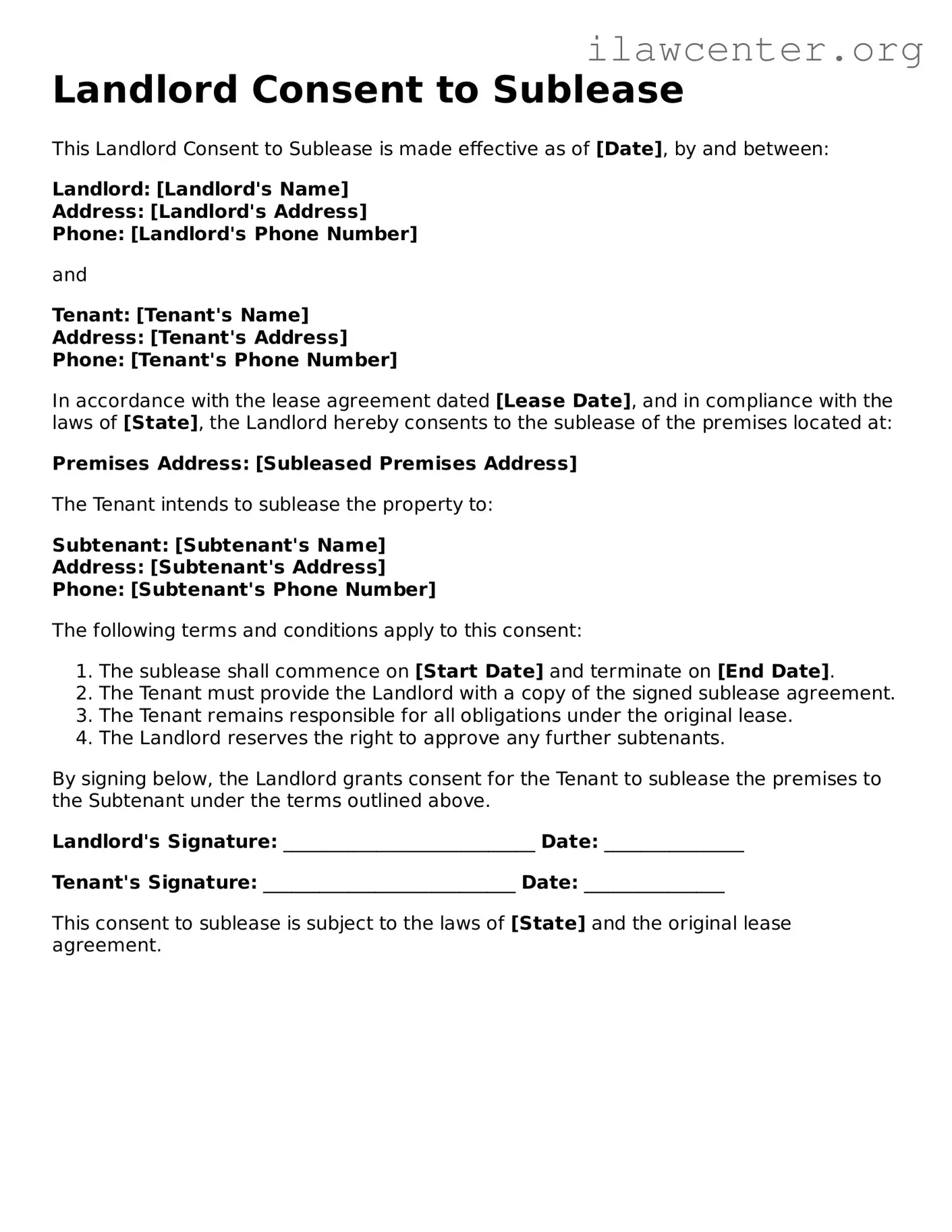
Landlord Consent to Sublease

This Landlord Consent to Sublease is made effective as of [Date], by and between:

Landlord: [Landlord's Name]
Address: [Landlord's Address]
Phone: [Landlord's Phone Number]

and

Tenant: [Tenant's Name]
Address: [Tenant's Address]
Phone: [Tenant's Phone Number]

In accordance with the lease agreement dated [Lease Date], and in compliance with the laws of [State], the Landlord hereby consents to the sublease of the premises located at:

Premises Address: [Subleased Premises Address]

The Tenant intends to sublease the property to:

Subtenant: [Subtenant's Name]
Address: [Subtenant's Address]
Phone: [Subtenant's Phone Number]

The following terms and conditions apply to this consent:

  1. The sublease shall commence on [Start Date] and terminate on [End Date].
  2. The Tenant must provide the Landlord with a copy of the signed sublease agreement.
  3. The Tenant remains responsible for all obligations under the original lease.
  4. The Landlord reserves the right to approve any further subtenants.

By signing below, the Landlord grants consent for the Tenant to sublease the premises to the Subtenant under the terms outlined above.

Landlord's Signature: ___________________________ Date: _______________

Tenant's Signature: ___________________________ Date: _______________

This consent to sublease is subject to the laws of [State] and the original lease agreement.

PDF Form Characteristics

Fact Name Description
Purpose The Landlord Consent to Sublease form is used to obtain permission from a landlord for a tenant to sublease their rental unit.
Legal Requirement In many states, tenants must seek landlord approval before subleasing, as outlined in the lease agreement.
Governing Laws Each state has specific laws regarding subleasing. For example, California's Civil Code Section 1995.210 governs subleases.
Tenant's Responsibilities The tenant remains responsible for the lease terms, even after subleasing the property.
Landlord's Discretion Landlords have the right to approve or deny a sublease request based on reasonable criteria.
Form Details The form typically requires details about the subtenant, rental terms, and duration of the sublease.
Notarization Some states may require the consent form to be notarized for it to be legally binding.
Potential Fees Landlords may charge a fee for processing the sublease request, depending on state laws and lease terms.
Impact on Lease Subleasing without consent can lead to lease violations, potentially resulting in eviction or legal action.

Filling out the Landlord Consent to Sublease form is an essential step in the subleasing process. This form ensures that both the landlord and the tenant are on the same page regarding the sublease agreement. It’s important to complete the form accurately to avoid any potential misunderstandings or disputes.

  1. Begin by entering the date at the top of the form. This helps establish a timeline for the sublease agreement.
  2. Next, provide your name as the current tenant. This identifies you as the person seeking consent to sublease.
  3. Fill in the address of the rental property. Ensure that this matches the address on your lease agreement.
  4. Indicate the name of the proposed subtenant. This is the person you wish to sublease your space to.
  5. Include the subtenant’s contact information, such as their phone number and email address. This allows the landlord to reach out if needed.
  6. Specify the duration of the sublease. Clearly state the start and end dates to avoid confusion.
  7. Sign the form to confirm that all the information provided is accurate and complete.
  8. Lastly, submit the completed form to your landlord for review and approval. Make sure to keep a copy for your records.

What is a Landlord Consent to Sublease form?

The Landlord Consent to Sublease form is a document that allows a tenant to sublease their rental property to another individual. This form ensures that the landlord is aware of and approves the new tenant, protecting both the landlord's and the original tenant's rights and responsibilities under the lease agreement.

Why do I need my landlord's consent to sublease?

What information is typically required on the form?

Can a landlord refuse to consent to a sublease?

What happens if my landlord does not respond to the request for consent?

If a landlord does not respond within a reasonable time frame, it may be interpreted as consent in some jurisdictions. However, it’s wise to check local laws and communicate clearly with the landlord to avoid misunderstandings.

Is there a fee associated with the consent process?

What if my landlord gives consent but with conditions?

What should I do if my landlord refuses to consent without a valid reason?

Common mistakes

When filling out the Landlord Consent to Sublease form, many tenants unknowingly make mistakes that can lead to complications down the road. One common error is failing to provide complete information about the proposed subtenant. It’s crucial to include the full name, contact information, and any relevant background details. Omitting this information can cause delays or even result in the landlord denying the request.

Another frequent mistake is neglecting to specify the duration of the sublease. A clear start and end date should be included to avoid any misunderstandings. If this information is missing, it may create confusion about how long the subtenant is allowed to occupy the property, potentially leading to disputes.

Many tenants also forget to check their lease agreement for specific subleasing clauses. Some leases have strict requirements or may even prohibit subleasing altogether. Ignoring these terms can lead to violations, which might result in penalties or eviction. Always review the lease before submitting the consent form.

In addition, tenants sometimes fail to communicate with their landlords before submitting the form. A lack of prior discussion can create tension and misunderstandings. It’s often beneficial to have a conversation about the sublease before formally requesting consent. This can pave the way for a smoother process.

Providing insufficient details about the sublease terms is another common pitfall. Tenants should outline the rent amount, payment schedule, and any shared responsibilities. If these terms are vague or missing, it can lead to confusion between the tenant and subtenant, as well as issues with the landlord.

Lastly, many individuals overlook the importance of signatures. Both the tenant and the landlord must sign the consent form for it to be valid. Failing to obtain the landlord's signature can render the entire agreement unenforceable. Always double-check that all necessary signatures are in place before considering the sublease finalized.

Documents used along the form

When subleasing a property, several additional forms and documents may be required to ensure compliance with legal and contractual obligations. These documents facilitate clear communication and protect the interests of all parties involved.

  • Sublease Agreement: This document outlines the terms and conditions of the sublease, including rent, duration, and responsibilities of the subtenant.
  • Lease Agreement: The original lease between the landlord and tenant. It serves as a reference for the sublease and outlines the primary obligations of the tenant.
  • Tenant's Request to Sublease: A formal request from the tenant to the landlord seeking permission to sublease the property, often required before the landlord's consent.
  • Subtenant Application: This form collects information about the prospective subtenant, including credit history and rental history, to assess their suitability.
  • Landlord's Consent Form: A document where the landlord formally agrees to the sublease, often including specific terms and conditions related to the subtenant.
  • Security Deposit Agreement: This document outlines the terms for any security deposit required from the subtenant, including conditions for its return.
  • Move-In/Move-Out Inspection Checklist: A list used to document the condition of the property before and after the subtenant's occupancy, protecting both the landlord and tenant.
  • Notice of Rent Payment: A form that outlines how and when rent should be paid by the subtenant, ensuring clarity on payment terms.
  • Utilities Agreement: This document specifies which utilities are the responsibility of the subtenant and how they will be managed during the sublease.

Having these documents in place helps streamline the subleasing process and minimizes potential disputes. It is essential to ensure that all parties understand their rights and responsibilities for a successful sublease arrangement.

Similar forms

The Landlord Consent to Sublease form is an important document in the rental process, especially when a tenant wishes to sublet their rental unit. This form is similar to several other documents that serve various purposes in rental agreements. Below is a list of ten documents that share similarities with the Landlord Consent to Sublease form:

  • Lease Agreement: This foundational document outlines the terms and conditions between the landlord and tenant, including rental amount, duration, and responsibilities.
  • Sublease Agreement: This document is created between the original tenant and the subtenant, detailing the terms of the sublease, including rent and duration.
  • Rental Application: Prospective tenants fill out this form to provide information to landlords, helping them assess the suitability of a potential tenant.
  • Notice to Quit: This document informs a tenant that they must vacate the premises, often used when a tenant violates lease terms.
  • Eviction Notice: Similar to the Notice to Quit, this document formally starts the eviction process, providing the tenant with details on their lease violations.
  • Pet Agreement: This addendum outlines the rules and responsibilities regarding pets in a rental property, similar to how the sublease form governs tenant relationships.
  • Maintenance Request Form: Tenants use this document to formally request repairs or maintenance, establishing communication between tenants and landlords.
  • Security Deposit Agreement: This document outlines the terms regarding the security deposit, including how it will be handled and returned, much like the sublease form governs financial responsibilities.
  • Tenant's Rights Information: This document provides tenants with information about their rights and responsibilities, similar to how the sublease form clarifies the obligations of all parties involved.
  • Roommate Agreement: This is a private agreement between roommates that details shared responsibilities and expectations, akin to the sublease form's focus on tenant relationships.

Dos and Don'ts

When filling out the Landlord Consent to Sublease form, it is crucial to approach the task with care. Here are some important do's and don'ts to consider:

  • Do read the entire form thoroughly before starting. Understanding all sections ensures accuracy.
  • Do provide complete and accurate information about the sublessee. This includes their full name and contact details.
  • Don't leave any sections blank. Incomplete forms can delay the approval process.
  • Don't forget to sign and date the form. Missing signatures can lead to rejection of the request.

Misconceptions

Understanding the Landlord Consent to Sublease form is crucial for both tenants and landlords. However, several misconceptions can lead to confusion. Here are seven common misconceptions:

  1. Only landlords can refuse a sublease.

    While landlords have the right to approve or deny a sublease, tenants also have rights. If a landlord unreasonably withholds consent, tenants may have legal recourse.

  2. A sublease is the same as an assignment.

    These terms are not interchangeable. A sublease involves the original tenant maintaining some rights, while an assignment transfers all rights to the new tenant.

  3. Consent to sublease is always required.

    In some cases, leases may allow tenants to sublease without needing explicit consent from the landlord. Always review your lease agreement carefully.

  4. Landlords can charge any fee for consent.

    While landlords can charge a fee, it must be reasonable and outlined in the lease. Excessive fees may be challenged.

  5. Once consent is given, it cannot be revoked.

    Landlords may have the right to revoke consent if the subtenant violates lease terms or if the original tenant fails to comply with the sublease agreement.

  6. Subtenants have the same rights as original tenants.

    Subtenants typically do not have the same rights as the original tenant. Their rights are generally limited to what is stated in the sublease agreement.

  7. The landlord must provide a reason for denying consent.

    While it is good practice for landlords to provide a reason, they are not legally required to do so in all situations. However, unreasonable denial may lead to disputes.

Clarifying these misconceptions can help ensure a smoother process for both tenants and landlords when dealing with subleases.

Key takeaways

When considering the Landlord Consent to Sublease form, it is important to understand several key aspects to ensure a smooth process. Below are the essential takeaways:

  • Obtain Consent: Always seek the landlord's written consent before subleasing. This is often a requirement in the lease agreement.
  • Provide Necessary Information: The form typically requires details about the proposed subtenant, including their name and contact information.
  • Review Lease Terms: Check the original lease for any specific clauses regarding subleasing. Some leases may have restrictions or conditions.
  • Subtenant Approval: The landlord may want to screen the subtenant. Be prepared to provide additional information if requested.
  • Document Everything: Keep a copy of the signed consent form and any correspondence with the landlord for your records.
  • Understand Liability: The original tenant remains responsible for the lease terms, even after subleasing. Ensure the subtenant is aware of this.
  • Consider Duration: Clearly outline the duration of the sublease. This should align with the original lease terms.
  • Follow Local Laws: Familiarize yourself with local laws regarding subleasing, as they can vary by state or municipality.

By following these key points, individuals can navigate the subleasing process more effectively and maintain a positive relationship with their landlord.