Landlord Damages Letter PDF Template

Landlord Damages Letter PDF Template

The Landlord Damages Letter form is a formal notice that landlords use to inform tenants about deductions from their security deposit due to damages. This document outlines the specific charges and provides a timeframe for tenants to respond. For those needing to address potential deductions, filling out this form is essential; click the button below to get started.

Article Guide

The Landlord Damages Letter form serves as an important communication tool between landlords and tenants regarding the assessment of damages against a tenant's security deposit. This form is required by Michigan law and must be sent to the tenant within a specific timeframe following the termination of their occupancy. It outlines the damages incurred during the tenant's stay, detailing the nature of each damage along with the estimated costs associated with repairs or other obligations. The form also specifies that the tenant must respond within seven days of receiving the notice; failure to do so may result in forfeiture of the claimed amount. Additionally, it clarifies the permissible uses of a security deposit, which include covering actual damages, unpaid rent, and outstanding utility bills. The letter concludes with a summary of the charges assessed, the total deductions made, and the remaining balance of the security deposit, if any, which is often accompanied by a check or money order for the tenant. This structured approach helps ensure transparency and compliance with legal requirements, fostering a clearer understanding between the parties involved.

Landlord Damages Letter Preview

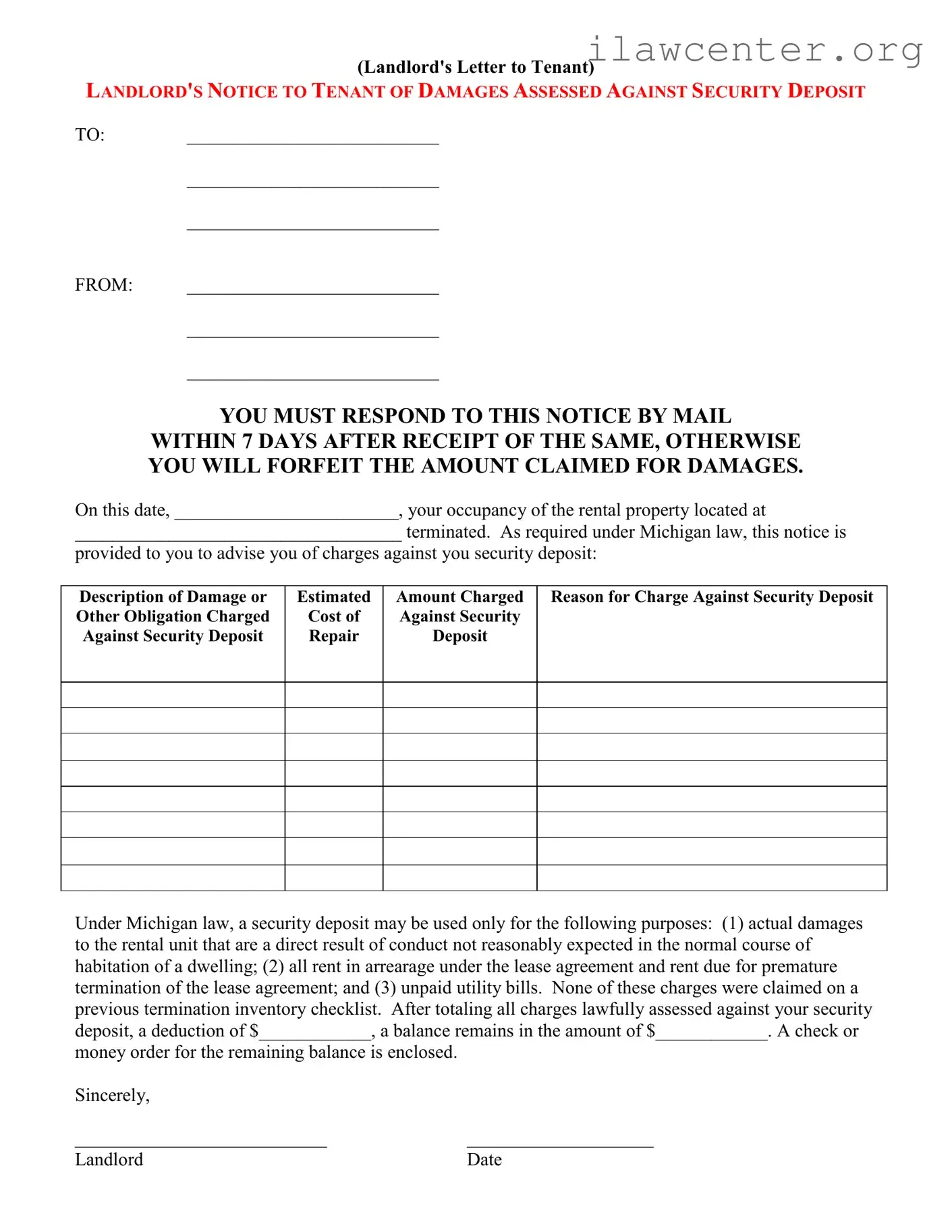
(Landlord's Letter to Tenant)
LANDLORD'S NOTICE TO TENANT OF DAMAGES ASSESSED AGAINST SECURITY DEPOSIT
TO: ___________________________
___________________________
___________________________
FROM: ___________________________
___________________________
___________________________
YOU MUST RESPOND TO THIS NOTICE BY MAIL
WITHIN 7 DAYS AFTER RECEIPT OF THE SAME, OTHERWISE
YOU WILL FORFEIT THE AMOUNT CLAIMED FOR DAMAGES.
On this date, ________________________, your occupancy of the rental property located at
___________________________________ terminated. As required under Michigan law, this notice is
provided to you to advise you of charges against you security deposit:
Description of Damage or
Other Obligation Charged
Against Security Deposit
Estimated
Cost of
Repair
Amount Charged
Against Security
Deposit
Reason for Charge Against Security Deposit
Under Michigan law, a security deposit may be used only for the following purposes: (1) actual damages
to the rental unit that are a direct result of conduct not reasonably expected in the normal course of
habitation of a dwelling; (2) all rent in arrearage under the lease agreement and rent due for premature
termination of the lease agreement; and (3) unpaid utility bills. None of these charges were claimed on a
previous termination inventory checklist. After totaling all charges lawfully assessed against your security
deposit, a deduction of $____________, a balance remains in the amount of $____________. A check or
money order for the remaining balance is enclosed.
Sincerely,
___________________________ ____________________
Landlord Date

File Properties

Fact Name Details
Purpose of the Letter This letter informs the tenant of damages assessed against their security deposit.
Response Timeframe The tenant must respond within 7 days of receiving the notice.
Governing Law This form is governed by Michigan law.
Occupancy Termination The letter states the date when the tenant's occupancy of the rental property ended.
Charges Against Security Deposit Charges can include actual damages, unpaid rent, and utility bills.
Previous Claims No charges can be claimed that were listed on a previous termination inventory checklist.
Balance Calculation The letter provides a total of charges and the remaining balance after deductions.
Payment Method A check or money order for the remaining balance is enclosed with the letter.
Signature Requirement The letter must be signed by the landlord and dated.

Instructions on Utilizing Landlord Damages Letter

Completing the Landlord Damages Letter form is a straightforward process that requires careful attention to detail. This letter serves as a formal notification to a tenant regarding any damages assessed against their security deposit. It’s essential to provide accurate information to ensure clarity and compliance with the law.

  1. Fill in the Tenant's Information: In the designated area, write the tenant's full name and address. Make sure to include the street address, city, state, and zip code.
  2. Fill in the Landlord's Information: Next, enter your full name and address in the appropriate section. Again, include all relevant details like street address, city, state, and zip code.
  3. Enter the Date: Write the date when the tenant's occupancy of the rental property ended. This date is crucial for establishing the timeline of the notice.
  4. Specify the Rental Property Address: Clearly indicate the address of the rental property where the tenant lived. Ensure this is accurate to avoid confusion.
  5. List the Damages: Under "Description of Damage," provide a detailed account of the damages assessed. Include the estimated amount charged for each damage listed.
  6. State the Reason for Charges: For each damage, explain why the charge is being applied to the security deposit. This helps the tenant understand the basis of the charges.
  7. Include Other Obligations: If applicable, mention any additional obligations that are being charged against the security deposit, such as unpaid utility bills or rent arrears.
  8. Total the Charges: After listing all charges, calculate the total amount being deducted from the security deposit. Write this total in the specified area.
  9. Calculate Remaining Balance: Subtract the total charges from the original security deposit amount. Write the remaining balance in the appropriate space.
  10. Attach Payment: If there is a remaining balance, include a check or money order for that amount with the letter.
  11. Sign and Date the Letter: Finally, sign the letter and write the date of signing. This adds a personal touch and confirms that you are the sender.

After completing the form, ensure that it is sent to the tenant by mail. The tenant is required to respond within seven days of receiving this notice. Failure to do so may result in forfeiture of the claimed amount for damages.

Important Facts about Landlord Damages Letter

What is the purpose of the Landlord Damages Letter form?

The Landlord Damages Letter form serves as a formal notification to a tenant regarding any damages assessed against their security deposit. When a tenant vacates a rental property, the landlord must inform them of any charges that will be deducted from their security deposit. This letter outlines the specific damages, the estimated costs, and the remaining balance after deductions. It ensures that the tenant is aware of the reasons for the charges and provides a clear record of the transaction.

What should a tenant do upon receiving this letter?

Upon receiving the Landlord Damages Letter, it is crucial for the tenant to respond promptly. They must mail their response within 7 days of receiving the notice. Failure to do so may result in forfeiting the amount claimed for damages. In the response, the tenant can address any disputes regarding the charges or request further clarification. It is advisable to keep a copy of the response for personal records, as this can be important for future reference.

What types of charges can be deducted from a security deposit?

Under Michigan law, a security deposit can only be used for specific purposes. These include actual damages to the rental unit that arise from conduct not typical of normal living conditions, any unpaid rent, and unpaid utility bills. The landlord must provide a detailed description of these charges in the letter. If the charges do not fall under these categories or were previously documented in a termination inventory checklist, the tenant may have grounds to dispute them.

What happens if the tenant disagrees with the charges?

If a tenant disagrees with the charges outlined in the Landlord Damages Letter, they should respond to the landlord within the specified 7-day period. In their response, they can contest the charges by providing evidence or reasoning that supports their position. It may be helpful to reference any previous agreements or documentation related to the condition of the rental unit. If the issue cannot be resolved directly with the landlord, the tenant may consider seeking legal advice or assistance to explore further options.

Common mistakes

When filling out the Landlord Damages Letter form, people often make several common mistakes that can lead to confusion or disputes. One frequent error is failing to provide complete and accurate information in the "TO" and "FROM" sections. Missing names or addresses can cause delays in communication and may lead to the tenant not receiving the notice at all.

Another mistake is neglecting to specify the date of termination of the rental agreement. This date is crucial as it marks the beginning of the tenant's timeline to respond. Without it, the tenant may not know how long they have to address the charges against their security deposit.

Many individuals also overlook the importance of detailing the description of damages and the estimated costs associated with each charge. Vague descriptions can lead to misunderstandings. Tenants need to understand exactly what they are being charged for, so clarity is essential.

Additionally, failing to include a breakdown of the charges can create confusion. The form should clearly list each charge, including the reason for each deduction. This transparency helps tenants understand the basis of the charges and can reduce disputes.

Another common oversight is not adhering to the timeline for sending the notice. According to Michigan law, the landlord must provide this notice within a specific period after the tenant vacates the property. Missing this deadline can invalidate the claim against the security deposit.

Some landlords also forget to include the final balance of the security deposit after deductions. Clearly stating the remaining balance helps tenants know what to expect regarding their funds and reinforces accountability.

Lastly, neglecting to sign and date the letter can undermine its validity. A signature adds a personal touch and confirms that the landlord has reviewed the charges. It is a simple yet essential step that should not be overlooked.

Documents used along the form

The Landlord Damages Letter form serves as a formal notification to tenants regarding deductions made from their security deposit due to damages or other charges. Alongside this form, several other documents may be necessary to support the claims made or to facilitate communication between landlords and tenants. Below is a list of related forms and documents commonly used in these situations.

  • Lease Agreement: This document outlines the terms and conditions agreed upon by both the landlord and tenant at the beginning of the rental period. It includes details such as rent amount, duration of the lease, and responsibilities for maintenance.
  • Move-In Inspection Checklist: Completed at the start of the tenancy, this checklist documents the condition of the rental property. It serves as a reference point for both parties when assessing any damages at the end of the lease.
  • Move-Out Inspection Checklist: Conducted when a tenant vacates the property, this checklist compares the property's condition against the move-in inspection. It helps determine if any damages occurred during the tenancy.
  • Security Deposit Receipt: This receipt acknowledges the payment of the security deposit by the tenant. It includes the amount paid and the date of payment, serving as proof for both parties.
  • Notice of Intent to Retain Security Deposit: This document is sent to inform the tenant of the landlord's intention to keep part or all of the security deposit due to specific damages or unpaid rent.
  • Repair Estimates: These documents provide a breakdown of costs associated with repairs needed due to damages. They are often obtained from contractors or maintenance personnel and support the charges listed in the Landlord Damages Letter.
  • Utility Bill Statements: If any unpaid utility bills are claimed against the security deposit, these statements serve as evidence of the amounts owed by the tenant.
  • Correspondence Records: This includes any emails, letters, or messages exchanged between the landlord and tenant regarding the condition of the property or disputes. Keeping a record can be beneficial in case of disagreements.

Utilizing these documents can help ensure a clear understanding between landlords and tenants regarding responsibilities and charges. Proper documentation can facilitate smoother communication and minimize potential disputes related to security deposits and property conditions.

Similar forms

The Landlord Damages Letter form serves a specific purpose in communicating damage assessments related to a tenant's security deposit. However, there are several other documents that share similar functions or features. Here’s a look at ten of those documents:

  • Security Deposit Return Letter: This document outlines the amount of the security deposit being returned to the tenant, along with any deductions for damages. Like the Landlord Damages Letter, it requires clear communication of charges and remaining balances.
  • Notice of Lease Violation: This letter informs tenants of any breaches of the lease agreement. Both documents require prompt responses from tenants to avoid further action.
  • Move-Out Inspection Report: This report details the condition of the rental unit at the time of move-out. Similar to the Landlord Damages Letter, it documents damages and outlines potential charges against the security deposit.
  • Eviction Notice: While more severe, this document notifies tenants of their eviction due to lease violations. Both require tenants to respond within a specified timeframe to avoid further legal consequences.
  • Repair Request Form: This form is used by tenants to request repairs. Like the Landlord Damages Letter, it emphasizes the importance of maintaining the property and outlines responsibilities.
  • Final Account Statement: This statement summarizes all financial transactions related to the rental agreement, including charges and payments. It shares the goal of transparency with the Landlord Damages Letter.
  • Notice of Non-Renewal: This document informs tenants that their lease will not be renewed. Both documents require timely communication and clear reasoning.
  • Tenancy Agreement Addendum: This addendum can modify existing lease terms. Similar to the Landlord Damages Letter, it requires clear documentation of any changes and their implications.
  • Utility Bill Statement: This statement details utility charges that may be deducted from the security deposit. Both documents emphasize financial obligations and the importance of timely payment.
  • Tenant Acknowledgment Form: This form confirms that tenants have received and understood various notices and documents. Like the Landlord Damages Letter, it ensures that both parties are on the same page regarding responsibilities and expectations.

Understanding these similar documents can help both landlords and tenants navigate their rights and responsibilities more effectively. Prompt attention to these communications can prevent misunderstandings and foster a more positive rental experience.

Dos and Don'ts

When filling out the Landlord Damages Letter form, it's essential to follow certain guidelines to ensure clarity and compliance. Here’s a list of things you should and shouldn't do:

  • Do provide accurate information about the tenant's address.
  • Do clearly state the date of termination of occupancy.
  • Do itemize each damage charge with a description and amount.
  • Do specify the reasons for each charge against the security deposit.
  • Do ensure that the total charges are correctly calculated and displayed.
  • Don't use vague language or general terms when describing damages.
  • Don't forget to include your contact information as the landlord.
  • Don't ignore the requirement for the tenant to respond within 7 days.
  • Don't claim charges that were already noted on a previous checklist.
  • Don't send the letter without double-checking for accuracy and completeness.

Misconceptions

  • Misconception 1: The Landlord Damages Letter can be sent at any time.
  • This is incorrect. The landlord must send this letter within a specific timeframe after the tenant vacates the property, typically within 30 days, to comply with state law.

  • Misconception 2: Tenants do not need to respond to the letter.
  • In fact, tenants must respond within 7 days of receiving the notice. Failing to do so can result in forfeiting the amount claimed for damages.

  • Misconception 3: Landlords can deduct any amount from the security deposit.
  • This is not true. Deductions can only be made for specific reasons outlined by law, such as actual damages, unpaid rent, or unpaid utility bills.

  • Misconception 4: A landlord can use the security deposit for any repair costs.
  • Only repairs that are a direct result of tenant conduct outside normal wear and tear can be deducted. Routine maintenance is the landlord's responsibility.

  • Misconception 5: Tenants are automatically entitled to a full refund of their security deposit.
  • Tenants may receive a refund, but only after the landlord has assessed any damages or unpaid charges. A balance may remain after legitimate deductions.

  • Misconception 6: The Landlord Damages Letter does not need to include specific details about the damages.
  • On the contrary, the letter must clearly outline the damages, the reasons for the charges, and the amounts deducted. Transparency is key in this process.

Key takeaways

When filling out and using the Landlord Damages Letter form, keep these key takeaways in mind:

  • Timely Response Required: Tenants must respond to the notice by mail within 7 days of receipt. Failure to do so may result in forfeiting the claimed amount for damages.
  • Clear Documentation: Provide a detailed description of the damages and the estimated costs associated with each charge against the security deposit.
  • Legal Compliance: Ensure that all charges against the security deposit are in accordance with Michigan law, which specifies allowable uses for the deposit.
  • Previous Claims: Note that none of the charges should have been claimed on a previous termination inventory checklist to avoid confusion.
  • Final Balance: After calculating the total charges, clearly state the remaining balance and include a check or money order for that amount.