Fillable Landlord Recommendation Letter Document

Fillable Landlord Recommendation Letter Document

The Landlord Recommendation Letter form serves as a formal document provided by a landlord to vouch for a tenant's reliability and character. This letter typically outlines the tenant's rental history, payment punctuality, and overall behavior during their lease. For those seeking to secure a new rental agreement, completing this form can significantly enhance their application; fill it out by clicking the button below.

Article Guide

When seeking a new rental property, a Landlord Recommendation Letter can serve as a valuable asset for prospective tenants. This letter, often provided by a previous landlord, offers insights into a tenant’s history, reliability, and overall behavior during their time in a rental unit. It typically includes essential details such as the duration of the tenancy, the tenant's payment history, and any notable positive attributes, such as cleanliness and respect for property rules. Additionally, the letter may address the tenant's communication skills and their ability to resolve issues amicably. By presenting this recommendation, tenants can enhance their credibility and increase their chances of securing a desirable rental. Moreover, landlords considering new tenants benefit from the information provided, allowing them to make informed decisions based on previous rental experiences. Thus, the Landlord Recommendation Letter not only aids tenants in their search but also supports landlords in their efforts to find reliable occupants.

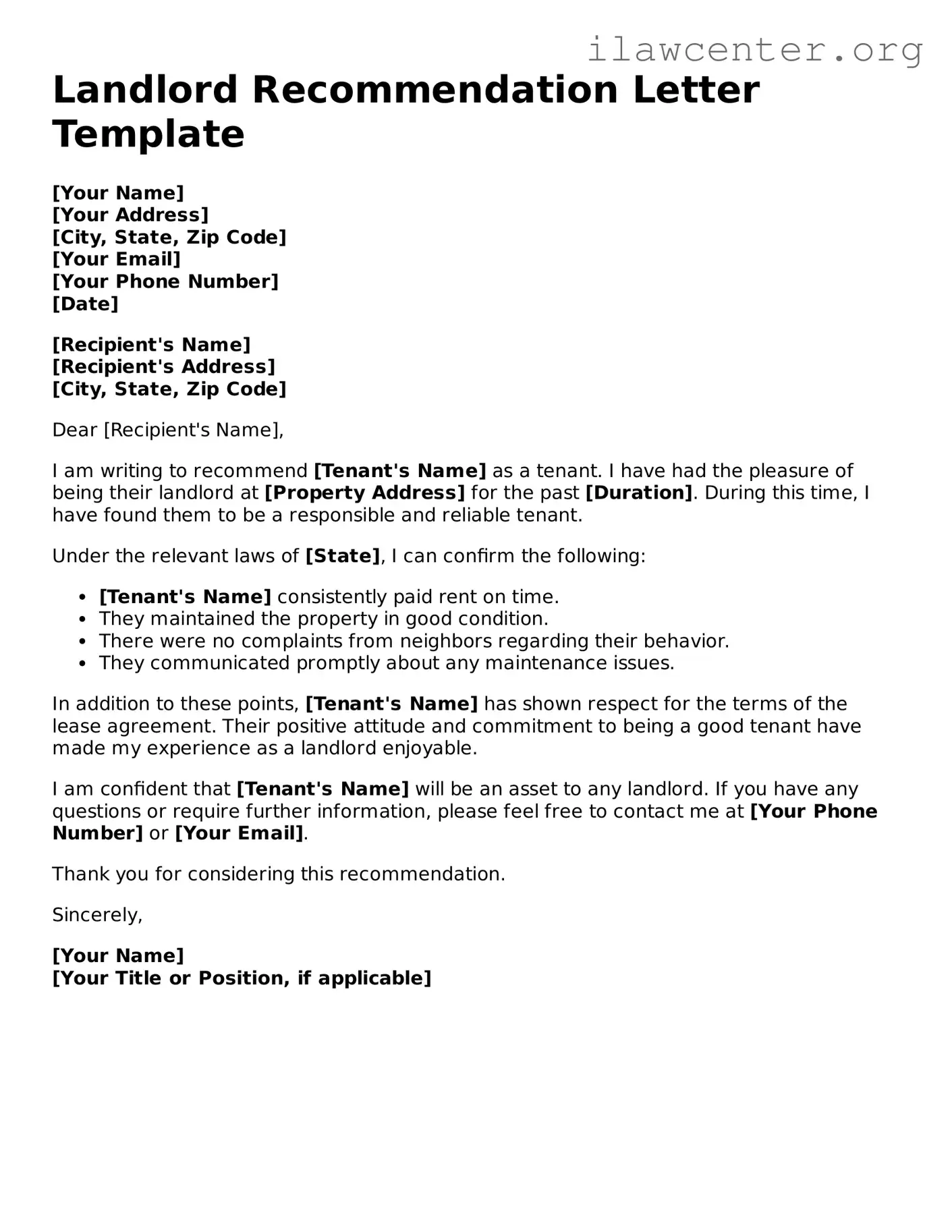
Landlord Recommendation Letter Preview

Landlord Recommendation Letter Template

[Your Name]
[Your Address]
[City, State, Zip Code]
[Your Email]
[Your Phone Number]
[Date]

[Recipient's Name]
[Recipient's Address]
[City, State, Zip Code]

Dear [Recipient's Name],

I am writing to recommend [Tenant's Name] as a tenant. I have had the pleasure of being their landlord at [Property Address] for the past [Duration]. During this time, I have found them to be a responsible and reliable tenant.

Under the relevant laws of [State], I can confirm the following:

  • [Tenant's Name] consistently paid rent on time.
  • They maintained the property in good condition.
  • There were no complaints from neighbors regarding their behavior.
  • They communicated promptly about any maintenance issues.

In addition to these points, [Tenant's Name] has shown respect for the terms of the lease agreement. Their positive attitude and commitment to being a good tenant have made my experience as a landlord enjoyable.

I am confident that [Tenant's Name] will be an asset to any landlord. If you have any questions or require further information, please feel free to contact me at [Your Phone Number] or [Your Email].

Thank you for considering this recommendation.

Sincerely,

[Your Name]
[Your Title or Position, if applicable]

PDF Form Characteristics

Fact Name Description
Purpose A landlord recommendation letter is used to provide a reference for a tenant seeking a new rental property.
Content The letter typically includes the tenant's rental history, payment behavior, and overall character.
Format It can be written in a formal letter format, often including the landlord's contact information and signature.
State-Specific Forms Some states may have specific forms or guidelines for landlord recommendation letters, ensuring compliance with local laws.
Governing Laws In California, for example, the letter must comply with the California Civil Code regarding tenant privacy.
Confidentiality Landlords should be cautious about sharing sensitive information, adhering to privacy laws that protect tenant data.
Duration The recommendation letter should reflect the duration of the tenant's stay, providing context to their rental history.
Positive vs. Negative While it is common to focus on positive aspects, landlords can mention issues if they are relevant and factual.
Usefulness A well-crafted recommendation letter can significantly impact a tenant's ability to secure a new rental.
Legality Landlords must ensure that their statements are truthful to avoid potential legal repercussions for defamation.

Instructions on Utilizing Landlord Recommendation Letter

Filling out the Landlord Recommendation Letter form is an important step in providing a reference for a tenant. This process ensures that the necessary information is clearly communicated and presented in a professional manner. Follow these steps to complete the form accurately.

  1. Begin by entering the date at the top of the form.
  2. Fill in the landlord's name and contact information, including phone number and email address.
  3. Provide the tenant's name and the address of the rental property.
  4. Indicate the duration of the tenant's residency, specifying the start and end dates.
  5. Detail the rent amount and payment history, noting if payments were made on time.
  6. Describe the tenant's behavior, including any issues or positive attributes observed during their stay.
  7. Include any additional comments that may be relevant to the tenant's application.
  8. Sign and date the form at the bottom to validate the recommendation.

Important Facts about Landlord Recommendation Letter

What is a Landlord Recommendation Letter?

A Landlord Recommendation Letter is a document that a previous landlord provides to vouch for a tenant's character, reliability, and rental history. This letter can be crucial for prospective tenants seeking to secure a new rental property, as it offers insights into their behavior and responsibilities as a tenant.

Why is a Landlord Recommendation Letter important?

This letter serves as a reference that can significantly influence a landlord's decision when considering a potential tenant. It highlights the tenant's positive attributes, such as timely rent payments, respect for property, and overall conduct, which can set them apart from other applicants.

Who should request a Landlord Recommendation Letter?

Anyone looking to rent a new property can benefit from obtaining a Landlord Recommendation Letter. It is particularly useful for individuals with limited rental history, such as first-time renters or those returning to the rental market after a long hiatus.

What should be included in a Landlord Recommendation Letter?

Typically, the letter should include the tenant's name, the duration of their tenancy, the rental property address, and specific positive behaviors or experiences. It may also mention the tenant's payment history and any maintenance of the property during their stay.

How can a tenant request a Landlord Recommendation Letter?

A tenant should approach their previous landlord politely, explaining the need for the letter. It is helpful to provide context, such as the type of rental they are applying for and any particular qualities they would like highlighted. A written request can often facilitate this process.

Is there a standard format for a Landlord Recommendation Letter?

While there is no strict format, a well-structured letter typically includes a formal greeting, an introduction of the landlord, the body containing the recommendation details, and a closing statement. It should also be signed by the landlord to add authenticity.

Can a Landlord Recommendation Letter be used for different types of rentals?

Yes, a Landlord Recommendation Letter can be versatile. Whether for an apartment, house, or shared living situation, the letter can be adapted to fit various rental scenarios. The key is to emphasize the qualities that would be relevant to the new landlord.

How long should a Landlord Recommendation Letter be?

Generally, a Landlord Recommendation Letter should be concise, ideally one page long. It should provide enough detail to convey the tenant's strengths without overwhelming the reader with excessive information.

What if a tenant had a negative experience with their previous landlord?

If a tenant had a less-than-ideal experience, they might consider seeking a recommendation from another landlord or a different reference, such as a property manager. It is crucial to have a positive endorsement when applying for a new rental.

Can a Landlord Recommendation Letter be revoked?

Yes, a landlord can choose to revoke a recommendation letter if they feel the tenant's behavior has changed or if new information comes to light. This emphasizes the importance of maintaining a good relationship with landlords throughout the tenancy.
Common mistakes

When filling out a Landlord Recommendation Letter form, many individuals inadvertently make mistakes that can impact the effectiveness of their recommendation. One common error is providing vague or generic information. Instead of detailing specific experiences or qualities of the tenant, some landlords may simply state that the tenant was "good" or "fine." This lack of specificity fails to give potential landlords a clear picture of the tenant’s reliability and behavior.

Another frequent mistake involves omitting essential details about the rental period. Landlords should clearly indicate how long the tenant lived in the property. This information helps establish the context of the recommendation. Without this, the recommendation may seem less credible or relevant.

Some landlords neglect to mention the tenant's payment history. It's crucial to include whether the tenant consistently paid rent on time or if there were any issues. A recommendation that highlights a tenant's prompt payments can significantly enhance their chances of securing a new rental.

In addition, failing to provide contact information can be a major oversight. If a potential landlord wishes to follow up for more details, they should have a way to reach the person giving the recommendation. Including a phone number or email address ensures that the recommendation carries more weight and allows for further verification.

Another mistake is not tailoring the letter to the specific needs of the new landlord. Each rental situation is unique, and a one-size-fits-all recommendation may not address the particular concerns or requirements of the new landlord. Customizing the letter to reflect the qualities that matter most to the potential landlord can make a significant difference.

Moreover, some landlords may forget to sign the recommendation letter. A signature adds a personal touch and authenticity to the letter. Without it, the recommendation may appear less formal and can lead to doubts about its legitimacy.

Additionally, using overly technical language or jargon can alienate the reader. The recommendation should be clear and straightforward. Using simple language helps ensure that the message is easily understood and appreciated by the potential landlord.

Another common error is neglecting to proofread the letter. Typos and grammatical errors can undermine the professionalism of the recommendation. Taking a moment to review the letter can help avoid these pitfalls and present a polished image.

Finally, failing to express a personal opinion can diminish the impact of the recommendation. A strong recommendation should include a personal endorsement of the tenant, highlighting their character and suitability as a tenant. This personal touch can make all the difference in a competitive rental market.

Documents used along the form

When seeking a rental property, a Landlord Recommendation Letter can be an important document. However, several other forms and documents may also be necessary to support your application. Below is a list of commonly used documents that can accompany the recommendation letter.

  • Rental Application Form: This form collects personal information about the applicant, including employment history, income, and references. Landlords use it to assess the applicant's suitability.
  • Credit Report: A credit report provides a snapshot of an applicant's credit history. It includes details about credit accounts, payment history, and outstanding debts. Landlords often review this to evaluate financial responsibility.
  • Background Check Authorization: This document allows landlords to conduct a background check on the applicant. It typically includes consent for checking criminal history and previous evictions.
  • Proof of Income: This can be a recent pay stub, bank statement, or tax return. It verifies the applicant's ability to pay rent consistently.
  • Identification: A government-issued ID, such as a driver's license or passport, is often required to confirm the applicant's identity.
  • Pet Agreement: If the applicant has pets, this document outlines the terms and conditions regarding pet ownership in the rental property.
  • Lease Agreement: This is the formal contract between the landlord and tenant. It details the terms of the rental arrangement, including duration, rent amount, and responsibilities.
  • Move-In Checklist: This checklist is used to document the condition of the rental property before the tenant moves in. It helps prevent disputes over security deposits later on.

Having these documents ready can streamline the rental application process. Each form plays a unique role in presenting a complete picture to potential landlords, increasing the chances of securing the desired rental property.

Similar forms

  • Tenant Reference Letter: This document serves a similar purpose by providing insights into a tenant’s behavior and reliability. Like the landlord recommendation letter, it is typically written by a previous landlord or property manager and highlights the tenant's payment history and adherence to lease agreements.

  • Character Reference Letter: Often used in various contexts, this letter can also be relevant for rental applications. A character reference speaks to an individual’s personal qualities and reliability, much like a landlord recommendation, but focuses more on the tenant's character rather than their rental history.

  • Employment Verification Letter: While this document primarily confirms a tenant’s employment status and income, it shares similarities with the landlord recommendation letter in that it provides assurance to landlords about a tenant's financial stability and reliability.

  • Credit Report: A credit report offers a comprehensive overview of an individual's financial history, including payment habits and debts. While not a letter, it complements the landlord recommendation letter by providing a quantitative measure of the tenant's reliability and responsibility in financial matters.

  • Rental Application: This document is filled out by prospective tenants and includes personal information, rental history, and references. It is similar to the landlord recommendation letter in that both aim to establish the credibility and reliability of a tenant, but the application is more comprehensive and serves as a formal request for tenancy.

Dos and Don'ts

When filling out a Landlord Recommendation Letter form, certain practices can enhance the quality of your submission. Below is a list of things to do and avoid.

  • Do provide accurate information. Ensure all details about the tenant are correct.
  • Do be honest. Include both strengths and any weaknesses of the tenant.
  • Do use clear and concise language. Avoid overly complex sentences that may confuse the reader.
  • Do include specific examples. Illustrate your points with real situations that demonstrate the tenant's behavior.
  • Don't exaggerate. Avoid making claims that are not supported by facts.
  • Don't use vague language. Be specific to give a clearer picture of the tenant.
  • Don't include personal opinions. Focus on professional observations rather than personal feelings.
  • Don't forget to proofread. Typos and grammatical errors can detract from the credibility of the recommendation.

Misconceptions

  • Misconception 1: The landlord recommendation letter is only necessary for first-time renters.

    This is not true. Even experienced renters may need a recommendation letter when applying for a new rental. Landlords often seek assurance about a tenant's reliability, regardless of their rental history.

  • Misconception 2: A landlord recommendation letter guarantees approval for a rental application.

    A recommendation letter can strengthen an application, but it does not guarantee approval. Landlords consider various factors, including credit history and income, before making their decision.

  • Misconception 3: All landlords provide recommendation letters without hesitation.

    Some landlords may be reluctant to write recommendation letters. They might have policies against it or feel uncomfortable providing a subjective opinion about a tenant.

  • Misconception 4: The letter must be lengthy and detailed.

    A concise letter can be just as effective as a longer one. What matters most is that it includes essential information about the tenant's reliability and behavior.

  • Misconception 5: A landlord recommendation letter is the only document needed for a rental application.

    While helpful, it is just one part of the application process. Applicants typically need to provide other documents, such as proof of income and identification.

  • Misconception 6: The letter is not important if the tenant has a good credit score.

    Even tenants with good credit scores can benefit from a recommendation letter. It adds a personal touch and can highlight positive aspects of the tenant's rental history that credit scores do not reflect.

Key takeaways

When filling out and using the Landlord Recommendation Letter form, there are several important considerations to keep in mind. Below are key takeaways that can help ensure the process is smooth and effective.

  • Clarity is essential. Provide clear and concise information about the tenant's rental history and behavior.
  • Be honest. It is important to present an accurate depiction of the tenant's reliability and character.
  • Include relevant details. Mention specifics such as the duration of tenancy, rent payment history, and any notable interactions.
  • Use a professional tone. Maintain a respectful and formal tone throughout the letter to reflect professionalism.
  • Proofread carefully. Ensure that the letter is free from grammatical errors and typos, as this reflects on both the landlord and the tenant.
  • Provide contact information. Include your contact details so that the recipient can reach out for further clarification if needed.
  • Limit personal opinions. Focus on factual information rather than personal judgments about the tenant.
  • Consider confidentiality. Be mindful of the tenant's privacy and only share information that is appropriate and necessary.

These takeaways serve as a guide for landlords to create effective recommendation letters that can positively influence a tenant's application for future housing opportunities.