Fillable Letter of Intent for a Teaching Job Document

Fillable Letter of Intent for a Teaching Job Document

A Letter of Intent for a Teaching Job is a formal document expressing a candidate's interest in a teaching position. This letter outlines the applicant's qualifications, teaching philosophy, and reasons for wanting to join a specific educational institution. If you're ready to take the next step in your teaching career, fill out the form by clicking the button below.

Article Guide

When pursuing a teaching position, candidates often encounter a crucial document known as the Letter of Intent for a Teaching Job. This letter serves as a formal introduction to the hiring committee, allowing educators to express their interest in a specific position while highlighting their qualifications and teaching philosophy. Typically, the letter includes essential elements such as the applicant's educational background, relevant teaching experience, and a clear articulation of their commitment to fostering a positive learning environment. Additionally, it may touch upon the applicant's understanding of the school's mission and values, demonstrating alignment with the institution's goals. By conveying enthusiasm and professionalism, the Letter of Intent not only showcases the candidate's skills but also sets the tone for their potential fit within the school community. Crafting this document thoughtfully is vital, as it may significantly influence the hiring decision, making it an important step in the journey toward securing a teaching role.

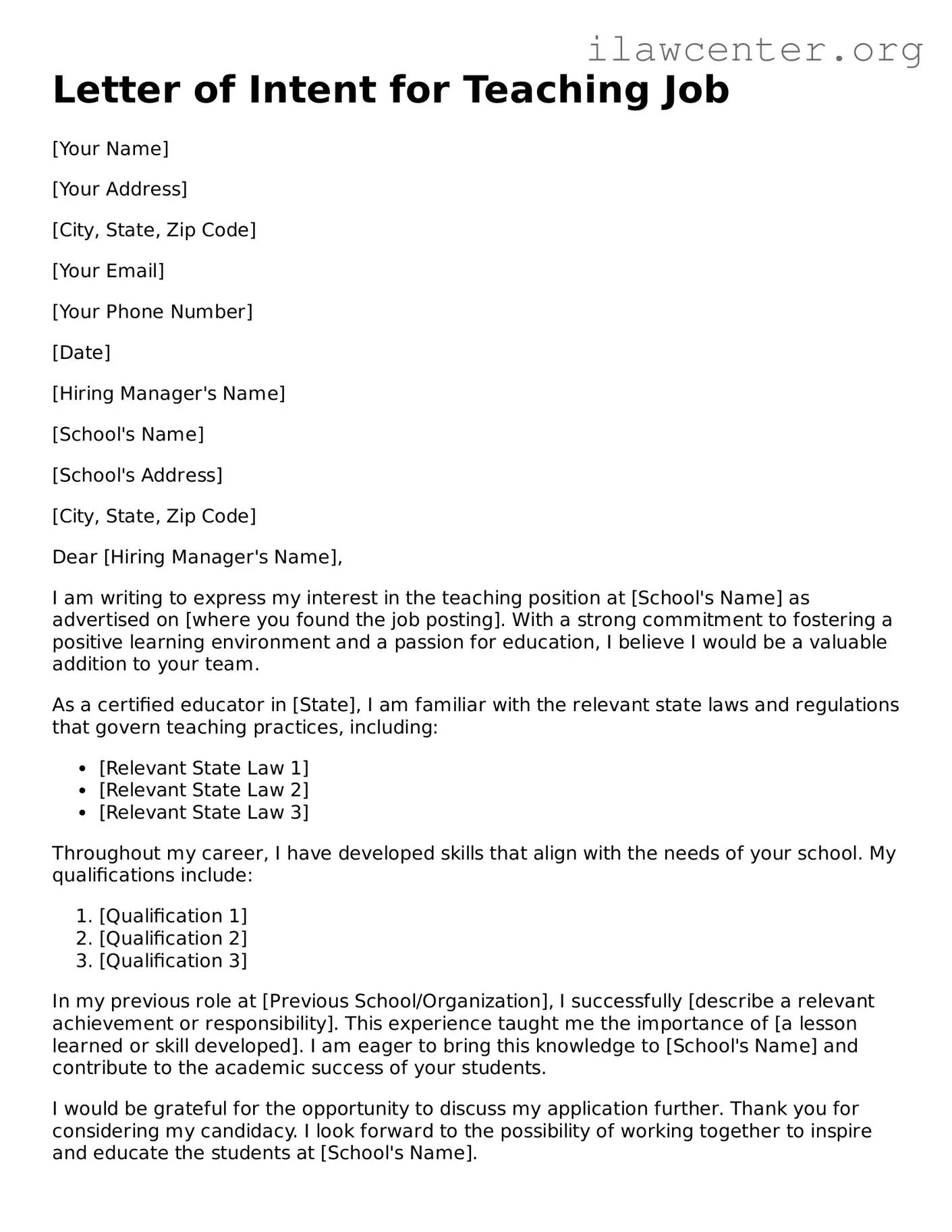
Letter of Intent for a Teaching Job Preview

Letter of Intent for Teaching Job

[Your Name]

[Your Address]

[City, State, Zip Code]

[Your Email]

[Your Phone Number]

[Date]

[Hiring Manager's Name]

[School's Name]

[School's Address]

[City, State, Zip Code]

Dear [Hiring Manager's Name],

I am writing to express my interest in the teaching position at [School's Name] as advertised on [where you found the job posting]. With a strong commitment to fostering a positive learning environment and a passion for education, I believe I would be a valuable addition to your team.

As a certified educator in [State], I am familiar with the relevant state laws and regulations that govern teaching practices, including:

  • [Relevant State Law 1]
  • [Relevant State Law 2]
  • [Relevant State Law 3]

Throughout my career, I have developed skills that align with the needs of your school. My qualifications include:

  1. [Qualification 1]
  2. [Qualification 2]
  3. [Qualification 3]

In my previous role at [Previous School/Organization], I successfully [describe a relevant achievement or responsibility]. This experience taught me the importance of [a lesson learned or skill developed]. I am eager to bring this knowledge to [School's Name] and contribute to the academic success of your students.

I would be grateful for the opportunity to discuss my application further. Thank you for considering my candidacy. I look forward to the possibility of working together to inspire and educate the students at [School's Name].

Sincerely,

[Your Name]

PDF Form Characteristics

Fact Name Description
Purpose A Letter of Intent for a Teaching Job expresses a candidate's interest in a teaching position and outlines their qualifications.
Format The letter should be professionally formatted, typically including the candidate's contact information, date, recipient's information, a salutation, body, and closing.
Content It generally includes a brief introduction, relevant experience, teaching philosophy, and a conclusion expressing eagerness for an interview.
State-Specific Forms Some states may have specific requirements or forms for Letters of Intent, governed by their education department regulations.
Governing Laws In states like California, the governing laws include the California Education Code, while New York follows the New York State Education Law.

Instructions on Utilizing Letter of Intent for a Teaching Job

After obtaining the Letter of Intent for a Teaching Job form, you will need to complete it accurately to ensure your application is considered. Follow these steps to fill out the form properly.

  1. Begin by entering your full name at the top of the form.
  2. Provide your current address, including street, city, state, and zip code.
  3. Include your phone number and email address for contact purposes.
  4. State the position you are applying for clearly.
  5. Write a brief introduction about yourself, highlighting your teaching experience and qualifications.
  6. Explain why you are interested in the position and what you can bring to the school.
  7. List any relevant certifications or degrees you hold.
  8. Conclude with a polite closing statement, expressing your eagerness for an interview.
  9. Sign and date the form at the bottom.

Important Facts about Letter of Intent for a Teaching Job

What is a Letter of Intent for a Teaching Job?

A Letter of Intent for a Teaching Job is a document that expresses your interest in a teaching position at a specific school or educational institution. It outlines your qualifications, teaching philosophy, and reasons for wanting to join the school. This letter serves as a formal introduction to your potential employer and can set the tone for your application process.

Why do I need to submit a Letter of Intent?

Submitting a Letter of Intent is often a required part of the application process for teaching positions. It allows you to showcase your personality and teaching style, which may not be evident in your resume alone. Additionally, it gives you the opportunity to explain why you are a good fit for the school and how your values align with its mission.

What should I include in my Letter of Intent?

Your Letter of Intent should include several key elements: an introduction that states your purpose, a summary of your qualifications and teaching experience, your educational philosophy, and specific reasons for wanting to work at that particular school. It’s also helpful to mention any connections you have to the school or community.

How long should my Letter of Intent be?

Typically, a Letter of Intent should be one page long. This allows you to provide enough detail to make a strong case for your candidacy without overwhelming the reader. Aim for clear and concise language, and ensure that your main points are easily identifiable.

Is it necessary to customize my Letter of Intent for each application?

Yes, it is highly recommended to customize your Letter of Intent for each application. Tailoring your letter shows that you have researched the school and understand its values and needs. A personalized letter can make a stronger impression than a generic one, demonstrating your genuine interest in the position.

When should I submit my Letter of Intent?

Submit your Letter of Intent along with your application materials, typically by the deadline specified in the job posting. If no deadline is given, try to submit your application as soon as possible, as many schools review applications on a rolling basis.

Can I use a template for my Letter of Intent?

While using a template can be a helpful starting point, it’s important to personalize your letter. A template may provide structure, but your content should reflect your unique experiences and motivations. Ensure that your voice comes through clearly to make a lasting impression.
Common mistakes

When applying for a teaching position, the Letter of Intent is a crucial document. However, many applicants make common mistakes that can undermine their chances of success. One significant error is failing to tailor the letter to the specific school or district. Generic letters often lack the personal touch that hiring committees seek. Each educational institution has its unique culture and values, and addressing these directly can make a strong impression.

Another frequent mistake is neglecting to highlight relevant experiences and qualifications. Candidates sometimes list their credentials without connecting them to the job at hand. It’s essential to demonstrate how past experiences align with the requirements of the teaching position. Providing specific examples of teaching methods, classroom management skills, or educational philosophies can set a candidate apart.

Additionally, many applicants overlook the importance of proofreading. Spelling and grammatical errors can detract from the professionalism of the letter. A polished document reflects attention to detail and a commitment to quality. Taking the time to review the letter or seeking feedback from a colleague can help catch mistakes before submission.

Some candidates also fail to express genuine enthusiasm for the position. A Letter of Intent should convey passion for teaching and a desire to contribute to the school community. Simply stating interest in the job is not enough. Sharing personal motivations and aspirations can resonate with hiring committees and create a memorable impression.

Finally, many applicants do not follow the specified format or guidelines outlined by the school. Each institution may have different requirements regarding length, structure, or content. Ignoring these guidelines can signal a lack of respect for the application process. Adhering to the instructions demonstrates professionalism and a willingness to comply with the school’s expectations.

Documents used along the form

A Letter of Intent for a Teaching Job serves as an important initial communication between a candidate and an educational institution. Along with this letter, several other documents are often required to provide a comprehensive view of the applicant's qualifications and suitability for the position. Below are some common forms and documents that may accompany the Letter of Intent.

  • Resume: A detailed account of the applicant's educational background, teaching experience, skills, and relevant certifications. The resume highlights qualifications and achievements, allowing hiring committees to quickly assess the candidate's fit for the role.
  • Cover Letter: A personalized letter that elaborates on the applicant's interest in the position and the specific school. It often includes anecdotes or examples that demonstrate teaching philosophy and commitment to education.
  • Teaching Philosophy Statement: A document that outlines the candidate's beliefs about teaching and learning. This statement reflects the educator's approach to instruction, classroom management, and student engagement, providing insight into their pedagogical style.
  • Transcripts: Official academic records that verify the candidate's educational credentials. Transcripts typically include information on degrees earned, courses taken, and grades received, serving as proof of the applicant's academic qualifications.

These documents collectively enhance the application package, offering a fuller picture of the candidate's abilities and aspirations. Together, they help educational institutions make informed hiring decisions.

Similar forms

The Letter of Intent for a Teaching Job serves as a formal expression of interest in a teaching position. Several other documents share similarities with this letter in terms of purpose and structure. Here are seven such documents:

  • Cover Letter: Like the Letter of Intent, a cover letter introduces the applicant to a potential employer. It highlights qualifications and expresses interest in a specific position, often accompanying a resume.
  • Statement of Purpose: This document outlines an applicant's motivations and goals, similar to how a Letter of Intent conveys the reasons for pursuing a teaching position. Both documents provide insight into the applicant's aspirations.
  • Curriculum Vitae (CV): A CV lists academic and professional achievements, much like the Letter of Intent summarizes relevant experiences. Both serve to present the applicant's qualifications to a hiring committee.
  • Teaching Philosophy Statement: This statement reflects an educator's beliefs about teaching and learning, akin to the intentions expressed in a Letter of Intent. Both documents showcase the applicant's educational values and approach.
  • Application Form: An application form collects essential information about the candidate, similar to how a Letter of Intent outlines the applicant's interest and qualifications. Both are critical components of the hiring process.
  • Recommendation Letters: These letters provide endorsements from others, paralleling the personal touch of a Letter of Intent. Both documents aim to strengthen the applicant's case for employment.
  • Interview Follow-Up Letter: After an interview, this letter expresses gratitude and reiterates interest, much like a Letter of Intent does at the outset. Both aim to maintain communication and reinforce the candidate's enthusiasm for the position.

Dos and Don'ts

When applying for a teaching position, the Letter of Intent serves as your introduction to the hiring committee. It is crucial to approach this document thoughtfully. Here are some important dos and don'ts to consider while filling out the form:

  • Do tailor your letter to the specific school and position.
  • Do highlight your relevant experience and qualifications.
  • Do express genuine enthusiasm for the role and the institution.
  • Do proofread your letter for spelling and grammatical errors.
  • Do keep your tone professional yet personable.
  • Don't use a generic template without customization.
  • Don't focus solely on your credentials without connecting them to the school’s mission.
  • Don't include irrelevant personal information.
  • Don't make your letter overly long; aim for clarity and conciseness.

By following these guidelines, you can create a compelling Letter of Intent that effectively communicates your passion for teaching and your fit for the position.

Misconceptions

The Letter of Intent for a Teaching Job form is often misunderstood. Below are seven common misconceptions about this document:

  1. It is the same as a resume.

    While a resume outlines qualifications and experience, a Letter of Intent expresses the applicant's interest in a specific position and highlights their motivation for applying.

  2. It is not important.

    Many believe that the Letter of Intent is optional. However, it plays a crucial role in the hiring process by providing insight into the candidate's personality and teaching philosophy.

  3. One size fits all.

    Some applicants think they can use the same letter for multiple positions. Each letter should be tailored to reflect the specific school and job requirements.

  4. It should be overly formal.

    While professionalism is essential, the letter should also convey authenticity. A conversational tone can help the applicant connect with the hiring committee.

  5. It must be lengthy.

    Some individuals believe that a longer letter is better. In reality, a concise and focused letter is more effective in conveying the applicant's message.

  6. It does not require proofreading.

    Many underestimate the importance of proofreading. Errors can detract from the professionalism of the letter and may leave a negative impression.

  7. It is only about qualifications.

    While qualifications are important, the letter should also reflect the candidate's passion for teaching and their commitment to student success.

Key takeaways

When filling out and using the Letter of Intent for a Teaching Job form, consider the following key takeaways:

  1. Be Clear and Concise: Clearly state your intent to apply for the teaching position. Avoid unnecessary jargon.
  2. Personalize Your Letter: Address the letter to the specific school or hiring committee. This shows your genuine interest.
  3. Highlight Your Qualifications: Briefly mention your relevant experience and qualifications that make you a strong candidate.
  4. Express Enthusiasm: Convey your passion for teaching and your desire to contribute to the school community.
  5. Follow the Format: Use a professional format. Include your contact information at the top, followed by the date and the school's address.
  6. Proofread: Review your letter for spelling and grammatical errors. A polished letter reflects professionalism.
  7. Keep it Short: Aim for one page. A concise letter is more likely to be read in full.
  8. Include a Closing Statement: End with a statement expressing your hope for an interview or further discussion.
  9. Use a Professional Tone: Maintain a respectful and formal tone throughout your letter.
  10. Follow Up: Consider following up with the school after submitting your letter to express continued interest.