Fillable Letter of Intent for Internship Document

Fillable Letter of Intent for Internship Document

A Letter of Intent for Internship form serves as a formal declaration of a student’s desire to secure an internship position, outlining their qualifications and goals. This document is essential for both the applicant and the employer, as it establishes clear intentions and expectations for the internship experience. Ready to take the next step in your career? Fill out the form by clicking the button below!

Article Guide

Securing an internship can be a pivotal step in a student's career journey, and the Letter of Intent for Internship form plays a crucial role in this process. This document serves as a formal expression of interest, allowing students to articulate their motivations, skills, and goals related to the internship opportunity. Typically, the form requires applicants to provide personal information, educational background, and relevant experiences that align with the internship. Additionally, it often includes sections for outlining specific interests in the organization and how the internship aligns with the applicant's career aspirations. By completing this form thoughtfully, students can effectively communicate their enthusiasm and suitability for the position, setting the stage for a successful application. Understanding the components and purpose of the Letter of Intent for Internship form can significantly enhance a student's chances of securing valuable hands-on experience in their chosen field.

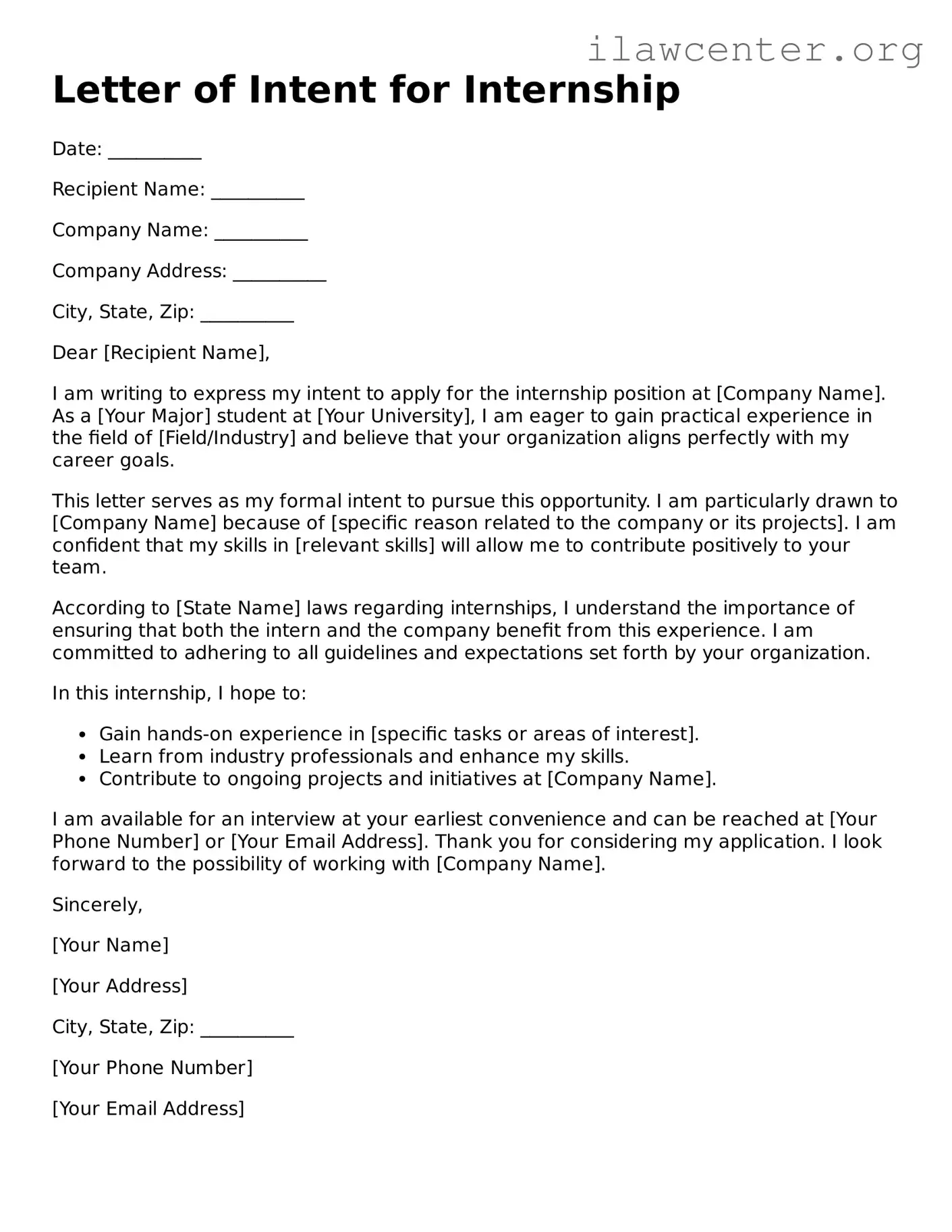
Letter of Intent for Internship Preview

Letter of Intent for Internship

Date: __________

Recipient Name: __________

Company Name: __________

Company Address: __________

City, State, Zip: __________

Dear [Recipient Name],

I am writing to express my intent to apply for the internship position at [Company Name]. As a [Your Major] student at [Your University], I am eager to gain practical experience in the field of [Field/Industry] and believe that your organization aligns perfectly with my career goals.

This letter serves as my formal intent to pursue this opportunity. I am particularly drawn to [Company Name] because of [specific reason related to the company or its projects]. I am confident that my skills in [relevant skills] will allow me to contribute positively to your team.

According to [State Name] laws regarding internships, I understand the importance of ensuring that both the intern and the company benefit from this experience. I am committed to adhering to all guidelines and expectations set forth by your organization.

In this internship, I hope to:

  • Gain hands-on experience in [specific tasks or areas of interest].
  • Learn from industry professionals and enhance my skills.
  • Contribute to ongoing projects and initiatives at [Company Name].

I am available for an interview at your earliest convenience and can be reached at [Your Phone Number] or [Your Email Address]. Thank you for considering my application. I look forward to the possibility of working with [Company Name].

Sincerely,

[Your Name]

[Your Address]

City, State, Zip: __________

[Your Phone Number]

[Your Email Address]

PDF Form Characteristics

Fact Name Details
Purpose The Letter of Intent for Internship serves as a formal document outlining the intent of a student to pursue an internship opportunity.
Components Typically includes information such as the intern's name, contact details, the name of the organization, and the duration of the internship.
State-Specific Forms Some states may require specific forms or additional documentation to accompany the Letter of Intent.
Governing Law The governing laws for the internship agreements may vary by state, often falling under employment law or educational regulations.
Signatures Both the intern and the organization typically must sign the document to indicate mutual agreement and understanding.
Submission The completed Letter of Intent for Internship is usually submitted to the internship provider prior to the start date of the internship.

Instructions on Utilizing Letter of Intent for Internship

After completing the Letter of Intent for Internship form, you will submit it to the appropriate department for review. This is an important step in securing your internship opportunity.

  1. Begin by downloading the Letter of Intent for Internship form from the designated website or portal.
  2. Open the form and read the instructions carefully to understand the requirements.
  3. Fill in your personal information, including your full name, contact details, and academic background.
  4. Provide the details of the internship position you are applying for, including the company name and internship title.
  5. Write a brief statement expressing your interest in the internship and what you hope to gain from the experience.
  6. Include any relevant skills or experiences that make you a good fit for the position.
  7. Review the form for any errors or missing information before submitting.
  8. Save the completed form in the required format, usually PDF or Word document.
  9. Submit the form via the specified method, whether it’s online submission or email.

Important Facts about Letter of Intent for Internship

What is a Letter of Intent for Internship?

A Letter of Intent for Internship is a document that expresses your interest in a specific internship position. It outlines your goals, qualifications, and reasons for wanting to join a particular organization. This letter helps you stand out by showcasing your enthusiasm and commitment to the opportunity. It's often required as part of the application process.

What should I include in my Letter of Intent?

Your Letter of Intent should include several key components. Start with a brief introduction about yourself and the internship you are applying for. Highlight your relevant skills, experiences, and educational background. Make sure to explain why you are interested in the internship and how it aligns with your career goals. Finally, express your eagerness to contribute to the organization and thank the reader for considering your application.

How long should my Letter of Intent be?

Generally, a Letter of Intent should be one page long. Aim for a concise yet informative letter that gets straight to the point. Use clear and direct language. Avoid long paragraphs; instead, break your content into smaller sections. This makes it easier for the reader to digest your message. A well-structured letter will leave a positive impression.

Is it necessary to send a Letter of Intent if it’s not requested?

Common mistakes

Completing a Letter of Intent for an internship can be a critical step in securing a position. However, many applicants make common mistakes that can hinder their chances of success. Understanding these pitfalls can help individuals present themselves in the best light possible.

One frequent error is failing to tailor the letter to the specific internship. Generic letters can come across as impersonal and may not capture the attention of the reader. It is essential to highlight relevant experiences and skills that align with the internship's requirements. Personalization shows genuine interest and effort.

Another common mistake is neglecting to proofread the letter. Spelling and grammatical errors can create a negative impression. Taking the time to review the document for mistakes demonstrates professionalism and attention to detail. It can be helpful to ask someone else to read it as well, as a fresh set of eyes may catch errors that were overlooked.

Additionally, some applicants fail to clearly articulate their goals. A Letter of Intent should outline what the applicant hopes to gain from the internship and how it fits into their career aspirations. Without this clarity, the letter may lack direction and purpose, leaving the reader uncertain about the applicant's motivations.

Another mistake is being too vague about skills and experiences. Instead of making broad statements, individuals should provide specific examples that showcase their qualifications. For instance, instead of saying, “I am a good team player,” it is more effective to describe a situation where teamwork led to a successful outcome.

Many applicants also overlook the importance of formatting. A well-organized letter with clear paragraphs and headings can improve readability. A cluttered or unprofessional layout can distract from the content and give the impression of carelessness.

In some cases, applicants write too much or too little. Striking the right balance is crucial. A concise letter that conveys key points is more effective than a lengthy one that may lose the reader's interest. Aim for clarity and brevity while ensuring all essential information is included.

Another mistake is not addressing the letter to a specific person. Whenever possible, it is best to find out the name of the hiring manager or internship coordinator. A personalized greeting adds a touch of professionalism and shows that the applicant has taken the initiative to research the organization.

Lastly, applicants often forget to include their contact information. While it may seem obvious, ensuring that phone numbers and email addresses are included and correct is vital. This information allows the organization to reach out easily for follow-up or interviews.

Avoiding these mistakes can significantly enhance the effectiveness of a Letter of Intent for an internship. By taking the time to personalize, proofread, and organize the letter, applicants can present themselves as strong candidates ready to take on new challenges.
Documents used along the form

The Letter of Intent for Internship serves as a foundational document for students seeking internships. However, several other forms and documents often accompany it to ensure a comprehensive application process. Below is a list of these documents, each playing a unique role in the internship application journey.

  • Resume: A concise summary of a candidate's educational background, work experience, skills, and accomplishments. It provides potential employers with a snapshot of the applicant's qualifications.
  • Cover Letter: This document accompanies the resume and offers a more personalized introduction to the candidate. It typically outlines the applicant's interest in the internship and highlights relevant experiences.
  • Transcripts: Official academic records that detail a student's coursework and grades. Transcripts help employers assess the applicant's academic performance and commitment to their field of study.
  • Recommendation Letters: Written endorsements from professors, employers, or mentors that speak to the candidate's skills, character, and suitability for the internship. These letters provide third-party validation of the applicant's qualifications.
  • Portfolio: A collection of work samples that showcases a candidate's abilities and creativity. This is particularly relevant for fields such as design, writing, or art, where tangible examples of work can make a strong impression.
  • Application Form: A standardized form that many organizations require as part of the internship application process. It typically collects basic information about the applicant, such as contact details and educational history.
  • Interview Preparation Materials: These may include guides or outlines that help candidates prepare for interviews. They often cover common questions and strategies for presenting oneself effectively.
  • Non-Disclosure Agreement (NDA): A legal document that may be required by the employer to protect confidential information. Signing an NDA ensures that the intern will not disclose sensitive information obtained during the internship.

Each of these documents plays a critical role in the internship application process. Together, they provide a comprehensive view of the candidate, enhancing their chances of securing the desired position.

Similar forms

  • Memorandum of Understanding (MOU): This document outlines the intentions of two parties to collaborate on a specific project or goal. Like the Letter of Intent, it establishes a framework for the relationship and expectations without creating a binding contract.
  • Non-Disclosure Agreement (NDA): An NDA protects sensitive information shared between parties. Similar to a Letter of Intent, it sets clear terms regarding confidentiality and the handling of proprietary information during the internship process.
  • Offer Letter: An offer letter formally presents the terms of employment or internship to a candidate. It shares similarities with the Letter of Intent as both documents clarify the expectations and responsibilities associated with the position.
  • Internship Agreement: This document outlines the specific terms and conditions of the internship. Like the Letter of Intent, it details the roles, responsibilities, and duration of the internship, ensuring both parties are aligned.
  • Project Proposal: A project proposal presents a plan for a specific project, including objectives and methods. It is similar to the Letter of Intent as both documents express intentions and outline the framework for collaboration.
  • Partnership Agreement: This agreement defines the terms of a partnership between two or more parties. It shares characteristics with the Letter of Intent by establishing mutual goals and responsibilities without being legally binding.
  • Employment Contract: An employment contract details the terms of employment, including duties, compensation, and duration. It is akin to the Letter of Intent in that it clarifies expectations and commitments between the employer and employee.
  • Letter of Recommendation: A letter of recommendation provides an endorsement for an individual seeking a position. While not a direct counterpart, it shares the purpose of supporting the candidate's intentions, similar to how a Letter of Intent articulates the intern's goals.

Dos and Don'ts

When filling out the Letter of Intent for an internship, certain practices can enhance your application while others may hinder it. Below is a list of what you should and shouldn't do.

  • Do clearly state your objectives for the internship.
  • Do tailor your letter to the specific organization and position.
  • Do highlight relevant skills and experiences that align with the internship.
  • Do proofread for spelling and grammatical errors before submission.
  • Don't use a generic template without personalizing it.
  • Don't include irrelevant information that does not pertain to the internship.
  • Don't forget to follow the submission guidelines provided by the organization.

By adhering to these guidelines, you can create a strong Letter of Intent that effectively communicates your enthusiasm and qualifications for the internship opportunity.

Misconceptions

Misconceptions about the Letter of Intent for Internship form can lead to confusion among students and employers alike. Understanding these misconceptions is crucial for both parties to navigate the internship process effectively. Below is a list of common misunderstandings.

  • It is a legally binding contract. Many believe that a Letter of Intent (LOI) serves as a formal contract. In reality, it is typically a preliminary document expressing interest and intent, not a binding agreement.
  • It must be lengthy and detailed. Some think that an effective LOI needs to be long and complex. However, a concise and clear letter often communicates intent more effectively.
  • It is only necessary for competitive internships. While it may seem more relevant for highly sought-after positions, an LOI can enhance any internship application by demonstrating professionalism and enthusiasm.
  • Employers do not read them. There is a common belief that employers overlook LOIs. In fact, many employers appreciate the extra effort and insight into a candidate's motivations.
  • It should be generic. Some people think a one-size-fits-all approach works best. Tailoring the LOI to the specific internship and organization can significantly increase its impact.
  • It is the same as a cover letter. While both documents express interest, an LOI is generally more focused on intent and future goals, whereas a cover letter emphasizes qualifications and experiences.
  • It is optional and can be skipped. Although some may consider the LOI as an optional addition, submitting one can set a candidate apart from others who do not provide this insight.
  • It is not important for networking. Many underestimate the networking potential of an LOI. A well-crafted letter can open doors and establish connections with potential employers.

By addressing these misconceptions, students can better prepare themselves for the internship application process and enhance their chances of success.

Key takeaways

When filling out and using the Letter of Intent for Internship form, several important considerations should be kept in mind. The following key takeaways can guide individuals through the process:

  • Understand the Purpose: The Letter of Intent serves as a formal declaration of interest in an internship position, outlining the applicant's goals and intentions.
  • Research the Organization: Familiarize yourself with the organization offering the internship. This knowledge can enhance the quality of your letter.
  • Be Clear and Concise: Use straightforward language to convey your intentions. Avoid unnecessary jargon to ensure clarity.
  • Highlight Relevant Experience: Include any past experiences or skills that relate to the internship. This helps demonstrate your qualifications.
  • Express Enthusiasm: Show genuine interest in the internship opportunity. Enthusiasm can make a positive impression on the reader.
  • Follow Formatting Guidelines: Adhere to any specific formatting requirements outlined by the organization. This may include font size, margins, and length.
  • Proofread Carefully: Review your letter for grammatical errors and typos. A polished letter reflects professionalism.
  • Be Honest: Provide truthful information about your skills and experiences. Misrepresentation can lead to complications later.
  • Include Contact Information: Ensure your contact details are clear and accessible. This allows the organization to reach you easily.
  • Submit on Time: Pay attention to deadlines for submission. Late applications may not be considered.

By following these key takeaways, applicants can effectively complete the Letter of Intent for Internship form and increase their chances of securing the desired internship position.