Fillable Letter of Intent for Promotion Document

Fillable Letter of Intent for Promotion Document

The Letter of Intent for Promotion form serves as a formal request by an employee expressing their desire for advancement within the organization. This document outlines the employee's qualifications, achievements, and reasons for seeking promotion. To initiate the process, please fill out the form by clicking the button below.

Article Guide

The Letter of Intent for Promotion form serves as a crucial document in the professional development journey of employees seeking advancement within their organization. This form outlines the employee's desire for promotion, detailing their qualifications, achievements, and contributions to the workplace. It requires the employee to articulate their career goals and how they align with the organization's mission and objectives. Additionally, the form often includes sections for supervisors to provide feedback and support for the promotion request, fostering a collaborative approach to career growth. By clearly stating intentions and demonstrating readiness for increased responsibilities, this form not only aids in the decision-making process but also encourages a culture of transparency and communication within the workplace.

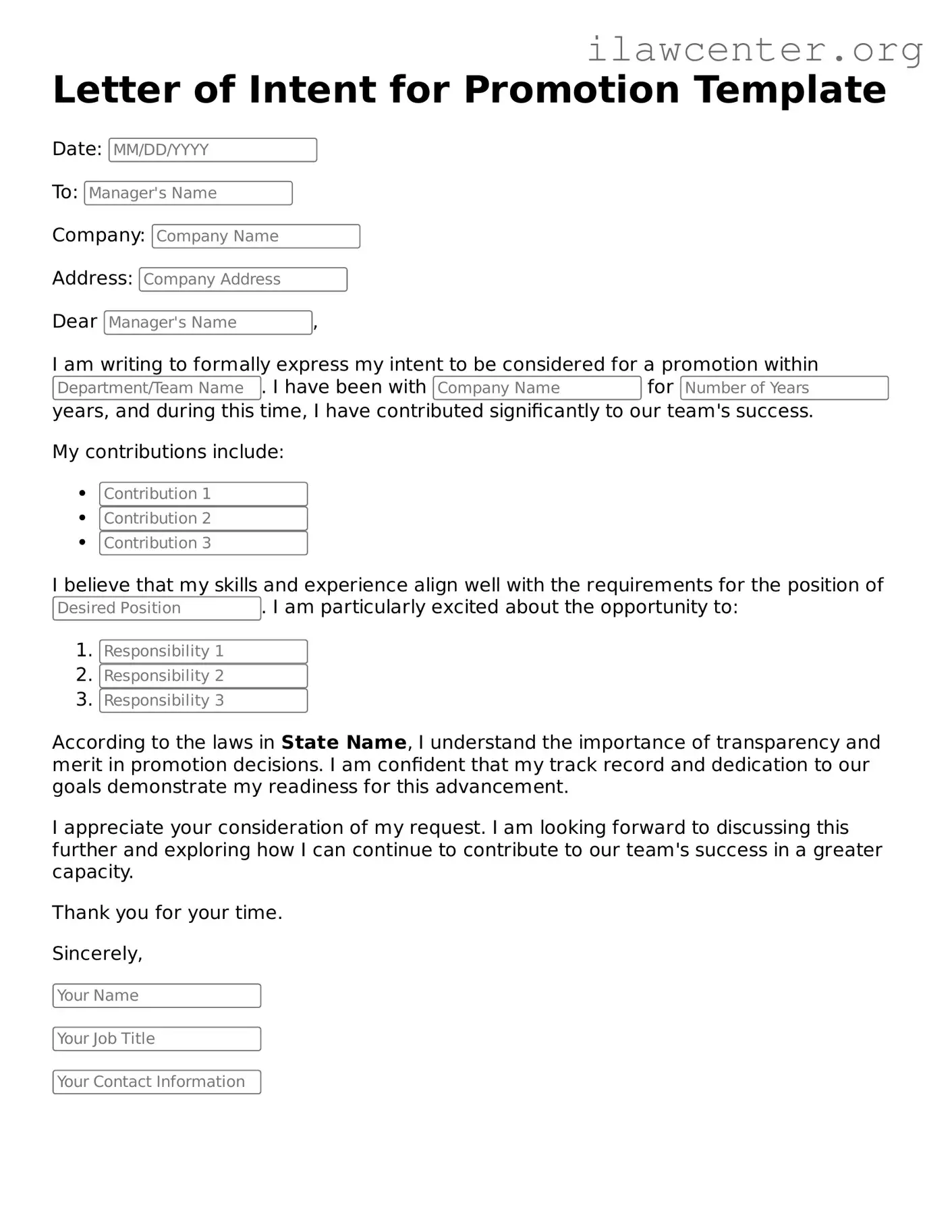
Letter of Intent for Promotion Preview

Letter of Intent for Promotion Template

Date:

To:

Company:

Address:

Dear ,

I am writing to formally express my intent to be considered for a promotion within . I have been with for years, and during this time, I have contributed significantly to our team's success.

My contributions include:

I believe that my skills and experience align well with the requirements for the position of . I am particularly excited about the opportunity to:

According to the laws in State Name, I understand the importance of transparency and merit in promotion decisions. I am confident that my track record and dedication to our goals demonstrate my readiness for this advancement.

I appreciate your consideration of my request. I am looking forward to discussing this further and exploring how I can continue to contribute to our team's success in a greater capacity.

Thank you for your time.

Sincerely,

PDF Form Characteristics

Fact Name Description
Purpose The Letter of Intent for Promotion form is used to express an employee's interest in being considered for a promotion within an organization.
Components This form typically includes sections for the employee's current position, desired position, and a statement of qualifications.
Submission Process Employees must submit the form to their direct supervisor or the human resources department, as per company policy.
State-Specific Forms Some states may have specific forms or additional requirements based on local employment laws.
Governing Laws In states like California, the governing laws include the Fair Employment and Housing Act (FEHA) which ensures fair treatment in promotions.
Confidentiality Information provided in the form is generally kept confidential and should only be reviewed by relevant personnel.
Impact on Career Submitting a Letter of Intent for Promotion can positively impact an employee's career trajectory by formally expressing their ambitions.

Instructions on Utilizing Letter of Intent for Promotion

Completing the Letter of Intent for Promotion form is an important step in your career advancement process. After filling out the form, it will be reviewed by your supervisor and relevant committees. This is your opportunity to clearly express your intentions and qualifications for the promotion you seek.

  1. Begin by downloading the Letter of Intent for Promotion form from the designated website or platform.
  2. Fill in your personal information, including your name, current position, and department.
  3. Provide the date you are submitting the form.
  4. In the section for the promotion you are seeking, clearly state the position title you wish to be considered for.
  5. Next, outline your qualifications. Highlight your achievements, contributions, and any relevant experience that supports your request for promotion.
  6. Include specific examples of how your work has positively impacted your team or organization.
  7. In the closing section, express your enthusiasm for the opportunity and your commitment to the organization.
  8. Review your completed form for any errors or missing information.
  9. Once satisfied, sign and date the form.
  10. Submit the form to your supervisor or the designated committee, following any specific submission guidelines provided.

Important Facts about Letter of Intent for Promotion

What is a Letter of Intent for Promotion?

A Letter of Intent for Promotion is a formal document that an employee submits to express their desire for a promotion within the organization. It outlines the employee's qualifications, accomplishments, and reasons for seeking the advancement. This letter serves as a way to communicate intentions and aspirations to management.

Who should submit a Letter of Intent for Promotion?

Any employee who believes they meet the criteria for a promotion and wishes to advance their career within the company should consider submitting this letter. It is particularly useful for those who have taken on additional responsibilities or have achieved significant milestones in their current role.

What should be included in the Letter of Intent for Promotion?

The letter should include the employee's current position, a summary of relevant achievements, skills, and experiences that support the promotion request. Additionally, it should articulate the reasons for seeking the promotion and how the employee can contribute to the organization in the new role.

Is there a specific format for the Letter of Intent for Promotion?

While there is no strict format, the letter should be professional and clearly organized. It typically includes a greeting, an introduction, a body that details qualifications and reasons for the promotion, and a closing statement. It is advisable to keep the letter concise and focused.

When is the best time to submit a Letter of Intent for Promotion?

The best time to submit this letter is during performance review periods or when there are open positions that align with the employee's career goals. However, it can also be submitted at any time when the employee feels ready to advance.

How does management typically respond to a Letter of Intent for Promotion?

Management will review the letter and consider the employee's qualifications and contributions to the organization. They may schedule a meeting to discuss the request further or provide feedback on the employee's readiness for promotion. A formal decision may take some time, depending on the organization's processes.

Can a Letter of Intent for Promotion guarantee a promotion?

No, submitting a Letter of Intent for Promotion does not guarantee that the employee will receive the promotion. It is simply a way to express interest and initiate a conversation about career advancement. Factors such as organizational needs, other candidates, and performance evaluations will ultimately influence the decision.

What should I do if my request for promotion is denied?

If the request for promotion is denied, it is important to seek feedback from management. Understanding the reasons behind the decision can provide valuable insights for future opportunities. Employees can then focus on areas for improvement and consider resubmitting their request at a later date.
Common mistakes

When filling out the Letter of Intent for Promotion form, individuals often overlook critical details that can hinder their chances of success. One common mistake is failing to provide complete and accurate personal information. This includes not only the applicant's name and current position but also their contact details. Incomplete information can lead to delays in processing the application or even disqualification.

Another frequent error involves the lack of specificity regarding the desired promotion. Applicants sometimes state their intention to advance without clearly outlining the position they seek. This vagueness can create confusion for decision-makers. It is essential to articulate the exact role and responsibilities associated with the desired promotion to ensure that the intent is understood.

Many applicants also neglect to highlight their achievements and contributions adequately. Simply stating that one is a good employee is insufficient. Instead, it is crucial to include specific examples of accomplishments that demonstrate readiness for the new role. This could involve mentioning successful projects, leadership roles, or any metrics that showcase performance.

Another mistake is ignoring the importance of formatting. A cluttered or poorly organized form can detract from the message. Clear headings, bullet points, and concise paragraphs can make the document more readable. Proper formatting ensures that the reader can easily follow the applicant's qualifications and intentions.

Some individuals fail to address why they are a good fit for the new position. This section should not be a mere reiteration of job duties but rather an insightful explanation of how the applicant's skills align with the goals of the organization. This connection is vital for persuading decision-makers of the applicant's suitability for the role.

Additionally, applicants often forget to proofread their submissions. Typos and grammatical errors can undermine the professionalism of the document. A well-written Letter of Intent reflects attention to detail and seriousness about the promotion. Taking the time to review the form can prevent unnecessary mistakes.

Lastly, many people do not follow the submission guidelines provided by their organization. Each company may have specific requirements regarding how to submit the form, deadlines, or additional documentation needed. Ignoring these guidelines can result in the application being dismissed outright. Adhering to the established process is crucial for a successful promotion application.

Documents used along the form

The Letter of Intent for Promotion form is often accompanied by several other documents that support an employee's request for advancement. Each of these documents plays a crucial role in presenting a comprehensive case for the promotion. Below are some commonly used forms and documents that may accompany the Letter of Intent for Promotion.

  • Performance Review: This document outlines the employee's achievements, strengths, and areas for improvement over a specified period. It provides a formal assessment of the employee's contributions to the organization.
  • Resume or Curriculum Vitae (CV): A current resume or CV details the employee's work history, skills, and qualifications. It serves as a summary of the employee's professional journey and relevant experiences.
  • Letters of Recommendation: These letters, typically written by supervisors or colleagues, endorse the employee's capabilities and character. They add credibility to the promotion request by highlighting the employee's impact on the team and organization.
  • Personal Statement: This document allows the employee to articulate their career goals, reasons for seeking promotion, and how they plan to contribute to the organization in a higher role. It provides a personal touch to the promotion request.

Including these documents alongside the Letter of Intent for Promotion can strengthen the case for advancement. Each piece of information adds depth and context, making it easier for decision-makers to evaluate the request thoroughly.

Similar forms

The Letter of Intent for Promotion form serves a specific purpose in the professional landscape, particularly in academic and organizational settings. It shares similarities with several other important documents. Here’s a look at seven documents that have comparable functions or features:

  • Curriculum Vitae (CV): Like the Letter of Intent for Promotion, a CV outlines an individual’s professional journey, including education, work experience, and achievements. Both documents highlight qualifications and are often used to support advancement or promotion.
  • Cover Letter: A cover letter accompanies job applications, similar to how the Letter of Intent for Promotion accompanies requests for advancement. Both documents allow individuals to express their interest and qualifications in a personalized manner.
  • Performance Review: This document evaluates an employee’s work over a specific period. It shares a common goal with the Letter of Intent for Promotion, as both assess an individual’s contributions and readiness for advancement.
  • Recommendation Letter: A recommendation letter, often written by a supervisor or colleague, supports an individual’s application for a position or promotion. Both documents aim to endorse the individual’s qualifications and potential for success.
  • Personal Statement: Typically used in academic settings, a personal statement allows individuals to articulate their goals and motivations. Like the Letter of Intent for Promotion, it provides insight into an individual’s aspirations and readiness for advancement.
  • Promotion Application: This formal request for promotion often includes specific criteria and accomplishments. It is closely aligned with the Letter of Intent for Promotion, as both serve to formally express interest in advancing one’s career.
  • Job Description: While not a personal document, a job description outlines the responsibilities and qualifications required for a position. The Letter of Intent for Promotion often references these criteria to demonstrate how the individual meets or exceeds them.

Each of these documents plays a crucial role in professional development and advancement. They not only showcase an individual’s qualifications but also reflect their aspirations and readiness for the next step in their career.

Dos and Don'ts

When completing the Letter of Intent for Promotion form, it is crucial to approach the task with care. Here are five important actions to take and avoid:

  • Do clearly state your reasons for seeking a promotion. This helps the review committee understand your motivations.
  • Do highlight your achievements and contributions to the organization. Use specific examples to demonstrate your impact.
  • Do ensure that your letter is well-organized and free of errors. A polished presentation reflects professionalism.
  • Don't use vague language or generalizations. Be specific about your qualifications and aspirations.
  • Don't overlook the importance of following the submission guidelines. Adhering to requirements shows respect for the process.

Taking these steps can significantly enhance your chances of a successful promotion. Remember, clarity and professionalism are key.

Misconceptions

When it comes to the Letter of Intent for Promotion form, there are several misconceptions that can lead to confusion. Understanding the truth behind these beliefs is crucial for anyone considering a promotion. Here are four common misconceptions:

  • It’s just a formality. Many people think that submitting this form is merely a bureaucratic step. In reality, it is a significant part of the promotion process and can influence decision-makers.
  • Only management can initiate the process. Some believe that only supervisors or managers can submit the Letter of Intent. In fact, employees can also express their interest in promotion by submitting this form.
  • It guarantees a promotion. There’s a common belief that filling out the form will automatically lead to a promotion. However, it does not guarantee a promotion; it simply indicates your interest and provides a basis for consideration.
  • There’s no need to follow up. Many assume that once the form is submitted, there’s no further action required. Following up is essential to show your continued interest and to keep communication open.

Addressing these misconceptions can empower individuals to navigate the promotion process more effectively. Make sure to approach the Letter of Intent for Promotion with the seriousness it deserves.

Key takeaways

When filling out and using the Letter of Intent for Promotion form, consider the following key takeaways:

  1. Ensure all personal information is accurate and up-to-date to avoid processing delays.
  2. Clearly state your intent to seek promotion and the specific position you are targeting.
  3. Highlight relevant skills and accomplishments that align with the desired role.
  4. Include any additional training or certifications that support your qualifications.
  5. Follow any specific guidelines provided by your organization regarding format and content.
  6. Submit the form within the designated timeframe to ensure consideration for the promotion cycle.
  7. Maintain a professional tone throughout the document to reflect your seriousness about the promotion.
  8. Consider discussing your intent with your supervisor prior to submission for additional support.
  9. Keep a copy of the submitted form for your records and future reference.