Fillable Letter of Intent For Scholarship Document

Fillable Letter of Intent For Scholarship Document

A Letter of Intent for Scholarship is a formal document that expresses a student's commitment to pursuing a specific scholarship opportunity. This letter not only highlights the applicant's qualifications and aspirations but also serves as a crucial step in the scholarship application process. Ready to take the next step in securing your future? Fill out the form by clicking the button below!

Article Guide

When applying for scholarships, a Letter of Intent serves as a crucial component in presenting your case to potential funders. This document typically outlines your academic achievements, career aspirations, and the reasons you are seeking financial assistance. It offers a platform for you to express your passion for your field of study and how the scholarship will help you achieve your goals. In addition, it often includes a brief personal narrative, allowing you to connect with the scholarship committee on a deeper level. The form usually requires specific information, such as your contact details, educational background, and any relevant extracurricular activities or community service. By carefully crafting your Letter of Intent, you can significantly enhance your chances of receiving the scholarship, as it reflects not only your qualifications but also your commitment and enthusiasm for your chosen path.

Letter of Intent For Scholarship Preview

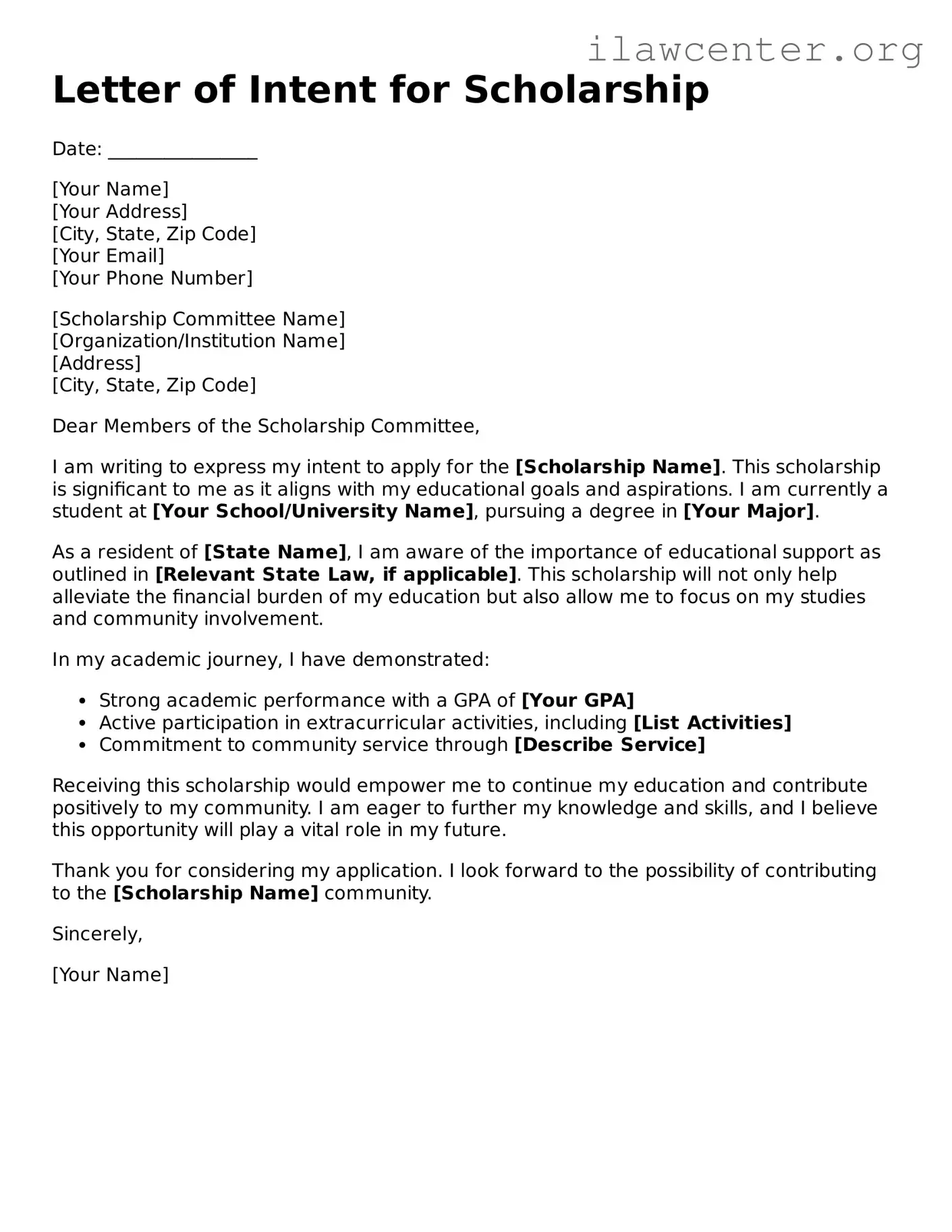
Letter of Intent for Scholarship

Date: ________________

[Your Name]
[Your Address]
[City, State, Zip Code]
[Your Email]
[Your Phone Number]

[Scholarship Committee Name]
[Organization/Institution Name]
[Address]
[City, State, Zip Code]

Dear Members of the Scholarship Committee,

I am writing to express my intent to apply for the [Scholarship Name]. This scholarship is significant to me as it aligns with my educational goals and aspirations. I am currently a student at [Your School/University Name], pursuing a degree in [Your Major].

As a resident of [State Name], I am aware of the importance of educational support as outlined in [Relevant State Law, if applicable]. This scholarship will not only help alleviate the financial burden of my education but also allow me to focus on my studies and community involvement.

In my academic journey, I have demonstrated:

  • Strong academic performance with a GPA of [Your GPA]
  • Active participation in extracurricular activities, including [List Activities]
  • Commitment to community service through [Describe Service]

Receiving this scholarship would empower me to continue my education and contribute positively to my community. I am eager to further my knowledge and skills, and I believe this opportunity will play a vital role in my future.

Thank you for considering my application. I look forward to the possibility of contributing to the [Scholarship Name] community.

Sincerely,

[Your Name]

PDF Form Characteristics

Fact Name Description
Purpose A Letter of Intent for Scholarship expresses a student's interest in receiving a scholarship and outlines their qualifications.
Components Typically includes personal information, academic achievements, extracurricular activities, and future goals.
Submission Students must submit the letter by a specified deadline to be considered for the scholarship.
State-Specific Forms Some states may have specific forms or guidelines that must be followed. Check local scholarship requirements.
Governing Laws Scholarship laws may vary by state. For example, California's scholarship programs are governed by the California Education Code.
Format The letter should be professionally formatted, typically in a standard business letter format.
Review Process Scholarship committees review letters based on content, clarity, and overall presentation.
Follow-Up After submission, students may follow up with the scholarship committee for updates on their application status.

Instructions on Utilizing Letter of Intent For Scholarship

After you have gathered all necessary information and documents, you are ready to fill out the Letter of Intent for Scholarship form. This form is a crucial step in expressing your interest and qualifications for the scholarship. Completing it accurately and thoughtfully can significantly enhance your application.

  1. Begin by entering your full name at the top of the form. Ensure that it matches your official documents.
  2. Provide your current address, including city, state, and zip code. Double-check for any typos.
  3. Include your email address and phone number. This information is vital for communication regarding your application.
  4. Write the name of the scholarship you are applying for. Be specific to avoid any confusion.
  5. Clearly state your educational background. List your current school, major, and any relevant academic achievements.
  6. Describe your career goals and how the scholarship will help you achieve them. Be concise but thorough.
  7. Include any extracurricular activities, volunteer work, or leadership roles you have participated in. Highlight experiences that demonstrate your commitment and skills.
  8. Review the form for completeness. Make sure all sections are filled out and that your answers are clear.
  9. Sign and date the form. Your signature indicates that the information provided is accurate to the best of your knowledge.
  10. Submit the form according to the instructions provided, whether electronically or by mail. Ensure that you meet any deadlines.

Important Facts about Letter of Intent For Scholarship

What is a Letter of Intent for Scholarship?

A Letter of Intent for Scholarship is a document that expresses a student's intention to apply for a specific scholarship. It typically outlines the student's academic achievements, career goals, and reasons for pursuing the scholarship. This letter serves as a way for students to convey their passion and commitment to their chosen field of study, helping scholarship committees understand their motivations and potential contributions to the academic community.

Who should write a Letter of Intent for Scholarship?

Any student seeking financial assistance for their education can write a Letter of Intent for Scholarship. This includes high school seniors, college students, and even graduate students. The letter is particularly important for competitive scholarships where applicants need to stand out among their peers. It’s an opportunity for students to showcase their individuality and dedication to their academic and career aspirations.

What should be included in a Letter of Intent for Scholarship?

When writing a Letter of Intent, students should include several key components. Start with a brief introduction that states your intent to apply for the scholarship. Next, discuss your academic achievements and extracurricular activities that demonstrate your commitment to your field. It’s also important to explain why you are interested in the scholarship and how it will help you achieve your goals. Lastly, conclude with a strong closing statement that reiterates your enthusiasm and gratitude for the opportunity.

How long should a Letter of Intent for Scholarship be?

A Letter of Intent for Scholarship typically ranges from one to two pages. It should be concise yet comprehensive enough to convey your message effectively. Aim for clarity and focus, ensuring that each paragraph serves a purpose. Avoid overly lengthy sentences and stick to the point to keep the reader engaged.

Is a Letter of Intent for Scholarship the same as a personal statement?

While both documents share similarities, they serve different purposes. A Letter of Intent is specifically focused on a particular scholarship and outlines your intent to apply. In contrast, a personal statement is broader and may be required for college admissions or other scholarship applications. Personal statements often delve deeper into your life experiences, values, and long-term goals, while a Letter of Intent is more targeted and succinct.

When should I submit my Letter of Intent for Scholarship?

Students should submit their Letter of Intent well ahead of the scholarship deadline. This allows ample time for the scholarship committee to review your application and consider your intent alongside other materials. Check the scholarship guidelines for specific submission dates and ensure you adhere to them to avoid missing out on the opportunity.

Can I use a template for my Letter of Intent for Scholarship?

While using a template can provide a helpful starting point, it’s crucial to personalize your Letter of Intent. Scholarship committees read numerous letters, and a generic template may not stand out. Tailor your letter to reflect your unique experiences and aspirations. This personal touch can make a significant difference in how your application is perceived.
Common mistakes

Filling out a Letter of Intent for a scholarship can be a critical step in securing financial support for education. However, many applicants make common mistakes that can jeopardize their chances. One prevalent error is failing to follow the instructions carefully. Each scholarship may have specific requirements regarding format, length, and content. Ignoring these guidelines can lead to disqualification, even if the applicant has strong qualifications.

Another frequent mistake is being too vague or generic in the content of the letter. Scholarship committees look for personal stories and unique perspectives. When applicants use boilerplate language or fail to articulate their individual experiences and aspirations, they miss an opportunity to stand out. It is essential to convey passion and purpose clearly.

Additionally, neglecting to proofread the letter can have serious consequences. Spelling and grammatical errors can create an impression of carelessness. A polished letter reflects attention to detail and professionalism. Taking the time to review and edit the letter can make a significant difference in how it is perceived by the selection committee.

Lastly, many applicants underestimate the importance of demonstrating fit with the scholarship’s mission. Each scholarship is typically aligned with specific values or goals. Failing to connect personal objectives with those of the scholarship can result in a lack of alignment. Applicants should take the time to research the scholarship and tailor their letter accordingly, emphasizing how their goals align with the organization’s mission.

Documents used along the form

When applying for a scholarship, a Letter of Intent is often just one part of a larger application package. Various other forms and documents can enhance your application and provide scholarship committees with a more comprehensive view of your qualifications and aspirations. Here’s a list of common documents that may accompany your Letter of Intent for Scholarship.

  • Scholarship Application Form: This is the primary document that outlines your personal information, academic achievements, and extracurricular activities. It serves as the foundation of your application.
  • Personal Statement: A personal statement allows you to express your motivations, goals, and why you deserve the scholarship. It’s your chance to share your story and make a personal connection.
  • Resume or Curriculum Vitae (CV): This document provides a detailed account of your educational background, work experience, and skills. It summarizes your qualifications in a concise format.
  • Transcripts: Official academic transcripts are often required to verify your educational history and achievements. They provide a snapshot of your grades and courses taken.
  • Letters of Recommendation: These letters come from individuals who can speak to your character, achievements, and potential. They add credibility to your application and offer insight from a third-party perspective.
  • Financial Aid Application: Some scholarships require a financial aid application to assess your financial need. This document helps scholarship committees determine how much assistance you may require.
  • Proof of Enrollment or Acceptance: If you are already enrolled or have been accepted into a program, providing proof can strengthen your application by demonstrating your commitment to your education.
  • Portfolio (if applicable): For scholarships in creative fields, a portfolio showcasing your work can be essential. It allows you to present your skills and creativity directly to the scholarship committee.
  • Interview Preparation Materials: If the scholarship process includes an interview, preparing materials such as answers to common questions can help you present yourself effectively.

Including these documents along with your Letter of Intent can provide a well-rounded view of your candidacy. Each piece contributes to the narrative of who you are and what you hope to achieve. Make sure to tailor your application package to reflect your unique strengths and aspirations.

Similar forms

  • Memorandum of Understanding (MOU): This document outlines a mutual agreement between parties. Like a Letter of Intent, it expresses the intention to collaborate but is often less formal and may not create binding obligations.

  • Letter of Interest: A Letter of Interest serves to express a candidate's enthusiasm for a position or opportunity. Similar to a Letter of Intent for Scholarship, it indicates a desire to engage but does not guarantee acceptance or funding.

  • Grant Proposal: A Grant Proposal seeks funding for a specific project. Both documents articulate intentions and objectives, but a grant proposal is typically more detailed regarding the project’s scope and financial needs.

  • Application Form: An Application Form collects necessary information from applicants. While it serves a different purpose, both the application and the Letter of Intent aim to initiate a formal process for scholarship consideration.

  • Statement of Purpose: A Statement of Purpose outlines an individual's goals and motivations for pursuing a specific opportunity. Like the Letter of Intent, it conveys intent and personal aspirations but is often more narrative and reflective in nature.

Dos and Don'ts

When filling out a Letter of Intent for a scholarship, it is important to approach the task thoughtfully. Below are some key points to consider, which can help ensure that your application is both effective and compelling.

Things You Should Do:

  • Read the scholarship guidelines thoroughly to understand the requirements.
  • Begin with a clear introduction that states your purpose for applying.
  • Highlight your academic achievements and relevant experiences.
  • Express your passion for your chosen field of study.
  • Be genuine and personal in your writing; let your personality shine through.

Things You Shouldn't Do:

  • Do not use a generic template; customize your letter for each scholarship.
  • Avoid overly complex language or jargon that may confuse the reader.
  • Do not include irrelevant information that does not support your application.
  • Refrain from making negative comments about previous experiences or institutions.
  • Do not forget to proofread for spelling and grammatical errors.

By following these guidelines, you can create a strong Letter of Intent that effectively communicates your goals and aspirations to the scholarship committee.

Misconceptions

Many people have misunderstandings about the Letter of Intent for Scholarship form. Here are eight common misconceptions:

  1. It is the same as a scholarship application.

    The Letter of Intent is not the same as a scholarship application. It is a separate document that outlines your intentions and goals regarding the scholarship.

  2. It guarantees funding.

    Submitting a Letter of Intent does not guarantee that you will receive funding. It is simply a way to express interest and commitment.

  3. Only high school students need to submit it.

    Students of all education levels, including those in college or graduate programs, may be required to submit a Letter of Intent for certain scholarships.

  4. It should be very formal.

    While professionalism is important, the tone does not need to be overly formal. A sincere and clear expression of your goals is often more effective.

  5. It is not important to proofread.
  6. It can be a generic letter.

    A generic letter may not be effective. Tailoring your Letter of Intent to the specific scholarship can help demonstrate your genuine interest.

  7. It is only about academic achievements.

    While academic achievements are important, the letter should also include personal experiences, goals, and motivations.

  8. There is no need to follow any specific format.

    Following any specific guidelines provided by the scholarship committee is essential. This ensures that your letter meets their expectations.

Key takeaways

When filling out the Letter of Intent for Scholarship form, consider the following key takeaways:

  1. Clearly state your purpose for applying. Explain why you want the scholarship and how it aligns with your educational goals.
  2. Be concise and direct. Use clear language to convey your thoughts without unnecessary details.
  3. Highlight your achievements. Include relevant academic, extracurricular, and community service accomplishments.
  4. Express your future plans. Describe how the scholarship will help you achieve your career aspirations.
  5. Personalize your letter. Tailor your content to reflect the values and mission of the scholarship provider.
  6. Proofread your letter. Check for spelling and grammatical errors to ensure professionalism.
  7. Follow submission guidelines. Adhere to any specific formatting or length requirements set by the scholarship provider.
  8. Include your contact information. Make it easy for the scholarship committee to reach you for follow-up questions.
  9. Submit your letter on time. Ensure you meet all deadlines to avoid disqualification.

By keeping these points in mind, you can create a strong Letter of Intent that effectively communicates your qualifications and intentions.