Fillable Letter of Intent to Hire Document

Fillable Letter of Intent to Hire Document

A Letter of Intent to Hire form is a document that outlines the preliminary agreement between an employer and a potential employee, signaling the employer's intention to hire the individual. This form typically includes key details such as the job title, compensation, and start date, serving as a crucial step in the hiring process. For those ready to take the next step, fill out the form by clicking the button below.

Article Guide

When a company is ready to bring a new employee on board, a Letter of Intent to Hire form plays a crucial role in the hiring process. This document outlines the preliminary agreement between the employer and the prospective employee, setting the stage for a formal employment contract. It typically includes important details such as the job title, salary, benefits, and start date, providing clarity for both parties. Additionally, the letter may address contingencies like background checks or drug screenings, ensuring that all necessary conditions are met before employment officially begins. By using this form, employers can convey their intent to hire while also establishing a mutual understanding of the terms of employment. This not only helps in managing expectations but also serves as a valuable reference point as the hiring process progresses.

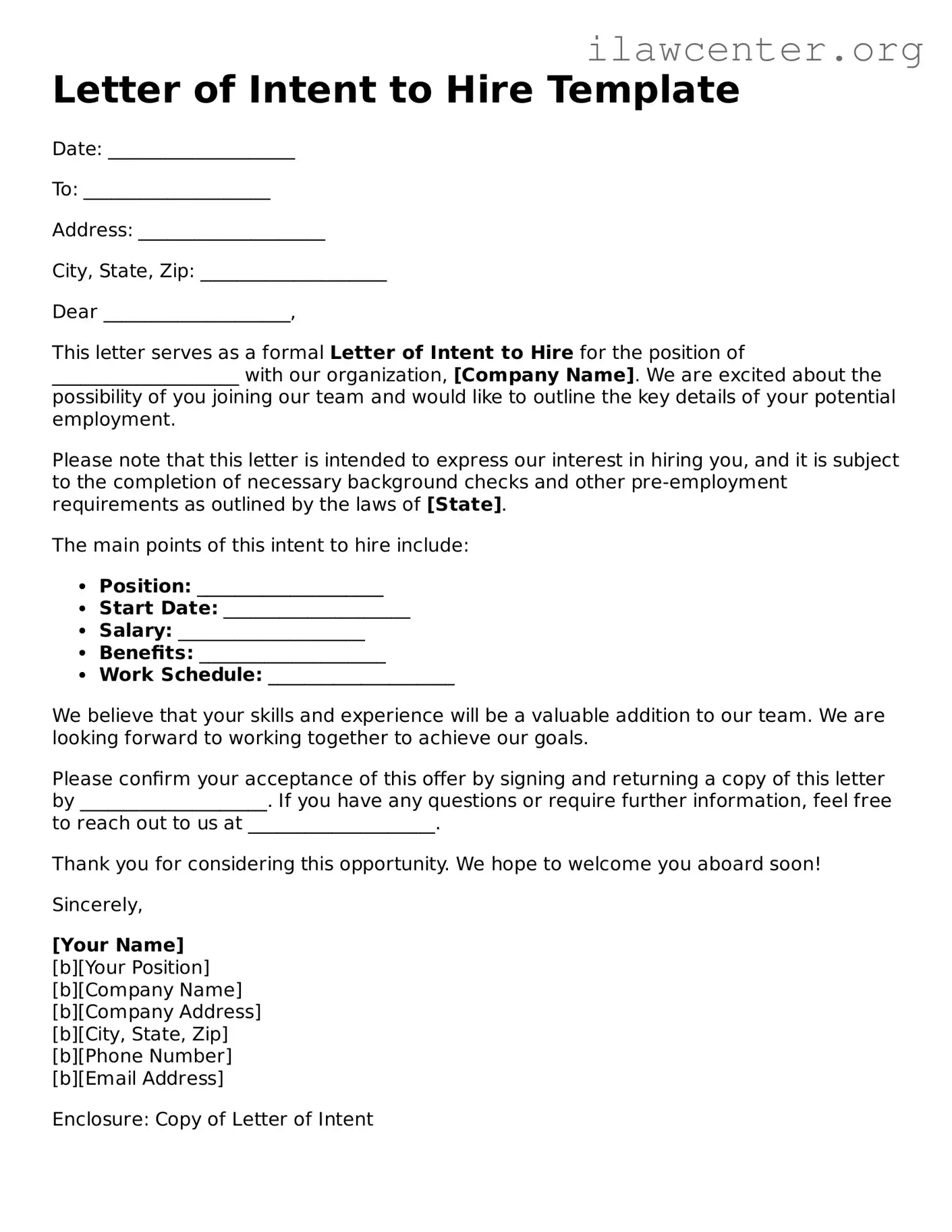
Letter of Intent to Hire Preview

Letter of Intent to Hire Template

Date: ____________________

To: ____________________

Address: ____________________

City, State, Zip: ____________________

Dear ____________________,

This letter serves as a formal Letter of Intent to Hire for the position of ____________________ with our organization, [Company Name]. We are excited about the possibility of you joining our team and would like to outline the key details of your potential employment.

Please note that this letter is intended to express our interest in hiring you, and it is subject to the completion of necessary background checks and other pre-employment requirements as outlined by the laws of [State].

The main points of this intent to hire include:

  • Position: ____________________
  • Start Date: ____________________
  • Salary: ____________________
  • Benefits: ____________________
  • Work Schedule: ____________________

We believe that your skills and experience will be a valuable addition to our team. We are looking forward to working together to achieve our goals.

Please confirm your acceptance of this offer by signing and returning a copy of this letter by ____________________. If you have any questions or require further information, feel free to reach out to us at ____________________.

Thank you for considering this opportunity. We hope to welcome you aboard soon!

Sincerely,

[Your Name]
[b][Your Position]
[b][Company Name]
[b][Company Address]
[b][City, State, Zip]
[b][Phone Number]
[b][Email Address]

Enclosure: Copy of Letter of Intent

PDF Form Characteristics

Fact Name Description
Definition A Letter of Intent to Hire is a document that outlines the preliminary agreement between an employer and a potential employee regarding the terms of employment.
Purpose This document serves to express the employer's intent to hire the candidate and can include key details such as job title, salary, and start date.
Non-Binding Nature Typically, a Letter of Intent is non-binding, meaning that neither party is legally obligated to proceed with the employment unless a formal contract is signed.
State-Specific Forms Some states may have specific requirements or forms for Letters of Intent to Hire, so it's important to check local laws.
Governing Law In California, for example, the governing law for employment agreements is primarily based on the California Labor Code.
Key Components A comprehensive Letter of Intent should include the job title, salary, benefits, and any contingencies such as background checks.
Importance of Clarity Clear and precise language in the document helps prevent misunderstandings and sets the stage for a successful employment relationship.

Instructions on Utilizing Letter of Intent to Hire

After completing the Letter of Intent to Hire form, you will typically submit it to the relevant parties involved in the hiring process. This may include the potential employee and the hiring manager or human resources department. Ensure that all information is accurate and clear to avoid any misunderstandings.

  1. Begin by entering the date at the top of the form.
  2. Fill in the name of the prospective employee in the designated space.
  3. Provide the job title for the position being offered.
  4. Include the name of the company or organization making the offer.
  5. Specify the starting salary or wage for the position.
  6. Indicate the proposed start date for employment.
  7. List any conditions or contingencies that must be met before the hire is finalized.
  8. Sign and date the form to confirm the intent to hire.

Important Facts about Letter of Intent to Hire

What is a Letter of Intent to Hire?

A Letter of Intent to Hire is a document that outlines the preliminary agreement between an employer and a prospective employee. It expresses the employer's intention to offer a job, detailing key terms such as position, salary, and start date. This letter serves as a formal acknowledgment of the hiring process and helps both parties understand the expectations before the official employment contract is signed.

Is a Letter of Intent to Hire legally binding?

Generally, a Letter of Intent to Hire is not legally binding. It is more of a statement of intent rather than a contract. However, some specific terms within the letter could create obligations if both parties agree to them. It's important to read the document carefully and understand that it primarily serves as a starting point for negotiations rather than a final agreement.

What should be included in a Letter of Intent to Hire?

A well-crafted Letter of Intent to Hire should include several key components. These typically encompass the job title, salary, start date, work schedule, and any benefits offered. Additionally, it may outline conditions that need to be met before employment begins, such as background checks or reference verification. Clarity in these areas helps prevent misunderstandings later on.

How do I use a Letter of Intent to Hire?

To use a Letter of Intent to Hire, the employer should draft the document and send it to the prospective employee. Once the candidate reviews the letter, they can sign it to indicate their acceptance of the terms. Both parties should keep a copy for their records. This document can help facilitate a smoother transition to the formal employment contract.

Can a Letter of Intent to Hire be revoked?

Yes, a Letter of Intent to Hire can be revoked by either party before a formal contract is signed. If circumstances change or if either party decides not to proceed, they can communicate their decision to the other party. It’s best to do this as soon as possible to maintain professionalism and clear communication.
Common mistakes

Filling out a Letter of Intent to Hire form can seem straightforward, but many people make common mistakes that can lead to delays or complications in the hiring process. Understanding these pitfalls can help ensure that the form is completed correctly and efficiently.

One frequent mistake is not providing complete information. Candidates may skip sections or leave out important details, thinking that certain information is unnecessary. However, every piece of information requested is typically relevant and helps the employer assess the candidate’s qualifications.

Another common error is failing to follow instructions. Each form may come with specific guidelines on how to fill it out. Ignoring these instructions can result in an incomplete or improperly formatted submission. Taking the time to read and understand the guidelines is essential.

People also often forget to double-check their contact information. Providing incorrect phone numbers or email addresses can lead to missed communications from potential employers. It is crucial to ensure that all contact details are accurate and up to date.

Additionally, many candidates make the mistake of using vague language. When describing their skills and experiences, being clear and specific is important. General statements do not effectively convey a candidate's qualifications and can leave employers with more questions than answers.

Another mistake is neglecting to proofread the form. Typos and grammatical errors can create a negative impression. Taking a moment to review the document for mistakes can significantly enhance its professionalism.

Some individuals also fail to sign and date the form. Omitting a signature can render the document invalid. It’s a simple step, but one that is often overlooked in the rush to submit the form.

Lastly, many candidates do not keep a copy of the submitted form. Having a record of what was submitted can be invaluable for future reference, especially if questions arise later in the hiring process. Keeping a copy ensures that candidates can quickly recall what information they provided.

Documents used along the form

The Letter of Intent to Hire form is an important document in the hiring process, but it is often accompanied by several other forms and documents. Each of these serves a specific purpose and helps streamline the onboarding process for new employees. Below are some commonly used documents that you may encounter alongside the Letter of Intent to Hire.

  • Employment Application: This form collects essential information about the candidate's work history, education, and skills. It serves as a foundational document for assessing qualifications.
  • Background Check Authorization: Candidates must sign this form to allow the employer to conduct background checks. It typically covers criminal history, credit reports, and employment verification.
  • W-4 Form: This IRS form is necessary for tax withholding purposes. New hires must complete it to inform the employer of their tax situation.
  • I-9 Form: Required by the U.S. Citizenship and Immigration Services, this form verifies the identity and employment eligibility of new hires. It must be completed within three days of starting work.
  • Offer Letter: This document formally outlines the terms of employment, including job title, salary, and start date. It serves as a confirmation of the job offer made to the candidate.
  • Employee Handbook Acknowledgment: New hires often sign this document to confirm they have received and understand the company’s policies and procedures as outlined in the employee handbook.

Having these documents in place can facilitate a smoother transition for new employees and ensure compliance with legal requirements. Each form plays a vital role in establishing a clear understanding between the employer and the employee, promoting a positive start to the employment relationship.

Similar forms

The Letter of Intent to Hire form shares similarities with several other documents commonly used in employment and contractual situations. Below is a list of these documents, along with a brief explanation of how they relate to the Letter of Intent to Hire.

  • Employment Contract: This document outlines the terms of employment, including duties, compensation, and duration, similar to how a Letter of Intent to Hire expresses the intent to employ under certain conditions.
  • Job Offer Letter: A job offer letter formally invites a candidate to accept a position, much like a Letter of Intent to Hire indicates a willingness to employ, pending further details.
  • Non-Disclosure Agreement (NDA): An NDA protects confidential information during negotiations, akin to how a Letter of Intent to Hire may include terms that safeguard both parties’ interests before finalizing employment.
  • Memorandum of Understanding (MOU): An MOU outlines mutual agreements between parties, similar to a Letter of Intent to Hire, which can express preliminary agreements regarding employment terms.
  • Offer of Employment: This document specifies the position and terms of employment, paralleling the Letter of Intent to Hire in its purpose of signaling a job offer.
  • Resignation Letter: A resignation letter indicates an employee's intent to leave their current position, reflecting a commitment that can be similar to the intent expressed in a Letter of Intent to Hire.
  • Contract for Services: This document details the terms for providing services, much like a Letter of Intent to Hire outlines the conditions of employment before a formal contract is created.
  • Partnership Agreement: This agreement outlines the terms between partners, similar to how a Letter of Intent to Hire sets the stage for a future employment relationship.
  • Consulting Agreement: A consulting agreement specifies the terms under which services will be provided, akin to how a Letter of Intent to Hire may lay out preliminary terms for employment.

Dos and Don'ts

When filling out a Letter of Intent to Hire form, it's important to approach the task thoughtfully. Here’s a list of things you should and shouldn't do to ensure clarity and compliance.

  • Do read the instructions carefully before starting.
  • Do provide accurate information about the position and the candidate.
  • Do include your contact information for follow-up questions.
  • Do double-check for any spelling or grammatical errors.
  • Don't leave any required fields blank.
  • Don't use vague language or jargon that may confuse the reader.
  • Don't submit the form without a thorough review.
  • Don't forget to sign and date the document where required.

By following these guidelines, you can help ensure that your Letter of Intent to Hire is clear, professional, and effective.

Misconceptions

Here are nine common misconceptions about the Letter of Intent to Hire form, along with explanations to clarify each point.

  1. It is a legally binding contract. Many people believe that a Letter of Intent to Hire is a formal contract. In reality, it is often a preliminary document that outlines the intent to hire, but it does not create binding obligations.
  2. It guarantees employment. Some individuals think that signing this letter guarantees they will be hired. However, the letter merely expresses an intention, and employment is not guaranteed until a formal employment contract is signed.
  3. It must be signed by both parties. While it is common for both the employer and potential employee to sign, it is not a strict requirement. In some cases, a letter may be considered valid even if only one party signs.
  4. It includes specific job details. Many assume that the Letter of Intent will detail the job position, salary, and other specifics. Typically, it provides a general overview, leaving the finer details to be discussed later.
  5. It can be used for any type of employment. Some believe this form is suitable for all employment situations. However, it is primarily used for formal job offers and may not be appropriate for temporary or freelance positions.
  6. It is the same as an offer letter. The Letter of Intent to Hire is often confused with an offer letter. An offer letter is more formal and includes specific terms of employment, while the Letter of Intent is more about the intention to hire.
  7. It is only for full-time positions. Some think this letter is only applicable to full-time jobs. In fact, it can be used for part-time or contract positions as well.
  8. It is unnecessary in the hiring process. Some people view the Letter of Intent as an unnecessary step. However, it can serve as a useful tool for clarifying intentions and setting the stage for further discussions.
  9. It can be easily ignored. A misconception exists that the Letter of Intent can be disregarded without consequences. In some cases, ignoring it may lead to misunderstandings or complications later in the hiring process.

Key takeaways

Filling out and using the Letter of Intent to Hire form is an important step in the hiring process. The following key takeaways can assist in understanding its purpose and proper use:

  • The form serves as a preliminary agreement between the employer and the prospective employee.
  • It outlines the terms of employment, including position, salary, and start date.
  • Completing the form accurately helps to avoid misunderstandings later in the hiring process.
  • Both parties should review the details carefully before signing to ensure mutual agreement.
  • It is advisable to keep a copy of the signed form for future reference.
  • The Letter of Intent to Hire is not a legally binding contract but indicates a commitment to proceed with the hiring.
  • Employers may use this form to formally communicate their intent to hire, which can enhance the candidate's experience.
  • Timely completion and submission of the form can expedite the onboarding process for the new hire.