Fillable Letter of Intent to Marry Document

Fillable Letter of Intent to Marry Document

A Letter of Intent to Marry is a document that expresses a couple's intention to enter into marriage. This form can serve as a formal declaration of commitment and may be useful in various legal contexts. If you're ready to take this important step, consider filling out the form by clicking the button below.

Article Guide

The Letter of Intent to Marry form serves as a significant document for couples contemplating marriage, encapsulating their mutual commitment and intentions. This form typically outlines essential details such as the names of both parties, their addresses, and the intended date of marriage. By signing the document, individuals express their readiness to enter into a marital relationship, which can be particularly useful in various legal contexts, such as immigration or prenuptial agreements. Additionally, the form may include provisions regarding the couple's plans for future financial responsibilities and shared assets, thereby establishing a foundation for their partnership. While not legally binding in the same way as a marriage certificate, this letter can symbolize a serious commitment and serve as a reference point for both individuals as they navigate the complexities of their upcoming union. Understanding the nuances of this form can help couples clarify their intentions and expectations, fostering open communication as they embark on this important life journey.

Letter of Intent to Marry Preview

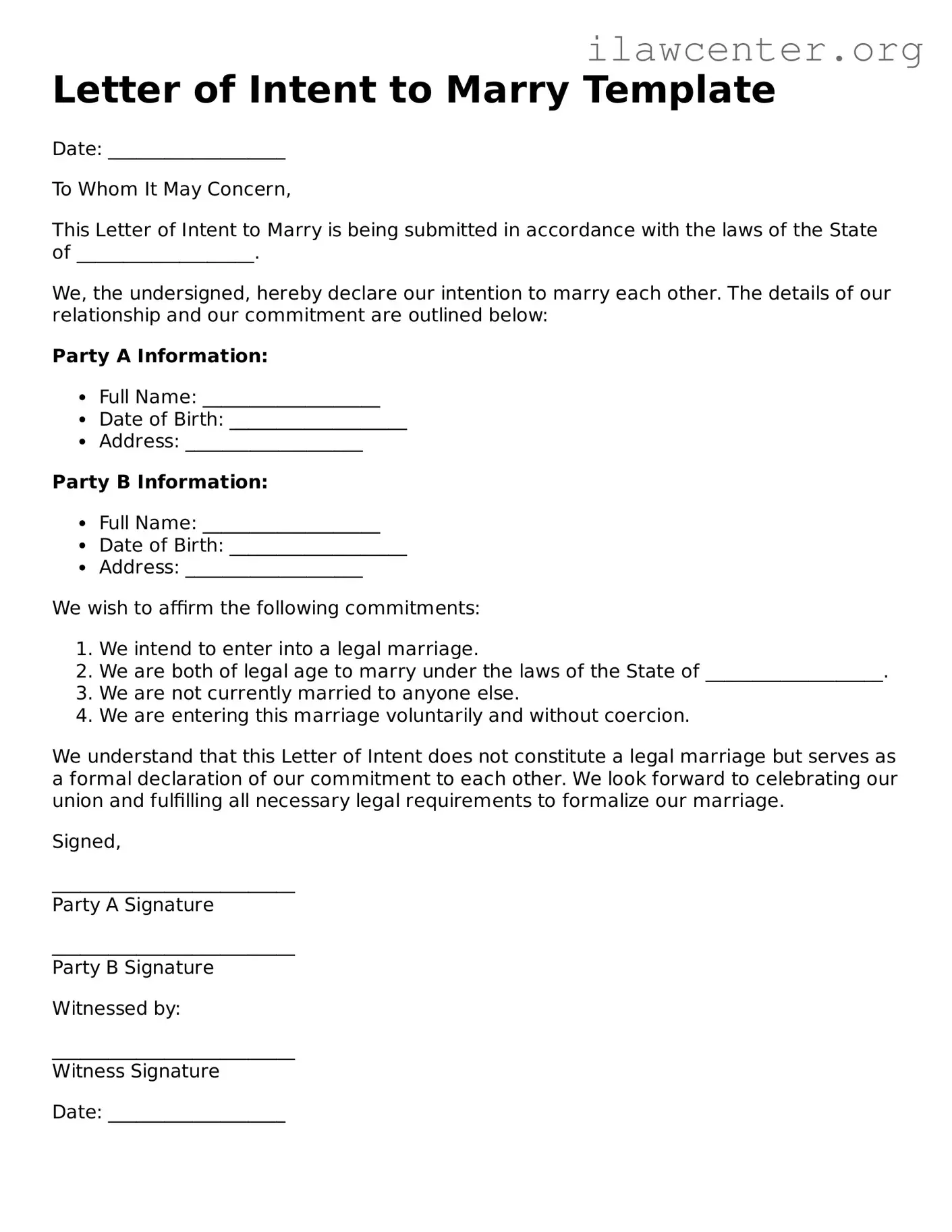
Letter of Intent to Marry Template

Date: ___________________

To Whom It May Concern,

This Letter of Intent to Marry is being submitted in accordance with the laws of the State of ___________________.

We, the undersigned, hereby declare our intention to marry each other. The details of our relationship and our commitment are outlined below:

Party A Information:

  • Full Name: ___________________
  • Date of Birth: ___________________
  • Address: ___________________

Party B Information:

  • Full Name: ___________________
  • Date of Birth: ___________________
  • Address: ___________________

We wish to affirm the following commitments:

  1. We intend to enter into a legal marriage.
  2. We are both of legal age to marry under the laws of the State of ___________________.
  3. We are not currently married to anyone else.
  4. We are entering this marriage voluntarily and without coercion.

We understand that this Letter of Intent does not constitute a legal marriage but serves as a formal declaration of our commitment to each other. We look forward to celebrating our union and fulfilling all necessary legal requirements to formalize our marriage.

Signed,

__________________________
Party A Signature

__________________________
Party B Signature

Witnessed by:

__________________________
Witness Signature

Date: ___________________

PDF Form Characteristics

Fact Name Description
Purpose A Letter of Intent to Marry outlines the intentions of two individuals to enter into marriage. It may serve as a preliminary agreement before a formal marriage contract is established.
State-Specific Forms Different states may have specific forms or requirements. For example, in California, the Family Code governs marriage intentions, while in New York, the Domestic Relations Law applies.
Legal Standing This document does not create a legally binding contract but expresses the parties' commitment to marry in the future.
Usage Couples may use this form in various situations, such as when planning a wedding or applying for a marriage license, to show their intent to marry.

Instructions on Utilizing Letter of Intent to Marry

Once you have the Letter of Intent to Marry form in hand, you will need to provide specific information to ensure it is completed correctly. After filling out the form, you may need to submit it to the appropriate authorities as part of the marriage process. Follow these steps carefully to ensure accuracy.

  1. Begin by writing the full names of both parties at the top of the form.
  2. Next, include the date of birth for each person. Ensure the information is accurate.
  3. Provide the current addresses for both parties. This should include street address, city, state, and zip code.
  4. Indicate the date you intend to marry. Be clear and precise with this date.
  5. Fill in any additional required information, such as previous marital status, if applicable.
  6. Both parties should sign the form in the designated areas. Signatures should be dated as well.
  7. Review the form for any errors or omissions before submitting it.

Important Facts about Letter of Intent to Marry

What is a Letter of Intent to Marry?

A Letter of Intent to Marry is a document that expresses the mutual intention of two individuals to enter into marriage. It serves as a formal declaration of commitment and can be used to outline plans for the future, including any specific arrangements or agreements the couple wishes to make prior to marriage. While it is not a legally binding contract, it can help clarify the couple's intentions and strengthen their relationship.

Is a Letter of Intent to Marry legally binding?

No, a Letter of Intent to Marry is not legally binding. It is primarily a personal statement that reflects the couple's desire to marry. The document does not create any legal obligations or rights. However, it can be a useful tool for couples to communicate their intentions and expectations before entering into a marriage.

Do I need a lawyer to create a Letter of Intent to Marry?

Typically, you do not need a lawyer to create a Letter of Intent to Marry. The document can be drafted by the couple themselves, using simple language to express their feelings and intentions. However, if you have specific concerns or wish to include legal language, consulting with a lawyer may be beneficial. They can provide guidance on what to include and ensure that the document meets your needs.

Can a Letter of Intent to Marry be used in place of a marriage license?

No, a Letter of Intent to Marry cannot be used in place of a marriage license. A marriage license is a legal document issued by the state that allows a couple to marry. The Letter of Intent to Marry is simply a declaration of intent and does not fulfill the legal requirements necessary for marriage. Couples must still obtain a marriage license from their local government to legally wed.

Common mistakes

Filling out the Letter of Intent to Marry form is a significant step for couples planning to wed. However, many individuals make common mistakes that can lead to complications. Understanding these errors can help ensure a smoother process.

One frequent mistake is providing incomplete information. Couples often overlook sections that require details such as full names, dates of birth, or addresses. Missing this information can delay the processing of the form or lead to unnecessary complications.

Another common error involves incorrect signatures. Both parties must sign the form, and it is essential that the signatures match the names provided. If one signature does not align with the name on the form, it may raise questions and require clarification.

People sometimes fail to check the requirements specific to their state. Each state may have different regulations regarding the Letter of Intent to Marry. Not being aware of these can result in submitting a form that does not meet local criteria.

Additionally, couples may neglect to double-check for typographical errors. Simple mistakes, such as misspellings of names or incorrect dates, can create issues. Such errors may lead to misunderstandings or complications in legal matters down the line.

Some individuals also forget to include necessary identification documents. Many jurisdictions require proof of identity, such as a driver's license or passport, to accompany the form. Failing to provide these documents can result in the form being rejected.

Lastly, individuals often misinterpret the purpose of the form. The Letter of Intent to Marry is not a marriage license. Confusing the two can lead to misconceptions about what steps need to be taken next. Understanding the distinction is crucial for proper planning.

Documents used along the form

When preparing for marriage, couples often complete a variety of documents to ensure a smooth transition into their new life together. Among these, the Letter of Intent to Marry is a crucial form that signifies the couple's commitment to one another. However, it is just one piece of the puzzle. Below is a list of other forms and documents that are commonly used alongside the Letter of Intent to Marry.

  • Marriage License Application: This is a formal request submitted to the local government to obtain a marriage license. It typically requires personal information about both parties and may involve a fee.
  • Pre-Marital Counseling Certificate: Some states encourage or require couples to undergo pre-marital counseling. A certificate may be issued upon completion, demonstrating that the couple has participated in discussions about important topics such as finances, communication, and family planning.
  • Affidavit of Eligibility to Marry: This document affirms that both individuals are legally eligible to marry. It may be necessary for those who have been previously married to provide proof of divorce or annulment.
  • Prenuptial Agreement: A prenuptial agreement outlines how assets and debts will be handled in the event of a divorce. While not mandatory, it can help clarify financial expectations and protect individual interests.
  • Name Change Petition: If one or both parties plan to change their last name after marriage, a name change petition may be required. This legal document initiates the process for altering one's name officially.
  • Witness Statements: Some jurisdictions require witnesses to sign documents affirming the marriage. These statements may serve as evidence that the marriage took place and can be important for legal purposes.
  • Marriage Certificate: After the wedding, couples should obtain a marriage certificate from the local government. This official document serves as proof of marriage and may be needed for various legal and financial matters.

Completing these documents alongside the Letter of Intent to Marry can help ensure that couples are well-prepared for their upcoming marriage. Each form plays a unique role in the process, contributing to a solid foundation for a successful partnership.

Similar forms

  • Marriage License Application: This document is submitted to the local government to obtain permission to marry. It includes personal information about both parties and may require identification and fees.
  • Pre-Nuptial Agreement: A contract made before marriage that outlines the division of assets and responsibilities in case of divorce. It protects individual property rights and can clarify financial expectations.
  • Affidavit of Marriage: A sworn statement confirming the validity of a marriage. This document may be required for legal purposes, such as immigration or insurance claims.
  • Marriage Certificate: An official document issued after a marriage ceremony, proving that the marriage took place. It is often needed for legal matters and name changes.
  • Separation Agreement: A document that outlines the terms of a couple's separation, including asset division and child custody. It is similar in that it addresses relationship expectations but occurs after marriage.
  • Domestic Partnership Agreement: This agreement is for couples who choose not to marry but want to establish legal recognition of their relationship. It covers similar issues of rights and responsibilities.
  • Consent to Marry: A document that requires parental or guardian approval for individuals under a certain age to marry. It emphasizes the importance of mutual agreement in a marriage.
  • Power of Attorney: While not exclusively for marriage, this document allows one partner to make decisions on behalf of the other in legal or financial matters. It reflects trust and shared responsibility.
  • Will: A legal document outlining how an individual's assets will be distributed upon death. Like the Letter of Intent to Marry, it deals with future intentions and responsibilities towards loved ones.

Dos and Don'ts

When filling out the Letter of Intent to Marry form, it is important to approach the task with care. Here are some guidelines to consider:

  • Do read the instructions carefully before starting the form.
  • Do ensure that all personal information is accurate and up-to-date.
  • Do sign and date the form where required.
  • Don't leave any sections blank unless instructed to do so.
  • Don't use nicknames; always use your legal names as they appear on official documents.
  • Don't submit the form without double-checking for errors.

Following these steps can help ensure that your Letter of Intent to Marry is processed smoothly and without complications.

Misconceptions

The Letter of Intent to Marry form often comes with a variety of misconceptions. Understanding these can help couples navigate their relationship and future plans more effectively. Here are five common misconceptions:

  • It is a legally binding contract. Many people believe that a Letter of Intent to Marry is a legally enforceable document. In reality, it is primarily a declaration of commitment and intention, rather than a legally binding agreement.
  • It guarantees a marriage. Some individuals think that submitting this letter guarantees that a marriage will take place. However, it simply expresses the intent to marry and does not obligate either party to follow through.
  • It is only necessary for couples planning a big wedding. Others assume that only those planning elaborate ceremonies need to file this form. In truth, it can be beneficial for couples of all types, regardless of their wedding plans.
  • It is required by law. A common belief is that this letter is a legal requirement before getting married. This is not true; it is optional and varies by state and personal preference.
  • It covers all aspects of a marriage. Some think that the Letter of Intent to Marry addresses all legal matters related to marriage. In fact, it does not cover issues like property division or spousal support, which are typically addressed in prenuptial agreements.

By clearing up these misconceptions, couples can approach their future with a clearer understanding of what the Letter of Intent to Marry truly represents.

Key takeaways

When considering the Letter of Intent to Marry form, it is essential to understand its purpose and implications. Here are some key takeaways to keep in mind:

  1. Understand the Purpose: This form serves as a formal declaration of your intention to marry, signaling commitment to your partner.
  2. Check State Requirements: Different states may have specific regulations regarding this form. Always verify what is required in your jurisdiction.
  3. Gather Necessary Information: Before filling out the form, collect all relevant details such as full names, addresses, and dates of birth for both parties.
  4. Be Accurate: Ensure that all information is correct. Mistakes can lead to delays or complications in the marriage process.
  5. Signatures Matter: Both parties must sign the form. This signifies mutual agreement and intent to marry.
  6. Consider Notarization: While not always required, having the document notarized can add an extra layer of authenticity.
  7. Keep Copies: After submission, retain copies of the completed form for your records. This can be useful for future reference.
  8. Understand the Next Steps: After submitting the form, familiarize yourself with the subsequent steps in the marriage process, such as obtaining a marriage license.
  9. Consult a Professional: If you have any doubts or questions, consider seeking advice from a legal professional to ensure you understand your rights and responsibilities.

By keeping these points in mind, you can navigate the process of filling out and using the Letter of Intent to Marry form with confidence.