Fillable Letter of Intent to Purchase Business Document

Fillable Letter of Intent to Purchase Business Document

A Letter of Intent to Purchase Business is a preliminary document that outlines the terms and conditions under which a buyer expresses interest in acquiring a business. This form serves as a foundation for negotiations and helps clarify the intentions of both parties involved. To get started on your journey toward purchasing a business, fill out the form by clicking the button below.

Article Guide

When embarking on the journey of acquiring a business, clarity and mutual understanding between the buyer and seller are paramount. The Letter of Intent to Purchase Business serves as a vital tool in this process, outlining the essential terms and conditions that both parties agree upon before entering into a formal purchase agreement. This document typically includes key elements such as the purchase price, payment structure, and a timeline for due diligence. Additionally, it may address contingencies, such as financing approvals or regulatory requirements, which must be met before the transaction can be finalized. By laying out these foundational aspects, the Letter of Intent not only helps to establish a framework for negotiation but also fosters trust and transparency between the involved parties. Ultimately, this form acts as a bridge, guiding both the buyer and seller toward a successful and amicable business transaction.

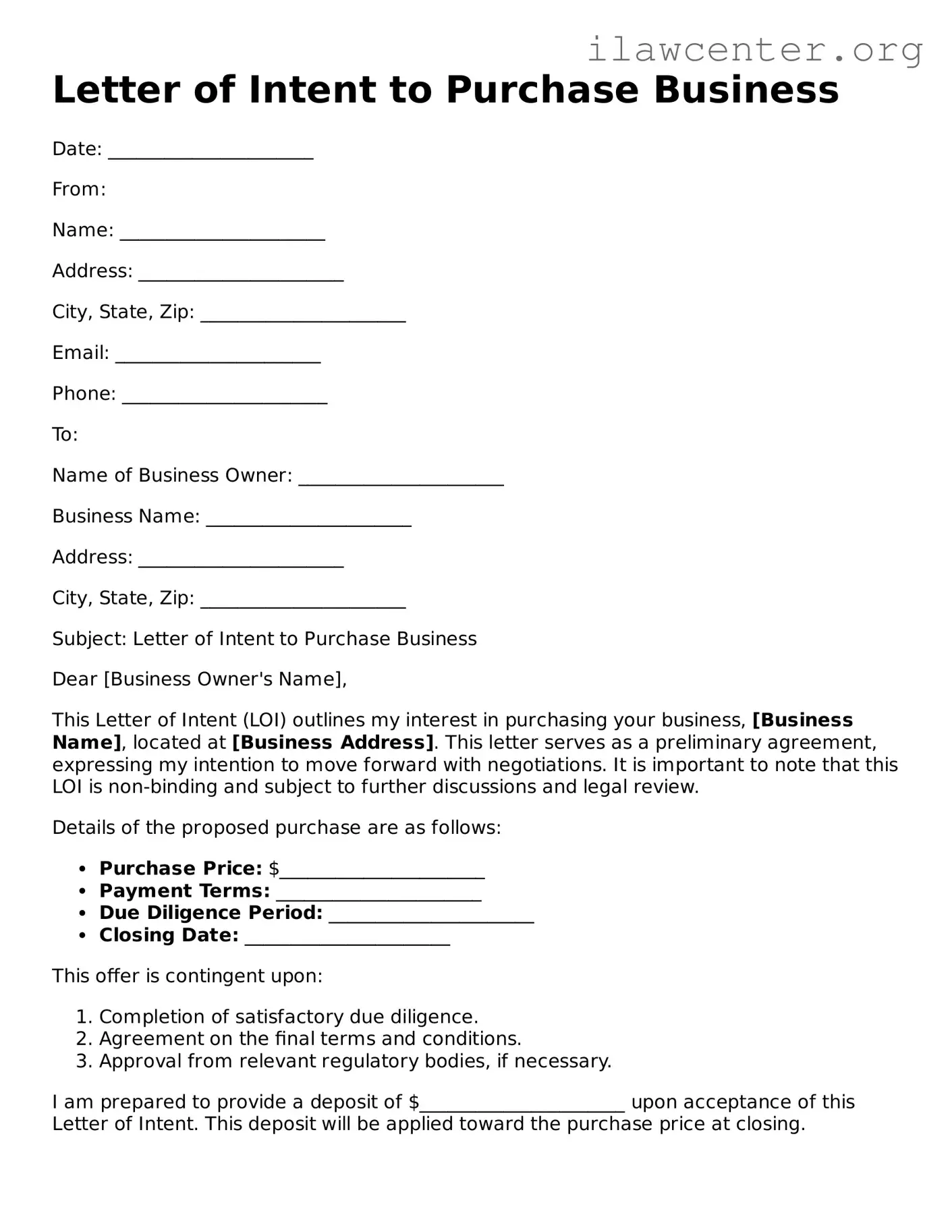
Letter of Intent to Purchase Business Preview

Letter of Intent to Purchase Business

Date: ______________________

From:

Name: ______________________

Address: ______________________

City, State, Zip: ______________________

Email: ______________________

Phone: ______________________

To:

Name of Business Owner: ______________________

Business Name: ______________________

Address: ______________________

City, State, Zip: ______________________

Subject: Letter of Intent to Purchase Business

Dear [Business Owner's Name],

This Letter of Intent (LOI) outlines my interest in purchasing your business, [Business Name], located at [Business Address]. This letter serves as a preliminary agreement, expressing my intention to move forward with negotiations. It is important to note that this LOI is non-binding and subject to further discussions and legal review.

Details of the proposed purchase are as follows:

  • Purchase Price: $______________________
  • Payment Terms: ______________________
  • Due Diligence Period: ______________________
  • Closing Date: ______________________

This offer is contingent upon:

  1. Completion of satisfactory due diligence.
  2. Agreement on the final terms and conditions.
  3. Approval from relevant regulatory bodies, if necessary.

I am prepared to provide a deposit of $______________________ upon acceptance of this Letter of Intent. This deposit will be applied toward the purchase price at closing.

In accordance with the laws of [State], I request that we enter into a more detailed purchase agreement following the acceptance of this Letter of Intent. I look forward to discussing this opportunity further and hope to reach a mutually beneficial agreement.

Please sign below to indicate your acceptance of this Letter of Intent:

______________________________
[Business Owner's Name]
Date: ______________________

Thank you for considering my proposal. I look forward to your prompt response.

Sincerely,

______________________________
[Your Name]
Date: ______________________
PDF Form Characteristics

Fact Name Description
Purpose A Letter of Intent (LOI) outlines the preliminary agreement between a buyer and seller regarding the purchase of a business. It serves as a foundation for further negotiations and formal agreements.
Non-Binding Nature Typically, an LOI is non-binding, meaning that it does not legally obligate either party to complete the transaction. However, certain provisions within the LOI may be binding, such as confidentiality agreements.
Key Components An effective LOI usually includes essential elements like the purchase price, payment terms, and a timeline for due diligence. These components help clarify expectations for both parties.
State-Specific Forms Different states may have specific requirements for LOIs. For example, California law may influence how an LOI is structured and enforced, while New York may have its own set of regulations.
Importance of Legal Review Before finalizing an LOI, it is advisable for both parties to seek legal counsel. A thorough review can ensure that the document accurately reflects their intentions and complies with applicable laws.

Instructions on Utilizing Letter of Intent to Purchase Business

After obtaining the Letter of Intent to Purchase Business form, you will need to provide specific information to express your interest in purchasing a business. Follow the steps below to complete the form accurately.

  1. Begin by entering your name and contact information at the top of the form.
  2. Next, fill in the name of the business you intend to purchase.
  3. Provide the address of the business, including the city, state, and zip code.
  4. Indicate the proposed purchase price for the business.
  5. Outline any terms or conditions you wish to include in the agreement.
  6. Sign and date the form at the bottom to validate your intent.

Once you have completed the form, review it for any errors or missing information before submitting it to the appropriate party.

Important Facts about Letter of Intent to Purchase Business

What is a Letter of Intent to Purchase Business?

A Letter of Intent (LOI) to Purchase Business is a document that outlines the preliminary agreement between a buyer and a seller regarding the sale of a business. It expresses the buyer's intention to purchase and provides a framework for negotiating the final terms of the sale. While it is not legally binding, it sets the stage for further discussions and due diligence.

Why is a Letter of Intent important?

This document serves several purposes. First, it clarifies the buyer's intentions and the seller's expectations. It can help both parties avoid misunderstandings as they move forward. Additionally, it often includes key terms such as purchase price, payment structure, and timelines, which can streamline negotiations and ensure that both sides are on the same page.

Is a Letter of Intent legally binding?

Generally, a Letter of Intent is not legally binding, except for certain provisions like confidentiality or exclusivity clauses. The main goal of the LOI is to outline the basic terms and conditions of the proposed sale, allowing both parties to agree on essential points before drafting a formal purchase agreement. However, it’s important to consult with a legal professional to understand which parts might carry legal weight.

What should be included in a Letter of Intent?

A comprehensive LOI typically includes the purchase price, payment terms, a description of the business being sold, and any contingencies that need to be met before the sale can proceed. Additionally, it may outline timelines for due diligence and closing, as well as any conditions related to financing or regulatory approvals. Including these details helps provide clarity and direction for both parties.

How does a Letter of Intent affect negotiations?

The LOI can significantly influence negotiations by establishing a mutual understanding of the key terms before entering into a formal agreement. It can serve as a roadmap for discussions and help both parties focus on critical issues. Additionally, having a well-drafted LOI can demonstrate to the seller that the buyer is serious and committed, which can strengthen the buyer's negotiating position.

Can a Letter of Intent be modified after it is signed?

Yes, a Letter of Intent can be modified after it is signed, provided both parties agree to the changes. It’s not uncommon for negotiations to evolve as new information comes to light or as circumstances change. Any modifications should be documented in writing to ensure clarity and to avoid potential disputes down the road.

Common mistakes

Filling out a Letter of Intent to Purchase Business form can be a critical step in the acquisition process. However, many individuals make mistakes that can lead to misunderstandings or complications later on. One common mistake is failing to include essential details about the business being purchased. This includes information such as the business name, address, and specific assets involved in the transaction. Omitting these details can create confusion and hinder the negotiation process.

Another frequent error is not clearly outlining the terms of the offer. Buyers should specify the proposed purchase price and any contingencies that may apply. Without these specifics, the seller may have difficulty assessing the seriousness of the offer. Furthermore, vague terms can lead to disputes down the line, as both parties may have different interpretations of the agreement.

People often overlook the importance of including a timeline for the transaction. A well-defined timeline helps both parties manage expectations and keeps the process on track. Without a timeline, delays can occur, leading to frustration and potential loss of interest from either party. It is advisable to outline key milestones, such as due diligence periods and closing dates.

Lastly, many individuals neglect to consult with professionals before submitting the form. Engaging with legal and financial advisors can provide valuable insights and help avoid costly mistakes. Their expertise can ensure that the letter accurately reflects the intentions of both parties and adheres to any relevant regulations. Involving professionals can ultimately lead to a smoother transaction and greater satisfaction for all involved.

Documents used along the form

A Letter of Intent to Purchase Business is an important document that outlines the preliminary understanding between a buyer and a seller regarding the sale of a business. However, this letter is often accompanied by several other documents that help clarify the terms and conditions of the transaction. Below is a list of commonly used forms and documents that may accompany the Letter of Intent.

  • Confidentiality Agreement: This document ensures that both parties agree to keep sensitive information private. It protects the seller's business secrets and financial details from being disclosed to third parties during negotiations.
  • Due Diligence Checklist: This is a comprehensive list of items that the buyer needs to review before finalizing the purchase. It typically includes financial records, legal documents, and operational information to ensure the buyer is fully informed about the business.
  • Purchase Agreement: Once negotiations are complete, this formal contract outlines the final terms of the sale. It includes details such as the purchase price, payment terms, and any contingencies that must be met before the sale is finalized.
  • Financial Statements: These documents provide a snapshot of the business's financial health. They typically include balance sheets, income statements, and cash flow statements, helping the buyer assess the value and profitability of the business.

Understanding these accompanying documents is crucial for both buyers and sellers. Each document plays a vital role in ensuring a smooth transaction and protecting the interests of all parties involved. Being well-prepared can lead to a successful business acquisition process.

Similar forms

  • Memorandum of Understanding (MOU): Similar to a Letter of Intent, an MOU outlines the intentions of parties to work together. It typically details the terms of a potential agreement but is generally non-binding.
  • Purchase Agreement: This document serves as a formal contract for the sale of a business. Unlike a Letter of Intent, it is legally binding and includes specific terms, conditions, and obligations of both parties.
  • Term Sheet: A term sheet summarizes the key terms and conditions of a proposed transaction. It provides a framework for negotiations and is often used before drafting a more detailed agreement.
  • Confidentiality Agreement (NDA): This document ensures that sensitive information shared during negotiations remains confidential. While the Letter of Intent may include confidentiality provisions, an NDA is a standalone agreement focused solely on protecting information.
  • Business Plan: A business plan outlines the strategy, goals, and financial projections for a business. While a Letter of Intent expresses intent to purchase, a business plan provides a comprehensive overview of the business's operations and potential.
  • Due Diligence Checklist: This document lists the information and documents needed to evaluate a business before completing a transaction. It complements the Letter of Intent by guiding the buyer's investigation into the business's operations and financial health.

Dos and Don'ts

When filling out a Letter of Intent to Purchase a Business, careful attention to detail is essential. Here are some key dos and don'ts to consider:

  • Do clearly state your intention to purchase the business.
  • Do include your contact information for follow-up.
  • Do outline the proposed purchase price and payment terms.
  • Do specify any contingencies that may affect the sale.
  • Do express your interest in conducting due diligence.
  • Don't use vague language that could lead to misunderstandings.
  • Don't forget to include a timeline for the transaction.
  • Don't make promises you cannot keep regarding the purchase.
  • Don't overlook the importance of a professional tone.
  • Don't submit the letter without proofreading for errors.

Misconceptions

Understanding the Letter of Intent to Purchase Business form is essential for anyone involved in a business transaction. However, several misconceptions can cloud the perception of this important document. Below are five common misconceptions, along with explanations to clarify them.

  1. A Letter of Intent is a legally binding contract.

    Many people believe that a Letter of Intent (LOI) is a binding contract. In reality, while some provisions in an LOI can be enforceable, the document itself is typically intended to outline preliminary agreements and intentions rather than serve as a legally binding contract for the entire transaction.

  2. All terms must be finalized in the Letter of Intent.

    Another misconception is that all terms of the sale must be fully negotiated and finalized in the LOI. In fact, the purpose of the LOI is to provide a framework for negotiations, allowing for flexibility and adjustments as the parties move toward a final agreement.

  3. The Letter of Intent is only for large transactions.

    Some individuals think that LOIs are only necessary for large business transactions. However, they can be beneficial in transactions of any size, as they help clarify the intentions of both parties and set the stage for further negotiations.

  4. A Letter of Intent guarantees the sale will go through.

    It is a common belief that signing an LOI guarantees that the sale will be completed. However, an LOI is merely a starting point for negotiations. The final sale is contingent upon due diligence, financing, and other factors that can still change.

  5. The Letter of Intent does not require legal review.

    Many assume that an LOI is simple enough to forgo legal review. This is a mistake. Having legal counsel review the LOI can help ensure that the document accurately reflects the intentions of both parties and protects their interests.

By addressing these misconceptions, individuals can better navigate the complexities of business transactions and utilize the Letter of Intent to its fullest potential.

Key takeaways

When filling out and using the Letter of Intent to Purchase Business form, there are several important points to keep in mind. Understanding these key takeaways can help ensure that the process goes smoothly.

  • Clarity is essential. Clearly outline the terms of the proposed purchase, including the price and any conditions. This helps prevent misunderstandings later on.
  • Include essential details. Make sure to include information about the business being purchased, such as its name, location, and any assets involved in the sale.
  • Consider confidentiality. If sensitive information is involved, consider including a confidentiality clause to protect both parties' interests.
  • Consult professionals. It is often beneficial to seek advice from legal or financial professionals to ensure that the letter meets all necessary requirements.
  • Use it as a negotiation tool. The letter serves not only as an expression of interest but also as a basis for negotiation. Be prepared for discussions and potential adjustments.

By keeping these key points in mind, individuals can navigate the process of purchasing a business more effectively and with greater confidence.