Fillable Livestock Bill of Sale Document

Fillable Livestock Bill of Sale Document

A Livestock Bill of Sale form is a legal document that records the sale and transfer of ownership of livestock between a seller and a buyer. This form provides essential details about the animals being sold, including their description and sale price, ensuring both parties have a clear understanding of the transaction. To get started on your own livestock sale, fill out the form by clicking the button below.

Article Guide

The Livestock Bill of Sale form serves as a crucial document in the transfer of ownership for livestock, ensuring that both buyers and sellers are protected during the transaction. This form typically includes essential details such as the names and contact information of the parties involved, a description of the livestock being sold—including breed, age, and any identifying marks—and the agreed-upon sale price. Additionally, it often outlines any warranties or guarantees regarding the health and condition of the animals, which can be vital for the buyer's peace of mind. The form may also specify the terms of payment and any conditions related to the transfer of ownership, such as delivery arrangements. By clearly documenting these aspects, the Livestock Bill of Sale helps to prevent disputes and misunderstandings, creating a transparent and trustworthy environment for all parties involved in the sale of livestock.

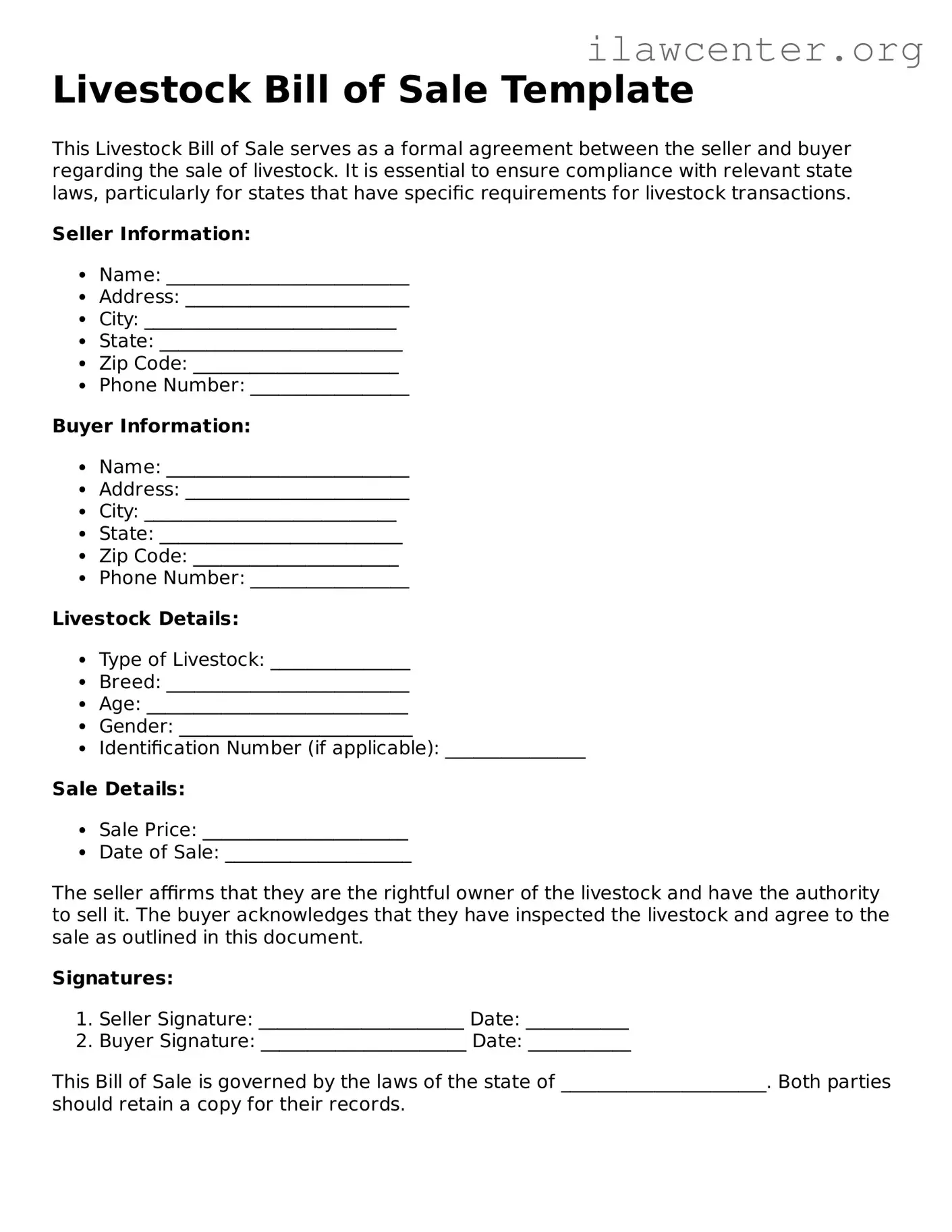
Livestock Bill of Sale Preview

Livestock Bill of Sale Template

This Livestock Bill of Sale serves as a formal agreement between the seller and buyer regarding the sale of livestock. It is essential to ensure compliance with relevant state laws, particularly for states that have specific requirements for livestock transactions.

Seller Information:

  • Name: __________________________
  • Address: ________________________
  • City: ___________________________
  • State: __________________________
  • Zip Code: ______________________
  • Phone Number: _________________

Buyer Information:

  • Name: __________________________
  • Address: ________________________
  • City: ___________________________
  • State: __________________________
  • Zip Code: ______________________
  • Phone Number: _________________

Livestock Details:

  • Type of Livestock: _______________
  • Breed: __________________________
  • Age: ____________________________
  • Gender: _________________________
  • Identification Number (if applicable): _______________

Sale Details:

  • Sale Price: ______________________
  • Date of Sale: ____________________

The seller affirms that they are the rightful owner of the livestock and have the authority to sell it. The buyer acknowledges that they have inspected the livestock and agree to the sale as outlined in this document.

Signatures:

  1. Seller Signature: ______________________ Date: ___________
  2. Buyer Signature: ______________________ Date: ___________

This Bill of Sale is governed by the laws of the state of ______________________. Both parties should retain a copy for their records.

PDF Form Characteristics

Fact Name Description
Definition A Livestock Bill of Sale is a legal document used to transfer ownership of livestock from one party to another.
Purpose This document serves as proof of the transaction and outlines the details of the sale, including the identification of the livestock.
State-Specific Forms Each state may have its own specific form for a Livestock Bill of Sale, which must comply with local laws.
Governing Laws In many states, the sale of livestock is governed by the Uniform Commercial Code (UCC) and specific state agriculture laws.
Essential Elements The form typically includes the names and addresses of the buyer and seller, a description of the livestock, and the sale price.
Signatures Both parties must sign the document to validate the sale, and in some cases, a witness or notary public may be required.

Instructions on Utilizing Livestock Bill of Sale

After obtaining the Livestock Bill of Sale form, ensure you have all necessary information ready. This includes details about the livestock, the buyer, and the seller. Follow the steps below to complete the form accurately.

  1. Begin by entering the date of the sale at the top of the form.
  2. Fill in the seller's name and address. Make sure this information is clear and correct.
  3. Provide the buyer's name and address. Double-check for accuracy.
  4. Describe the livestock being sold. Include details such as species, breed, age, and any identifying marks.
  5. State the sale price clearly. This should be the total amount agreed upon for the livestock.
  6. Include any terms of the sale, such as payment method or delivery arrangements, if applicable.
  7. Both the seller and buyer should sign the form. Ensure signatures are dated.
  8. Make copies of the completed form for both the seller and buyer for their records.

Important Facts about Livestock Bill of Sale

What is a Livestock Bill of Sale form?

A Livestock Bill of Sale form is a legal document that records the transfer of ownership of livestock from one party to another. This form serves as proof of the transaction and includes essential details such as the type of livestock, sale price, and the names and addresses of both the buyer and seller.

Why is a Livestock Bill of Sale important?

This document is crucial for several reasons. It provides a clear record of the transaction, which can help prevent disputes between the buyer and seller. Additionally, it may be required for registration purposes with certain agricultural or livestock associations. Having a formal record also aids in establishing ownership for future sales or breeding purposes.

What information should be included in the form?

The form should include the following information: the date of the sale, a description of the livestock (including breed, age, and identification numbers if applicable), the sale price, and the names and addresses of both the buyer and seller. It may also include any warranties or guarantees related to the livestock's health or condition.

Is the Livestock Bill of Sale form required by law?

While it is not always legally required, using a Livestock Bill of Sale is highly recommended. Many states do not mandate a bill of sale for livestock transactions, but having one can protect both parties and serve as a legal record. Some buyers may require it for financing or insurance purposes.

Can the form be modified after it is signed?

Once the Livestock Bill of Sale is signed by both parties, it becomes a binding contract. Modifying the form after signing is generally not advisable unless both parties agree to the changes and initial the modifications. It is best to create a new document if changes are necessary.

What happens if the livestock is found to be unhealthy after the sale?

This situation depends on the terms outlined in the Bill of Sale. If the seller provided any warranties regarding the health of the livestock, the buyer may have recourse based on those terms. If no warranties were included, the buyer may have limited options for seeking a remedy.

How can I obtain a Livestock Bill of Sale form?

Livestock Bill of Sale forms can often be found online through agricultural associations, legal websites, or local government offices. Many templates are available for free or for purchase. Ensure that the form you choose complies with your state’s regulations and requirements.

Should I consult a lawyer when completing a Livestock Bill of Sale?

Consulting a lawyer is not mandatory, but it can be beneficial, especially for larger transactions or if specific legal concerns arise. A lawyer can help ensure that the document meets all legal requirements and adequately protects your interests in the sale.
Common mistakes

When completing a Livestock Bill of Sale form, individuals often overlook critical details that can lead to complications down the line. One common mistake is failing to provide complete and accurate information about the livestock being sold. This includes not specifying the breed, age, and any identifying marks or tags. Without this information, it can become challenging to verify ownership or the specific characteristics of the animal.

Another frequent error is neglecting to include the sale price. This might seem straightforward, but some sellers either forget to write it down or leave it ambiguous. A clear sale price is essential for both parties to understand the terms of the transaction. If the price is not documented, it may lead to disputes later regarding the agreed amount.

People also sometimes forget to include the date of the transaction. This detail is important for record-keeping and can affect the legal standing of the sale. The date helps establish when the ownership officially transferred and can be crucial in resolving any future disputes regarding the sale.

Lastly, signatures are a vital part of the Livestock Bill of Sale. Failing to obtain the necessary signatures from both the buyer and the seller can invalidate the document. Each party should ensure that their signature is present, along with any witnesses if required by state law. Without these signatures, the agreement may not hold up in a legal context.

Documents used along the form

When engaging in the buying or selling of livestock, it is essential to have the proper documentation to protect both parties involved in the transaction. In addition to the Livestock Bill of Sale form, several other documents can help ensure a smooth and legally sound process. Here are some commonly used forms and documents:

  • Health Certificate: This document verifies that the livestock is healthy and free from diseases. It is often required by state regulations to ensure the safety of the animals and the public.
  • Brand Inspection Certificate: If the livestock has a brand, this certificate confirms ownership and helps prevent theft. It is particularly important in states with strict brand laws.
  • Transfer of Ownership Form: This form is used to officially transfer ownership of the livestock from the seller to the buyer. It may be required for registration purposes with breed associations.
  • Livestock Purchase Agreement: This agreement outlines the terms and conditions of the sale, including payment details, delivery dates, and any warranties. It serves as a more detailed contract between the buyer and seller.
  • Feed and Care Agreement: This document specifies the responsibilities for feeding and caring for the livestock during the transition period. It can help avoid misunderstandings about the care of the animals.
  • Sales Tax Exemption Certificate: In some states, buyers may be exempt from sales tax on livestock purchases. This certificate provides the necessary documentation to claim that exemption.

Having these documents in place can facilitate a successful livestock transaction. Ensure that you are prepared and informed about all necessary paperwork to protect your interests and comply with legal requirements.

Similar forms

The Livestock Bill of Sale form is similar to several other documents used in various transactions. Each document serves a specific purpose, but they share common elements in terms of transferring ownership and documenting agreements. Here are seven documents that are similar:

  • Vehicle Bill of Sale: This document records the transfer of ownership for a vehicle. Like the Livestock Bill of Sale, it includes details about the buyer, seller, and the item being sold.
  • Real Estate Purchase Agreement: This agreement outlines the terms of a real estate transaction. It details the property, purchase price, and the parties involved, similar to how a Livestock Bill of Sale outlines livestock details.
  • Equipment Bill of Sale: Used for the sale of machinery or equipment, this document includes information about the item, its condition, and the parties involved, much like the livestock form.
  • Boat Bill of Sale: This form documents the sale of a boat, including seller and buyer information and details about the boat. It shares the same purpose of transferring ownership.
  • Pet Bill of Sale: This document is used when selling a pet. It includes details about the pet and the transaction, similar to the livestock bill for animals.
  • Business Asset Bill of Sale: This document transfers ownership of business assets. It details the assets being sold and the parties involved, paralleling the livestock sale process.
  • Art Bill of Sale: This form is used for the sale of artwork. It includes descriptions of the artwork and the buyer and seller information, akin to the livestock bill's requirements.

Dos and Don'ts

When filling out the Livestock Bill of Sale form, it is important to follow specific guidelines to ensure accuracy and compliance. Below are four key dos and don'ts to consider:

  • Do provide accurate information about the livestock being sold, including breed, age, and identification numbers.
  • Do include the names and contact information of both the seller and the buyer.
  • Don't leave any sections of the form blank; incomplete forms can lead to disputes.
  • Don't forget to sign and date the form; signatures are essential for validation.

Misconceptions

The Livestock Bill of Sale form is an important document in the livestock industry. However, several misconceptions surround it. Here are eight common misunderstandings:

  1. It is only necessary for large transactions. Many people believe that a bill of sale is only required for high-value livestock sales. In reality, it is wise to use this document for any sale, regardless of the amount, to ensure clarity and legal protection.
  2. It is a government requirement. Some assume that the Livestock Bill of Sale form is mandated by the government. While it is not a federal requirement, it serves as a useful tool for both buyers and sellers to document the transaction.
  3. Only the seller needs to sign it. A common misconception is that only the seller's signature is needed for the document to be valid. In fact, both parties should sign the bill of sale to confirm their agreement and protect their interests.
  4. It is only for cattle sales. Many people think that this form is applicable only to cattle transactions. The truth is, it can be used for any type of livestock, including sheep, pigs, goats, and more.
  5. It does not need to be notarized. Some believe that notarization is not necessary for a bill of sale. While notarization is not always required, having the document notarized can add an extra layer of authenticity and protection.
  6. It is the same as a receipt. Many confuse a bill of sale with a simple receipt. A receipt confirms payment, while a bill of sale provides detailed information about the transaction, including terms and conditions.
  7. It does not need to include health information. Some people think that health information about the livestock is irrelevant in the bill of sale. However, including health records can be crucial for the buyer's peace of mind and future management of the livestock.
  8. It is only important for the buyer. A misconception exists that only the buyer benefits from a bill of sale. In reality, it protects both parties by documenting the terms of the sale and serving as evidence in case of disputes.

Understanding these misconceptions can help ensure smoother transactions in the livestock industry. Being informed about the importance of the Livestock Bill of Sale form can protect both buyers and sellers.

Key takeaways

When filling out and using the Livestock Bill of Sale form, it is essential to understand the key components to ensure a smooth transaction. Here are six important takeaways:

  1. Accurate Information: Provide precise details about the livestock being sold, including species, breed, age, and any identifying marks. This information is crucial for clarity and legal purposes.
  2. Seller and Buyer Details: Include full names and contact information for both the seller and the buyer. This helps establish accountability and facilitates communication.
  3. Sale Price: Clearly state the sale price of the livestock. This should be agreed upon by both parties before completing the form.
  4. Payment Terms: Specify the payment method and any terms related to the transaction. This could include payment due dates or installment agreements.
  5. Signatures: Both the seller and buyer must sign the form. This signature serves as a confirmation of the agreement and acceptance of the terms outlined.
  6. Record Keeping: Keep a copy of the completed Bill of Sale for your records. This document can serve as proof of ownership and may be needed for future transactions or legal matters.

By following these guidelines, you can ensure that the Livestock Bill of Sale form is filled out correctly and serves its intended purpose effectively.