Fillable Loan Agreement Document

Fillable Loan Agreement Document

A Loan Agreement is a legally binding document that outlines the terms and conditions under which a borrower receives funds from a lender. This form protects both parties by clearly defining the loan amount, interest rate, repayment schedule, and any other relevant details. To ensure a smooth lending process, consider filling out the Loan Agreement form by clicking the button below.

Article Guide

A Loan Agreement form serves as a crucial document in the lending process, outlining the terms and conditions under which a borrower receives funds from a lender. It typically includes essential details such as the loan amount, interest rate, repayment schedule, and any applicable fees. This form also specifies the duration of the loan, which can vary depending on the agreement between the parties involved. In addition to these financial aspects, the Loan Agreement often addresses the consequences of default, providing clarity on what actions may be taken if the borrower fails to meet their obligations. Furthermore, it may include clauses related to collateral, ensuring that the lender has some form of security in case of non-payment. By clearly delineating the rights and responsibilities of both the borrower and lender, the Loan Agreement form plays a vital role in fostering transparency and trust in financial transactions.

Loan Agreement Preview

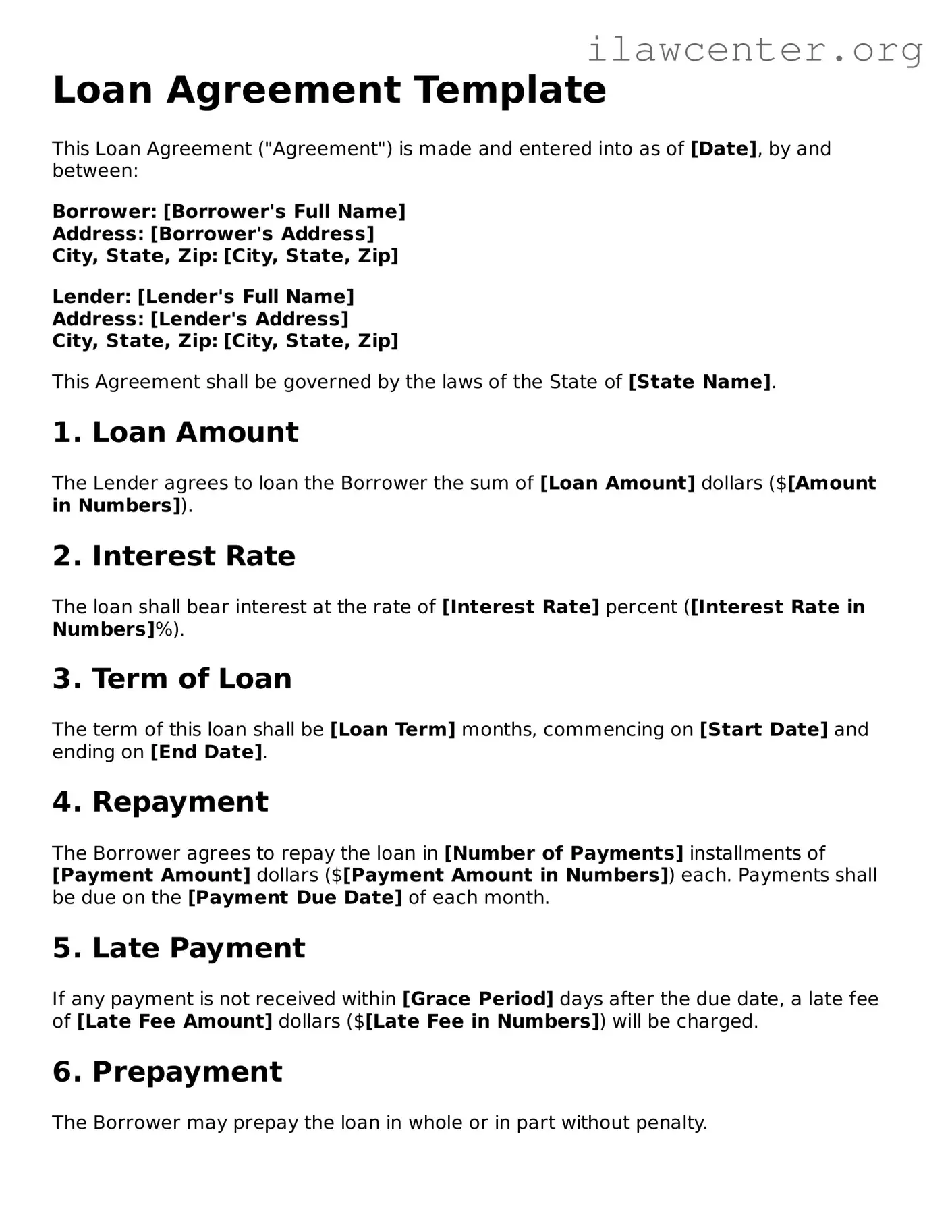
Loan Agreement Template

This Loan Agreement ("Agreement") is made and entered into as of [Date], by and between:

Borrower: [Borrower's Full Name]
Address: [Borrower's Address]
City, State, Zip: [City, State, Zip]

Lender: [Lender's Full Name]
Address: [Lender's Address]
City, State, Zip: [City, State, Zip]

This Agreement shall be governed by the laws of the State of [State Name].

1. Loan Amount

The Lender agrees to loan the Borrower the sum of [Loan Amount] dollars ($[Amount in Numbers]).

2. Interest Rate

The loan shall bear interest at the rate of [Interest Rate] percent ([Interest Rate in Numbers]%).

3. Term of Loan

The term of this loan shall be [Loan Term] months, commencing on [Start Date] and ending on [End Date].

4. Repayment

The Borrower agrees to repay the loan in [Number of Payments] installments of [Payment Amount] dollars ($[Payment Amount in Numbers]) each. Payments shall be due on the [Payment Due Date] of each month.

5. Late Payment

If any payment is not received within [Grace Period] days after the due date, a late fee of [Late Fee Amount] dollars ($[Late Fee in Numbers]) will be charged.

6. Prepayment

The Borrower may prepay the loan in whole or in part without penalty.

7. Default

If the Borrower defaults on any payment, the Lender may declare the entire remaining balance due and payable immediately.

8. Governing Law

This Agreement shall be governed by and construed in accordance with the laws of the State of [State Name].

9. Signatures

By signing below, both parties agree to the terms outlined in this Loan Agreement.

Borrower's Signature: ___________________________ Date: ________________

Lender's Signature: ___________________________ Date: ________________

This document constitutes the entire agreement between the parties. Any amendments must be in writing and signed by both parties.

PDF Form Characteristics

Fact Name Description
Definition A Loan Agreement is a legal document outlining the terms and conditions of a loan between a lender and a borrower.
Parties Involved The agreement typically involves two parties: the lender, who provides the funds, and the borrower, who receives the funds.
Loan Amount The specific amount of money being borrowed is clearly stated in the agreement.
Interest Rate The agreement specifies the interest rate, which can be fixed or variable, and how it will be applied to the loan amount.
Repayment Terms Details about the repayment schedule, including the duration of the loan and payment frequency, are outlined.
Governing Law The agreement is governed by the laws of the state where the loan is made. For example, in California, it follows California Civil Code § 1916.
Default Conditions The document outlines what constitutes a default and the consequences of failing to meet the loan obligations.
Collateral If applicable, the agreement may specify collateral that secures the loan, providing the lender with a claim to the asset if the borrower defaults.
Amendments Any changes to the agreement must be made in writing and signed by both parties to be enforceable.
Signatures Both the lender and borrower must sign the agreement for it to be legally binding.

Instructions on Utilizing Loan Agreement

Filling out a Loan Agreement form is a straightforward process that requires attention to detail. This document outlines the terms of the loan, including the amount borrowed, interest rates, and repayment schedule. Below are the steps to complete the form accurately.

  1. Begin by entering the date at the top of the form.
  2. Provide the names and addresses of both the borrower and the lender. Ensure that all information is current and accurate.
  3. Specify the loan amount in the designated section. This should be the total amount being borrowed.
  4. Indicate the interest rate. This may be a fixed or variable rate, so clarify which applies.
  5. Fill in the repayment terms. Include the duration of the loan and the schedule for payments, whether monthly, quarterly, or otherwise.
  6. Detail any collateral, if applicable. This is any asset pledged to secure the loan.
  7. Include any additional terms or conditions that may apply to the loan agreement.
  8. Both parties should sign and date the form at the bottom. Make sure that all signatures are legible.

Important Facts about Loan Agreement

What is a Loan Agreement?

A Loan Agreement is a legal document that outlines the terms and conditions under which a borrower receives money from a lender. It specifies the loan amount, interest rate, repayment schedule, and any collateral involved. This document serves to protect both parties by clearly defining their rights and obligations throughout the loan process.

Who needs a Loan Agreement?

Anyone who is lending or borrowing money should consider using a Loan Agreement. This includes individuals, businesses, or organizations. Whether it's a personal loan between friends or a business loan from a bank, having a formal agreement helps prevent misunderstandings and provides a clear record of the transaction.

What should be included in a Loan Agreement?

A comprehensive Loan Agreement should include several key elements. These typically consist of the loan amount, interest rate, repayment terms, due dates, and any fees associated with the loan. Additionally, it may detail the consequences of late payments or defaults, and whether any collateral is required to secure the loan.

How do I enforce a Loan Agreement?

To enforce a Loan Agreement, both parties must adhere to the terms outlined in the document. If a borrower fails to make payments, the lender can take legal action to recover the owed amount. This may involve mediation, arbitration, or filing a lawsuit. Having a signed agreement makes it easier to present evidence in court if necessary.

Common mistakes

Filling out a Loan Agreement form can be a straightforward process, but many people make common mistakes that can lead to complications later on. One of the most frequent errors is not reading the entire document carefully. It’s crucial to understand each section of the agreement. Skimming through the text can result in missing important details about interest rates, repayment terms, and any fees associated with the loan.

Another mistake is providing inaccurate personal information. This includes misspelling names, incorrect addresses, or wrong Social Security numbers. Such inaccuracies can delay the processing of the loan or even result in the denial of the application. Always double-check your information before submitting the form.

People often overlook the importance of understanding the terms of the loan. Many individuals may sign the agreement without fully grasping what they are agreeing to. This can lead to unexpected financial burdens down the line. Take the time to ask questions or seek clarification on any terms that seem confusing.

Additionally, failing to disclose all necessary financial information can be a significant mistake. Lenders typically require details about your income, debts, and credit history. Omitting any of this information can raise red flags and might jeopardize your chances of getting approved for the loan.

Another common error involves not keeping copies of the completed Loan Agreement form. After submission, it’s essential to have a record of what you agreed to. This documentation can be invaluable if any disputes arise in the future regarding the terms of the loan.

Some individuals also underestimate the importance of reviewing the loan’s interest rate and terms. A low monthly payment may seem appealing, but it could come with a higher interest rate or longer repayment period. Understanding the total cost of the loan over time is vital for making informed financial decisions.

Lastly, neglecting to ask about potential penalties for late payments is a mistake that can have serious repercussions. Knowing the consequences of late payments, including fees or impacts on credit scores, can help borrowers manage their finances more effectively. Being informed and proactive can prevent unnecessary stress and financial strain.

Documents used along the form

A Loan Agreement is a critical document in the lending process, outlining the terms between the lender and borrower. Alongside this agreement, several other forms and documents are commonly utilized to ensure clarity and legal compliance. Below is a list of these documents, each serving a specific purpose.

  • Promissory Note: This document serves as a written promise from the borrower to repay the loan under specified terms. It includes details such as the loan amount, interest rate, and repayment schedule.
  • Loan Application: The borrower completes this form to provide the lender with necessary financial information. It typically includes personal details, income, and credit history to assess creditworthiness.
  • Credit Report: Lenders often request a credit report to evaluate the borrower’s credit history. This report provides insights into the borrower’s past financial behavior and current credit score.
  • Collateral Agreement: If the loan is secured, this document outlines the assets pledged as collateral. It details what happens to the collateral if the borrower defaults on the loan.
  • Disclosure Statement: This statement informs the borrower of the loan's terms, including fees and interest rates. It is designed to ensure transparency and help borrowers make informed decisions.
  • Personal Guarantee: In some cases, a personal guarantee may be required. This document holds an individual personally responsible for the loan if the borrowing entity defaults.
  • Amortization Schedule: This schedule outlines each payment over the life of the loan, detailing principal and interest breakdowns. It helps borrowers understand their payment obligations over time.
  • Loan Closing Statement: This document summarizes the final details of the loan transaction. It includes the final loan amount, fees, and any adjustments made at closing.

These documents collectively support the Loan Agreement, ensuring that both parties have a clear understanding of their rights and obligations. Proper documentation is essential for a smooth lending process and helps mitigate potential disputes.

Similar forms

  • Promissory Note: This document outlines a borrower's promise to repay a loan under specified terms. Like a Loan Agreement, it includes details such as the loan amount, interest rate, and repayment schedule.

  • Mortgage Agreement: A mortgage agreement secures a loan with property collateral. It shares similarities with a Loan Agreement in that both detail the terms of the loan and the obligations of the borrower.

  • Credit Agreement: This document governs the terms of a credit facility, similar to a Loan Agreement, as it specifies the amount of credit, interest rates, and repayment terms.

  • Lease Agreement: While primarily for renting property, a lease agreement can resemble a Loan Agreement in that it outlines the terms of payment and obligations of both parties involved.

  • Partnership Agreement: In a business context, this document can detail the financial contributions and profit-sharing among partners, akin to how a Loan Agreement specifies the financial terms between lender and borrower.

  • Service Agreement: This document outlines the terms under which services are provided. It can mirror a Loan Agreement in detailing payment terms and conditions for services rendered.

  • Sale Agreement: Similar to a Loan Agreement, a sale agreement specifies the terms of payment for goods or services, including price and delivery conditions.

  • Personal Guarantee: This document may accompany a Loan Agreement, where a third party agrees to repay the loan if the borrower defaults, reinforcing the financial obligations outlined in the Loan Agreement.

  • Security Agreement: This document establishes a security interest in collateral for a loan, much like a Loan Agreement, which often details the collateral securing the loan.

  • Debt Settlement Agreement: This document outlines the terms for settling a debt, similar to a Loan Agreement, as it specifies the obligations of the parties involved in resolving financial obligations.

Dos and Don'ts

When filling out a Loan Agreement form, certain practices can help ensure a smooth process. Below is a list of dos and don'ts that can guide you.

Things You Should Do:

  • Read the entire form carefully before filling it out.
  • Provide accurate and complete information to avoid delays.
  • Double-check your entries for any errors or omissions.
  • Keep a copy of the completed form for your records.

Things You Shouldn't Do:

  • Do not rush through the form; take your time to understand each section.
  • Avoid using unclear or ambiguous language in your responses.
  • Do not leave any required fields blank; this could lead to rejection.
  • Refrain from signing the form until you have reviewed all terms and conditions.

Misconceptions

Loan agreements are essential documents in financial transactions, yet several misconceptions surround them. Understanding these misconceptions can help borrowers and lenders navigate their agreements more effectively.

  • Misconception 1: All loan agreements are the same.
  • This is not true. Loan agreements vary widely based on the type of loan, the lender's policies, and the borrower's financial situation. Each agreement is tailored to specific terms and conditions, making it crucial to read and understand the details of any particular loan.

  • Misconception 2: A verbal agreement is sufficient.
  • Many believe that a verbal agreement is enough to secure a loan. However, without a written contract, it can be challenging to enforce the terms. A written loan agreement provides legal protection and clarity for both parties, outlining the repayment terms, interest rates, and consequences of default.

  • Misconception 3: Loan agreements are only for large sums of money.
  • This misconception can lead to missed opportunities. Loan agreements can apply to any amount, whether it's a small personal loan or a large mortgage. Even smaller loans should be documented to ensure that both parties are clear on the terms.

  • Misconception 4: Once signed, a loan agreement cannot be changed.
  • While it is true that loan agreements are binding, they can be modified if both parties agree to the changes. It is essential to document any amendments in writing to avoid misunderstandings in the future.

Key takeaways

When it comes to filling out and using a Loan Agreement form, there are several important points to keep in mind. Here are some key takeaways:

  1. Understand the Purpose: A Loan Agreement outlines the terms of a loan between the lender and the borrower. It serves as a legal document that protects both parties.
  2. Identify the Parties: Clearly state the names and addresses of both the lender and the borrower. This ensures that both parties are correctly identified in the agreement.
  3. Specify the Loan Amount: Clearly indicate the total amount being borrowed. This figure is crucial for both parties to understand their financial obligations.
  4. Detail the Interest Rate: Include the interest rate being charged on the loan. This information helps the borrower understand the total cost of borrowing.
  5. Outline Repayment Terms: Specify how and when the borrower will repay the loan. This includes the payment schedule and any grace periods.
  6. Include Default Terms: Clearly state what happens if the borrower fails to repay the loan. This can include late fees, legal action, or other consequences.
  7. Consider Security: If applicable, mention any collateral being used to secure the loan. This provides the lender with additional protection.
  8. Review and Sign: Both parties should review the agreement carefully before signing. This ensures everyone understands their rights and responsibilities.
  9. Keep Copies: After signing, each party should retain a copy of the Loan Agreement. This serves as a reference point in case of any disputes.

By following these guidelines, you can create a clear and effective Loan Agreement that protects the interests of both the lender and the borrower.