Fillable Location Release Document

Fillable Location Release Document

A Location Release form is a legal document that grants permission for filmmakers, photographers, or other creatives to use a specific location for their projects. This form ensures that the property owner consents to the use of their space, protecting both parties from potential disputes. If you are ready to secure your location, please fill out the form by clicking the button below.

Article Guide

When planning a film, commercial, or photo shoot, securing the right location is crucial. A Location Release form plays an essential role in this process. It serves as a legal agreement between the property owner and the production team, granting permission to use the property for specific purposes. This form outlines important details such as the location address, the dates of use, and any restrictions or conditions set by the owner. Additionally, it often includes provisions for compensation, liability, and indemnification, ensuring that both parties understand their rights and responsibilities. By clearly defining the terms of use, the Location Release form protects the interests of all involved and helps prevent potential disputes down the line.

Location Release Preview

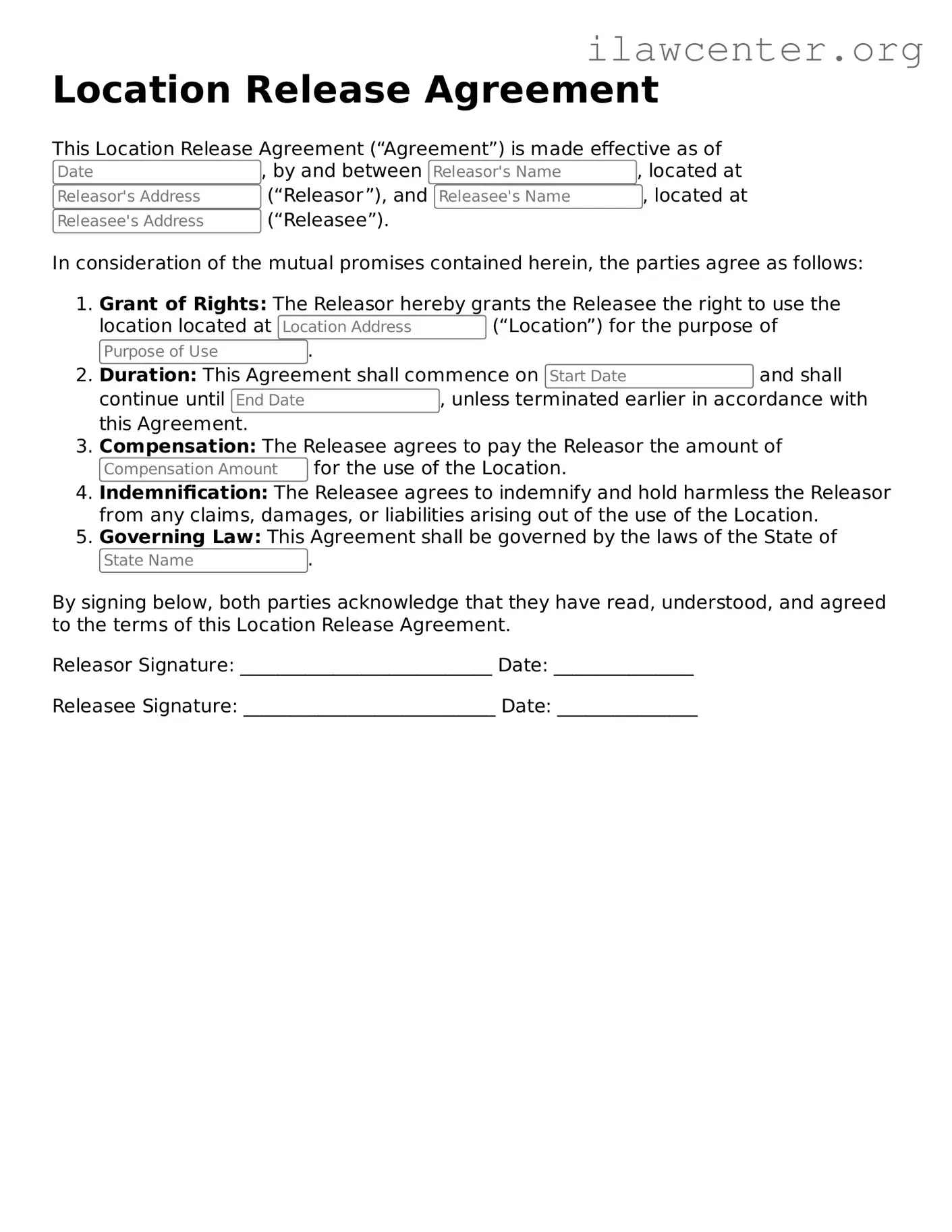
Location Release Agreement

This Location Release Agreement (“Agreement”) is made effective as of , by and between , located at (“Releasor”), and , located at (“Releasee”).

In consideration of the mutual promises contained herein, the parties agree as follows:

  1. Grant of Rights: The Releasor hereby grants the Releasee the right to use the location located at (“Location”) for the purpose of .
  2. Duration: This Agreement shall commence on and shall continue until , unless terminated earlier in accordance with this Agreement.
  3. Compensation: The Releasee agrees to pay the Releasor the amount of for the use of the Location.
  4. Indemnification: The Releasee agrees to indemnify and hold harmless the Releasor from any claims, damages, or liabilities arising out of the use of the Location.
  5. Governing Law: This Agreement shall be governed by the laws of the State of .

By signing below, both parties acknowledge that they have read, understood, and agreed to the terms of this Location Release Agreement.

Releasor Signature: ___________________________ Date: _______________

Releasee Signature: ___________________________ Date: _______________

PDF Form Characteristics

Fact Name Description
Purpose A Location Release form is used to obtain permission from property owners to film or photograph on their property.
Consent The form ensures that the property owner consents to the use of their location in the project.
State-Specific Requirements Different states may have specific requirements for the form. For example, California requires compliance with Civil Code Section 1088.
Liability Protection By signing the form, property owners can protect themselves from liability claims related to the filming or photography.
Duration The release typically specifies the duration of the permission granted, outlining when filming can occur.

Instructions on Utilizing Location Release

Filling out the Location Release form is a straightforward process that will help you secure the necessary permissions for your project. Once completed, you can move forward with confidence, knowing that you have addressed all legal requirements related to the use of the location.

  1. Begin by entering the name of the location at the top of the form. Make sure to provide a clear and accurate description.
  2. Next, fill in the address of the location. Include the street address, city, state, and zip code.
  3. Identify the owner of the location by providing their full name. This is important for establishing who has the authority to grant permission.
  4. In the next section, include the contact information for the owner. This should consist of a phone number and email address for easy communication.
  5. Specify the dates when you plan to use the location. Clearly outline the start and end dates of your project.
  6. Detail the purpose for which you will use the location. Be as specific as possible to avoid any misunderstandings.
  7. Finally, ensure that the owner’s signature is included at the bottom of the form. This signature is essential to validate the agreement.

After completing these steps, review the form for accuracy and clarity. Once everything is in order, submit the form to the appropriate parties to finalize the location agreement.

Important Facts about Location Release

What is a Location Release form?

A Location Release form is a legal document that grants permission to use a specific location for filming, photography, or other media projects. It ensures that the property owner agrees to the use of their space and outlines the terms of that agreement.

Why do I need a Location Release form?

You need a Location Release form to protect yourself legally. It helps to avoid disputes over property use and ensures that you have the necessary permissions to film or photograph at a location. This document also provides clarity on what is allowed and what is not.

Who should sign the Location Release form?

The property owner or authorized representative should sign the Location Release form. This person must have the legal right to grant permission for the use of the property. If the property is rented, the landlord may need to be involved as well.

What information is included in a Location Release form?

A Location Release form typically includes the names of the parties involved, a description of the location, the purpose of the use, and the duration of the agreement. It may also outline any fees, insurance requirements, and conditions for the use of the property.

Is a Location Release form necessary for all projects?

While not all projects require a Location Release form, it is highly recommended for any commercial use. If you are filming or photographing for personal use, you may not need one, but it is still wise to get permission from the property owner.

What happens if I don’t have a Location Release form?

If you do not have a Location Release form, you risk facing legal issues. The property owner could claim that you used their property without permission, leading to potential lawsuits or financial penalties. It is best to have the form to avoid these complications.

Can I modify a Location Release form?

Yes, you can modify a Location Release form to fit your specific needs. However, both parties must agree to any changes, and it is essential to ensure that the modified terms are clear and legally sound.

How long is a Location Release form valid?

The validity of a Location Release form typically lasts for the duration specified in the agreement. Once the agreed-upon time has passed, the rights granted in the form expire unless otherwise stated.

What if the property owner changes their mind?

If the property owner changes their mind after signing the Location Release form, they may not be able to revoke the agreement without consequences. However, the terms of the agreement will dictate the process for cancellation or modification.

Where can I find a Location Release form?

You can find a Location Release form online through various legal websites, or you may consult with a legal professional to create a customized version. It is important to ensure that the form meets your specific needs and complies with local laws.
Common mistakes

Filling out a Location Release form can seem straightforward, but many people make mistakes that can lead to complications later on. One common mistake is not providing accurate contact information. If there are issues or questions about the location, having the correct phone number and email address is essential for quick communication.

Another frequent error is failing to specify the exact location. Vague descriptions can create confusion. It’s important to include the complete address and any relevant details that clarify where the filming will take place. This ensures everyone involved understands the location being referenced.

Some individuals overlook the need for signatures. Both the property owner and the person requesting the release must sign the form. Without these signatures, the document is not valid. It’s a simple step that can easily be forgotten but is crucial for legal purposes.

Additionally, people sometimes neglect to read the entire form before signing. Each section is important and contains details that could affect the agreement. Taking the time to review the form can prevent misunderstandings and protect everyone’s interests.

Another mistake is not including the dates of use. Specifying when the location will be used helps avoid any future disputes. This detail is vital for both parties to ensure they are on the same page regarding the timeline.

Finally, some may fail to keep a copy of the signed form. Having a record of the agreement is important for reference. It provides proof of the terms agreed upon and can be useful if any questions arise later.

Documents used along the form

A Location Release form is an important document used in the film and photography industries. It grants permission to use a specific location for shooting purposes. In addition to this form, there are several other documents that may be necessary to ensure a smooth production process. Below is a list of commonly used forms and documents that often accompany the Location Release form.

  • Talent Release Form: This document is used to obtain permission from individuals who appear in a film or photo shoot. It ensures that the production team has the right to use the likeness of the individuals in their work.
  • Property Release Form: When a specific property, such as artwork or branded items, is featured in a production, a Property Release form is required. This form secures permission from the owner of the property to use it in the project.
  • Insurance Certificate: Productions often require an insurance certificate to protect against potential liabilities. This document demonstrates that the production has appropriate insurance coverage in case of accidents or damages that may occur during filming.
  • Script or Treatment: A script or treatment outlines the storyline and details of the project. While not a legal document, it is essential for communicating the vision of the production to all parties involved, including those providing location access.

Having these documents in place can help prevent misunderstandings and legal issues during the production process. Each document serves a specific purpose, contributing to the overall success of the project.

Similar forms

The Location Release form is similar to several other documents that serve specific purposes in the realm of permissions and agreements. Below is a list of these documents and how they relate to the Location Release form.

  • Property Release Form: This document grants permission to use a property in a film, photo shoot, or other production. Like the Location Release form, it ensures that the property owner agrees to the usage of their space.
  • Model Release Form: This form is used to obtain permission from individuals featured in photographs or videos. It is similar because both documents protect the rights of the person or entity granting permission.
  • Talent Release Form: This document allows filmmakers or photographers to use the likeness of an actor or performer. It parallels the Location Release form in that it secures consent for usage in creative projects.
  • Sound Release Form: This form is used to obtain permission to use recorded sounds or music. Like the Location Release form, it ensures that the creator's rights are respected.
  • Event Release Form: This document allows for the recording or photographing of events. It is similar as it provides permission from event organizers to capture their activities.
  • Video Release Form: This form grants permission to use a person's image and voice in video productions. Both documents serve to protect the rights of those involved.
  • Social Media Release Form: This document allows for the use of images or videos shared on social media. It is similar in that it seeks consent for the use of personal content.
  • Advertising Release Form: This form is used to obtain permission to use images or videos for promotional purposes. It parallels the Location Release form by ensuring that all parties agree to the usage.
  • Location Agreement: This is a more detailed contract that outlines the terms for using a specific location. Like the Location Release form, it seeks to formalize the permission granted by the property owner.

Dos and Don'ts

When filling out a Location Release form, it's important to follow certain guidelines to ensure everything goes smoothly. Here’s a helpful list of things you should and shouldn't do:

  • Do read the entire form carefully before starting.
  • Do provide accurate information about the location.
  • Do sign and date the form where indicated.
  • Do keep a copy of the signed form for your records.
  • Do communicate with the property owner if you have any questions.
  • Don't leave any required fields blank.
  • Don't use unclear or vague language.
  • Don't forget to include any additional agreements if necessary.
  • Don't rush through the process; take your time to ensure accuracy.

Misconceptions

When it comes to the Location Release form, many misunderstandings can lead to confusion. Here are ten common misconceptions, clarified for better understanding:

  1. It’s only necessary for commercial shoots.

    Many people think that a Location Release is only needed for commercial purposes. However, it’s wise to have one for any filming, including personal projects, to avoid potential disputes.

  2. It guarantees you can use the location indefinitely.

    A Location Release grants permission for a specific time frame and purpose. If you wish to use the location again, you may need to obtain a new release.

  3. All locations require a Location Release.

    While it’s advisable to get a release for most locations, some public spaces may not require one. Always check local regulations.

  4. Verbal agreements are sufficient.

    Relying on verbal agreements can lead to misunderstandings. A written Location Release provides clear documentation of the terms agreed upon.

  5. Only the property owner needs to sign.

    While the property owner’s signature is crucial, any other parties with rights to the location may also need to sign the release.

  6. Location Releases are only for film productions.

    This form is not limited to film; it’s also applicable for photography, live events, and any media that captures the location.

  7. Once signed, the release cannot be revoked.

    In some cases, a property owner may revoke the release under specific conditions. Always clarify the terms before signing.

  8. It’s a one-size-fits-all document.

    Each Location Release should be tailored to fit the specific project and location. Generic forms may not cover unique circumstances.

  9. Having a Location Release means you won’t face legal issues.

    While a release minimizes risks, it does not eliminate them entirely. Other legal factors may still come into play.

  10. You don’t need a Location Release if you’re just filming for personal use.

    Even personal projects can lead to legal complications. It’s better to be safe and secure a release to protect yourself.

Understanding these misconceptions can help ensure a smoother filming process and protect everyone involved.

Key takeaways

When working with a Location Release form, understanding its purpose and how to fill it out correctly is essential. Here are some key takeaways to keep in mind:

  • Purpose of the Form: The Location Release form grants permission to use a specific location for filming or photography. It protects both the property owner and the production team.
  • Property Owner's Consent: Always ensure that the property owner or authorized representative signs the form. This consent is crucial for legal protection.
  • Clear Identification: Clearly identify the location being used. Include details such as the address and any specific areas within the property that will be filmed.
  • Duration of Use: Specify the dates and times when the location will be used. This helps avoid any misunderstandings about access and availability.
  • Liability Clauses: Review any liability clauses included in the form. These clauses outline responsibilities and potential risks associated with using the location.
  • Compensation Details: If applicable, include any compensation or fees for using the location. This should be agreed upon by both parties before signing.
  • Distribution of Copies: After signing, make sure both the property owner and the production team have copies of the completed form. This ensures everyone is on the same page.
  • Legal Advice: If unsure about any aspect of the form, seeking legal advice can provide clarity and ensure that all necessary protections are in place.

By keeping these takeaways in mind, you can navigate the process of using a Location Release form more effectively and ensure a smoother experience for everyone involved.