
Louisiana Counter Offer PDF Template

Louisiana Counter Offer PDF Template

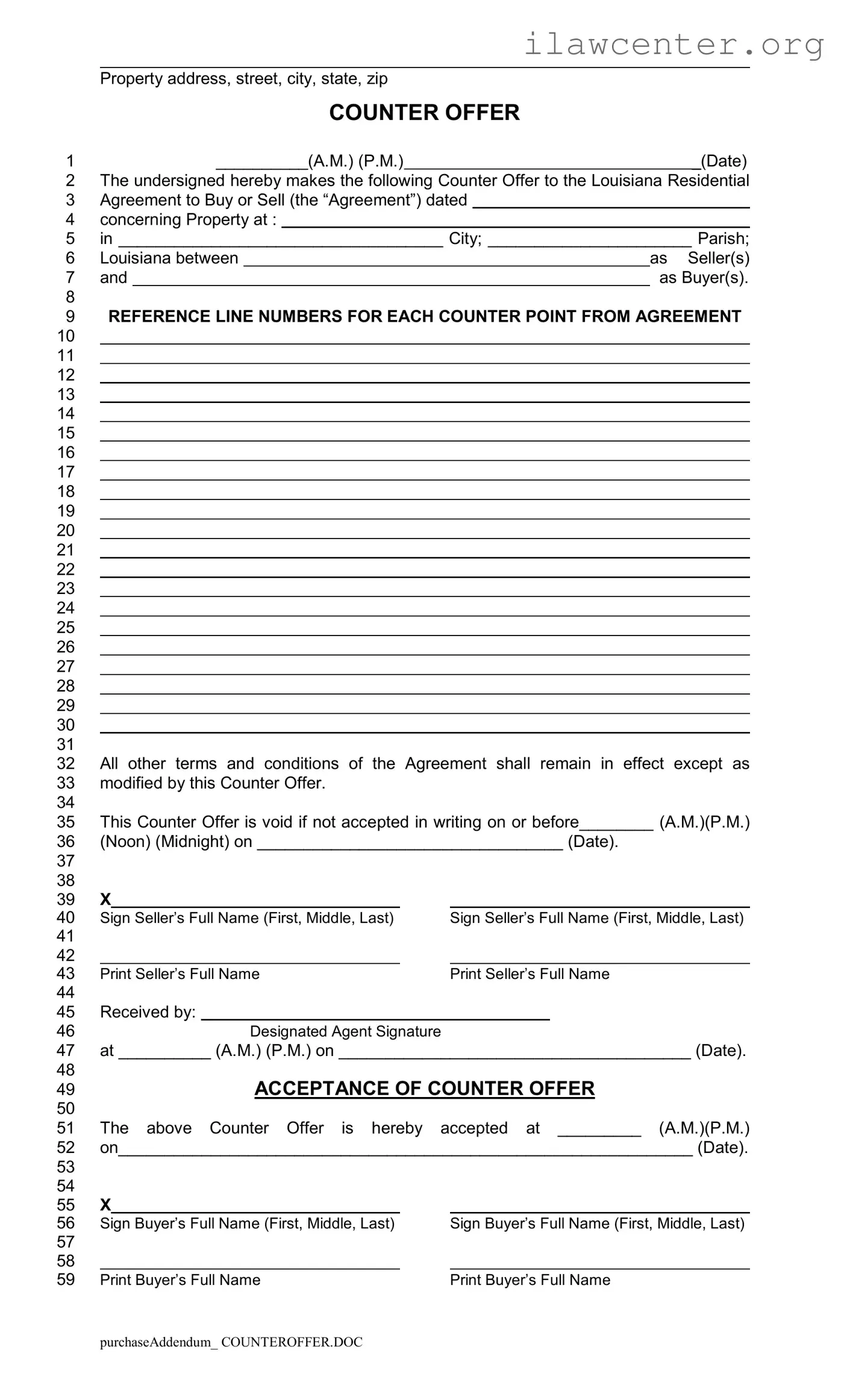
The Louisiana Counter Offer form is a document used by buyers and sellers to propose changes to the terms of an existing real estate agreement. This form allows the party making the counter offer to specify adjustments while keeping the original agreement intact. To ensure a smooth transaction, complete the form by clicking the button below.

Article Guide

The Louisiana Counter Offer form serves as a crucial tool in real estate transactions, allowing buyers and sellers to negotiate terms after an initial offer has been made. This form is designed to facilitate communication between parties involved in the sale of a property, ensuring that all modifications to the original agreement are documented clearly. It includes essential details such as the property address, the names of the buyer(s) and seller(s), and reference line numbers that specify which terms are being countered. The form also stipulates that all other terms of the original agreement remain in effect unless explicitly modified by the counter offer. Additionally, it establishes a deadline for acceptance, emphasizing the importance of timely responses in real estate negotiations. By requiring signatures from both parties, the form solidifies the counter offer as a formal proposal, paving the way for further discussions and potential agreement on the sale of the property.

Louisiana Counter Offer Preview

Property address, street, city, state, zip
COUNTER OFFER
__________(A.M.) (P.M.) _(Date) 1
The undersigned hereby makes the following Counter Offer to the Louisiana Residential 2
Agreement to Buy or Sell (the “Agreement”) dated
3
concerning Property at : 4
in ___________________________________ City; ______________________ Parish; 5
Louisiana between as Seller(s)
6
and as Buyer(s).
7
8
REFERENCE LINE NUMBERS FOR EACH COUNTER POINT FROM AGREEMENT 9
10
11
12
13
14
15
16
17
18
19
20
21
22
23
24
25
26
27
28
29
30
31
All other terms and conditions of the Agreement shall remain in effect except as 32
modified by this Counter Offer. 33
34
This Counter Offer is void if not accepted in writing on or before________ (A.M.)(P.M.) 35
(Noon) (Midnight) on _________________________________ (Date). 36
37
38
X 39
Sign Seller’s Full Name (First, Middle, Last) Sign Seller’s Full Name (First, Middle, Last) 40
41
42
Print Seller’s Full Name Print Seller’s Full Name 43
44
Received by: 45
Designated Agent Signature 46
at __________ (A.M.) (P.M.) on ______________________________________ (Date). 47
48
ACCEPTANCE OF COUNTER OFFER 49
50
The above Counter Offer is hereby accepted at _________ (A.M.)(P.M.) 51
on______________________________________________________________ (Date). 52
53
54
X 55
Sign Buyer’s Full Name (First, Middle, Last) Sign Buyer’s Full Name (First, Middle, Last) 56
57
58
Print Buyer’s Full Name Print Buyer’s Full Name 59
purchaseAddendum_ COUNTEROFFER.DOC

File Properties

Fact Name Description
Purpose The Louisiana Counter Offer form is used to propose changes to an existing real estate agreement.
Governing Law This form is governed by Louisiana state law, specifically under the Louisiana Civil Code.
Acceptance Deadline The Counter Offer must be accepted in writing by a specified date and time to remain valid.
Property Details It requires specific information about the property, including address and parish.
Seller and Buyer Information The form must include the full names of both sellers and buyers involved in the transaction.
Reference Line Numbers It allows reference to specific line numbers from the original Agreement for clarity on counterpoints.
Modification Clause All other terms of the original Agreement remain in effect unless modified by the Counter Offer.
Signature Requirement Both sellers and buyers must sign the form to indicate acceptance of the Counter Offer.
Designated Agent The form includes a section for the designated agent to acknowledge receipt of the Counter Offer.
Legal Implications Submitting a Counter Offer can lead to further negotiations or a finalized agreement if accepted.

Instructions on Utilizing Louisiana Counter Offer

Once the Louisiana Counter Offer form is completed, it will need to be signed by the appropriate parties. This form serves as a formal response to a previous offer and outlines any modifications to the terms of the original agreement. Ensure that all necessary details are accurately filled in before submitting.

  1. Begin by entering the property address, including the street, city, state, and zip code at the top of the form.
  2. In the designated area, write the date and time of the counter offer.
  3. Identify the original agreement by referencing the date and the property location.
  4. Clearly state the names of the seller(s) and buyer(s) involved in the agreement.
  5. List the reference line numbers from the original agreement that pertain to each counter point you wish to address.
  6. Specify the terms and conditions that are being modified in this counter offer.
  7. Indicate the deadline for acceptance of the counter offer, including the date and time.
  8. Have the seller(s) sign their full names, including first, middle, and last names, in the appropriate spaces provided.
  9. Print the seller(s) full names below their signatures.
  10. Include the designated agent's signature along with the time and date of receipt.
  11. When the counter offer is accepted, the buyer(s) must sign their full names in the designated area.
  12. Print the buyer(s) full names below their signatures.

Important Facts about Louisiana Counter Offer

What is the purpose of the Louisiana Counter Offer form?

The Louisiana Counter Offer form is used when one party involved in a real estate transaction wishes to propose changes to the original terms of the Agreement to Buy or Sell. This form allows sellers or buyers to specify their counter terms while keeping the original agreement intact, except for the modifications made. It serves as a formal way to communicate these changes and ensures that all parties are aware of the updated terms being proposed.

How do I fill out the Counter Offer form?

To complete the Counter Offer form, you will need to provide specific information about the property, including the address and the parties involved. Begin by entering the property address and the names of the seller(s) and buyer(s). Then, reference the line numbers from the original agreement where changes are being proposed. Clearly outline the counter points you wish to address. Finally, ensure that both parties sign and date the form to indicate acceptance of the counter offer.

What happens if the Counter Offer is not accepted?

If the Counter Offer is not accepted in writing by the specified deadline, it becomes void. This means that the original terms of the Agreement remain in effect, and no changes will be made. It is important for all parties to be aware of the acceptance deadline to avoid any misunderstandings regarding the status of the offer.

Can I make multiple Counter Offers?

Yes, it is possible to make multiple Counter Offers during negotiations. Each Counter Offer should be documented separately, and the parties involved must clearly understand which offer is currently on the table. Keep in mind that each new Counter Offer voids the previous one, so clear communication is essential to ensure that everyone is on the same page.

Is legal advice necessary when using the Counter Offer form?

While it is not mandatory to seek legal advice when using the Louisiana Counter Offer form, it can be beneficial. A legal professional can help clarify any concerns regarding the terms being proposed or the implications of the counter offer. If you have questions about specific terms or how they may affect your transaction, consulting with a real estate attorney may provide valuable insights.

Common mistakes

Filling out the Louisiana Counter Offer form can be straightforward, but mistakes can happen. One common error is not providing the correct property address. Ensure that the street, city, state, and zip code are filled out accurately. A missing or incorrect address can lead to confusion and delays in the negotiation process.

Another mistake is neglecting to specify the date and time for acceptance. The form requires a clear deadline for when the counter offer must be accepted. If this information is left blank, it may result in misunderstandings or the offer becoming void.

Many people forget to reference the line numbers from the original agreement when making counter points. This is crucial for clarity. Without these references, the other party may not understand the specific terms being modified, which can lead to disputes.

Some individuals also overlook the importance of signatures. Both sellers and buyers must sign the form for it to be valid. If any signature is missing, the counter offer may not hold up legally.

Providing incomplete names can create issues as well. The form requires full names, including first, middle, and last names. If any part of a name is omitted, it could complicate the acceptance of the offer later on.

Another frequent error involves the designated agent's signature. If an agent is involved, their signature must be included. Failing to do so may invalidate the process, as the agent's role is often crucial in real estate transactions.

Lastly, not keeping a copy of the completed form can lead to problems. It's essential to retain a copy for your records. This way, you can refer back to the terms agreed upon, should any questions arise in the future.

Documents used along the form

In real estate transactions, various forms and documents play a crucial role in ensuring clarity and legal compliance. The Louisiana Counter Offer form is one such document, but it is often accompanied by other essential forms that facilitate the negotiation process. Below is a list of documents frequently used alongside the Louisiana Counter Offer form, each serving a specific purpose in the transaction.

  • Louisiana Residential Agreement to Buy or Sell: This is the primary contract between the buyer and seller outlining the terms of the sale. It includes details such as the purchase price, property description, and contingencies.
  • Property Disclosure Form: Sellers are typically required to provide this form, which discloses any known issues or defects with the property. Transparency is vital for building trust between parties.
  • Lead-Based Paint Disclosure: For homes built before 1978, this form must be provided to inform buyers about potential lead hazards. It is a critical safety measure aimed at protecting families, especially children.
  • Financing Addendum: This document outlines the terms of the buyer's financing arrangements, including loan types and contingencies. It helps clarify how the purchase will be funded.
  • Inspection Addendum: This form details the buyer's rights to conduct inspections on the property. It outlines the process and timeline for inspections, ensuring that buyers can make informed decisions.
  • Appraisal Addendum: This document specifies the requirements for an appraisal of the property. It protects the buyer by ensuring that the property's value meets or exceeds the agreed-upon purchase price.
  • Title Commitment: This is a document from a title company that outlines the status of the property's title. It assures the buyer that the title is clear of any liens or disputes.
  • Closing Disclosure: Provided before the closing of the transaction, this form outlines the final terms of the loan, including all closing costs. It ensures that both parties understand their financial obligations.
  • Escrow Agreement: This document details the terms under which the buyer's earnest money deposit will be held in escrow until the transaction is completed. It protects both parties during the transaction process.

Understanding these documents can significantly enhance the experience of both buyers and sellers in real estate transactions. Each form serves a distinct purpose, contributing to a smooth negotiation and closing process. It is advisable for all parties involved to review these documents carefully and seek professional guidance when necessary.

Similar forms

The Louisiana Counter Offer form shares similarities with several other real estate documents. Each serves a unique purpose in the negotiation process, but all facilitate communication between buyers and sellers. Here are four documents that align closely with the Louisiana Counter Offer form:

  • Purchase Agreement: This foundational document outlines the terms of the sale, including price, contingencies, and timelines. Like the Counter Offer, it requires signatures from both parties to be binding.
  • Addendum: An addendum modifies the original agreement by adding new terms or clarifying existing ones. Similar to the Counter Offer, it must be agreed upon in writing by all parties involved.
  • Letter of Intent: This document expresses a party's intention to enter into a formal agreement. It sets the stage for negotiations, much like a Counter Offer, by outlining key points for discussion.
  • Acceptance Form: This document signifies that one party agrees to the terms proposed by another. It functions similarly to the Counter Offer, as it formalizes acceptance and finalizes the agreement process.

Dos and Don'ts

When filling out the Louisiana Counter Offer form, it is important to follow certain guidelines to ensure accuracy and clarity. Here are six things you should and shouldn't do:

  • Do provide complete information about the property, including the address, city, and parish.
  • Do clearly reference the line numbers from the original agreement for each counter point.
  • Do ensure that all parties involved sign the form, including both sellers and buyers.
  • Do specify the deadline for acceptance in writing to avoid any confusion.
  • Don't leave any sections blank; incomplete forms can lead to misunderstandings.
  • Don't use informal language or abbreviations that could create ambiguity.

Misconceptions

Misconceptions about the Louisiana Counter Offer form can lead to confusion during real estate transactions. Here are five common misunderstandings:

  • It is a binding contract as soon as it is signed. Many believe that signing the Counter Offer makes it a binding contract. In reality, it only becomes binding once both parties have signed and accepted the terms.
  • All terms from the original agreement are void. Some think that submitting a Counter Offer cancels the original agreement. This is not true. The original terms remain in effect unless specifically modified by the Counter Offer.
  • Verbal acceptance is sufficient. A common myth is that a verbal agreement is enough to accept a Counter Offer. However, acceptance must be in writing to be valid.
  • Counter Offers are only for price changes. Many assume that Counter Offers are solely about changing the price. In fact, they can address various terms, including closing dates, contingencies, and repairs.
  • There is no deadline for acceptance. Some people think they can take their time to respond to a Counter Offer. However, each Counter Offer includes a specific deadline for acceptance, after which it becomes void.

Key takeaways

  • Ensure all parties are clearly identified in the Louisiana Counter Offer form. This includes full names of sellers and buyers, as well as the property address.

  • Reference specific line numbers from the original agreement when making counter points. This clarity helps avoid confusion and ensures that all parties understand the changes being proposed.

  • Be aware that the counter offer is only valid if accepted in writing before the specified deadline. This deadline must be clearly stated in the form to avoid any disputes.

  • All other terms of the original agreement remain in effect unless explicitly modified in the counter offer. Review the entire agreement to ensure consistency and clarity.

  • Both sellers and buyers should sign and print their names on the form. This step is crucial for validating the counter offer and ensuring all parties are in agreement.