Attorney-Verified  Deed Document for Louisiana

Attorney-Verified Deed Document for Louisiana

A Louisiana Deed form is a legal document used to transfer ownership of real property in the state of Louisiana. This form outlines the details of the transaction, including the parties involved and the property description. For a smooth transfer of ownership, it is essential to fill out the form accurately; click the button below to get started.

Article Guide

The Louisiana Deed form serves as a crucial legal document in real estate transactions, facilitating the transfer of property ownership from one party to another. This form outlines essential details, such as the names of the grantor (the seller) and grantee (the buyer), the legal description of the property, and any specific terms or conditions associated with the transfer. Additionally, it may include information about warranties, which provide assurances regarding the title's validity. The form must be signed by the grantor and typically requires notarization to ensure its authenticity. Understanding the nuances of this deed is vital for both buyers and sellers, as it not only formalizes the transaction but also protects the rights of all parties involved. Properly executing the Louisiana Deed form can prevent future disputes and clarify ownership, making it an indispensable part of the property transfer process.

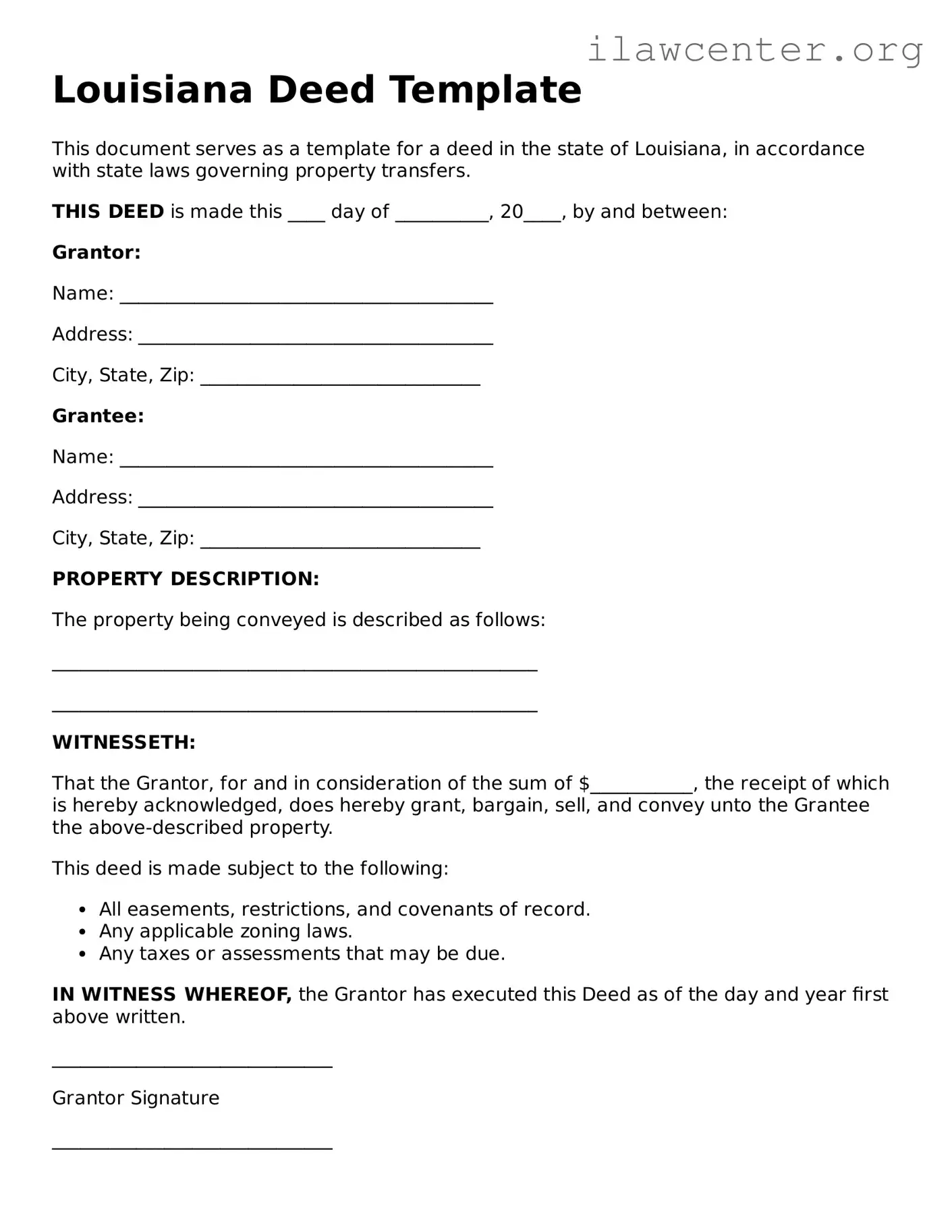
Louisiana Deed Preview

Louisiana Deed Template

This document serves as a template for a deed in the state of Louisiana, in accordance with state laws governing property transfers.

THIS DEED is made this ____ day of __________, 20____, by and between:

Grantor:

Name: ________________________________________

Address: ______________________________________

City, State, Zip: ______________________________

Grantee:

Name: ________________________________________

Address: ______________________________________

City, State, Zip: ______________________________

PROPERTY DESCRIPTION:

The property being conveyed is described as follows:

____________________________________________________

____________________________________________________

WITNESSETH:

That the Grantor, for and in consideration of the sum of $___________, the receipt of which is hereby acknowledged, does hereby grant, bargain, sell, and convey unto the Grantee the above-described property.

This deed is made subject to the following:

  • All easements, restrictions, and covenants of record.
  • Any applicable zoning laws.
  • Any taxes or assessments that may be due.

IN WITNESS WHEREOF, the Grantor has executed this Deed as of the day and year first above written.

______________________________

Grantor Signature

______________________________

Grantor Printed Name

______________________________

Grantee Signature

______________________________

Grantee Printed Name

NOTARY PUBLIC:

State of Louisiana

Parish of ______________________

On this ____ day of __________, 20____, before me, a Notary Public, personally appeared ____________________________, known to me to be the person whose name is subscribed to the within instrument, and acknowledged that he/she executed the same for the purposes therein contained.

______________________________

Notary Public Signature

My Commission Expires: _______________

PDF Form Characteristics

Fact Name Details
Governing Law The Louisiana Deed form is governed by Louisiana state law.
Types of Deeds Common types include warranty deeds, quitclaim deeds, and special warranty deeds.
Required Signatures All parties involved in the transaction must sign the deed.
Notarization The deed must be notarized to be legally valid in Louisiana.
Recording Deeds should be recorded in the parish where the property is located.
Property Description A clear and accurate description of the property must be included.
Consideration The deed should state the consideration or payment made for the property.
Transfer of Ownership The deed serves as a legal document to transfer ownership from one party to another.
Legal Capacity All parties must have the legal capacity to enter into the agreement.

Instructions on Utilizing Louisiana Deed

Once you have the Louisiana Deed form ready, the next step involves carefully filling it out to ensure all necessary information is accurately recorded. This process is essential for the legal transfer of property ownership and should be approached with attention to detail.

  1. Begin by entering the date at the top of the form. Make sure to write it in the format of month, day, and year.
  2. Identify the parties involved in the transaction. In the section labeled "Grantor," provide the full name and address of the person or entity transferring the property. In the "Grantee" section, enter the full name and address of the person or entity receiving the property.
  3. Next, describe the property being transferred. Include the legal description, which can often be found in previous deeds or property tax documents. This may involve a detailed description of the land's boundaries.
  4. Indicate the consideration, or payment, for the property. This is typically expressed as a dollar amount. If the transfer is a gift, you may write "for love and affection" or a similar phrase.
  5. Include any additional clauses that may be necessary for your specific situation. This could involve stipulations regarding the use of the property or other conditions of the transfer.
  6. Both the grantor and grantee should sign the form. Ensure that the signatures are dated and that the signers are properly identified.
  7. Have the deed notarized. A notary public will verify the identities of the signers and witness the signing of the document.
  8. Finally, make copies of the completed deed for your records. The original should be filed with the appropriate local government office, typically the parish clerk of court or the register of deeds.

Important Facts about Louisiana Deed

What is a Louisiana Deed form?

A Louisiana Deed form is a legal document used to transfer ownership of real property from one party to another within the state of Louisiana. This form is essential for ensuring that the transfer of property is recognized by law. The deed outlines the details of the transaction, including the names of the parties involved, a description of the property, and any conditions or warranties associated with the transfer. It serves as proof of ownership once it is properly executed and recorded with the appropriate local government office.

What types of deeds are available in Louisiana?

In Louisiana, there are several types of deeds, each serving a different purpose. The most common types include the warranty deed, which guarantees that the seller holds clear title to the property and has the right to sell it; the quitclaim deed, which transfers whatever interest the seller has in the property without any guarantees; and the special warranty deed, which provides limited guarantees about the title. Each type has its own implications for the buyer and seller, so understanding these differences is crucial for anyone involved in a property transaction.

How do I complete a Louisiana Deed form?

Completing a Louisiana Deed form requires careful attention to detail. First, you must gather all necessary information, including the names and addresses of both the grantor (the seller) and the grantee (the buyer), as well as a legal description of the property. After filling out the form, both parties must sign it in the presence of a notary public to ensure its validity. Once signed, the deed should be recorded with the local parish clerk of court to make the transfer official and protect the rights of the new owner.

Are there any fees associated with filing a Louisiana Deed?

Yes, there are fees associated with filing a Louisiana Deed. These fees can vary by parish and may include recording fees, which are charged for the official filing of the deed with the local government. Additionally, there may be other costs, such as notary fees or taxes related to the property transfer. It is advisable to check with the local clerk of court’s office for specific fee amounts and any additional requirements that may apply to your situation.

Common mistakes

Filling out a Louisiana Deed form can be a straightforward process, but many people make common mistakes that can lead to complications down the line. Understanding these pitfalls is crucial for ensuring that the transfer of property is legally sound and recognized. One of the most frequent errors involves incorrect names. It is essential to ensure that the names of all parties involved are spelled correctly and match their legal identification documents. A simple typo can create significant issues in the future.

Another common mistake is failing to include all necessary parties. In Louisiana, both the seller and the buyer must be listed on the deed. If there are multiple sellers or buyers, all individuals must be included to avoid any disputes later. Omitting a party can lead to challenges in proving ownership.

Additionally, many people neglect to provide a clear description of the property. A vague or incomplete description can result in confusion about what is being transferred. It is vital to include the full legal description of the property, which can usually be found in previous deeds or property tax documents.

Another mistake often made is not considering the type of ownership being established. Louisiana recognizes various forms of ownership, such as sole ownership, joint ownership, and community property. Understanding these distinctions is crucial for ensuring that the deed reflects the intended ownership arrangement.

People also frequently forget to sign the deed properly. All parties must sign the document in the presence of a notary. Failing to do so can render the deed invalid. Notarization is a critical step that adds an extra layer of authenticity to the document.

Moreover, the date of execution is often overlooked. It is important to include the date when the deed is signed, as this establishes the timeline for the transfer of ownership. Without a proper date, legal complications may arise regarding the effective date of the transaction.

Many individuals also fail to consider the filing requirements after the deed is completed. In Louisiana, the deed must be filed with the appropriate parish clerk of court. Neglecting to file the deed can lead to challenges in proving ownership and may affect property rights.

Another mistake involves not understanding the tax implications of the property transfer. It is advisable to consult with a tax professional to understand any potential tax liabilities that may arise from the transfer of property. Ignoring this aspect can lead to unexpected financial burdens.

Finally, many people rush through the process and do not review the deed thoroughly before submission. Taking the time to double-check all information can prevent costly mistakes. A careful review ensures that all details are accurate and complete, safeguarding against future disputes.

Documents used along the form

When engaging in real estate transactions in Louisiana, several key documents often accompany the deed form. These documents serve various purposes, from establishing ownership to ensuring compliance with local laws. Understanding each of these forms can facilitate a smoother transaction process.

  • Title Insurance Policy: This document protects the buyer from potential disputes over property ownership. It ensures that the title is clear and free from liens or other claims.
  • Affidavit of Identity: This sworn statement confirms the identity of the parties involved in the transaction. It helps prevent fraud and ensures that all parties are who they claim to be.
  • Property Disclosure Statement: Sellers provide this document to disclose any known issues with the property. It informs buyers of potential problems, such as structural defects or environmental hazards.
  • Bill of Sale: This document transfers ownership of personal property associated with the real estate, such as appliances or fixtures. It is crucial for clarifying what is included in the sale.
  • Mortgage Agreement: If financing is involved, this document outlines the terms of the loan. It details the repayment schedule, interest rates, and consequences of default.

Each of these documents plays a vital role in the real estate transaction process in Louisiana. Being aware of their functions can help ensure that buyers and sellers navigate the complexities of property transfer with confidence.

Similar forms

The Deed form is a crucial document in property transactions, but it shares similarities with several other important legal documents. Here are four documents that are similar to the Deed form, along with explanations of how they are alike:

  • Title Insurance Policy: Like a Deed, a Title Insurance Policy protects the buyer's ownership rights. It provides assurance that the property is free from liens or claims, similar to how a Deed establishes legal ownership.
  • Bill of Sale: A Bill of Sale transfers ownership of personal property from one party to another. Much like a Deed, it serves as a legal document that confirms the transfer of ownership, although it typically applies to movable items rather than real estate.
  • Lease Agreement: A Lease Agreement outlines the terms under which one party rents property from another. Similar to a Deed, it creates a legal relationship regarding property rights, although it does not transfer ownership but rather grants temporary use.
  • Mortgage Agreement: A Mortgage Agreement secures a loan with the property as collateral. Like a Deed, it involves property rights and is recorded in public records, ensuring that the lender has a legal claim to the property until the loan is repaid.

Dos and Don'ts

When filling out the Louisiana Deed form, it is essential to follow specific guidelines to ensure accuracy and compliance. Here are four important do's and don'ts:

  • Do provide accurate and complete information about the property being transferred.
  • Do include the names of all parties involved in the transaction.
  • Don't leave any sections blank; incomplete forms can lead to delays or rejection.
  • Don't use abbreviations or shorthand that may confuse the reader.

Misconceptions

Understanding the Louisiana Deed form is essential for anyone involved in real estate transactions in the state. However, several misconceptions can lead to confusion. Here are six common misconceptions:

  • All deeds are the same. Many people believe that all deeds serve the same purpose. In reality, different types of deeds exist, such as warranty deeds and quitclaim deeds, each with unique implications for ownership and liability.
  • A deed must be notarized to be valid. While notarization is often recommended, it is not a strict requirement for all deeds in Louisiana. A deed can be valid if it is signed by the parties involved, but notarization provides an extra layer of authenticity.
  • Deeds are only necessary for property sales. Some think deeds are only needed when buying or selling property. However, deeds are also used for transferring property ownership through gifts, inheritance, or other means.
  • Once a deed is signed, it cannot be changed. Many assume that a deed is final and cannot be altered. In fact, deeds can be amended or revoked, but doing so typically requires following specific legal procedures.
  • The language in a deed is always straightforward. It’s a common belief that deed language is simple and easy to understand. In truth, legal terminology can be complex, and it’s wise to seek clarification or assistance if needed.
  • All deeds must be filed with the state. Some individuals think that every deed must be filed with a state office. While it is essential to record deeds for public notice, not all deeds are required to be filed in the same manner.

By addressing these misconceptions, individuals can better navigate the complexities of the Louisiana Deed form and ensure a smoother real estate transaction process.

Key takeaways

When filling out and using the Louisiana Deed form, it’s important to keep several key points in mind. Understanding these can help ensure that the process goes smoothly and that the deed is valid.

  • Ensure that all parties involved are clearly identified. This includes the grantor (seller) and grantee (buyer).
  • Provide a complete legal description of the property. This description should be accurate and detailed to avoid any confusion.
  • Include the date of the transaction. This helps establish when the transfer of property ownership occurs.
  • Sign the deed in front of a notary public. This step is crucial for the deed to be legally recognized.
  • Check for any specific requirements in Louisiana law. Different types of deeds may have unique stipulations.
  • Consider recording the deed with the local parish clerk. Recording provides public notice of the property transfer.
  • Keep a copy of the completed deed for your records. This can be useful for future reference or in case of disputes.
  • Consult with a real estate attorney if you have questions. They can provide guidance tailored to your situation.

By following these key takeaways, you can navigate the process of completing and using the Louisiana Deed form with greater confidence.