Attorney-Verified  Divorce Settlement Agreement Document for Louisiana

Attorney-Verified Divorce Settlement Agreement Document for Louisiana

The Louisiana Divorce Settlement Agreement form is a legal document that outlines the terms agreed upon by both parties during a divorce. This form addresses important matters such as property division, child custody, and financial support, ensuring that both individuals understand their rights and responsibilities. To begin the process, consider filling out the form by clicking the button below.

Article Guide

When navigating the often complex waters of divorce, having the right paperwork can make a significant difference in ensuring a smooth process. In Louisiana, the Divorce Settlement Agreement form is a vital document that outlines the terms agreed upon by both parties regarding the division of assets, child custody, and support obligations. This form serves as a roadmap for how each spouse will manage their responsibilities post-divorce, addressing crucial issues such as property division, spousal support, and arrangements for any children involved. By clearly detailing these agreements, the form helps prevent future misunderstandings and provides a legal framework that both parties can rely on. Understanding the contents and implications of this agreement is essential for anyone looking to finalize their divorce in Louisiana, as it can influence everything from financial stability to co-parenting dynamics.

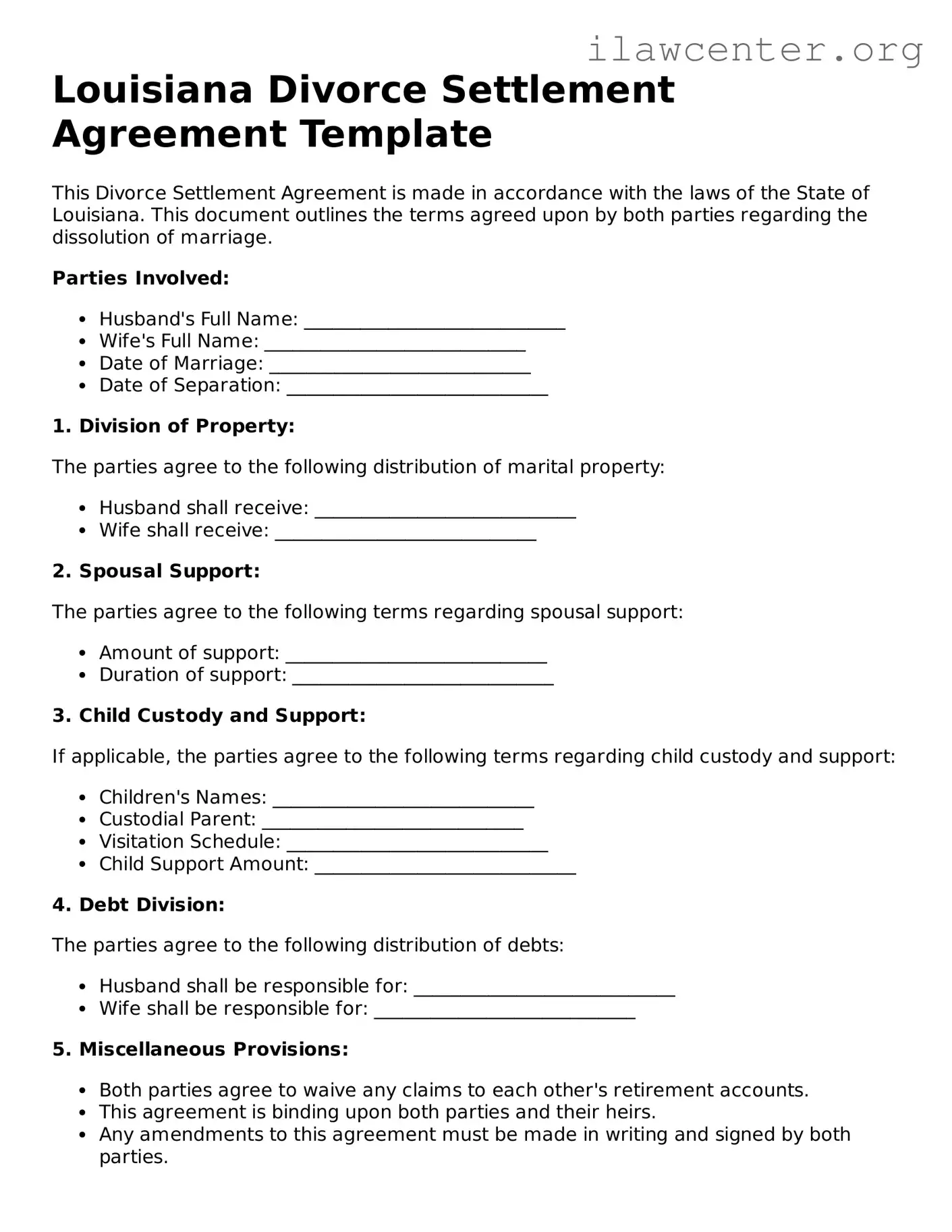
Louisiana Divorce Settlement Agreement Preview

Louisiana Divorce Settlement Agreement Template

This Divorce Settlement Agreement is made in accordance with the laws of the State of Louisiana. This document outlines the terms agreed upon by both parties regarding the dissolution of marriage.

Parties Involved:

  • Husband's Full Name: ____________________________
  • Wife's Full Name: ____________________________
  • Date of Marriage: ____________________________
  • Date of Separation: ____________________________

1. Division of Property:

The parties agree to the following distribution of marital property:

  • Husband shall receive: ____________________________
  • Wife shall receive: ____________________________

2. Spousal Support:

The parties agree to the following terms regarding spousal support:

  • Amount of support: ____________________________
  • Duration of support: ____________________________

3. Child Custody and Support:

If applicable, the parties agree to the following terms regarding child custody and support:

  • Children's Names: ____________________________
  • Custodial Parent: ____________________________
  • Visitation Schedule: ____________________________
  • Child Support Amount: ____________________________

4. Debt Division:

The parties agree to the following distribution of debts:

  • Husband shall be responsible for: ____________________________
  • Wife shall be responsible for: ____________________________

5. Miscellaneous Provisions:

  • Both parties agree to waive any claims to each other's retirement accounts.
  • This agreement is binding upon both parties and their heirs.
  • Any amendments to this agreement must be made in writing and signed by both parties.

6. Signatures:

By signing below, both parties acknowledge that they have read and understood this Divorce Settlement Agreement and agree to its terms.

______________________________
Husband's Signature
Date: ____________________________

______________________________
Wife's Signature
Date: ____________________________

This agreement is effective as of the date of the last signature.

PDF Form Characteristics

Fact Name Description
Purpose The Louisiana Divorce Settlement Agreement form outlines the terms agreed upon by both parties regarding the division of assets, debts, and other matters during a divorce.
Governing Law This form is governed by Louisiana Civil Code Articles 131 through 132, which address the dissolution of marriage and related agreements.
Required Signatures Both spouses must sign the agreement to ensure it is valid and enforceable in court.
Filing Process Once completed, the form must be filed with the local court as part of the divorce proceedings.

Instructions on Utilizing Louisiana Divorce Settlement Agreement

Once you have the Louisiana Divorce Settlement Agreement form in hand, it's time to fill it out carefully. This document will help outline the terms of your divorce, ensuring both parties agree on key issues. Follow these steps to complete the form accurately.

  1. Start by entering your full name and your spouse's full name at the top of the form.
  2. Provide the date of your marriage and the date of separation.
  3. Indicate whether you have any children together. If yes, list their names and ages.
  4. Detail the arrangements for child custody, visitation, and child support. Be specific about the terms you both agree upon.
  5. Outline how you will divide your property and debts. Include any specific items or assets that need to be addressed.
  6. State any spousal support or alimony arrangements, if applicable.
  7. Review the form for any additional clauses or agreements that may be relevant to your situation.
  8. Both parties should sign and date the form to confirm agreement on the terms outlined.

After completing the form, you may need to file it with the court as part of your divorce proceedings. Make sure to keep copies for your records and follow any additional steps required by your local court.

Important Facts about Louisiana Divorce Settlement Agreement

What is a Louisiana Divorce Settlement Agreement form?

A Louisiana Divorce Settlement Agreement form is a legal document that outlines the terms agreed upon by both parties during a divorce. This agreement typically includes details about the division of assets, debts, child custody arrangements, and support payments. It serves as a binding contract that helps ensure both parties understand their rights and responsibilities following the divorce. By formalizing these agreements, the form helps to prevent future disputes and provides clarity for both individuals involved.

How do I complete the Louisiana Divorce Settlement Agreement form?

To complete the Louisiana Divorce Settlement Agreement form, both parties should first discuss and negotiate the terms of their divorce. It is important to be thorough and honest during these discussions to ensure that all relevant issues are addressed. Once the terms are agreed upon, the form can be filled out with the necessary information, including personal details, asset division, and child custody arrangements. It is advisable to review the completed form carefully and consider having it reviewed by a legal professional to ensure compliance with Louisiana law before submission.

Do I need a lawyer to file the Divorce Settlement Agreement?

What happens if my spouse and I cannot agree on the terms of the settlement?

If spouses cannot reach an agreement on the terms of the divorce settlement, they may need to consider mediation or other forms of dispute resolution. Mediation involves a neutral third party who helps facilitate discussions and negotiations between the couple. If mediation fails, the case may proceed to court, where a judge will make decisions regarding the division of assets, custody, and support. It is important to note that unresolved issues can lead to a longer and more costly divorce process.

Common mistakes

Filling out the Louisiana Divorce Settlement Agreement form can be a daunting task. Many people make common mistakes that can lead to delays or complications in their divorce proceedings. One prevalent mistake is failing to provide complete information. Each section of the form requires specific details about assets, debts, and agreements. Omitting even a small piece of information can create confusion and may necessitate additional court hearings.

Another frequent error is not being clear about the division of property. It’s crucial to specify how assets and debts will be divided. Vague language can lead to misunderstandings later on. For instance, simply stating “we will split everything” does not provide the clarity needed for enforcement. Instead, detailing each item and its assigned value is essential.

People often overlook the importance of updating their financial information. If circumstances change—such as a job loss or a new source of income—failing to reflect these changes in the agreement can lead to disputes. Regularly reviewing and revising the financial aspects of the agreement ensures that both parties have a clear understanding of their obligations and rights.

Inadequate attention to child custody arrangements is another common pitfall. Parents sometimes assume that verbal agreements will suffice. However, it’s essential to document custody arrangements clearly in the form. This includes visitation schedules, decision-making responsibilities, and any other relevant details. A well-defined custody agreement protects the interests of the children involved.

Many individuals forget to consider tax implications when dividing assets. Certain assets may carry tax liabilities that could affect the overall value of the settlement. Consulting with a financial advisor or accountant can provide valuable insights into how to structure the division in a tax-efficient manner.

Another mistake involves not addressing spousal support adequately. Some people may think that simply stating “no spousal support” is sufficient. However, it’s wise to include terms regarding support, even if it is not being awarded. This clarity can prevent future claims and disputes.

Failing to sign the agreement correctly is a surprisingly common error. Each party must sign and date the document in the appropriate places. Additionally, having the signatures notarized can add an extra layer of authenticity and may be required by the court.

People sometimes underestimate the importance of reviewing the agreement with legal counsel. While it may seem tempting to complete the form independently, having a legal professional review the document can help identify potential issues and ensure that both parties are protected.

Lastly, neglecting to keep copies of the completed agreement can lead to complications down the road. After submitting the form, both parties should retain copies for their records. This practice ensures that everyone has access to the terms agreed upon, which can be crucial if disputes arise in the future.
Documents used along the form

When navigating the process of divorce in Louisiana, several important forms and documents accompany the Divorce Settlement Agreement. Each of these documents serves a specific purpose and helps ensure that all aspects of the divorce are handled properly. Below is a list of commonly used forms that you may encounter.

  • Petition for Divorce: This is the initial document filed with the court to initiate the divorce process. It outlines the grounds for divorce and requests the court to grant the dissolution of marriage.
  • Service of Process: This document confirms that the divorce petition has been formally delivered to the other spouse. Proper service is crucial for the court to proceed with the case.
  • Judgment of Divorce: After the court has reviewed the case, this document officially finalizes the divorce. It outlines the terms agreed upon by both parties or determined by the court.
  • Child Custody Agreement: If children are involved, this document details the custody arrangements, including physical and legal custody, visitation rights, and any related provisions.
  • Child Support Worksheet: This form calculates the amount of child support one parent will pay to the other. It considers various factors such as income, expenses, and the needs of the child.
  • Community Property Agreement: In Louisiana, property acquired during the marriage is typically considered community property. This document outlines how property and debts will be divided between the spouses.
  • Spousal Support Agreement: This form specifies any financial support one spouse may provide to the other after the divorce. It includes details about the amount and duration of support payments.
  • Motion for Temporary Orders: This document requests the court to issue temporary orders regarding child custody, support, and property use while the divorce is pending.

Understanding these forms can help streamline the divorce process and ensure that all necessary legal requirements are met. It's important to consult with a legal professional to ensure that each document is completed accurately and submitted in a timely manner.

Similar forms

  • Separation Agreement: This document outlines the terms of a couple's separation, including property division, child custody, and support obligations. Like a Divorce Settlement Agreement, it serves to clarify the rights and responsibilities of each party.
  • Child Custody Agreement: This document specifically addresses the custody and visitation arrangements for children. Similar to a Divorce Settlement Agreement, it aims to ensure the best interests of the children are prioritized and that both parents understand their roles.
  • Property Settlement Agreement: This agreement details how marital assets and debts will be divided. It is akin to a Divorce Settlement Agreement in that it seeks to resolve financial matters before finalizing the divorce.
  • Alimony Agreement: This document specifies the terms of spousal support payments. Like a Divorce Settlement Agreement, it provides clarity on financial obligations after the divorce is finalized.
  • Parenting Plan: A parenting plan outlines the daily responsibilities of each parent regarding their children. This document shares similarities with a Divorce Settlement Agreement by providing a structured approach to co-parenting after separation.
  • Marital Settlement Agreement: This is a comprehensive document that resolves all issues related to the marriage, including division of assets, debts, and child custody. It is very similar to a Divorce Settlement Agreement in its intent to finalize all aspects of the divorce.
  • Final Judgment of Divorce: This court document officially ends the marriage and incorporates the terms agreed upon in the Divorce Settlement Agreement. It is similar in that it reflects the agreements made by both parties regarding their divorce.

Dos and Don'ts

When filling out the Louisiana Divorce Settlement Agreement form, it is crucial to approach the process with care. Here are ten essential do's and don'ts to consider:

  • Do read the entire form thoroughly before starting.
  • Don't rush through the sections; take your time to understand each requirement.
  • Do provide accurate and complete information to avoid delays.
  • Don't leave any blank spaces; if a section does not apply, write "N/A."
  • Do consult with a legal professional if you have questions.
  • Don't assume you know what to write; verify details, especially financial ones.
  • Do keep a copy of the completed form for your records.
  • Don't forget to sign and date the form where required.
  • Do check for any additional documentation that may need to accompany the form.
  • Don't overlook deadlines; ensure you submit the form on time.

Misconceptions

When it comes to the Louisiana Divorce Settlement Agreement form, there are several misconceptions that can lead to confusion. Here are eight common misunderstandings:

  1. It’s only for couples with children.

    This form is not limited to those with kids. Any couple seeking a divorce can use it, regardless of whether they have children or not.

  2. It’s a legally binding document.

    While the agreement can become legally binding once signed by both parties and approved by a judge, it is not automatically binding upon completion. Proper legal procedures must be followed.

  3. It covers everything related to the divorce.

    The form addresses many important issues, but it may not cover every detail of the divorce. Additional agreements may be necessary for specific situations.

  4. It’s only needed if both parties agree.

    Even if there is disagreement, the form can still be useful. It helps outline each party's position and can facilitate negotiations.

  5. Filing the form is the last step in the divorce process.

    Submitting the form is an important step, but it is not the final one. A judge must review and approve the agreement before it takes effect.

  6. It can be filled out without legal help.

    While it is possible to fill out the form independently, consulting with a lawyer is advisable. Legal advice can ensure that all aspects are properly addressed.

  7. It’s the same as a divorce decree.

    The Divorce Settlement Agreement is not the same as a divorce decree. The decree is the final order issued by the court, while the agreement is a proposal that must be approved.

  8. Once signed, it cannot be changed.

    Changes can be made to the agreement before it is finalized by the court. After approval, modifications can still occur but may require additional legal steps.

Understanding these misconceptions can help individuals navigate the divorce process more effectively. Clear communication and informed decisions are key to achieving a fair outcome.

Key takeaways

Filling out and using the Louisiana Divorce Settlement Agreement form is an important step in the divorce process. This document outlines the terms agreed upon by both parties regarding various aspects of their separation. Here are some key takeaways to consider:

  • The agreement should be comprehensive, addressing issues such as property division, spousal support, child custody, and visitation rights.
  • Both parties must fully disclose their financial information to ensure a fair division of assets and debts.
  • It is advisable to seek legal counsel when drafting the agreement to ensure that it complies with Louisiana law and protects your interests.
  • Once signed, the agreement must be submitted to the court for approval, making it a legally binding document.
  • Changes to the agreement may be necessary in the future, but any modifications must also be documented and approved by the court.
  • Open communication between both parties can facilitate a smoother negotiation process and lead to a more amicable resolution.

Understanding these key points can help individuals navigate the complexities of divorce in Louisiana more effectively.