Attorney-Verified  Employee Handbook Document for Louisiana

Attorney-Verified Employee Handbook Document for Louisiana

The Louisiana Employee Handbook form serves as a crucial document that outlines the policies, procedures, and expectations for employees within a company. It provides essential information regarding workplace conduct, benefits, and rights, ensuring that both employers and employees are aligned. To create a comprehensive handbook, consider filling out the form by clicking the button below.

Article Guide

Creating a comprehensive employee handbook is an essential step for any business operating in Louisiana. This document serves as a crucial guide, outlining the rights and responsibilities of both employers and employees. In Louisiana, the Employee Handbook form typically includes key policies on workplace conduct, attendance, and disciplinary procedures, ensuring that all team members understand the expectations set forth by the organization. Additionally, it often addresses important topics such as anti-discrimination policies, harassment prevention, and safety protocols, fostering a respectful and secure work environment. By clearly articulating these guidelines, the handbook not only helps in maintaining consistency in managing employee relations but also plays a vital role in protecting the business from potential legal disputes. Moreover, it can include information on benefits, leave policies, and procedures for addressing grievances, making it a valuable resource for employees to navigate their rights and responsibilities within the company. Ultimately, a well-crafted employee handbook is not just a legal formality; it is a foundational tool that promotes a positive workplace culture and supports the overall success of the organization.

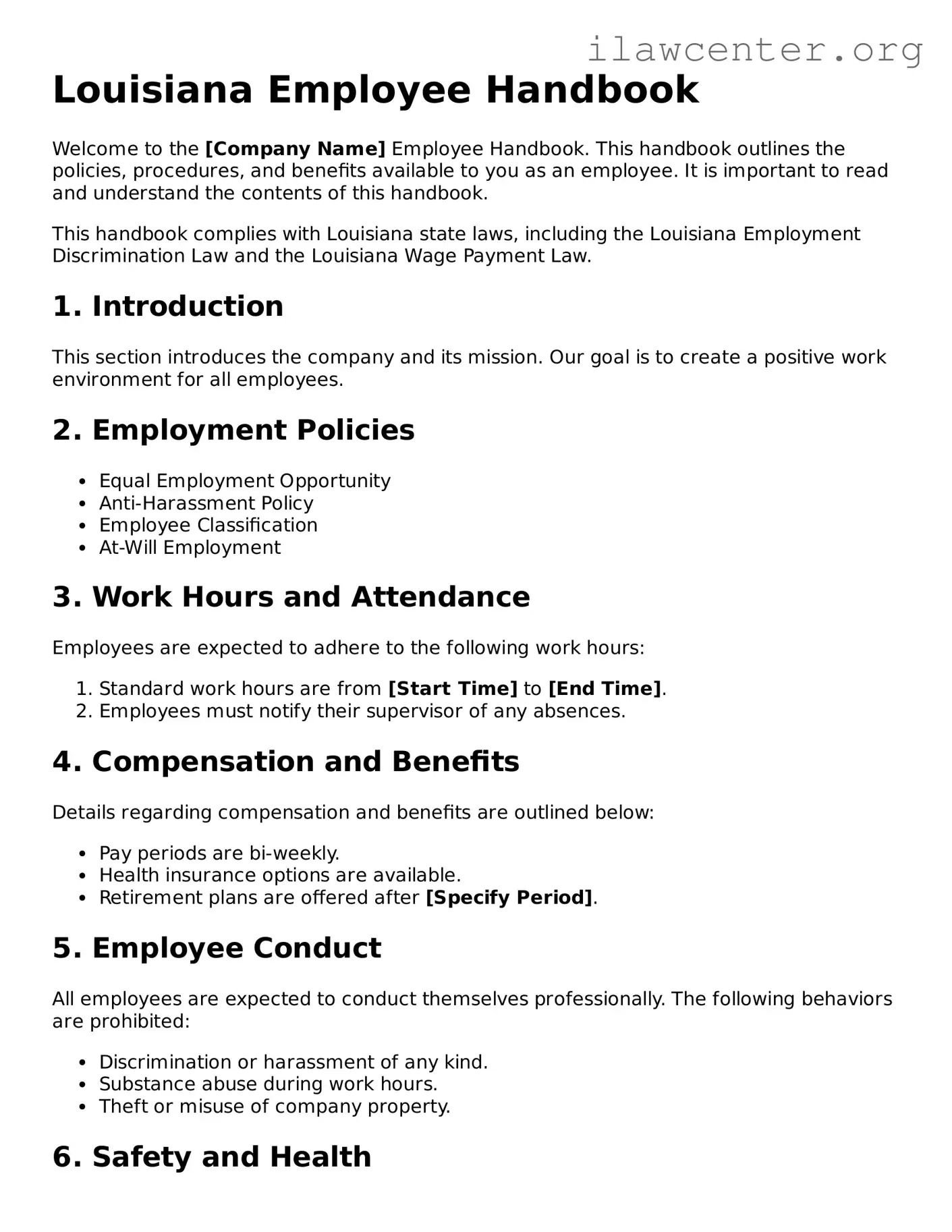
Louisiana Employee Handbook Preview

Louisiana Employee Handbook

Welcome to the [Company Name] Employee Handbook. This handbook outlines the policies, procedures, and benefits available to you as an employee. It is important to read and understand the contents of this handbook.

This handbook complies with Louisiana state laws, including the Louisiana Employment Discrimination Law and the Louisiana Wage Payment Law.

1. Introduction

This section introduces the company and its mission. Our goal is to create a positive work environment for all employees.

2. Employment Policies

  • Equal Employment Opportunity
  • Anti-Harassment Policy
  • Employee Classification
  • At-Will Employment

3. Work Hours and Attendance

Employees are expected to adhere to the following work hours:

  1. Standard work hours are from [Start Time] to [End Time].
  2. Employees must notify their supervisor of any absences.

4. Compensation and Benefits

Details regarding compensation and benefits are outlined below:

  • Pay periods are bi-weekly.
  • Health insurance options are available.
  • Retirement plans are offered after [Specify Period].

5. Employee Conduct

All employees are expected to conduct themselves professionally. The following behaviors are prohibited:

  • Discrimination or harassment of any kind.
  • Substance abuse during work hours.
  • Theft or misuse of company property.

6. Safety and Health

We prioritize your safety. Please report any unsafe conditions to your supervisor immediately.

7. Acknowledgment of Receipt

By signing below, you acknowledge that you have received, read, and understood the [Company Name] Employee Handbook.

Employee Name: [Employee Name]

Signature: [Employee Signature]

Date: [Date]

PDF Form Characteristics

Fact Name Details
Purpose The Louisiana Employee Handbook serves as a guide for employees regarding workplace policies and procedures.
Governing Laws This handbook is governed by Louisiana state labor laws, including the Louisiana Employment Security Law.
Content Requirements Employers must include information about workplace expectations, employee rights, and benefits.
Distribution Employers are required to provide the handbook to all employees, either in print or electronically.
Updates The handbook should be reviewed and updated regularly to reflect changes in laws and company policies.

Instructions on Utilizing Louisiana Employee Handbook

Completing the Louisiana Employee Handbook form is a straightforward process. Follow these steps to ensure that all necessary information is accurately provided. Once filled out, the form will serve as a vital resource for understanding workplace policies and expectations.

  1. Begin by obtaining a blank copy of the Louisiana Employee Handbook form.
  2. Carefully read any instructions provided with the form.
  3. Fill in your name in the designated space at the top of the form.
  4. Provide your job title and department where prompted.
  5. Enter the date you are completing the form.
  6. Review the sections that outline company policies and procedures.
  7. Initial each section to indicate your understanding and acceptance of the policies.
  8. Sign and date the form at the bottom to confirm your agreement.
  9. Submit the completed form to your HR department or designated supervisor.

Important Facts about Louisiana Employee Handbook

What is the Louisiana Employee Handbook form?

The Louisiana Employee Handbook form is a document that outlines the policies, procedures, and expectations of an employer in the state of Louisiana. It serves as a guide for employees, detailing their rights, responsibilities, and the workplace culture. This handbook helps ensure that both employers and employees understand the rules governing their working relationship.

Why is it important to have an Employee Handbook?

An Employee Handbook is crucial for several reasons. First, it provides clarity on company policies, which can help prevent misunderstandings. Second, it establishes a framework for workplace behavior and expectations, promoting a positive work environment. Finally, having a written handbook can protect employers legally by demonstrating that they have communicated their policies clearly to employees.

Who should receive a copy of the Employee Handbook?

Every employee should receive a copy of the Employee Handbook, ideally during their onboarding process. This ensures that they are aware of the company's policies from the start. Additionally, it’s good practice to provide updates to the handbook whenever changes occur, ensuring that all employees are informed and compliant with the latest guidelines.

Can the Employee Handbook be updated?

Yes, the Employee Handbook can and should be updated as necessary. Changes in laws, company policies, or workplace culture may require revisions. It is advisable to review the handbook periodically and communicate any updates to all employees to maintain transparency and compliance.

What should be included in the Employee Handbook?

Key elements of an Employee Handbook typically include company history, mission statement, employment policies, workplace conduct, benefits information, and procedures for reporting issues. Additionally, it should cover topics like anti-discrimination policies, safety protocols, and disciplinary procedures. Tailoring the handbook to reflect the specific needs and culture of the company is also important.

Is legal advice needed when creating an Employee Handbook?

While it is not mandatory to seek legal advice when creating an Employee Handbook, it is highly recommended. Consulting with a legal professional can help ensure that the handbook complies with federal and state laws, minimizing the risk of potential legal issues. A lawyer can also provide insights into best practices for drafting policies that protect both the employer and employees.
Common mistakes

Filling out the Louisiana Employee Handbook form can be straightforward, but many people make common mistakes that can lead to confusion or issues down the line. One frequent error is not reading the instructions carefully. Each section of the form has specific requirements. Skipping this step may result in incomplete or incorrect submissions.

Another common mistake is failing to provide accurate personal information. It’s essential to double-check your name, address, and contact details. Mistakes in this area can cause significant delays in communication or benefits.

Many individuals overlook the importance of signing and dating the form. A signature signifies that you agree to the terms outlined in the handbook. Without it, the form may be considered invalid, which can lead to misunderstandings regarding your employment rights.

Some people neglect to update their forms when their circumstances change. For instance, if you change your address or legal name, it’s crucial to submit an updated form. Failing to do so can create problems with payroll or benefits.

In addition, individuals sometimes forget to ask questions if they are unsure about certain sections. The Employee Handbook is meant to clarify your rights and responsibilities. If something is unclear, seeking clarification can prevent future issues.

Another mistake involves not keeping a copy of the completed form. This document serves as a record of your acknowledgment of the handbook. Having a copy can be useful if any disputes arise later on.

People may also rush through the form without reviewing it for errors. Typos or incorrect information can lead to complications. Taking a moment to proofread can save time and hassle later.

Some individuals fail to follow the submission guidelines. Each employer may have specific procedures for how the form should be turned in. Not adhering to these guidelines can result in your form being misplaced or ignored.

Additionally, misunderstanding the policies outlined in the handbook can lead to non-compliance. It’s vital to read and understand the policies before signing. Ignorance of the rules does not exempt you from following them.

Lastly, people sometimes assume that once the form is submitted, they no longer need to engage with it. In reality, the handbook should be reviewed regularly. Policies may change, and staying informed is essential to your employment.

Documents used along the form

The Louisiana Employee Handbook is an essential document for any business operating in the state. It outlines company policies, employee rights, and expectations. Alongside this handbook, there are several other forms and documents that can enhance workplace clarity and compliance. Below is a list of some commonly used forms that complement the Employee Handbook.

  • Job Description Form: This document provides a detailed overview of the responsibilities, qualifications, and expectations for specific positions within the company. It helps employees understand their roles and can assist in performance evaluations.
  • Employee Acknowledgment Form: This form is used to confirm that employees have received and read the Employee Handbook. It serves as a record that the employee understands the company policies outlined in the handbook.
  • Confidentiality Agreement: Often required for employees who have access to sensitive company information, this document ensures that employees understand their obligation to protect proprietary information and trade secrets.
  • Workplace Safety Policy: This document outlines safety procedures and protocols that employees must follow to maintain a safe working environment. It is crucial for compliance with state and federal safety regulations.

Utilizing these forms alongside the Employee Handbook can create a more structured and transparent workplace. They help set clear expectations and protect both the employer and employees by ensuring everyone is on the same page regarding company policies and procedures.

Similar forms

The Employee Handbook serves as a crucial resource for both employers and employees, outlining company policies, procedures, and expectations. It shares similarities with several other important documents in the workplace. Below are six documents that are similar to the Employee Handbook, along with an explanation of how they relate:

  • Code of Conduct: This document outlines the expected behaviors and ethical standards for employees. Like the Employee Handbook, it sets clear guidelines for acceptable conduct within the workplace.
  • Onboarding Manual: Often provided to new hires, this manual includes essential information about the company, similar to the Employee Handbook. It helps employees acclimate to the workplace culture and policies.
  • Policy Manual: This document details specific policies regarding various workplace issues, such as leave, harassment, and safety. It complements the Employee Handbook by providing more in-depth explanations of policies mentioned in the handbook.
  • Job Descriptions: These documents outline the responsibilities and expectations for specific roles within the company. Like the Employee Handbook, they help clarify what is expected from employees in their positions.
  • Performance Review Guidelines: This document explains the criteria and process for employee evaluations. Similar to the Employee Handbook, it sets expectations for performance and development within the organization.
  • Training Manuals: These manuals provide instructions and guidelines for specific tasks or procedures. They align with the Employee Handbook by ensuring employees understand their roles and responsibilities within the framework of company policies.

Dos and Don'ts

When filling out the Louisiana Employee Handbook form, it is important to follow certain guidelines to ensure accuracy and compliance. Below is a list of things you should and shouldn't do.

  • Do read the entire form carefully before starting to fill it out.
  • Do provide accurate and up-to-date information.
  • Do ask questions if you are unsure about any section of the form.
  • Do sign and date the form once you have completed it.
  • Don't leave any sections blank unless instructed to do so.
  • Don't use abbreviations or shorthand that may confuse the reader.
  • Don't submit the form without reviewing it for errors.

Misconceptions

Understanding the Louisiana Employee Handbook form is crucial for both employers and employees. However, several misconceptions can lead to confusion. Here are five common misconceptions:

  1. It is optional for employers to provide an employee handbook.

    This is not entirely true. While Louisiana law does not mandate an employee handbook, having one is highly recommended. It helps set clear expectations and can protect the employer in legal situations.

  2. All employee handbooks must be the same.

    Each employee handbook should be tailored to the specific needs of the business. Different industries and company cultures require different policies and procedures, making a one-size-fits-all approach ineffective.

  3. Once created, the employee handbook never needs updates.

    This is a misconception. Laws change, and company policies may evolve. Regularly reviewing and updating the handbook ensures compliance and relevance.

  4. Employees must sign the handbook to acknowledge receipt.

    While it is beneficial to have employees sign an acknowledgment form, it is not a legal requirement. However, obtaining a signed acknowledgment can provide proof that employees received and understood the handbook.

  5. The handbook covers all possible workplace scenarios.

    No handbook can address every situation that may arise. It is essential to include broad policies and procedures while also allowing for flexibility in unique circumstances.

Key takeaways

Filling out and using the Louisiana Employee Handbook form is an important step for both employers and employees. Here are some key takeaways to consider:

  • Understand the purpose of the Employee Handbook. It serves as a guide for employees about company policies, expectations, and benefits.
  • Ensure the handbook complies with Louisiana state laws. Familiarize yourself with local labor regulations to avoid legal issues.
  • Involve employees in the process. Gathering input can lead to a more comprehensive and relevant handbook.
  • Keep the language clear and straightforward. Avoid legal jargon to ensure that all employees can easily understand the content.
  • Regularly update the handbook. As laws and company policies change, so should the handbook to remain current and effective.
  • Provide training on the handbook. This ensures that employees understand the policies and how to apply them in their daily work.
  • Require employees to acknowledge receipt of the handbook. This can be done through a signature or an electronic confirmation, creating a record of compliance.
  • Consult with legal experts if needed. When in doubt, seeking professional advice can help clarify complex issues and safeguard against potential pitfalls.