Attorney-Verified  Firearm Bill of Sale Document for Louisiana

Attorney-Verified Firearm Bill of Sale Document for Louisiana

The Louisiana Firearm Bill of Sale form is a legal document used to record the sale or transfer of a firearm between two parties in the state of Louisiana. This form serves as proof of the transaction, detailing essential information about the buyer, seller, and the firearm itself. To ensure compliance with state laws and protect both parties, it is important to complete this form accurately.

For more information and to fill out the form, please click the button below.

Article Guide

In Louisiana, the Firearm Bill of Sale form serves as an essential document for anyone looking to buy or sell a firearm privately. This form provides a clear record of the transaction, detailing key information such as the names and addresses of both the buyer and seller, the make and model of the firearm, and its serial number. Additionally, it includes the date of sale and the purchase price, ensuring that both parties have a transparent understanding of the agreement. By completing this form, individuals can protect themselves legally and establish proof of ownership, which can be crucial in case of future disputes or legal inquiries. The document also helps to ensure compliance with state laws regarding firearm transfers, emphasizing the importance of responsible ownership and transaction practices. Overall, the Firearm Bill of Sale form is not just a piece of paper; it is a vital tool for promoting safe and lawful firearm exchanges in Louisiana.

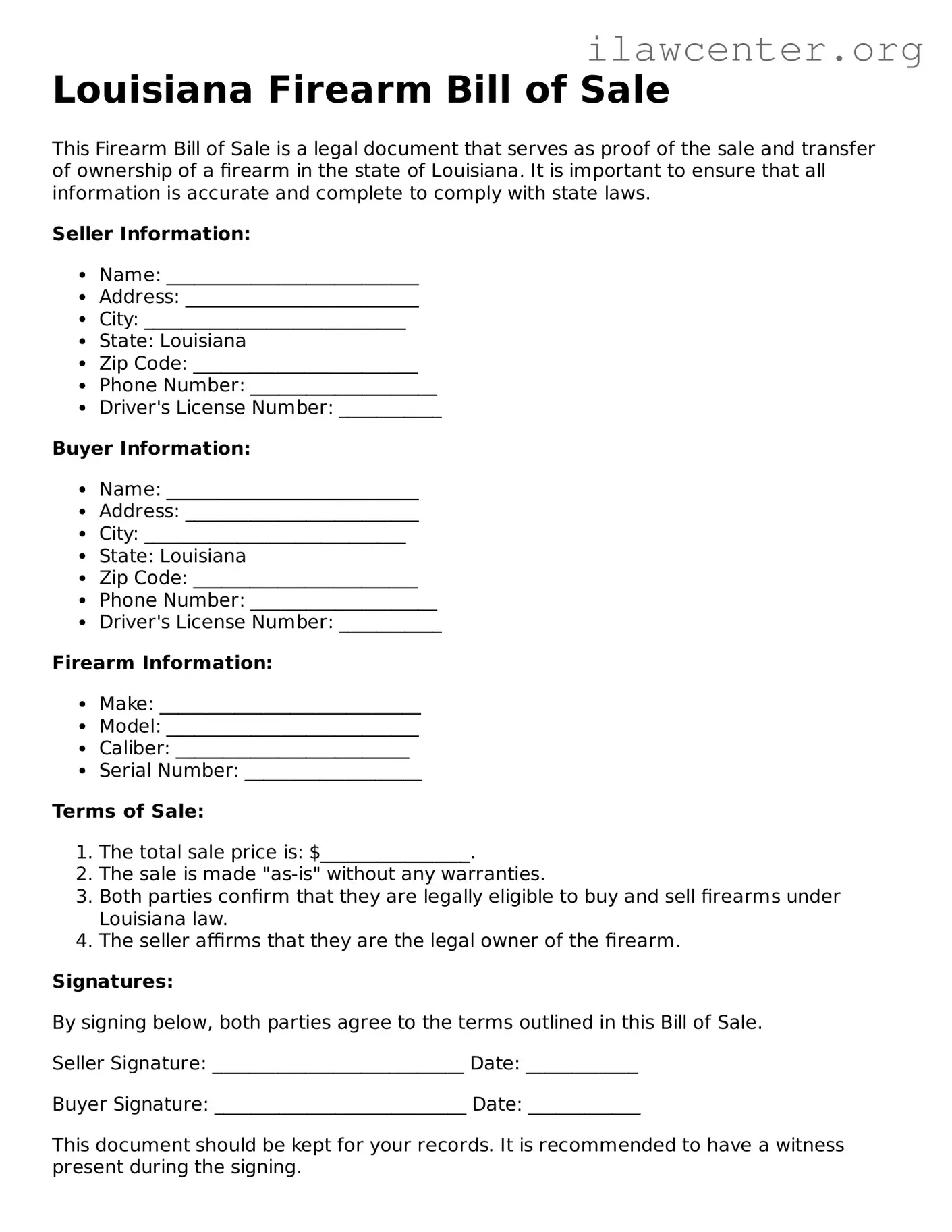
Louisiana Firearm Bill of Sale Preview

Louisiana Firearm Bill of Sale

This Firearm Bill of Sale is a legal document that serves as proof of the sale and transfer of ownership of a firearm in the state of Louisiana. It is important to ensure that all information is accurate and complete to comply with state laws.

Seller Information:

  • Name: ___________________________
  • Address: _________________________
  • City: ____________________________
  • State: Louisiana
  • Zip Code: ________________________
  • Phone Number: ____________________
  • Driver's License Number: ___________

Buyer Information:

  • Name: ___________________________
  • Address: _________________________
  • City: ____________________________
  • State: Louisiana
  • Zip Code: ________________________
  • Phone Number: ____________________
  • Driver's License Number: ___________

Firearm Information:

  • Make: ____________________________
  • Model: ___________________________
  • Caliber: _________________________
  • Serial Number: ___________________

Terms of Sale:

  1. The total sale price is: $________________.
  2. The sale is made "as-is" without any warranties.
  3. Both parties confirm that they are legally eligible to buy and sell firearms under Louisiana law.
  4. The seller affirms that they are the legal owner of the firearm.

Signatures:

By signing below, both parties agree to the terms outlined in this Bill of Sale.

Seller Signature: ___________________________ Date: ____________

Buyer Signature: ___________________________ Date: ____________

This document should be kept for your records. It is recommended to have a witness present during the signing.

PDF Form Characteristics

Fact Name Details
Purpose The Louisiana Firearm Bill of Sale form serves as a legal document to record the sale of a firearm between two parties.
Governing Law This form is governed by Louisiana Revised Statutes Title 14, Section 95.1.
Parties Involved The form requires information from both the seller and the buyer, including their names and addresses.
Firearm Description A detailed description of the firearm must be included, such as the make, model, and serial number.
Transfer Date The date of the transfer must be clearly stated on the form.
Signatures Both parties must sign the document to validate the sale.
Record Keeping It is advisable for both the seller and the buyer to keep a copy of the completed form for their records.
Legal Protection Using this form provides legal protection for both parties in case of disputes regarding the sale.

Instructions on Utilizing Louisiana Firearm Bill of Sale

Completing the Louisiana Firearm Bill of Sale form is an important step in the process of transferring ownership of a firearm. This document serves as proof of the sale and outlines key details about the transaction. Following these instructions will ensure that all necessary information is accurately recorded.

  1. Begin by entering the date of the transaction at the top of the form.
  2. Provide the full name of the seller. Include the seller's address and contact information as well.
  3. Next, fill in the buyer's full name, address, and contact information.
  4. Clearly describe the firearm being sold. Include details such as the make, model, caliber, and serial number.
  5. Indicate the sale price of the firearm. This should reflect the agreed-upon amount between the buyer and seller.
  6. Both the seller and the buyer must sign and date the form to validate the transaction.
  7. Make copies of the completed form for both parties to keep for their records.

Important Facts about Louisiana Firearm Bill of Sale

What is a Louisiana Firearm Bill of Sale?

A Louisiana Firearm Bill of Sale is a legal document that records the sale or transfer of a firearm between two parties. This form serves as proof of the transaction and includes essential details such as the buyer's and seller's information, the description of the firearm, and the date of the sale. It is important for both parties to keep a copy for their records to ensure compliance with state laws regarding firearm ownership and transfer.

Is a Bill of Sale required for private firearm sales in Louisiana?

While Louisiana law does not mandate a Bill of Sale for private firearm sales, it is highly recommended. Having a Bill of Sale provides legal protection for both the buyer and seller. It helps establish ownership and can serve as evidence in case of any future disputes. Furthermore, it can demonstrate that the buyer is legally allowed to own a firearm, which is crucial in avoiding potential legal issues.

What information should be included in the Bill of Sale?

The Bill of Sale should include several key pieces of information. This includes the full names and addresses of both the buyer and seller, the date of the transaction, a detailed description of the firearm (including make, model, caliber, and serial number), and the sale price. Both parties should sign and date the document to validate the transaction. Including this information helps ensure clarity and reduces the likelihood of misunderstandings.

Do I need to have the Bill of Sale notarized?

No, Louisiana law does not require the Bill of Sale to be notarized. However, having the document notarized can add an extra layer of legitimacy and security to the transaction. A notary public can verify the identities of the parties involved and witness the signing of the document. This can be particularly useful if any disputes arise in the future.

Can I use a Bill of Sale for a firearm purchased from a dealer?

Typically, a Bill of Sale is not necessary when purchasing a firearm from a licensed dealer. Dealers usually provide their own documentation, which serves as proof of purchase. This documentation often includes the buyer’s information and details about the firearm. However, if you wish to keep a personal record, you may still create a Bill of Sale for your own files.

What should I do if I lose my Bill of Sale?

If you lose your Bill of Sale, it is advisable to try to obtain a replacement from the seller, if possible. If that is not an option, you may want to create a new Bill of Sale that includes the same information as the original. Both parties should sign this new document to acknowledge the transaction. Keeping a digital copy or storing the document in a safe place can help prevent future loss.

Are there any restrictions on who can buy a firearm in Louisiana?

Yes, certain restrictions apply. Individuals who are prohibited from owning firearms include those with felony convictions, individuals who have been declared mentally incompetent, and those subject to domestic violence restraining orders. It is essential for both the buyer and seller to verify that the buyer is legally eligible to purchase a firearm. A Bill of Sale can serve as a record of this verification process.

What happens if I sell a firearm to someone who is prohibited from owning one?

Transferring a firearm to someone who is not legally allowed to own one can lead to serious legal consequences for the seller. It is crucial to conduct due diligence before completing the sale. If you suspect that the buyer may be prohibited, it is best to refrain from the sale and seek legal advice. Keeping thorough records, including the Bill of Sale, can also help demonstrate that you acted in good faith during the transaction.
Common mistakes

When filling out the Louisiana Firearm Bill of Sale form, one common mistake is failing to provide complete information about the firearm. This includes details such as the make, model, caliber, and serial number. Omitting any of these details can lead to confusion or disputes later on. A well-documented sale protects both the buyer and the seller, ensuring that there is a clear record of the transaction.

Another frequent error involves the lack of proper identification for both parties. The form requires that both the buyer and seller present valid identification. If this step is overlooked, it can invalidate the sale. It is crucial to include the full names and addresses of both individuals, along with their driver's license numbers or other identifying information. This not only fulfills legal requirements but also helps establish accountability.

People often forget to sign the form. A signature is essential to indicate that both parties agree to the terms of the sale. Without signatures, the document may not hold up in legal situations. Therefore, it is important to ensure that both the buyer and seller have signed the form before completing the transaction.

Lastly, many individuals neglect to keep a copy of the completed Bill of Sale. This document serves as proof of the transaction and can be crucial in case of any future disputes or legal questions. Both parties should retain a copy for their records. Failing to do so can lead to complications, especially if the firearm is involved in any legal matters down the line.

Documents used along the form

When buying or selling a firearm in Louisiana, several other forms and documents may be needed alongside the Firearm Bill of Sale. These documents help ensure that the transaction is legal and well-documented. Here’s a list of commonly used forms:

  • Background Check Form: This form is often required to ensure the buyer is legally eligible to purchase a firearm. It typically includes personal information and is submitted for a background check.
  • Firearm Transfer Form: This document records the details of the firearm being transferred, including its make, model, and serial number. It helps track ownership and is important for both parties.
  • Identification Documents: Buyers may need to present a government-issued ID, such as a driver’s license or passport, to verify their identity and age during the transaction.
  • Concealed Carry Permit: If applicable, this permit shows that the buyer has undergone the necessary training and background checks to carry a concealed firearm legally.
  • Affidavit of Eligibility: This sworn statement affirms that the buyer meets all legal requirements to own a firearm, such as not having felony convictions or restraining orders.
  • Transfer of Ownership Receipt: This document serves as proof of the transfer of ownership. It can be useful for future reference or in case of disputes.
  • State-Specific Regulations Document: This may outline any additional laws or requirements specific to Louisiana regarding firearm sales and ownership.
  • Notarized Statement: In some cases, having the Bill of Sale notarized adds an extra layer of authenticity and can help prevent disputes about the transaction.

Having these documents ready can streamline the process and ensure that everything is handled properly. Always check local laws to ensure compliance with all regulations when buying or selling firearms.

Similar forms

The Firearm Bill of Sale form serves a specific purpose in documenting the sale of a firearm. Several other documents share similarities with it, particularly in their function of recording the transfer of ownership or assets. Here are eight documents that are comparable:

  • Vehicle Bill of Sale: This document records the sale of a vehicle, detailing the buyer, seller, and vehicle information, similar to how a Firearm Bill of Sale captures firearm details.
  • Boat Bill of Sale: Used for the transfer of ownership of a boat, this document includes buyer and seller information, much like the firearm form.
  • Real Estate Purchase Agreement: This agreement outlines the terms of a property sale, documenting the buyer and seller, akin to the firearm transaction.
  • Personal Property Bill of Sale: This document is used for the sale of personal items, capturing details of the transaction similar to the firearm bill.
  • Business Bill of Sale: When selling a business, this document details the terms and conditions, paralleling the firearm sale process.
  • Lease Agreement: While primarily for rental, it documents the terms between lessor and lessee, similar to how a firearm bill outlines ownership transfer.
  • Stock Transfer Agreement: This document facilitates the transfer of stock ownership, requiring details about the buyer and seller, much like the firearm bill.
  • Gift Deed: Used to transfer property as a gift, it includes the names of the giver and receiver, similar to the identification required in a firearm sale.

Dos and Don'ts

When filling out the Louisiana Firearm Bill of Sale form, it is important to follow certain guidelines to ensure accuracy and compliance. Below is a list of things you should and shouldn't do.

  • Do provide accurate information about the firearm, including make, model, and serial number.
  • Do include the full names and addresses of both the buyer and seller.
  • Do ensure that both parties sign and date the form.
  • Do keep a copy of the completed Bill of Sale for your records.
  • Don't leave any sections of the form blank.
  • Don't forge or alter any information on the form.
  • Don't forget to check local laws regarding firearm sales.
  • Don't rush through the process; take your time to ensure everything is filled out correctly.

Misconceptions

The Louisiana Firearm Bill of Sale form is often misunderstood. Here are ten common misconceptions about this document, along with clarifications to help clear up any confusion.

  1. It is not required to use a Bill of Sale for firearm transactions.

    While it is not legally mandated, having a Bill of Sale is highly recommended. This document provides proof of ownership and can protect both the buyer and seller in case of disputes.

  2. All firearm sales require a background check.

    In private sales, background checks are not always required in Louisiana. However, it is advisable to conduct one for safety and legal compliance.

  3. Only licensed dealers can sell firearms.

    Private individuals can sell firearms without a license, provided they comply with state laws. The Bill of Sale serves as a record of the transaction.

  4. The Bill of Sale is only necessary for handguns.

    This document is applicable to all types of firearms, including rifles and shotguns. It serves as proof of ownership regardless of the firearm type.

  5. Once the Bill of Sale is signed, the transaction is final and cannot be reversed.

    While the Bill of Sale indicates a completed transaction, buyers and sellers can agree to reverse the sale if both parties consent.

  6. There is a specific format that must be followed for the Bill of Sale.

    While it should include essential details such as the names of both parties, firearm description, and signatures, there is no mandated format. Flexibility exists in how it is drafted.

  7. The seller must keep a copy of the Bill of Sale.

    Although it is good practice for the seller to retain a copy, it is not a legal requirement. Both parties should ideally keep a copy for their records.

  8. Only residents of Louisiana can use the Bill of Sale.

    Individuals from other states can also use this form when purchasing firearms in Louisiana, but they must adhere to their home state’s laws regarding firearm ownership.

  9. The Bill of Sale protects against all legal issues.

    While it provides some protection, it does not shield individuals from liability if the firearm is used in a crime. It is essential to ensure the firearm is legally owned and sold.

  10. Filling out the Bill of Sale is a lengthy process.

    The form can be completed quickly. It typically requires only basic information, making it a straightforward task.

Understanding these misconceptions can help ensure that firearm transactions in Louisiana are conducted smoothly and legally. Always consider seeking advice from a knowledgeable source if there are uncertainties.

Key takeaways

When filling out and using the Louisiana Firearm Bill of Sale form, there are several important points to consider. Here are key takeaways:

  1. Provide Accurate Information: Ensure that all details, such as the names, addresses, and firearm descriptions, are correct. This helps prevent any misunderstandings or legal issues.
  2. Include Identification: Both the buyer and seller should provide valid identification. This is crucial for verifying identities and ensuring compliance with state laws.
  3. Document the Transaction: The Bill of Sale serves as a record of the transaction. Keep a copy for your records, as it may be needed for future reference.
  4. Understand Legal Requirements: Familiarize yourself with Louisiana's laws regarding firearm sales. Knowing the regulations can help you avoid potential legal problems.
  5. Signatures Are Essential: Both parties must sign the form. Without signatures, the document may not be considered valid.

By following these guidelines, individuals can navigate the process of transferring firearm ownership more smoothly.