Attorney-Verified  Hold Harmless Agreement Document for Louisiana

Attorney-Verified Hold Harmless Agreement Document for Louisiana

The Louisiana Hold Harmless Agreement is a legal document designed to protect one party from liability for any damages or injuries that may occur during a specified activity or event. By signing this agreement, individuals agree to assume responsibility for any risks involved, ensuring that the other party is not held accountable. If you need to fill out this form, click the button below.

Article Guide

The Louisiana Hold Harmless Agreement form serves as a crucial legal document that protects one party from liability for any damages or injuries that may occur during a specified activity or event. This agreement is particularly important in various contexts, such as construction projects, rental agreements, or special events, where one party may assume risks on behalf of another. By signing this form, the party agreeing to hold harmless effectively waives their right to seek compensation for any losses incurred, thereby providing a layer of security for the other party involved. It typically outlines the scope of the agreement, detailing the specific activities covered and any limitations or exclusions. Understanding the nuances of this form is essential for both individuals and businesses, as it helps clarify responsibilities and mitigate potential legal disputes. In Louisiana, adhering to the specific requirements of this agreement ensures that it is enforceable and serves its intended purpose of risk management.

Louisiana Hold Harmless Agreement Preview

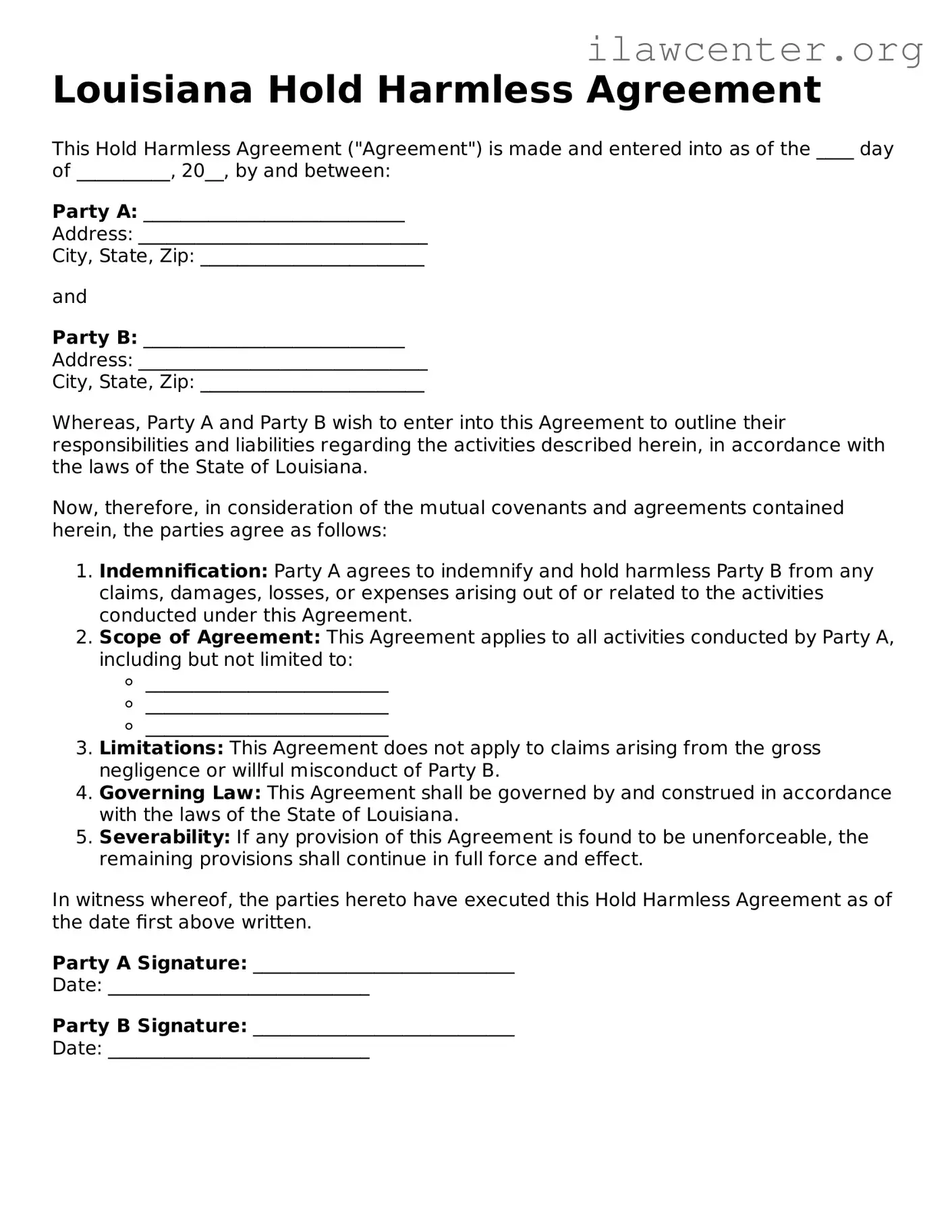
Louisiana Hold Harmless Agreement

This Hold Harmless Agreement ("Agreement") is made and entered into as of the ____ day of __________, 20__, by and between:

Party A: ____________________________
Address: _______________________________
City, State, Zip: ________________________

and

Party B: ____________________________
Address: _______________________________
City, State, Zip: ________________________

Whereas, Party A and Party B wish to enter into this Agreement to outline their responsibilities and liabilities regarding the activities described herein, in accordance with the laws of the State of Louisiana.

Now, therefore, in consideration of the mutual covenants and agreements contained herein, the parties agree as follows:

  1. Indemnification: Party A agrees to indemnify and hold harmless Party B from any claims, damages, losses, or expenses arising out of or related to the activities conducted under this Agreement.
  2. Scope of Agreement: This Agreement applies to all activities conducted by Party A, including but not limited to:
    • __________________________
    • __________________________
    • __________________________
  3. Limitations: This Agreement does not apply to claims arising from the gross negligence or willful misconduct of Party B.
  4. Governing Law: This Agreement shall be governed by and construed in accordance with the laws of the State of Louisiana.
  5. Severability: If any provision of this Agreement is found to be unenforceable, the remaining provisions shall continue in full force and effect.

In witness whereof, the parties hereto have executed this Hold Harmless Agreement as of the date first above written.

Party A Signature: ____________________________
Date: ____________________________

Party B Signature: ____________________________
Date: ____________________________

PDF Form Characteristics

Fact Name Description
Purpose The Louisiana Hold Harmless Agreement is designed to protect one party from legal liability for damages or injuries that may occur during a specified activity.
Governing Law This agreement is governed by the laws of the State of Louisiana.
Parties Involved Typically, there are two parties: the indemnitor (the party providing protection) and the indemnitee (the party being protected).
Use Cases Commonly used in contracts related to events, construction, and recreational activities.
Enforceability For the agreement to be enforceable, it must be clear, specific, and mutually agreed upon by both parties.
Limitations The agreement cannot protect against gross negligence or willful misconduct.
Duration The duration of the hold harmless provision should be clearly stated within the agreement.

Instructions on Utilizing Louisiana Hold Harmless Agreement

After obtaining the Louisiana Hold Harmless Agreement form, you will need to fill it out carefully to ensure all necessary information is provided. This process is straightforward and involves a few key steps that will guide you through the completion of the form.

  1. Start by reading the entire form to understand its requirements and sections.
  2. In the first section, fill in your full name and contact information. Make sure to include your address, phone number, and email address.
  3. Next, identify the party or organization you are entering into the agreement with. Write their name and contact details in the designated area.
  4. In the following section, specify the activity or event related to the agreement. Clearly describe what the agreement pertains to.
  5. Review any clauses or conditions outlined in the form. If there are areas that require your acknowledgment or signature, ensure you understand them fully.
  6. Sign and date the form at the bottom. Your signature indicates your agreement to the terms outlined.
  7. Finally, make a copy of the completed form for your records before submitting it to the relevant party.

Important Facts about Louisiana Hold Harmless Agreement

What is a Louisiana Hold Harmless Agreement?

A Louisiana Hold Harmless Agreement is a legal document designed to protect one party from liability for any damages or injuries that may occur during a specific activity or event. This agreement essentially states that one party agrees not to hold the other party responsible for certain risks. It's often used in various situations, such as rental agreements, construction projects, or events where one party may be exposed to potential hazards. By signing this agreement, the parties acknowledge the risks involved and agree to take responsibility for their own actions.

Who should use a Hold Harmless Agreement in Louisiana?

Individuals and businesses involved in activities that carry a risk of injury or damage should consider using a Hold Harmless Agreement. For example, property owners renting out space for events may require renters to sign this document to protect themselves from liability. Similarly, contractors may use it to ensure that clients understand the risks associated with construction work. Anyone organizing an event, such as a festival or sporting event, can also benefit from this agreement to mitigate potential legal issues.

What are the key components of a Hold Harmless Agreement?

A comprehensive Hold Harmless Agreement typically includes several essential components. First, it should clearly identify the parties involved, outlining who is assuming liability and who is being protected. Next, it should describe the specific activity or event covered by the agreement. Importantly, the document must detail the scope of the hold harmless clause, specifying what types of claims or damages are included. Finally, it should include a section for signatures and dates, indicating that all parties agree to the terms laid out in the agreement.

Is a Hold Harmless Agreement enforceable in Louisiana?

Yes, a Hold Harmless Agreement can be enforceable in Louisiana, provided it meets certain legal requirements. For the agreement to hold up in court, it must be clear, specific, and voluntarily signed by all parties involved. Courts generally uphold these agreements unless they are found to be unconscionable or against public policy. It's important to remember that while a Hold Harmless Agreement can offer significant protection, it may not shield a party from liability in cases of gross negligence or willful misconduct.
Common mistakes

Filling out the Louisiana Hold Harmless Agreement form can be straightforward, but several common mistakes often occur. One frequent error is failing to provide complete information. Each section of the form requires specific details, such as names, dates, and descriptions of the activities involved. Incomplete entries can lead to misunderstandings or disputes later on.

Another mistake is not understanding the implications of the agreement. The Hold Harmless Agreement is designed to protect one party from liability for certain actions. If individuals do not fully comprehend what they are agreeing to, they may inadvertently accept risks they did not intend to. It is crucial to read the document carefully and seek clarification if needed.

Additionally, individuals sometimes neglect to sign and date the form. A signature is essential for the agreement to be valid. Without it, the document may not hold up in a legal context. It is advisable to double-check that all required signatures are present before submitting the form.

Lastly, overlooking the need for witnesses or notarization can be a significant oversight. Certain situations may require the presence of a witness or a notary public to validate the agreement. Failing to include these elements can render the agreement unenforceable. Taking the time to ensure all formalities are observed will help protect all parties involved.

Documents used along the form

A Louisiana Hold Harmless Agreement is often used in various contexts, particularly in construction, real estate, and event planning. However, it is typically accompanied by other forms and documents that serve complementary purposes. Below is a list of commonly associated documents that help clarify responsibilities, establish terms, and protect parties involved in agreements.

  • Indemnity Agreement: This document outlines the obligation of one party to compensate another for certain damages or losses. It is often used alongside a Hold Harmless Agreement to provide additional protection against liability.
  • Waiver of Liability: This form is used to relinquish the right to pursue legal claims against another party. It is particularly common in recreational activities, where participants acknowledge risks and agree not to hold organizers responsible for injuries.
  • Insurance Certificate: A document that verifies the existence of insurance coverage. It provides proof that a party is insured and can cover potential liabilities that may arise during the execution of a contract.
  • Contractor Agreement: This formal agreement defines the terms of the relationship between a contractor and a client. It specifies the scope of work, payment terms, and responsibilities, often integrating Hold Harmless clauses to manage liability.
  • Release Form: This document releases one party from liability for any claims that may arise from a specific activity or event. It is often used in conjunction with Hold Harmless Agreements to ensure comprehensive protection.
  • Scope of Work Document: This outlines the specific tasks and responsibilities to be performed under a contract. It helps clarify expectations and can include Hold Harmless provisions to protect against unforeseen issues.
  • Safety Agreement: This document establishes safety protocols and responsibilities for parties involved in a project. It may include Hold Harmless language to protect against claims arising from safety violations.
  • Subcontractor Agreement: This agreement details the relationship between a primary contractor and a subcontractor. It often contains Hold Harmless clauses to allocate risk and liability between the parties.

Understanding these associated documents can enhance the effectiveness of a Louisiana Hold Harmless Agreement. Each document serves a distinct purpose, contributing to a more comprehensive risk management strategy. When used together, they help ensure that all parties are aware of their responsibilities and liabilities, fostering a clearer and more secure contractual environment.

Similar forms

The Hold Harmless Agreement is a legal document that shares similarities with several other agreements and contracts. Each of these documents serves to protect parties from liability or to clarify responsibilities. Below is a list of nine documents that are similar to the Hold Harmless Agreement:

  • Liability Waiver: This document releases one party from liability for injuries or damages that may occur during a specific activity, similar to how a Hold Harmless Agreement protects against claims.
  • Indemnity Agreement: This agreement involves one party agreeing to compensate another for certain damages or losses, much like the Hold Harmless Agreement.
  • Release of Liability: This document allows a participant to waive their right to sue for injuries sustained during an event, mirroring the protective intent of a Hold Harmless Agreement.
  • Non-Disclosure Agreement (NDA): While primarily focused on confidentiality, NDAs can include clauses that limit liability for the disclosure of sensitive information, akin to the protective nature of Hold Harmless Agreements.
  • Service Agreement: This document outlines the responsibilities of each party and may include indemnity clauses, similar to the provisions found in a Hold Harmless Agreement.
  • Rental Agreement: Often includes clauses that protect landlords from liability for injuries occurring on the property, paralleling the intent of a Hold Harmless Agreement.
  • Partnership Agreement: This document may contain indemnity provisions to protect partners from each other's actions, similar to the protections offered in a Hold Harmless Agreement.
  • Event Participation Agreement: Participants may agree to hold organizers harmless for any injuries sustained during the event, reflecting the core principle of a Hold Harmless Agreement.
  • Construction Contract: These contracts often include indemnification clauses that protect one party from claims related to construction activities, aligning with the objectives of a Hold Harmless Agreement.

Dos and Don'ts

When filling out the Louisiana Hold Harmless Agreement form, it's important to be careful and precise. Here are some key points to consider:

  • Do read the entire agreement carefully. Understand all terms and conditions before signing.
  • Do provide accurate information. Ensure that all details, such as names and dates, are correct.
  • Don't rush through the process. Take your time to think through each section and its implications.
  • Don't ignore legal advice. If you have questions, seek guidance from a qualified attorney.

Misconceptions

Understanding the Louisiana Hold Harmless Agreement is essential for anyone involved in contracts within the state. However, several misconceptions can lead to confusion. Here are six common misconceptions:

  1. It protects against all types of liability.

    This is not true. A Hold Harmless Agreement primarily protects against specific liabilities outlined in the contract. It does not offer blanket protection against all potential claims.

  2. It is legally binding in all situations.

    While these agreements are generally enforceable, their validity can depend on the context and how they are written. Courts may not uphold them if they are deemed unfair or overly broad.

  3. Only one party needs to sign the agreement.

    Both parties typically need to sign the Hold Harmless Agreement for it to be effective. A lack of mutual consent can render the agreement unenforceable.

  4. It eliminates the need for insurance.

    This is a misconception. While a Hold Harmless Agreement can mitigate liability, it does not replace the need for adequate insurance coverage. Insurance remains a crucial safety net.

  5. It can be used for any type of agreement.

    Hold Harmless Agreements are most commonly used in specific contexts, such as construction or event planning. They may not be suitable for all types of contracts.

  6. It absolves negligence.

    This is misleading. A Hold Harmless Agreement cannot protect a party from liability arising from their own gross negligence or willful misconduct. Courts often view such provisions with skepticism.

Clarifying these misconceptions can help individuals and businesses navigate their contractual obligations more effectively.

Key takeaways

When dealing with the Louisiana Hold Harmless Agreement form, it is crucial to understand its implications and how to fill it out correctly. Here are some key takeaways:

  • Understand the Purpose: The Hold Harmless Agreement is designed to protect one party from liability for certain actions or events. It is essential to grasp why you are using this form.
  • Identify the Parties: Clearly specify who is involved in the agreement. This includes the party being held harmless and the party assuming liability.
  • Be Specific: Detail the activities or circumstances that the agreement covers. Vague language can lead to misunderstandings or disputes.
  • Consult Legal Counsel: While the form is straightforward, seeking legal advice can ensure that the agreement meets all necessary legal requirements and protects your interests.
  • Review the Agreement Thoroughly: Before signing, read through the entire document carefully. Ensure that all terms are clear and acceptable to both parties.
  • Keep Copies: After the agreement is signed, make sure to keep copies for your records. This is important for future reference and potential disputes.