Attorney-Verified  Homeschool Letter of Intent Document for Louisiana

Attorney-Verified Homeschool Letter of Intent Document for Louisiana

The Louisiana Homeschool Letter of Intent form is a crucial document that parents must submit to officially notify the state of their decision to homeschool their children. This form serves as a formal declaration of intent and helps ensure compliance with state regulations. If you're ready to take this important step in your homeschooling journey, fill out the form by clicking the button below.

Article Guide

In Louisiana, families choosing to homeschool their children must navigate a few essential steps to comply with state regulations, one of which is the Homeschool Letter of Intent form. This form serves as a formal notification to the state that a parent or guardian intends to provide home-based education for their child. It requires the inclusion of specific information, such as the names and ages of the children being homeschooled, as well as the educational curriculum or approach that will be utilized. Additionally, it must be submitted to the appropriate local school district, ensuring that the state is aware of the family's educational plans. This process not only establishes a clear intention to homeschool but also helps maintain a framework for educational accountability. Understanding the nuances of this form is crucial for parents embarking on the homeschooling journey, as it lays the foundation for a legally recognized and structured educational experience.

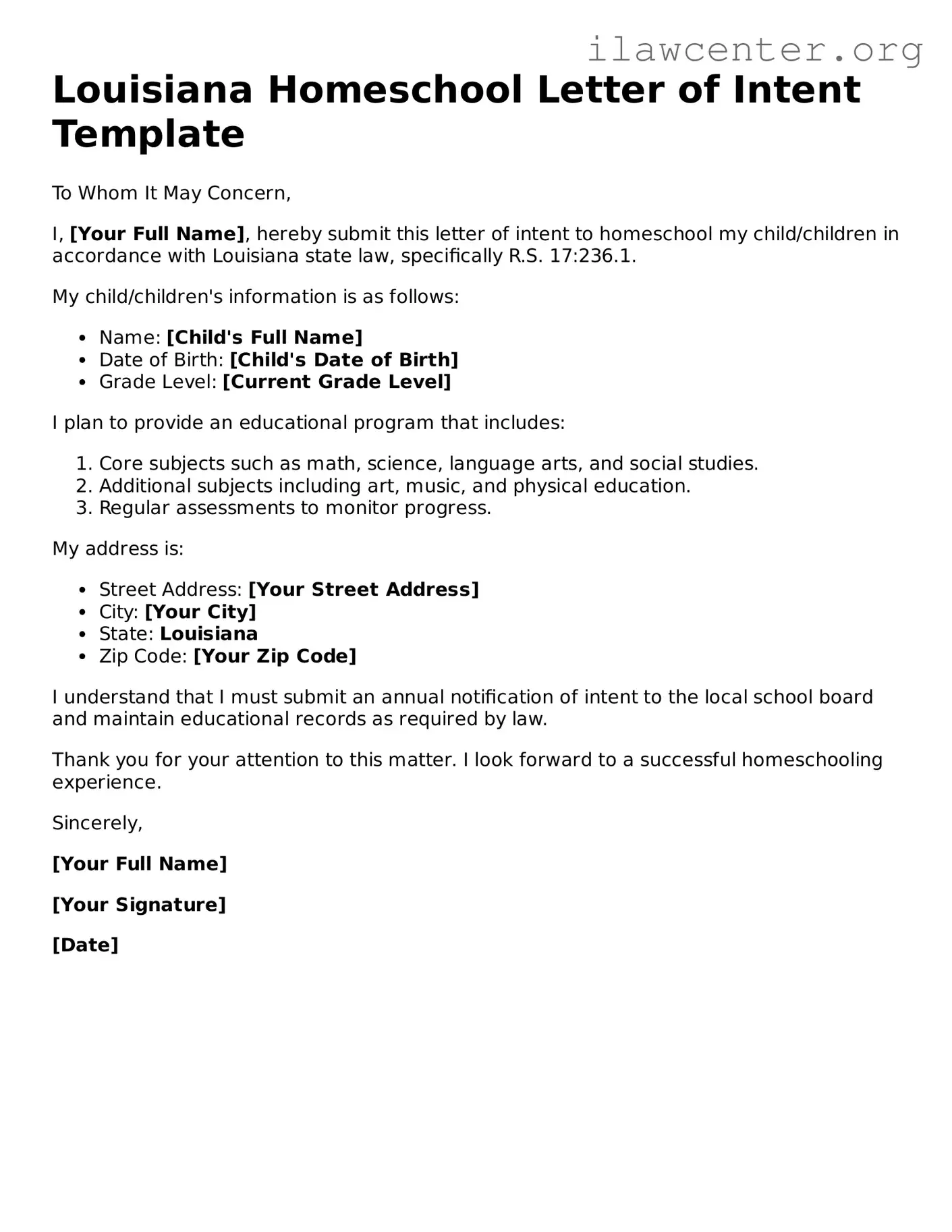
Louisiana Homeschool Letter of Intent Preview

Louisiana Homeschool Letter of Intent Template

To Whom It May Concern,

I, [Your Full Name], hereby submit this letter of intent to homeschool my child/children in accordance with Louisiana state law, specifically R.S. 17:236.1.

My child/children's information is as follows:

  • Name: [Child's Full Name]
  • Date of Birth: [Child's Date of Birth]
  • Grade Level: [Current Grade Level]

I plan to provide an educational program that includes:

  1. Core subjects such as math, science, language arts, and social studies.
  2. Additional subjects including art, music, and physical education.
  3. Regular assessments to monitor progress.

My address is:

  • Street Address: [Your Street Address]
  • City: [Your City]
  • State: Louisiana
  • Zip Code: [Your Zip Code]

I understand that I must submit an annual notification of intent to the local school board and maintain educational records as required by law.

Thank you for your attention to this matter. I look forward to a successful homeschooling experience.

Sincerely,

[Your Full Name]

[Your Signature]

[Date]

PDF Form Characteristics

Fact Name Details
Governing Law The Louisiana Homeschool Letter of Intent is governed by Louisiana Revised Statutes, Title 17, Section 236.1.
Purpose This form serves to notify the state of a parent's intention to homeschool their child.
Submission Deadline Parents must submit the Letter of Intent at least 14 days before the start of the school year.
Required Information The form requires the child's name, date of birth, and address, along with the parent's contact information.
Annual Renewal Families must submit a new Letter of Intent each year to continue homeschooling.
Record Keeping Parents are encouraged to keep a copy of the submitted form for their records.
Eligibility All children aged 7 to 18 are eligible to be homeschooled under Louisiana law.
Notification to Local School District The local school district receives a copy of the Letter of Intent once submitted.
Additional Requirements Parents must also comply with Louisiana's educational requirements for homeschooling, including curriculum standards.

Instructions on Utilizing Louisiana Homeschool Letter of Intent

After you complete the Louisiana Homeschool Letter of Intent form, you will need to submit it to the appropriate school district. This step is essential to ensure that your homeschooling plans are officially recognized. Follow the steps below to fill out the form accurately.

  1. Obtain the Louisiana Homeschool Letter of Intent form from your local school district's website or office.
  2. Fill in your name and contact information at the top of the form.
  3. Provide the name and age of each child you plan to homeschool.
  4. Indicate the educational curriculum you plan to use for homeschooling.
  5. Include the date you plan to start homeschooling.
  6. Sign and date the form at the bottom.
  7. Make a copy of the completed form for your records.
  8. Submit the original form to your local school district office, either in person or by mail.

Important Facts about Louisiana Homeschool Letter of Intent

What is the Louisiana Homeschool Letter of Intent?

The Louisiana Homeschool Letter of Intent is a formal notification that you, as a parent or guardian, intend to homeschool your child. This letter informs the state that you will be taking responsibility for your child's education outside of the traditional school system.

Who needs to submit the Letter of Intent?

If you are planning to homeschool your child in Louisiana, you must submit the Letter of Intent. This applies to children who are of school age, typically between 7 and 18 years old. It’s important to notify the state to ensure you comply with homeschooling laws.

When should I submit the Letter of Intent?

You should submit the Letter of Intent at the beginning of your homeschooling journey. It’s best to do this before the school year starts or as soon as you decide to switch from public or private schooling to homeschooling. This helps ensure you meet state requirements.

How do I submit the Letter of Intent?

What information is required in the Letter of Intent?

Your Letter of Intent should include your name, address, and the names and ages of your children. You may also want to specify the educational program you plan to use. Keep it straightforward and clear to avoid any confusion.

Is there a deadline for submitting the Letter of Intent?

While there isn't a strict deadline, it’s advisable to submit the Letter of Intent as soon as you decide to homeschool. This helps you stay compliant with state regulations and allows you to start your educational program without delay.

What happens after I submit the Letter of Intent?

After you submit the Letter of Intent, your local school district will acknowledge receipt. You are then free to begin homeschooling your child. Keep in mind that you will need to maintain records of your child’s education and progress throughout the year.

Can I change my mind after submitting the Letter of Intent?

Yes, you can change your mind. If you decide to enroll your child back into a public or private school, you simply need to notify the school district. It’s a good idea to keep documentation of your homeschooling activities in case you need to provide proof of education.
Common mistakes

Filling out the Louisiana Homeschool Letter of Intent form can be straightforward, but many make common mistakes that can lead to delays or complications. One frequent error is not providing complete information. The form requires specific details about the student and the parent or guardian. Omitting any required fields can result in the form being returned for corrections, which can slow down the approval process.

Another mistake is failing to sign and date the form. This step might seem minor, but without a signature, the document is not valid. Parents often overlook this critical detail in their rush to submit the form. It’s essential to double-check that all necessary signatures are included before sending it off.

Some individuals also misinterpret the deadline for submission. The Louisiana Department of Education has specific timelines for when the Letter of Intent must be submitted. Missing this deadline can lead to complications in the homeschooling process. Make sure to mark your calendar and submit the form on time to avoid any issues.

Additionally, many people do not keep a copy of the submitted form. It is important to retain a copy for personal records. This can help in case there are any questions or issues that arise later. Having documentation can provide peace of mind and assist in any future communications with the school district.

Lastly, some parents fail to understand the implications of their choice to homeschool. The Letter of Intent is not just a formality; it signifies a commitment to providing an education at home. Understanding the responsibilities that come with this decision is crucial. Parents should be prepared to meet educational standards and maintain records of their child's progress.

Documents used along the form

When filing the Louisiana Homeschool Letter of Intent form, there are several other documents that may be useful in ensuring compliance with state regulations. These documents help provide clarity and organization to your homeschooling journey. Below is a list of commonly used forms and documents.

  • Curriculum Plan: This document outlines the subjects and materials you plan to use for your homeschooling. It provides a roadmap for your educational goals and can be helpful for both parents and students.
  • Attendance Records: Keeping a log of daily attendance is important. This document helps track the number of days your child is engaged in learning activities, which is often required by state regulations.
  • Progress Reports: These reports summarize your child's academic progress over a specific period. They can include grades, completed assignments, and assessments, providing a clear picture of educational achievements.
  • Standardized Test Results: If you choose to administer standardized tests, keeping the results on file is beneficial. These results can demonstrate your child's academic performance and are sometimes required for compliance with state homeschooling laws.

By preparing these additional documents, you can create a comprehensive homeschooling plan that meets Louisiana's requirements and supports your child's education. Keeping everything organized will make the process smoother for both you and your student.

Similar forms

The Homeschool Letter of Intent serves as an important document for families choosing to educate their children at home. It notifies the appropriate educational authorities of a family's intention to homeschool. Several other documents share similar purposes or functions. Below is a list of these documents, each accompanied by an explanation of how they relate to the Homeschool Letter of Intent.

  • Enrollment Form: This document is often required by schools when a child is registered to attend. Like the Homeschool Letter of Intent, it formally indicates the family's choice regarding the child's education.
  • Withdrawal Notice: When a child is removed from a traditional school setting, a withdrawal notice informs the school of this decision. Similar to the Homeschool Letter of Intent, it serves to officially communicate a change in the child's educational status.
  • Curriculum Plan: This document outlines the educational materials and methods a family plans to use while homeschooling. It complements the Homeschool Letter of Intent by providing a detailed view of the educational approach the family intends to take.
  • Annual Assessment Report: Many states require an annual assessment of a homeschooled child's progress. This report, like the Homeschool Letter of Intent, serves as a means of accountability and transparency in the homeschooling process.
  • Educational Philosophy Statement: Some families choose to include a statement explaining their educational beliefs and values. This document aligns with the Homeschool Letter of Intent by providing context and rationale for the family's choice to homeschool.
  • Notification of Change in Educational Status: If a family decides to switch from homeschooling back to public or private schooling, this notification informs the relevant authorities. It shares the same purpose of communicating educational decisions, similar to the Homeschool Letter of Intent.
  • Request for Special Education Services: For families with children who require special education, this document requests necessary services. Like the Homeschool Letter of Intent, it is a formal communication that outlines specific educational needs and intentions.

Each of these documents plays a crucial role in the educational landscape, ensuring that families are recognized and supported in their choices. They facilitate communication between families and educational authorities, fostering a collaborative approach to education.

Dos and Don'ts

When filling out the Louisiana Homeschool Letter of Intent form, it is important to follow certain guidelines to ensure the process goes smoothly. Below is a list of things you should and shouldn't do.

  • Do read the instructions carefully before starting the form.
  • Do provide accurate information about the student and the educational program.
  • Do submit the form within the required timeframe.
  • Do keep a copy of the completed form for your records.
  • Don't leave any sections of the form blank unless instructed.
  • Don't use unofficial or outdated forms.
  • Don't forget to include any required attachments or documentation.

Following these guidelines can help ensure that the Letter of Intent is processed without delays or issues.

Misconceptions

  • Misconception 1: The Letter of Intent is a complicated document.

    Many believe that the Louisiana Homeschool Letter of Intent is filled with legal jargon and complex requirements. In reality, it is a straightforward form that simply requires basic information about the homeschooling family and the educational plan.

  • Misconception 2: You need to submit the Letter of Intent every year.

    Some families think they must file a new Letter of Intent each year. However, once submitted, the letter remains valid as long as the family continues to homeschool without interruption.

  • Misconception 3: The Letter of Intent must be notarized.

    There is a common belief that the form requires notarization. In fact, Louisiana law does not mandate notarization for the Letter of Intent, making the process easier for families.

  • Misconception 4: Submitting the Letter of Intent means you are under constant oversight.

    Some parents fear that filing the Letter of Intent subjects them to ongoing scrutiny by the state. This is not the case; once the form is submitted, parents have the freedom to design their own educational approach without regular check-ins.

  • Misconception 5: You must provide a detailed curriculum with the Letter of Intent.

    Many think they need to outline a comprehensive curriculum at the time of submission. However, the form only requires basic information, and families can develop their curriculum as they go.

  • Misconception 6: The Letter of Intent is only for certain age groups.

    There is a misconception that this document is only necessary for children of a specific age. In truth, it is required for any child being homeschooled, regardless of their age.

  • Misconception 7: You cannot change your educational plan after submitting the Letter of Intent.

    Some believe that once the Letter of Intent is filed, they are locked into a specific educational plan. This is incorrect; families can adjust their teaching methods and curricula as needed throughout the year.

Key takeaways

Filling out and using the Louisiana Homeschool Letter of Intent form is an important step for families choosing to homeschool their children. Here are some key takeaways to consider:

  1. Understand the Requirements: Familiarize yourself with the Louisiana Department of Education's guidelines for homeschooling. This will help ensure compliance.
  2. Provide Accurate Information: When filling out the form, ensure that all personal information is correct, including the names and ages of your children.
  3. Submit on Time: The Letter of Intent must be submitted within 15 days of beginning your homeschool program or within 15 days of the start of the school year.
  4. Keep Copies: Always retain a copy of the submitted Letter of Intent for your records. This can be useful for future reference or if questions arise.
  5. Notify Changes: If there are any changes to your homeschooling status or if you decide to enroll your child in a traditional school, notify the state promptly.
  6. Review Curriculum Options: While the form does not require you to specify a curriculum, it’s wise to have a plan in place for your educational approach.
  7. Know Your Rights: As a homeschooling parent, you have rights. Familiarize yourself with them to advocate for your educational choices.
  8. Stay Organized: Keep all documentation related to your homeschooling journey, including the Letter of Intent, curriculum plans, and progress reports.
  9. Engage with the Community: Consider joining local or online homeschooling groups. They can provide support, resources, and camaraderie.
  10. Monitor Progress: Regularly assess your child’s learning and development. This will help you adjust your teaching methods as needed.

By following these key takeaways, you can navigate the process of filling out and using the Louisiana Homeschool Letter of Intent form with confidence.