Attorney-Verified  Horse Bill of Sale Document for Louisiana

Attorney-Verified Horse Bill of Sale Document for Louisiana

The Louisiana Horse Bill of Sale form is a legal document that records the sale of a horse, detailing important information about the buyer, seller, and the horse itself. This form serves to protect both parties by providing proof of ownership transfer and ensuring that all terms of the sale are clear. For a smooth transaction, it’s essential to complete this form accurately—click the button below to fill it out.

Article Guide

When buying or selling a horse in Louisiana, having a well-structured Horse Bill of Sale form is essential for both parties involved in the transaction. This document serves as a legal record that outlines the specifics of the sale, including the horse's identification details, such as breed, age, and registration number. It also captures the sale price, payment terms, and any warranties or guarantees provided by the seller. Additionally, the form may include important disclosures about the horse’s health and history, ensuring that the buyer is fully informed before finalizing the purchase. By using this form, both the buyer and seller can protect their interests and establish clear expectations, making the transaction smoother and more transparent. Understanding the key components of the Louisiana Horse Bill of Sale form can help facilitate a successful sale while minimizing potential disputes down the line.

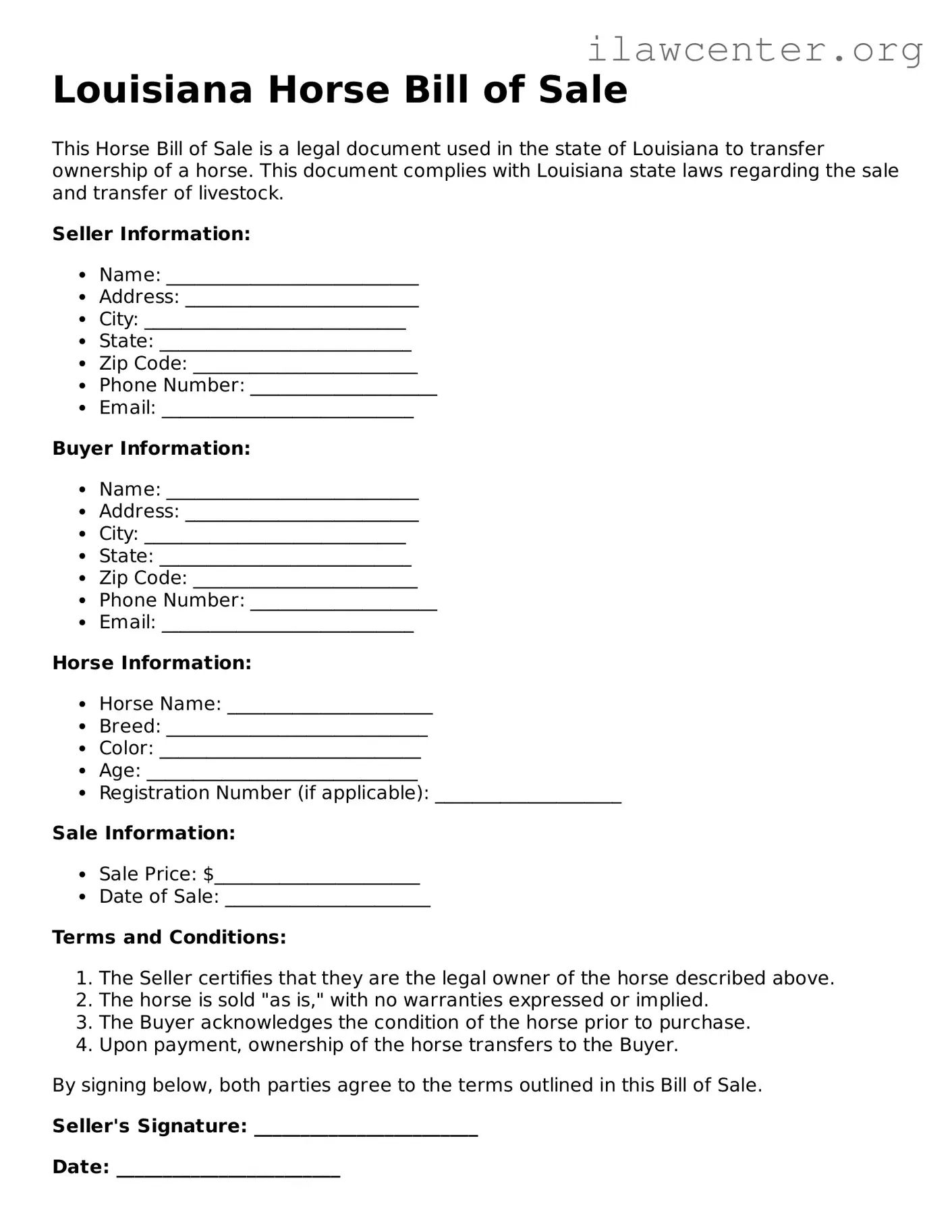
Louisiana Horse Bill of Sale Preview

Louisiana Horse Bill of Sale

This Horse Bill of Sale is a legal document used in the state of Louisiana to transfer ownership of a horse. This document complies with Louisiana state laws regarding the sale and transfer of livestock.

Seller Information:

  • Name: ___________________________
  • Address: _________________________
  • City: ____________________________
  • State: ___________________________
  • Zip Code: ________________________
  • Phone Number: ____________________
  • Email: ___________________________

Buyer Information:

  • Name: ___________________________
  • Address: _________________________
  • City: ____________________________
  • State: ___________________________
  • Zip Code: ________________________
  • Phone Number: ____________________
  • Email: ___________________________

Horse Information:

  • Horse Name: ______________________
  • Breed: ____________________________
  • Color: ____________________________
  • Age: _____________________________
  • Registration Number (if applicable): ____________________

Sale Information:

  • Sale Price: $______________________
  • Date of Sale: ______________________

Terms and Conditions:

  1. The Seller certifies that they are the legal owner of the horse described above.
  2. The horse is sold "as is," with no warranties expressed or implied.
  3. The Buyer acknowledges the condition of the horse prior to purchase.
  4. Upon payment, ownership of the horse transfers to the Buyer.

By signing below, both parties agree to the terms outlined in this Bill of Sale.

Seller's Signature: ________________________

Date: ________________________

Buyer's Signature: ________________________

Date: ________________________

PDF Form Characteristics

Fact Name Description
Purpose The Louisiana Horse Bill of Sale form is used to document the sale and transfer of ownership of a horse in Louisiana.
Governing Law This form is governed by Louisiana Civil Code, particularly the provisions related to the sale of movable property.
Buyer and Seller Information The form requires the full names and addresses of both the buyer and the seller to ensure clear identification of the parties involved.
Horse Description A detailed description of the horse, including breed, age, color, and any identifying marks, must be included to avoid confusion.
Purchase Price The agreed-upon purchase price must be stated clearly to confirm the financial terms of the sale.
Signatures Both parties must sign the document to validate the transaction, making it legally binding.
Witness or Notary While not always required, having a witness or notary public can enhance the document's credibility and enforceability.

Instructions on Utilizing Louisiana Horse Bill of Sale

After gathering all the necessary information about the horse and the parties involved, you can proceed to fill out the Louisiana Horse Bill of Sale form. This document will serve as a record of the transaction and includes important details that both the buyer and seller need to agree upon.

  1. Obtain the form: You can find the Louisiana Horse Bill of Sale form online or at local equestrian shops.
  2. Fill in the date: Write the date when the sale is taking place at the top of the form.
  3. Enter seller information: Provide the seller's full name, address, and contact information in the designated area.
  4. Enter buyer information: Write the buyer's full name, address, and contact information next.
  5. Describe the horse: Include details such as the horse's name, breed, age, color, and any identifying marks or registration numbers.
  6. Specify the sale price: Clearly state the agreed-upon price for the horse.
  7. Include payment terms: Indicate whether the payment is made in full or if there are any installment agreements.
  8. Sign the form: Both the seller and buyer must sign and date the form to validate the agreement.
  9. Provide copies: Make sure both parties receive a signed copy of the completed form for their records.

Important Facts about Louisiana Horse Bill of Sale

What is a Louisiana Horse Bill of Sale form?

The Louisiana Horse Bill of Sale form is a legal document used to record the sale of a horse in the state of Louisiana. This form serves as proof of the transaction between the seller and the buyer, detailing important information about the horse, the sale price, and the parties involved. It helps ensure that both parties have a clear understanding of the terms of the sale.

Why is a Bill of Sale important?

A Bill of Sale is important for several reasons. It provides legal protection for both the buyer and the seller by documenting the terms of the sale. This document can be used as evidence in case of disputes regarding ownership or the condition of the horse. Additionally, having a Bill of Sale can help establish the buyer’s ownership for registration purposes with equine organizations.

What information is typically included in the form?

The form generally includes details such as the names and addresses of the buyer and seller, a description of the horse (including breed, age, color, and any identifying marks), the sale price, and the date of the transaction. It may also include any warranties or representations made by the seller regarding the horse's health or condition.

Is the Bill of Sale required by law in Louisiana?

While a Bill of Sale is not legally required for the sale of a horse in Louisiana, it is highly recommended. Having this document can help prevent misunderstandings and protect the interests of both parties. In certain situations, such as when registering the horse with breed associations, a Bill of Sale may be necessary.

Can the Bill of Sale be modified after it is signed?

Once the Bill of Sale is signed by both parties, it is considered a binding agreement. Modifications to the document should be made in writing and signed by both the buyer and the seller. This helps ensure that any changes are legally recognized and agreed upon by both parties.

What should I do if I lose the Bill of Sale?

If the Bill of Sale is lost, it is advisable to contact the other party involved in the transaction to obtain a copy. If that is not possible, you may need to create a new Bill of Sale to document the transaction again. Be sure to include all relevant details to avoid any confusion in the future.

Can I use a generic Bill of Sale for my horse sale?

While it is possible to use a generic Bill of Sale, it is recommended to use a specific Louisiana Horse Bill of Sale form. This ensures that all necessary information is included and complies with state requirements. Using a tailored form helps protect both parties and provides clarity in the transaction.
Common mistakes

When filling out the Louisiana Horse Bill of Sale form, individuals often encounter common pitfalls that can lead to complications down the line. One frequent mistake is failing to include all necessary information about the horse. Essential details such as the horse's breed, age, color, and registration number are crucial for identification. Omitting any of this information can create confusion and potentially lead to disputes between the buyer and seller.

Another common error involves incorrect or incomplete contact information for both parties. It is vital to provide accurate names, addresses, and phone numbers. If any of this information is missing or incorrect, it can hinder communication and complicate future transactions. Ensuring that both parties can be reached is essential for a smooth transfer of ownership.

Many people also overlook the importance of signatures. Both the buyer and seller must sign the form to validate the transaction. Without these signatures, the bill of sale may not hold up legally. It is advisable to double-check that all required signatures are present before finalizing the document.

In addition to signatures, the date of the sale is another critical detail that is sometimes neglected. Including the date helps establish a timeline for the transaction and is often required for record-keeping purposes. Failing to document the date can lead to misunderstandings regarding when ownership officially changed hands.

Another mistake involves not keeping a copy of the completed bill of sale. After filling out the form, both parties should retain a copy for their records. This document serves as proof of the transaction and can be useful in case any issues arise later. Without a copy, one party may find themselves at a disadvantage if disputes occur.

Lastly, some individuals may not realize the importance of reviewing the entire document before submission. Taking a moment to read through the completed form can help catch any errors or omissions. This simple step can save time and prevent potential legal headaches in the future. Attention to detail is key when it comes to legal documents.

Documents used along the form

When engaging in the sale or purchase of a horse in Louisiana, the Horse Bill of Sale form is a crucial document. However, several other forms and documents may accompany it to ensure a smooth transaction and protect the interests of both parties involved. Below is a list of commonly used documents that complement the Horse Bill of Sale.

  • Equine Liability Waiver: This document protects the seller from liability in case of injury to the buyer or their associates while interacting with the horse. It outlines the inherent risks associated with horse ownership and riding.
  • Health Certificate: Issued by a veterinarian, this certificate confirms that the horse is healthy and free from contagious diseases at the time of sale. It is often required for travel and ensures the buyer that they are acquiring a sound animal.
  • Registration Papers: If the horse is registered with a breed association, these papers provide proof of the horse's lineage and pedigree. They are essential for buyers interested in showing or breeding the horse.
  • Bill of Sale for Equipment: If the sale includes tack or other equipment, a separate bill of sale may be necessary. This document details the items being sold and their condition, ensuring clarity in the transaction.
  • Purchase Agreement: This is a more comprehensive document that outlines the terms of the sale, including payment terms, warranties, and any contingencies. It serves as a formal contract between the buyer and seller.
  • Inspection Report: An inspection report may be created by a qualified equine professional. It assesses the horse's physical condition and behavior, providing the buyer with valuable information before finalizing the sale.

Utilizing these documents alongside the Horse Bill of Sale can facilitate a more secure and transparent transaction. Each document serves a specific purpose, ensuring that both the buyer and seller are protected and informed throughout the process.

Similar forms

  • Vehicle Bill of Sale: This document serves as proof of the transfer of ownership for a vehicle. Like the Horse Bill of Sale, it includes details about the buyer, seller, and the item being sold, ensuring a clear record of the transaction.
  • Pet Bill of Sale: Similar to the Horse Bill of Sale, this document outlines the sale of a pet. It includes information about the pet, such as breed and age, and identifies the buyer and seller, providing legal protection for both parties involved.
  • Equipment Bill of Sale: This document is used when selling equipment, much like the Horse Bill of Sale is for horses. It details the condition of the equipment and the terms of the sale, ensuring that both the buyer and seller understand the transaction.
  • Real Estate Purchase Agreement: While more complex, this document shares similarities with the Horse Bill of Sale in that it formalizes the transfer of ownership. It includes critical details about the property and the parties involved, ensuring clarity in the transaction.

Dos and Don'ts

When filling out the Louisiana Horse Bill of Sale form, it’s important to follow certain guidelines to ensure the document is valid and serves its purpose effectively. Here are nine things you should and shouldn't do:

  • Do include the full name and contact information of both the buyer and the seller.
  • Do provide a clear description of the horse, including breed, age, color, and any identifying marks.
  • Do state the sale price and payment method clearly.
  • Do ensure both parties sign and date the form.
  • Do keep a copy of the completed bill of sale for your records.
  • Don't leave any fields blank; incomplete information can lead to disputes later.
  • Don't use vague terms to describe the horse; specifics are crucial.
  • Don't forget to mention any warranties or guarantees regarding the horse's health or condition.
  • Don't rush through the process; take your time to ensure accuracy.

By following these guidelines, you can create a clear and effective Horse Bill of Sale that protects both parties involved in the transaction.

Misconceptions

There are several misconceptions surrounding the Louisiana Horse Bill of Sale form. Understanding the facts can help ensure a smooth transaction when buying or selling a horse.

  • It’s not legally binding. Many believe that a bill of sale is just a piece of paper without legal weight. In reality, a properly completed bill of sale is a legal document that can protect both the buyer and seller.
  • Only the seller needs to sign. Some think that only the seller's signature is necessary for the document to be valid. However, both the buyer and seller should sign to confirm the agreement.
  • It doesn’t need to be notarized. There’s a common belief that notarization is unnecessary. While it’s not always required, having a notary can add an extra layer of authenticity and can be beneficial in case of disputes.
  • It’s only for high-value horses. Some assume that a bill of sale is only needed for expensive horses. In truth, regardless of the horse’s value, a bill of sale is a good practice to document the transaction.
  • It doesn’t require detailed information. Many think a simple statement of sale is enough. In fact, including detailed information about the horse, such as registration numbers and health records, is important for clarity and future reference.

Key takeaways

When completing the Louisiana Horse Bill of Sale form, there are several important points to keep in mind. This document serves as a legal record of the sale and transfer of ownership of a horse. Here are some key takeaways:

  1. Accurate Information: Ensure that all details about the horse, including its name, breed, age, and registration number, are correct.
  2. Seller and Buyer Details: Include full names and contact information for both the seller and the buyer. This helps in case any follow-up is needed.
  3. Sale Price: Clearly state the sale price of the horse. This is crucial for both parties to understand the terms of the transaction.
  4. Payment Method: Specify how the payment will be made, whether by cash, check, or another method. This adds clarity to the agreement.
  5. Condition of the Horse: It is wise to include a statement about the horse's health and condition at the time of sale. This protects both parties.
  6. Disclosure of Issues: If there are any known issues with the horse, such as health problems or behavioral issues, these should be disclosed to the buyer.
  7. Signatures: Both the seller and the buyer must sign the document. This signifies that both parties agree to the terms outlined.
  8. Date of Sale: Include the date when the sale takes place. This is important for record-keeping.
  9. Witness or Notary: While not always required, having a witness or notary can add an extra layer of validity to the document.
  10. Keep Copies: After completing the form, both parties should keep a copy for their records. This ensures that there is a reference in the future.

By following these guidelines, both the seller and the buyer can ensure a smooth transaction and protect their interests during the sale of a horse in Louisiana.