Attorney-Verified  Motor Vehicle Power of Attorney Document for Louisiana

Attorney-Verified Motor Vehicle Power of Attorney Document for Louisiana

The Louisiana Motor Vehicle Power of Attorney form is a legal document that allows one person to authorize another to act on their behalf regarding motor vehicle transactions. This form is essential for individuals who need someone else to handle tasks like registering a vehicle, transferring ownership, or obtaining title documents. If you’re ready to simplify your vehicle-related processes, fill out the form by clicking the button below.

Article Guide

The Louisiana Motor Vehicle Power of Attorney form is a crucial document for anyone looking to delegate authority regarding their vehicle. This form allows a designated individual, often referred to as an agent, to act on behalf of the vehicle owner in various matters related to motor vehicle transactions. These transactions can include signing documents for the sale or transfer of a vehicle, applying for a title, or registering a vehicle with the state. By using this form, vehicle owners can ensure that their interests are represented even when they cannot be present to handle these tasks personally. The form is designed to be straightforward, making it accessible for individuals who may not have legal training. Additionally, it’s important to note that the Power of Attorney can be limited to specific tasks or be broad in scope, depending on the needs of the vehicle owner. Understanding how to properly fill out and execute this form can save time and prevent potential complications in the future.

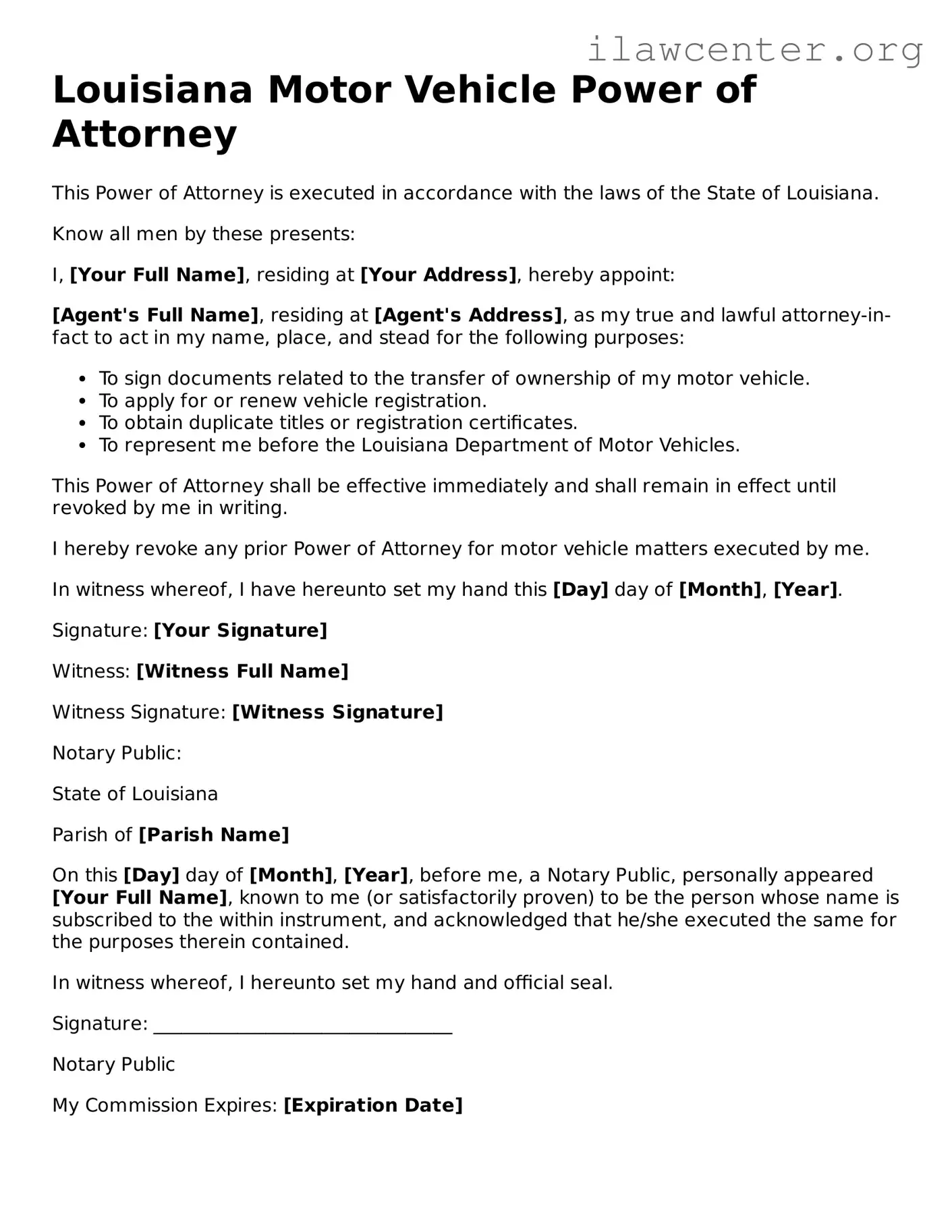
Louisiana Motor Vehicle Power of Attorney Preview

Louisiana Motor Vehicle Power of Attorney

This Power of Attorney is executed in accordance with the laws of the State of Louisiana.

Know all men by these presents:

I, [Your Full Name], residing at [Your Address], hereby appoint:

[Agent's Full Name], residing at [Agent's Address], as my true and lawful attorney-in-fact to act in my name, place, and stead for the following purposes:

  • To sign documents related to the transfer of ownership of my motor vehicle.
  • To apply for or renew vehicle registration.
  • To obtain duplicate titles or registration certificates.
  • To represent me before the Louisiana Department of Motor Vehicles.

This Power of Attorney shall be effective immediately and shall remain in effect until revoked by me in writing.

I hereby revoke any prior Power of Attorney for motor vehicle matters executed by me.

In witness whereof, I have hereunto set my hand this [Day] day of [Month], [Year].

Signature: [Your Signature]

Witness: [Witness Full Name]

Witness Signature: [Witness Signature]

Notary Public:

State of Louisiana

Parish of [Parish Name]

On this [Day] day of [Month], [Year], before me, a Notary Public, personally appeared [Your Full Name], known to me (or satisfactorily proven) to be the person whose name is subscribed to the within instrument, and acknowledged that he/she executed the same for the purposes therein contained.

In witness whereof, I hereunto set my hand and official seal.

Signature: ________________________________

Notary Public

My Commission Expires: [Expiration Date]

PDF Form Characteristics

Fact Name Details
Purpose The Louisiana Motor Vehicle Power of Attorney form allows an individual to authorize another person to act on their behalf regarding motor vehicle transactions.
Governing Law This form is governed by Louisiana Revised Statutes, Title 32, which covers motor vehicles and traffic regulations.
Notarization Requirement While notarization is not always required, having the document notarized can enhance its validity and acceptance.
Revocation The power of attorney can be revoked at any time by the principal, as long as the revocation is documented and communicated to the agent.

Instructions on Utilizing Louisiana Motor Vehicle Power of Attorney

Filling out the Louisiana Motor Vehicle Power of Attorney form allows you to designate someone to act on your behalf regarding vehicle-related matters. Once you have completed the form, ensure that both you and the designated agent sign it. This step is crucial for the document to be valid and effective.

  1. Obtain the form: You can find the Louisiana Motor Vehicle Power of Attorney form online or at your local Department of Motor Vehicles (DMV).
  2. Fill in your information: Start by entering your full name, address, and contact information in the designated sections. This identifies you as the principal.
  3. Designate your agent: Provide the full name, address, and contact information of the person you are appointing as your agent. This person will act on your behalf.
  4. Specify the powers granted: Clearly outline the specific powers you are giving to your agent. This may include signing documents, registering the vehicle, or handling transactions.
  5. Include vehicle details: Enter the make, model, year, and Vehicle Identification Number (VIN) of the vehicle involved. This ensures clarity about which vehicle the power of attorney pertains to.
  6. Sign and date the form: As the principal, you must sign and date the form at the bottom. This validates the document.
  7. Have your signature notarized: Take the completed form to a notary public to have your signature notarized. This step adds an extra layer of legitimacy.
  8. Provide a copy to your agent: Once notarized, give a copy of the completed form to your agent. They will need it to act on your behalf.

Important Facts about Louisiana Motor Vehicle Power of Attorney

What is a Louisiana Motor Vehicle Power of Attorney form?

The Louisiana Motor Vehicle Power of Attorney form is a legal document that allows one person to grant another person the authority to act on their behalf regarding motor vehicle transactions. This can include tasks such as signing documents for the sale or transfer of a vehicle, registering a vehicle, or handling other related matters. It is particularly useful when the vehicle owner cannot be present to complete these transactions themselves.

Who can be designated as an agent in this form?

Any competent adult can be designated as an agent in the Louisiana Motor Vehicle Power of Attorney form. This means that you can choose a family member, friend, or trusted professional to handle your motor vehicle matters. It’s important to select someone you trust, as they will have the authority to make decisions regarding your vehicle on your behalf.

Do I need to have the form notarized?

Yes, the Louisiana Motor Vehicle Power of Attorney form must be notarized to be considered valid. Notarization adds an extra layer of authenticity and helps prevent fraud. When you sign the form in front of a notary public, they will verify your identity and witness your signature, ensuring that the document is legally binding.

How long is the Power of Attorney effective?

The effectiveness of the Louisiana Motor Vehicle Power of Attorney can vary based on how you specify its duration in the document. You can choose to make it effective for a specific transaction, for a set period, or until you revoke it. If you decide to revoke the Power of Attorney, you must do so in writing and notify your agent and any relevant parties.

What happens if I need to revoke the Power of Attorney?

If you need to revoke the Power of Attorney, you must provide written notice to your agent and any institutions or individuals that were relying on the document. It’s advisable to create a formal revocation document and have it notarized. This ensures that there is a clear record of your decision to revoke the authority granted to your agent.

Common mistakes

Filling out the Louisiana Motor Vehicle Power of Attorney form can seem straightforward, yet many individuals stumble over common pitfalls. One frequent mistake involves not clearly identifying the vehicle in question. When completing the form, it is essential to provide specific details such as the make, model, year, and Vehicle Identification Number (VIN). Omitting any of these details can lead to confusion and potentially render the document ineffective.

Another common error arises from the misinterpretation of the powers being granted. Some individuals may fail to fully understand the extent of authority they are providing to the designated agent. It is crucial to read through the entire form and comprehend what actions the agent can take on behalf of the vehicle owner. This includes everything from signing documents to transferring ownership. Without this clarity, one might inadvertently give away more power than intended.

In addition, many people neglect to sign and date the form correctly. A Power of Attorney document is not valid unless it is properly executed. This means that the principal—the person granting authority—must sign the form in the designated area, and the date of signing must be included. Failure to do so can lead to complications down the line, especially if the agent attempts to use the document to conduct business on behalf of the principal.

Lastly, a significant oversight occurs when individuals forget to have the form notarized. In Louisiana, notarization is often a requirement for the Power of Attorney to be legally recognized. Without a notary's seal, the document may not hold up in legal situations. Therefore, it is advisable to ensure that the form is notarized after it has been filled out completely. This step adds an additional layer of authenticity and can help prevent disputes in the future.

Documents used along the form

The Louisiana Motor Vehicle Power of Attorney form allows an individual to designate another person to act on their behalf in matters related to motor vehicle transactions. In addition to this form, there are several other documents that may be necessary or beneficial when dealing with motor vehicle matters in Louisiana. Below is a list of these forms and documents, each described briefly.

  • Vehicle Title Application: This document is used to apply for a new title for a vehicle. It includes information about the vehicle and the owner, and it must be submitted to the Louisiana Office of Motor Vehicles.
  • Bill of Sale: A bill of sale serves as a legal document that records the sale of a vehicle. It includes details such as the buyer and seller's information, vehicle identification number (VIN), and sale price.
  • Odometer Disclosure Statement: This statement is required for certain vehicle sales and provides information about the vehicle's mileage at the time of sale. It helps prevent odometer fraud.
  • Application for Duplicate Title: If a vehicle title is lost or damaged, this form is used to request a duplicate title from the state. It requires the owner to provide specific details about the vehicle.
  • Vehicle Registration Application: This application is necessary for registering a vehicle with the state. It includes information about the vehicle and proof of ownership.
  • Affidavit of Heirship: In cases where a vehicle owner has passed away, this document may be used to establish the rightful heir to the vehicle, allowing them to transfer the title without probate.
  • Insurance Verification Form: This form is often required to prove that a vehicle is insured. It may need to be submitted when registering a vehicle or during a traffic stop.

Understanding these documents can help streamline the process of handling motor vehicle transactions in Louisiana. Properly completing and submitting the necessary forms ensures compliance with state laws and facilitates smoother transactions.

Similar forms

  • General Power of Attorney: This document allows one person to act on behalf of another in a variety of matters, not limited to motor vehicles. It grants broad authority to manage financial and legal affairs.
  • Limited Power of Attorney: Similar to the general version, but this document restricts the agent's authority to specific tasks or situations. It can be used for vehicle transactions only.
  • Durable Power of Attorney: This type remains effective even if the principal becomes incapacitated. It can cover vehicle-related decisions, ensuring continuity in management.
  • Vehicle Title Transfer Form: This document is used specifically for transferring ownership of a vehicle. It requires signatures from both the seller and buyer, much like a Power of Attorney for vehicle transactions.
  • Bill of Sale: This document records the sale of a vehicle and includes details about the buyer and seller. It serves as proof of ownership transfer, similar to the authority granted in a Power of Attorney.
  • Registration Application: This form is used to register a vehicle with the state. It often requires a signature from the owner, similar to the authorization provided in a Power of Attorney.
  • Title Application: When applying for a new title after purchasing a vehicle, this document is necessary. It often requires proof of ownership, akin to the responsibilities outlined in a Power of Attorney.
  • Insurance Authorization Form: This document allows someone to manage insurance matters on behalf of another person. It shares similarities with the Motor Vehicle Power of Attorney in granting authority over specific decisions.
  • Consent to Release Information Form: This form permits the release of personal information related to a vehicle. It is similar in that it authorizes another party to act on behalf of the individual.

Dos and Don'ts

When filling out the Louisiana Motor Vehicle Power of Attorney form, there are several important considerations to keep in mind. The following list outlines actions you should take and those you should avoid.

  • Do read the entire form carefully before filling it out.
  • Do provide accurate information regarding the vehicle and the parties involved.
  • Do sign the form in the presence of a notary public.
  • Do keep a copy of the completed form for your records.
  • Don't leave any sections of the form blank unless instructed to do so.
  • Don't use white-out or other correction methods on the form.

Misconceptions

Understanding the Louisiana Motor Vehicle Power of Attorney form can be challenging, and several misconceptions often arise. Below is a list of common misunderstandings that people may have regarding this important legal document.

  • The form is only for buying and selling vehicles. Many believe that the Motor Vehicle Power of Attorney is limited to transactions involving the purchase or sale of vehicles. In reality, this form can also authorize someone to handle various other tasks related to vehicle registration, title transfers, and even obtaining license plates.
  • Only a lawyer can fill out the form. While having legal assistance can be beneficial, it is not a requirement. Individuals can complete the form on their own, provided they understand the necessary information and requirements.
  • The form must be notarized. Some people think that notarization is mandatory for the Motor Vehicle Power of Attorney to be valid. However, while notarization can add an extra layer of authenticity, it is not always required in Louisiana.
  • It can only be used for one specific transaction. Another misconception is that the Power of Attorney is limited to a single transaction. In fact, the document can be drafted to cover multiple transactions or a specified time frame, depending on the needs of the principal.
  • All states have the same Motor Vehicle Power of Attorney rules. It is important to recognize that laws regarding Power of Attorney forms can vary significantly from state to state. Louisiana has its own specific regulations that must be followed.
  • Once signed, it cannot be revoked. Some individuals mistakenly believe that signing the form is a permanent decision. In truth, the principal has the right to revoke the Power of Attorney at any time, as long as they are competent to do so.
  • Anyone can be designated as an agent. While it is true that the principal can choose anyone they trust, it is essential that the designated agent is someone who can act responsibly and in the best interest of the principal. This is a critical aspect that should not be overlooked.
  • The form is the same as a general Power of Attorney. A common misunderstanding is that the Motor Vehicle Power of Attorney is interchangeable with a general Power of Attorney. However, the former is specifically tailored for vehicle-related matters, while the latter covers a broader range of legal and financial decisions.
  • It is only necessary for individuals with multiple vehicles. Many believe that only those who own several vehicles need this form. In reality, anyone who may need assistance with vehicle-related matters can benefit from having a Motor Vehicle Power of Attorney in place.

By clarifying these misconceptions, individuals can better understand the purpose and function of the Louisiana Motor Vehicle Power of Attorney form. It is essential to approach this document with accurate information to ensure that it serves its intended purpose effectively.

Key takeaways

Filling out and using the Louisiana Motor Vehicle Power of Attorney form can be a straightforward process if you keep a few key points in mind. Here are some important takeaways:

  1. Understand the Purpose: This form allows you to designate someone to handle vehicle-related matters on your behalf, such as transferring ownership or registering a vehicle.
  2. Choose Your Agent Wisely: Select a trustworthy person to act as your agent. This person will have the authority to make decisions regarding your vehicle.
  3. Complete the Form Accurately: Fill out the form completely and clearly. Ensure that all required information, such as names and vehicle details, is correct.
  4. Sign and Date: Your signature and the date are essential. Without them, the form may not be valid.
  5. Consider Notarization: While notarization is not always required, having the form notarized can provide an extra layer of security and validity.
  6. Keep Copies: After completing the form, make copies for your records and provide a copy to your agent. This ensures everyone has access to the necessary documentation.

By following these guidelines, you can effectively use the Louisiana Motor Vehicle Power of Attorney form to manage your vehicle-related needs with confidence.