Attorney-Verified  Notary Acknowledgement Document for Louisiana

Attorney-Verified Notary Acknowledgement Document for Louisiana

The Louisiana Notary Acknowledgement form is a legal document that verifies the identity of a signer and confirms their willingness to sign a document. This form plays a crucial role in ensuring that transactions are conducted fairly and transparently. If you need to complete this form, take action now by clicking the button below.

Article Guide

The Louisiana Notary Acknowledgement form plays a crucial role in the realm of legal documentation, serving as a vital tool for ensuring the authenticity of signatures on various documents. This form is primarily used to confirm that a signer has willingly and knowingly executed a document in front of a notary public. In Louisiana, the notary’s role is not just ceremonial; it includes verifying the identity of the signer and ensuring that they understand the contents of the document they are signing. The form typically requires specific information, such as the name of the signer, the date of the acknowledgment, and the notary's signature and seal. It is important to note that the Louisiana Notary Acknowledgement form must be filled out correctly to be legally binding, as any errors can lead to complications in the validity of the document. Furthermore, this form is applicable in various contexts, including real estate transactions, powers of attorney, and other legal agreements, making it an essential aspect of the state’s legal framework. Understanding its components and requirements is vital for anyone involved in legal processes in Louisiana.

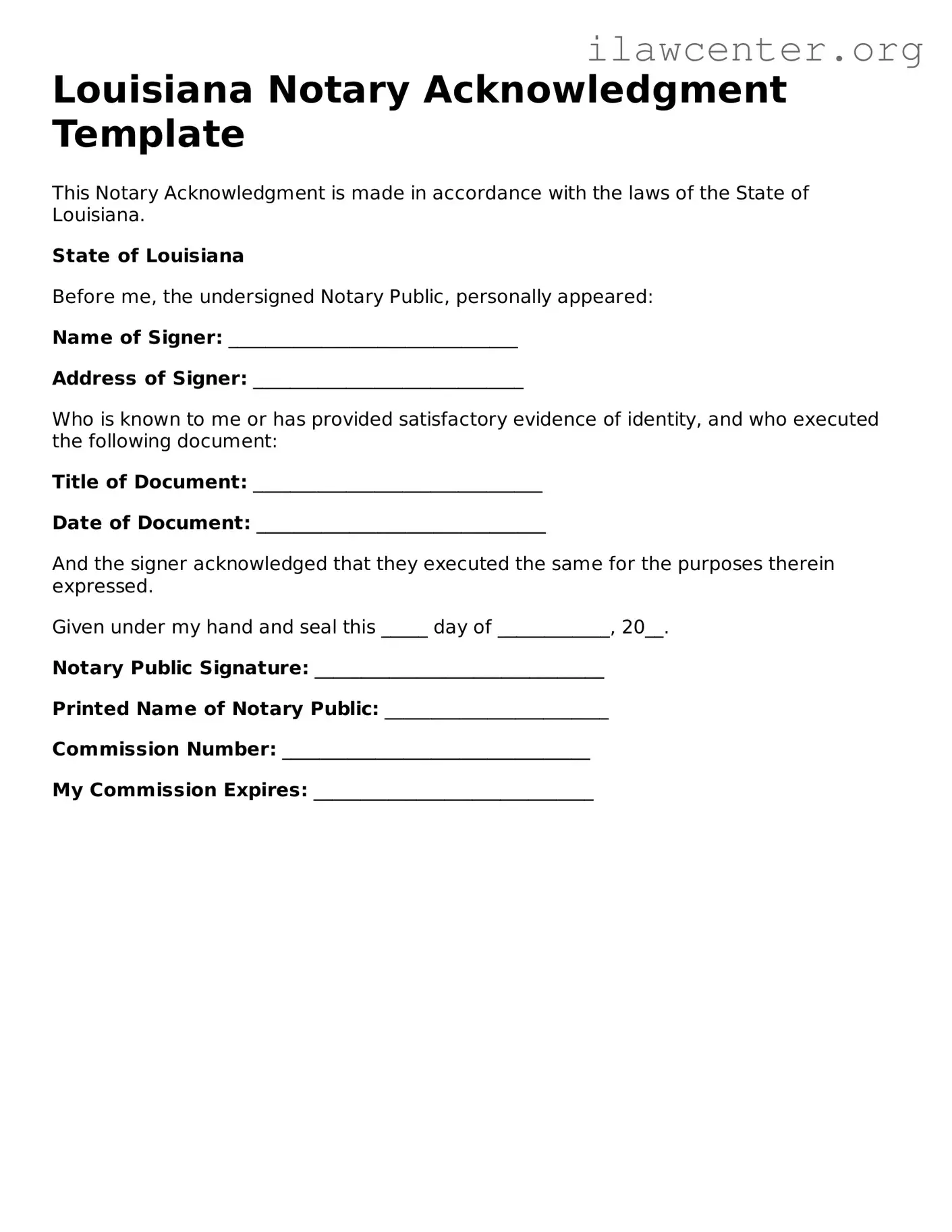
Louisiana Notary Acknowledgement Preview

Louisiana Notary Acknowledgment Template

This Notary Acknowledgment is made in accordance with the laws of the State of Louisiana.

State of Louisiana

Before me, the undersigned Notary Public, personally appeared:

Name of Signer: _______________________________

Address of Signer: _____________________________

Who is known to me or has provided satisfactory evidence of identity, and who executed the following document:

Title of Document: _______________________________

Date of Document: _______________________________

And the signer acknowledged that they executed the same for the purposes therein expressed.

Given under my hand and seal this _____ day of ____________, 20__.

Notary Public Signature: _______________________________

Printed Name of Notary Public: ________________________

Commission Number: _________________________________

My Commission Expires: ______________________________

PDF Form Characteristics

Fact Name Description
Purpose The Louisiana Notary Acknowledgement form is used to verify the identity of individuals signing a document, ensuring that they are doing so willingly and under their own free will.
Governing Law This form is governed by Louisiana Civil Code Article 1833, which outlines the requirements for notarial acts in the state.
Required Signatures Both the signer and the notary public must sign the form. The notary's signature certifies the acknowledgment of the signer.
Identification Signers must present valid identification to the notary, which helps confirm their identity before the form is completed.
Form Availability The Louisiana Notary Acknowledgement form can typically be obtained from notaries, legal offices, or online legal resources.
Importance This form plays a crucial role in preventing fraud and ensuring that documents are executed properly, providing legal protection for all parties involved.

Instructions on Utilizing Louisiana Notary Acknowledgement

After obtaining the Louisiana Notary Acknowledgment form, you will need to fill it out accurately. This form is essential for verifying signatures on legal documents. Follow these steps to complete the form correctly.

  1. Begin by entering the date at the top of the form.
  2. Fill in the name of the person whose signature is being acknowledged.
  3. Provide the address of that individual, including city, state, and zip code.
  4. Next, write the name of the notary public who will be signing the document.
  5. Include the notary’s commission number if applicable.
  6. Indicate the date of the notary's commission expiration.
  7. Have the individual sign the document in the designated area.
  8. Finally, the notary should sign and seal the document in the appropriate sections.

Important Facts about Louisiana Notary Acknowledgement

What is a Louisiana Notary Acknowledgement form?

The Louisiana Notary Acknowledgement form is a legal document that verifies the identity of a signer and confirms that they willingly signed a document. This form is essential for ensuring the authenticity of signatures on various legal documents, such as contracts and deeds.

Why is a Notary Acknowledgement important?

A Notary Acknowledgement provides a layer of protection against fraud. It helps to ensure that the person signing the document is indeed who they claim to be and that they understand the contents of the document. This can be crucial in legal disputes, as it serves as evidence of the signer’s intent.

Who can act as a notary in Louisiana?

In Louisiana, a notary public must be a resident of the state and at least 18 years old. They must also complete a training program and pass an exam. Notaries are authorized to perform various duties, including witnessing signatures and administering oaths.

How do I complete a Notary Acknowledgement form?

To complete a Notary Acknowledgement form, the signer must first fill out the document that requires notarization. Then, the signer presents the document to a notary public, who will verify their identity, witness the signature, and complete the Notary Acknowledgement form by providing their signature and seal.

Is there a fee for notarization in Louisiana?

Yes, notaries in Louisiana are allowed to charge a fee for their services. The maximum fee for a standard acknowledgment is typically set by state law. It is advisable to confirm the fee with the notary beforehand to avoid any surprises.

Can a Notary Acknowledgement be done remotely?

Yes, Louisiana allows for remote notarization under certain conditions. The notary and the signer must both use audio-visual technology to conduct the notarization. It is important to ensure that all legal requirements are met for remote notarization to be valid.

Where can I find a Louisiana Notary Acknowledgement form?

You can obtain a Louisiana Notary Acknowledgement form from various sources, including online legal form providers, local government offices, and law libraries. Ensure that the form you use complies with Louisiana state laws and regulations.
Common mistakes

Filling out the Louisiana Notary Acknowledgement form can seem straightforward, but many people make common mistakes that can lead to complications. One frequent error is not providing the correct name of the person signing the document. It’s crucial to ensure that the name matches the identification presented. If there’s a discrepancy, the notary may refuse to acknowledge the signature.

Another mistake involves the date of the acknowledgment. Some individuals forget to include the date or mistakenly write an incorrect one. This can create confusion about when the document was signed, affecting its validity. Always double-check the date to ensure it is accurate and clearly written.

Additionally, people often overlook the notary’s signature and seal. The notary must sign and apply their seal to the document for it to be valid. If this step is missed, the acknowledgment will not hold up in legal situations. It’s essential to confirm that the notary has completed this part before leaving.

Some individuals fail to provide the correct type of identification for the notary. In Louisiana, the notary needs to verify the identity of the signer. Acceptable forms of ID include a driver’s license or a state-issued ID. Using an expired ID or an unrecognized form can lead to rejection of the acknowledgment.

Another common oversight is not filling out the venue section properly. The venue indicates where the acknowledgment takes place. Leaving this blank or writing it incorrectly can create problems later on. Always ensure this section is completed accurately to avoid any issues.

People sometimes forget to include the appropriate wording in the acknowledgment. The form must contain specific language that confirms the signer’s intent. Omitting or altering this wording can invalidate the acknowledgment. It’s important to follow the prescribed format closely.

Moreover, some signers might rush through the process and fail to read the entire document. This can lead to misunderstandings about what they are signing. Taking the time to read and understand the form can prevent future disputes and complications.

Another mistake is not having witnesses present when required. While Louisiana does not always require witnesses for notarial acts, certain documents may have specific requirements. Failing to meet these requirements can render the acknowledgment ineffective.

Lastly, individuals sometimes do not keep copies of the acknowledged documents. It’s wise to retain a copy for personal records. This can serve as proof of the acknowledgment and can be helpful if any questions arise later. Keeping good records is always a best practice.

Documents used along the form

When engaging in legal transactions in Louisiana, various forms and documents often accompany the Notary Acknowledgment form. Understanding these documents can help ensure that your legal processes run smoothly and efficiently. Below is a list of commonly used forms that may be relevant.

  • Act of Sale: This document outlines the terms of the sale of property, including the parties involved, the purchase price, and any conditions that must be met. It serves as the official record of the transaction.
  • Power of Attorney: A Power of Attorney allows one person to act on behalf of another in legal matters. This document can grant broad or limited powers, depending on the needs of the parties involved.
  • Affidavit: An affidavit is a written statement confirmed by oath or affirmation, used as evidence in court. It is often employed to verify facts or details in legal proceedings.
  • Living Will: A living will outlines a person's wishes regarding medical treatment in the event they become unable to communicate their preferences. This document is crucial for healthcare decisions.
  • Marriage License: A marriage license is a legal document that authorizes two individuals to marry. It typically requires signatures from both parties and may need to be notarized.
  • Quitclaim Deed: This type of deed transfers interest in a property from one party to another without guaranteeing that the title is clear. It is often used in divorce settlements or to add a spouse to a title.
  • Lease Agreement: A lease agreement outlines the terms under which one party agrees to rent property from another. It includes details such as rent amount, duration, and responsibilities of both parties.
  • Certificate of Incorporation: This document establishes a corporation in Louisiana. It includes essential details about the business, such as its name, purpose, and the names of its directors.

Each of these documents plays a vital role in various legal processes. Familiarity with them can facilitate a smoother navigation through the complexities of legal transactions in Louisiana.

Similar forms

The Notary Acknowledgment form serves a specific purpose in verifying the identity of individuals signing documents. However, several other documents share similar functions or characteristics. Here’s a list of eight documents that are comparable to the Notary Acknowledgment form:

  • Affidavit: An affidavit is a written statement confirmed by oath or affirmation. Like a notary acknowledgment, it requires a notary to verify the identity of the person making the statement.
  • Power of Attorney: This document allows one person to act on behalf of another. Notarization is often required to ensure the authenticity of the signatures involved.
  • Deed: A deed transfers ownership of property. A notary acknowledgment is typically needed to confirm that the signatures on the deed are genuine.
  • Will: While not always required, having a will notarized can add an extra layer of validity, similar to how a notary acknowledgment affirms the identity of signers.
  • Contract: Many contracts require notarization to ensure that all parties involved have willingly signed the document, much like the acknowledgment process.
  • Certificate of Authenticity: This document certifies that a particular item is genuine. Notarization can provide assurance that the signer is indeed the person they claim to be.
  • Loan Documents: When signing loan agreements, a notary acknowledgment may be necessary to verify the identity of the borrower and other parties involved.
  • Real Estate Closing Documents: These documents often require notarization to confirm that all parties have signed willingly and understand the terms, similar to the notary acknowledgment process.

Dos and Don'ts

When filling out the Louisiana Notary Acknowledgement form, it is essential to follow certain guidelines to ensure accuracy and compliance. Here are five things you should and shouldn't do:

  • Do ensure that all information is accurate and complete.
  • Do sign the document in the presence of the notary public.
  • Do provide valid identification to the notary.
  • Don't leave any blank spaces on the form.
  • Don't attempt to sign the document before meeting with the notary.

Misconceptions

There are several misconceptions surrounding the Louisiana Notary Acknowledgement form. Understanding the truth behind these can help ensure proper use and compliance. Here are nine common misconceptions:

  1. Notary Acknowledgements are the same as Notarizations. Many people think these terms are interchangeable. However, a Notary Acknowledgement specifically confirms that a signer appeared before the notary and acknowledged signing the document.
  2. All documents require a Notary Acknowledgement. This is not true. Only certain documents, especially those intended for public record, typically require this form of acknowledgment.
  3. A Notary can sign on behalf of the signer. This is a misconception. The signer must personally appear before the Notary and sign the document themselves.
  4. Notary Acknowledgements can be completed after a document is signed. This is incorrect. The acknowledgment must occur at the time of signing, ensuring the Notary witnesses the act.
  5. Notaries can refuse to perform an acknowledgment for any reason. While Notaries have discretion, they must follow state laws and cannot refuse without valid reasons, such as lack of identification.
  6. There is no need for identification during the acknowledgment process. This is false. A Notary must verify the identity of the signer, typically through government-issued ID.
  7. All Notary Acknowledgement forms are the same across states. This is misleading. Each state has its own specific requirements and formats for Notary Acknowledgements.
  8. Once a document is notarized, it cannot be challenged. This is a misconception. A notarization does not guarantee the validity of the content; it only verifies the signature and identity.
  9. Notaries are responsible for the content of the documents they notarize. This is not accurate. Notaries only verify the signature and identity; they do not assess the legality or accuracy of the document’s content.

Being aware of these misconceptions can help you navigate the process of using a Louisiana Notary Acknowledgement form more effectively.

Key takeaways

When filling out and using the Louisiana Notary Acknowledgement form, it is important to keep several key points in mind:

  • Ensure that the document is signed in the presence of a notary public.
  • Clearly identify the parties involved in the acknowledgment.
  • The notary must complete the acknowledgment section accurately.
  • Always use the most current version of the form to avoid issues.
  • Verify that the notary's seal is legible and properly affixed.
  • Understand that the notary's role is to verify identities, not to provide legal advice.
  • Keep a copy of the acknowledged document for your records.

Following these guidelines will help ensure that the notary acknowledgment process goes smoothly and that your documents are valid and enforceable.