Attorney-Verified  Notice to Quit Document for Louisiana

Attorney-Verified Notice to Quit Document for Louisiana

The Louisiana Notice to Quit form is a legal document that landlords use to notify tenants of their intent to terminate a lease agreement. This form serves as an official request for tenants to vacate the rental property, typically due to lease violations or non-payment of rent. For those needing to complete this form, assistance is available; click the button below to get started.

Article Guide

The Louisiana Notice to Quit form serves as a crucial tool for landlords seeking to terminate a rental agreement. This document outlines the landlord's intent to end a lease due to various reasons, such as non-payment of rent or violation of lease terms. It is important for both landlords and tenants to understand the implications of this notice, as it sets the stage for potential eviction proceedings. The form must be completed accurately, specifying the tenant's name, the property address, and the reason for the termination. Additionally, it should clearly state the time frame within which the tenant must vacate the premises. By adhering to the legal requirements associated with this notice, landlords can ensure a smoother transition while protecting their rights. For tenants, receiving a Notice to Quit can be a significant event, prompting them to take immediate action to either resolve the issues or seek legal advice. Understanding this form is essential for maintaining clear communication and ensuring compliance with Louisiana rental laws.

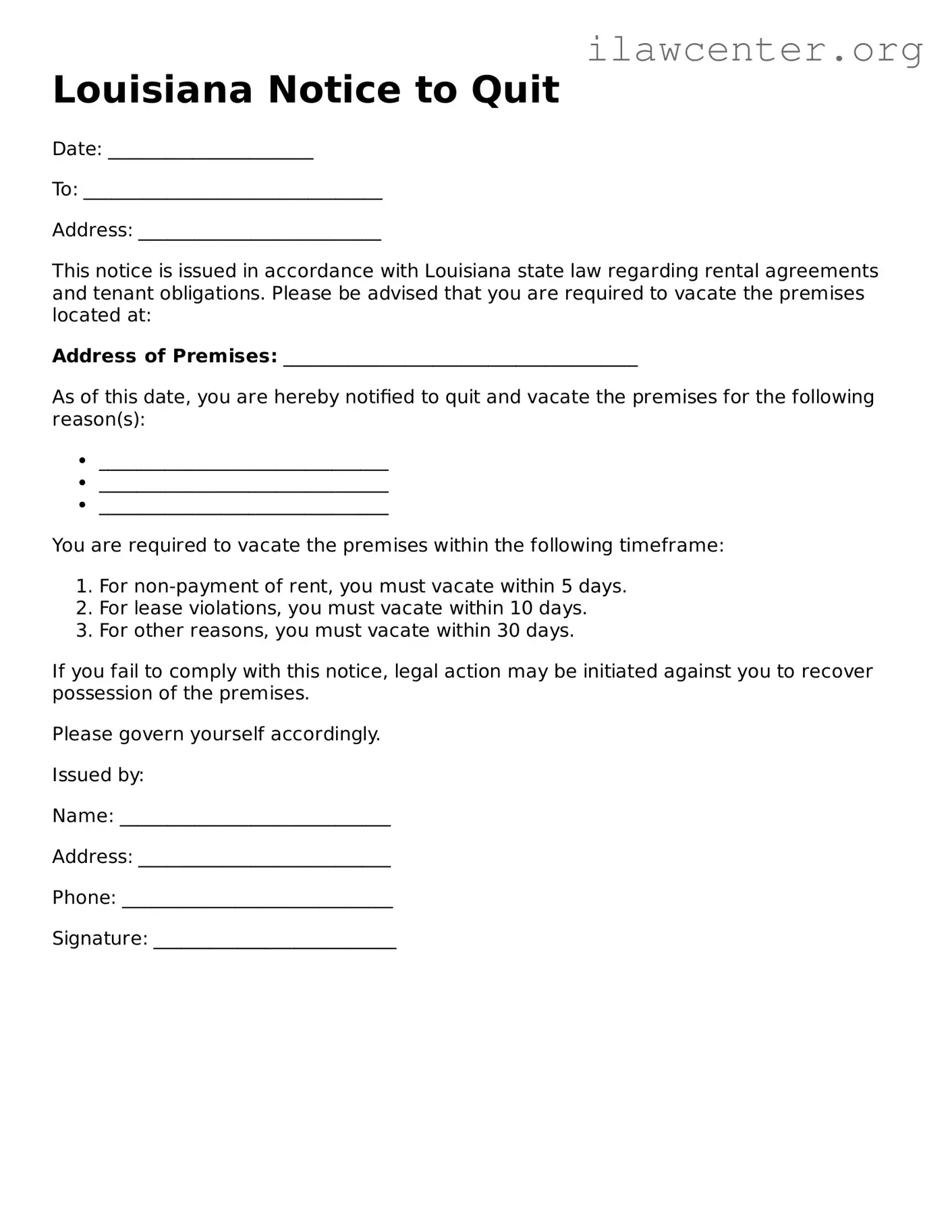
Louisiana Notice to Quit Preview

Louisiana Notice to Quit

Date: ______________________

To: ________________________________

Address: __________________________

This notice is issued in accordance with Louisiana state law regarding rental agreements and tenant obligations. Please be advised that you are required to vacate the premises located at:

Address of Premises: ______________________________________

As of this date, you are hereby notified to quit and vacate the premises for the following reason(s):

  • _______________________________
  • _______________________________
  • _______________________________

You are required to vacate the premises within the following timeframe:

  1. For non-payment of rent, you must vacate within 5 days.
  2. For lease violations, you must vacate within 10 days.
  3. For other reasons, you must vacate within 30 days.

If you fail to comply with this notice, legal action may be initiated against you to recover possession of the premises.

Please govern yourself accordingly.

Issued by:

Name: _____________________________

Address: ___________________________

Phone: _____________________________

Signature: __________________________

PDF Form Characteristics

Fact Name Description
Purpose The Louisiana Notice to Quit form is used by landlords to notify tenants of their need to vacate the rental property.
Governing Law This form is governed by Louisiana Revised Statutes, specifically La. R.S. 9:3251.
Delivery Methods Landlords can deliver the notice by personal service, mail, or posting on the property.
Timeframe Tenants typically have five days to respond to the notice before eviction proceedings can begin.
Contents The form must include the date, tenant's name, address of the property, and a clear statement of the reason for eviction.
Signature Requirement The landlord or their authorized agent must sign the notice for it to be valid.
Legal Consequences Failure to comply with the notice may lead to eviction proceedings in court.

Instructions on Utilizing Louisiana Notice to Quit

Once you have the Louisiana Notice to Quit form, you are ready to fill it out. Ensure you have all necessary information at hand, as accuracy is crucial. After completing the form, you will need to deliver it to the tenant to formally initiate the process of eviction.

  1. Begin by entering the date at the top of the form.
  2. Fill in your name and address in the designated fields.
  3. Provide the tenant's name and address. Make sure this information is correct.
  4. Clearly state the reason for the notice. Be specific and concise.
  5. Indicate the amount of time the tenant has to vacate the property. This is typically three to five days, depending on the situation.
  6. Sign the form at the bottom. Your signature confirms the notice is valid.
  7. Make a copy of the completed form for your records.
  8. Deliver the form to the tenant. This can be done in person or via certified mail for proof of delivery.

Important Facts about Louisiana Notice to Quit

What is a Louisiana Notice to Quit form?

The Louisiana Notice to Quit form is a legal document that a landlord uses to inform a tenant that they must vacate the rental property. This notice is often the first step in the eviction process. It outlines the reasons for the eviction and provides a specific timeframe for the tenant to leave the property.

When should a landlord use a Notice to Quit?

A landlord should use a Notice to Quit when a tenant has violated the terms of the lease agreement, such as failing to pay rent or causing damage to the property. This notice is essential for initiating the eviction process legally. It's important to follow the correct procedures to avoid complications later on.

How long does a tenant have to respond to a Notice to Quit?

The timeframe for a tenant to respond to a Notice to Quit can vary. Typically, the notice will specify how many days the tenant has to vacate the premises. In Louisiana, this period is usually between 5 to 30 days, depending on the reason for the eviction. Tenants should read the notice carefully to understand their obligations.

Can a tenant dispute a Notice to Quit?

Yes, a tenant can dispute a Notice to Quit. If a tenant believes the notice is unjust or that they have not violated the lease terms, they can respond to the landlord. It may be beneficial for the tenant to seek legal advice or assistance to understand their rights and options in this situation.

What happens if a tenant does not leave after receiving a Notice to Quit?

If a tenant does not leave the property by the date specified in the Notice to Quit, the landlord can proceed with filing for eviction in court. This process can lead to a hearing where both parties can present their cases. If the court rules in favor of the landlord, a judge may issue an order for the tenant to vacate the property.

Is a Notice to Quit required for all evictions in Louisiana?

A Notice to Quit is generally required for most evictions in Louisiana, especially for non-payment of rent or lease violations. However, there are exceptions. For instance, if a tenant is involved in illegal activities, a landlord may not need to provide a notice. It’s crucial for landlords to understand the specific requirements for their situation to ensure compliance with the law.
Common mistakes

Filling out the Louisiana Notice to Quit form can be a straightforward process, but many individuals make common mistakes that can complicate matters. One frequent error is failing to provide accurate tenant information. It is crucial to include the full name of the tenant and the correct rental address. Omitting or misspelling this information can lead to delays or even invalidate the notice.

Another common mistake involves the lack of specificity regarding the reason for the eviction. The form requires a clear explanation of why the tenant is being asked to vacate the property. Simply stating "non-payment" without detailing the amount owed or the time frame can create confusion. Clear communication is essential to ensure that all parties understand the situation.

People often overlook the importance of dates on the Notice to Quit form. The notice must include the date it is issued and the date by which the tenant must vacate. If these dates are missing or incorrect, it can lead to misunderstandings. It is vital to ensure that the timeline is realistic and complies with local laws, providing the tenant with adequate time to respond.

Lastly, many individuals neglect to sign and date the form. A Notice to Quit without a signature may not be considered valid. This simple step is critical in confirming that the notice was issued by the landlord or authorized agent. Taking the time to review the form for completeness can prevent unnecessary complications down the line.

Documents used along the form

When dealing with rental agreements and tenant evictions in Louisiana, the Notice to Quit form is often accompanied by several other important documents. Each of these forms plays a crucial role in the process, ensuring that both landlords and tenants understand their rights and responsibilities. Below is a list of commonly used forms that may accompany the Notice to Quit.

  • Lease Agreement: This document outlines the terms and conditions of the rental arrangement between the landlord and tenant. It typically includes details such as the rental amount, payment due dates, and rules regarding property use.
  • Notice of Non-Payment: This form is issued when a tenant fails to pay rent on time. It serves as a formal notification, reminding the tenant of their overdue rent and the potential consequences of continued non-payment.
  • Eviction Notice: If the tenant does not respond to the Notice to Quit, the landlord may issue an eviction notice. This document formally initiates the eviction process, detailing the reasons for eviction and the timeline for the tenant to vacate the property.
  • Affidavit of Service: This form is used to prove that the Notice to Quit or other eviction-related documents were properly delivered to the tenant. It typically includes details about how and when the documents were served.

Understanding these documents is essential for both landlords and tenants to navigate the rental process smoothly. Each form serves a distinct purpose and helps maintain clarity and fairness in landlord-tenant relationships.

Similar forms

  • Eviction Notice: This document serves as a formal request for a tenant to vacate the rental property. Like the Notice to Quit, it outlines the reason for the eviction and the timeframe in which the tenant must leave.
  • Lease Termination Letter: Similar to the Notice to Quit, this letter notifies a tenant that their lease will not be renewed. It specifies the end date of the tenancy and any obligations the tenant must fulfill before moving out.
  • Demand for Possession: This document is used to demand that a tenant vacate the property. It often follows the Notice to Quit and provides a legal basis for taking further action if the tenant does not comply.
  • Notice of Rent Increase: While primarily focused on rent changes, this notice can also indicate that the landlord may not wish to continue the lease under the current terms. It alerts tenants to the possibility of needing to find new housing if they cannot meet the new rent.
  • Notice of Default: This document informs a tenant that they have violated a term of their lease, such as non-payment of rent. Like the Notice to Quit, it often provides a specific timeframe to remedy the issue before further action is taken.
  • Termination of Tenancy Notice: This notice formally ends a tenancy agreement. It is similar to the Notice to Quit in that it specifies the reason for termination and the timeframe for the tenant to vacate the premises.

Dos and Don'ts

When filling out the Louisiana Notice to Quit form, it is important to follow specific guidelines to ensure the process is handled correctly. Here are seven things to do and not do:

  • Do include the correct address of the rental property.
  • Do clearly state the reason for the notice.
  • Do provide the date by which the tenant must vacate the property.
  • Do sign and date the form to validate it.
  • Don't use vague language or unclear terms in the notice.
  • Don't forget to keep a copy of the notice for your records.
  • Don't deliver the notice in a way that does not comply with local laws.

Misconceptions

Many people have misunderstandings about the Louisiana Notice to Quit form. This document is an important part of the eviction process, and clarifying common misconceptions can help both landlords and tenants understand their rights and responsibilities. Here are five misconceptions:

  1. The Notice to Quit is the same as an eviction notice. Many believe that the Notice to Quit automatically means that eviction is imminent. In reality, this notice is just a formal request for the tenant to vacate the property. It does not guarantee that eviction will occur.

  2. Landlords can issue a Notice to Quit for any reason. Some think that landlords can simply issue this notice whenever they want. However, there are specific legal grounds that must be met for a Notice to Quit to be valid, such as non-payment of rent or lease violations.

  3. Tenants have no rights after receiving a Notice to Quit. It is a common belief that once a tenant receives this notice, they must leave immediately. In fact, tenants have the right to respond and may be able to contest the notice or negotiate with the landlord.

  4. A Notice to Quit must be delivered in person. Some people think that the only way to serve this notice is through personal delivery. However, Louisiana law allows for several methods of service, including mailing the notice or posting it on the property.

  5. Receiving a Notice to Quit means the tenant will lose their security deposit. There is a misconception that tenants automatically forfeit their security deposit upon receiving this notice. This is not true; the return of a security deposit depends on the condition of the property and the terms of the lease, not solely on the issuance of a Notice to Quit.

Understanding these misconceptions can help both landlords and tenants navigate the eviction process more effectively. It is always advisable to seek legal advice if there are uncertainties about the Notice to Quit or any related issues.

Key takeaways

When filling out and using the Louisiana Notice to Quit form, it is important to understand the key elements involved. Here are some essential takeaways:

  • The Notice to Quit is a formal document used by landlords to inform tenants that they must vacate the rental property.
  • It is typically used when a tenant has violated the lease agreement or failed to pay rent.
  • The form must include specific information, such as the tenant's name, the address of the rental property, and the reason for the notice.
  • Landlords should provide a clear deadline for the tenant to vacate, usually a minimum of five days for non-payment of rent.
  • It is advisable to deliver the notice in person or via certified mail to ensure proper documentation of receipt.
  • Failure to comply with the Notice to Quit may lead to eviction proceedings in court.
  • Tenants have the right to contest the notice if they believe it is unjust or if they have remedied the issue.
  • Keeping a copy of the Notice to Quit for personal records is important for both parties involved.

Understanding these points can help both landlords and tenants navigate the process more effectively.