Attorney-Verified  Power of Attorney for a Child Document for Louisiana

Attorney-Verified Power of Attorney for a Child Document for Louisiana

The Louisiana Power of Attorney for a Child form is a legal document that allows a parent or guardian to grant another individual the authority to make decisions on behalf of their child. This arrangement can be particularly useful in situations where the parent is unable to care for their child temporarily, such as during travel or medical emergencies. To ensure your child's well-being and make informed decisions, consider filling out this form by clicking the button below.

Article Guide

When parents or guardians in Louisiana need to ensure their child's well-being in their absence, the Power of Attorney for a Child form becomes a vital tool. This legal document allows a designated adult to make decisions on behalf of a child, covering areas such as education, healthcare, and general welfare. The form is particularly useful for parents who may be traveling, working out of state, or facing temporary challenges that prevent them from being present for their child. By granting this authority, parents can ensure that their child is cared for and that important decisions can be made without delay. It is essential to understand the rights and responsibilities that come with this form, as well as the specific requirements for its completion and execution in Louisiana. Properly filling out and notarizing the form helps protect the child's interests and provides peace of mind for parents during uncertain times.

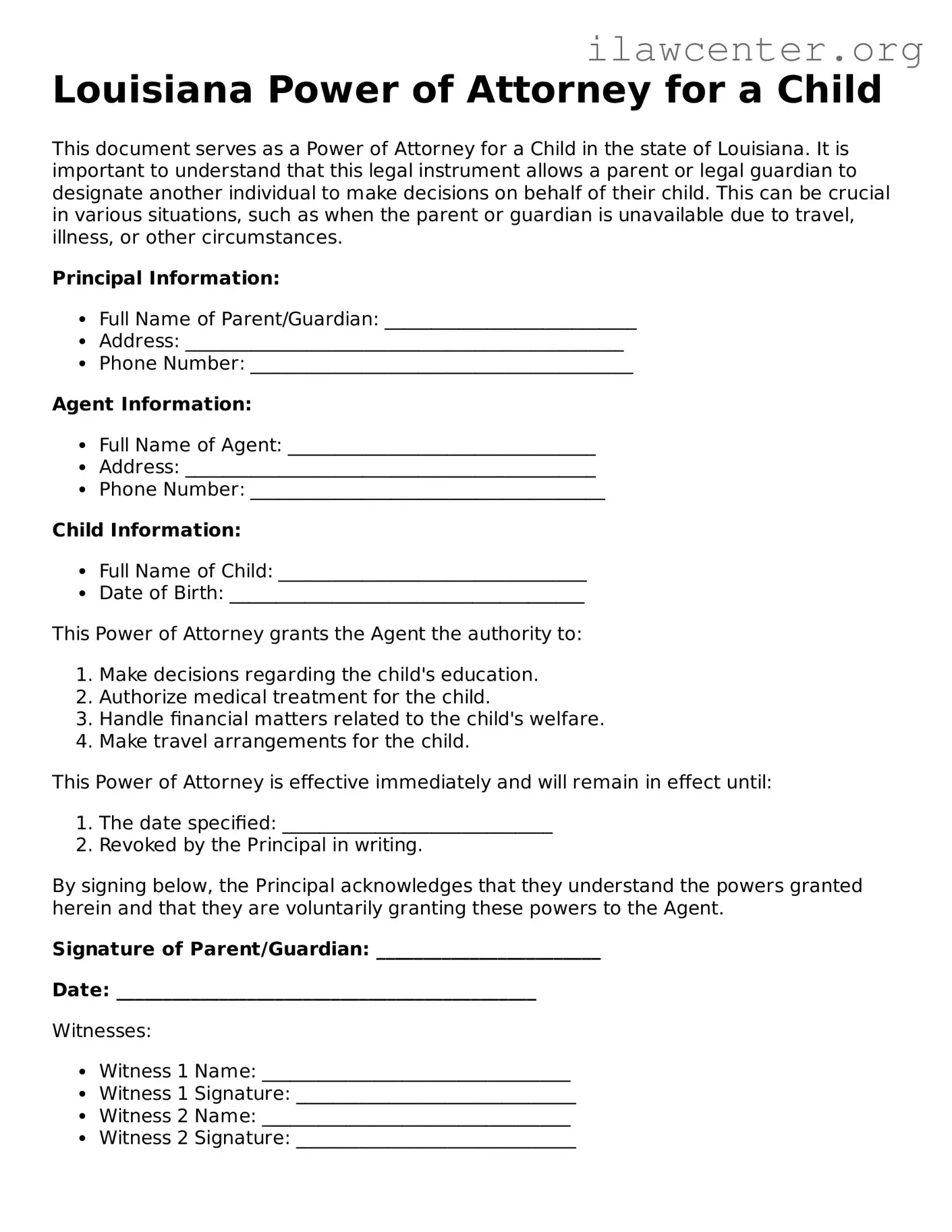
Louisiana Power of Attorney for a Child Preview

Louisiana Power of Attorney for a Child

This document serves as a Power of Attorney for a Child in the state of Louisiana. It is important to understand that this legal instrument allows a parent or legal guardian to designate another individual to make decisions on behalf of their child. This can be crucial in various situations, such as when the parent or guardian is unavailable due to travel, illness, or other circumstances.

Principal Information:

  • Full Name of Parent/Guardian: ___________________________
  • Address: _______________________________________________
  • Phone Number: _________________________________________

Agent Information:

  • Full Name of Agent: _________________________________
  • Address: ____________________________________________
  • Phone Number: ______________________________________

Child Information:

  • Full Name of Child: _________________________________
  • Date of Birth: ______________________________________

This Power of Attorney grants the Agent the authority to:

  1. Make decisions regarding the child's education.
  2. Authorize medical treatment for the child.
  3. Handle financial matters related to the child's welfare.
  4. Make travel arrangements for the child.

This Power of Attorney is effective immediately and will remain in effect until:

  1. The date specified: _____________________________
  2. Revoked by the Principal in writing.

By signing below, the Principal acknowledges that they understand the powers granted herein and that they are voluntarily granting these powers to the Agent.

Signature of Parent/Guardian: ________________________

Date: _____________________________________________

Witnesses:

  • Witness 1 Name: _________________________________
  • Witness 1 Signature: ______________________________
  • Witness 2 Name: _________________________________
  • Witness 2 Signature: ______________________________

Notary Public:

  • Name: ___________________________________________
  • Signature: ________________________________________
  • Date: ____________________________________________

It is advisable to consult with a legal professional to ensure that this document meets all legal requirements specific to Louisiana.

PDF Form Characteristics

Fact Name Details
Purpose The Louisiana Power of Attorney for a Child form allows a parent or guardian to grant temporary authority to another adult for the care of their child.
Governing Law This form is governed by Louisiana Civil Code Article 4401.
Duration The authority granted can be limited to a specific time period, typically not exceeding one year.
Notarization The form must be notarized to be legally valid.
Eligibility Any adult can be appointed as an agent, provided they are willing to accept the responsibility.
Revocation The parent or guardian can revoke the power of attorney at any time, as long as it is done in writing.
Limitations The agent cannot make decisions regarding the child's education or medical treatment without further consent.
Emergency Use This form is particularly useful in emergencies, allowing for immediate care arrangements.
Additional Requirements It is advisable to include contact information for the parent or guardian and any relevant medical information about the child.

Instructions on Utilizing Louisiana Power of Attorney for a Child

Filling out the Louisiana Power of Attorney for a Child form is a straightforward process. Once completed, this document will allow a designated person to make decisions on behalf of a child in specific situations. Follow the steps below to ensure the form is filled out correctly.

  1. Begin by downloading the Louisiana Power of Attorney for a Child form from an official source.
  2. Read through the form carefully to understand all sections that require your attention.
  3. In the first section, provide the full name of the child for whom the power of attorney is being established.
  4. Next, fill in the child’s date of birth and current address.
  5. Identify the person you are appointing as the agent. Write their full name, address, and phone number in the designated areas.
  6. Specify the duration of the power of attorney. Indicate whether it is effective immediately or if it will begin at a later date.
  7. In the section regarding the powers granted, check the boxes that correspond to the specific powers you wish to give the agent.
  8. Both the parent(s) and the agent must sign and date the form in the appropriate spaces provided.
  9. Finally, consider having the document notarized to add an extra layer of validity.

After completing the form, keep a copy for your records and provide a copy to the appointed agent. This ensures that everyone involved is aware of the arrangements made.

Important Facts about Louisiana Power of Attorney for a Child

What is a Power of Attorney for a Child in Louisiana?

A Power of Attorney for a Child in Louisiana is a legal document that allows a parent or legal guardian to designate another adult to make decisions on behalf of their child. This can include decisions about education, healthcare, and general welfare. It is particularly useful when parents are temporarily unavailable due to travel, work commitments, or other reasons.

Who can serve as an agent under this Power of Attorney?

Any adult can serve as an agent, as long as they are trustworthy and capable of making decisions in the best interest of the child. This can be a relative, family friend, or another responsible adult. It’s essential to choose someone who understands your values and is willing to take on this responsibility.

How long does the Power of Attorney last?

The duration of the Power of Attorney can vary based on the specifications outlined in the document. Typically, it remains in effect until a specified date, until the parent revokes it, or until the child reaches the age of majority (18 years old in Louisiana). Always ensure to clarify the time frame in the document itself.

Do I need to have the Power of Attorney notarized?

Yes, in Louisiana, the Power of Attorney for a Child must be notarized to be legally binding. This means that you will need to sign the document in front of a notary public, who will then add their seal to confirm its authenticity. This step helps prevent any disputes about the document's validity.

Can I revoke the Power of Attorney once it is established?

Absolutely. You can revoke the Power of Attorney at any time as long as you are of sound mind. To do this, you should create a written notice of revocation and provide it to the agent and any relevant parties, such as schools or healthcare providers. This ensures everyone is aware that the authority has been terminated.

What if the agent is unable to fulfill their duties?

If the designated agent is unable or unwilling to act, it’s important to have a backup agent specified in the Power of Attorney document. If no backup is named, you may need to create a new Power of Attorney to appoint someone else. Always consider the possibility of needing a substitute when choosing your agent.

Is there a specific form I need to use?

While there is no mandatory state form, using a standardized Power of Attorney for a Child form can help ensure that all necessary information is included. It is advisable to review the form with a legal professional to ensure it meets all requirements and adequately reflects your intentions.

What decisions can the agent make on behalf of the child?

The agent can make a variety of decisions regarding the child’s education, medical care, and general welfare. This can include enrolling the child in school, consenting to medical treatment, and making decisions about extracurricular activities. However, the scope of authority should be clearly outlined in the document.

Do I need to inform my child about the Power of Attorney?

It’s generally a good idea to inform your child about the Power of Attorney, especially if they are old enough to understand. This can help them feel more secure and aware of who will be making decisions for them in your absence. Open communication fosters trust and understanding.

Can the Power of Attorney for a Child be used for international travel?

Yes, a Power of Attorney for a Child can be useful for international travel, as it allows the designated agent to make necessary decisions while abroad. However, it’s crucial to check the specific requirements of the destination country, as some may require additional documentation or notarization for the Power of Attorney to be accepted.
Common mistakes

Filling out the Louisiana Power of Attorney for a Child form can be a straightforward process, but several common mistakes can lead to complications. One frequent error occurs when individuals neglect to include all necessary information about the child. This includes the child's full name, date of birth, and any relevant identification details. Omitting this information can result in delays or even rejection of the form.

Another common mistake is failing to specify the duration of the power of attorney. Without clear dates, the authority granted may be open-ended, leading to confusion about when the arrangement begins and ends. This lack of clarity can create issues for both the parent and the appointed agent.

Some individuals overlook the importance of selecting an appropriate agent. It is essential to choose someone trustworthy and responsible, as this person will have significant authority over the child's welfare. Failing to consider the agent’s ability to fulfill these responsibilities can have serious consequences.

Additionally, people often forget to sign and date the form. A signature is crucial for validating the document. Without it, the power of attorney may not be recognized by schools, medical facilities, or other entities that require it.

Another mistake is not having the document notarized. In Louisiana, notarization is typically required for the power of attorney to be legally binding. Skipping this step can render the document ineffective, leaving the child without the necessary legal protections.

Some individuals may also fail to provide copies of the completed form to relevant parties. It is advisable to share copies with the agent, schools, and medical providers to ensure everyone is aware of the arrangement. Not distributing copies can lead to misunderstandings and complications in emergencies.

Moreover, people sometimes overlook the need for witnesses. Depending on the circumstances, having witnesses present during the signing can strengthen the validity of the document. Ignoring this requirement can weaken the power of attorney's enforceability.

Another frequent oversight is not reviewing the form for accuracy before submission. Simple errors, such as misspellings or incorrect dates, can undermine the document's integrity. Taking the time to double-check all entries is essential for ensuring clarity and correctness.

Finally, individuals may underestimate the importance of understanding the rights being granted. It is crucial to fully comprehend what powers are being given to the agent. Misunderstanding these rights can lead to unintended consequences and potential conflicts down the line.

Documents used along the form

When establishing a Power of Attorney for a Child in Louisiana, several other forms and documents may be beneficial to ensure comprehensive legal coverage. These documents can provide additional authority or clarification regarding the child's care and welfare.

  • Medical Authorization Form: This document allows a designated individual to make medical decisions on behalf of the child in case of an emergency. It typically includes consent for medical treatment and access to medical records.
  • Child Custody Agreement: If applicable, this agreement outlines the custody arrangements for the child. It specifies where the child will live and the visitation rights of the non-custodial parent or guardians.
  • Emergency Contact Information: This form lists key contacts for the child, including parents, guardians, and other emergency contacts. It ensures that caregivers have immediate access to necessary information in urgent situations.
  • Travel Consent Form: If the child will be traveling, this document provides consent for travel, particularly if the child is traveling with someone other than a parent or legal guardian. It may include details about the trip and emergency contacts.

Each of these documents plays a vital role in supporting the Power of Attorney for a Child form. Together, they help clarify responsibilities and ensure that the child's needs are met effectively.

Similar forms

The Power of Attorney for a Child form is a vital document that allows a designated individual to make decisions on behalf of a child. This form is not unique; several other documents serve similar purposes in different contexts. Here are ten documents that share similarities with the Power of Attorney for a Child form:

  • General Power of Attorney: This document allows an individual to appoint someone to make financial and legal decisions on their behalf. Like the Power of Attorney for a Child, it grants authority to act in specific situations.
  • Medical Power of Attorney: This form enables a person to designate someone to make healthcare decisions for them if they become unable to do so. Similar to the child-specific form, it focuses on the well-being of an individual.
  • Guardianship Agreement: This legal arrangement appoints a guardian to take care of a minor. It parallels the Power of Attorney for a Child in that both documents assign responsibility for a child’s welfare.
  • Temporary Custody Agreement: This document allows a parent to give temporary custody of their child to another person. It shares the purpose of ensuring care and protection for the child, much like the Power of Attorney for a Child.
  • Child Care Authorization: This form permits someone to make decisions regarding a child's care, including education and medical needs. It is similar in function to the Power of Attorney for a Child, focusing on a child's best interests.
  • Living Will: A living will outlines a person's wishes regarding medical treatment in the event of incapacitation. While it primarily focuses on health care, it shares the aspect of decision-making authority found in the Power of Attorney for a Child.
  • Trust Agreement: A trust can be established to manage assets for a child. This document, like the Power of Attorney for a Child, involves the management of a child's interests, albeit in a financial context.
  • Foster Care Agreement: This document is used when a child is placed in foster care, allowing caregivers to make decisions for the child. It serves a similar purpose in ensuring the child's needs are met.
  • Education Power of Attorney: This specific power of attorney allows someone to make educational decisions on behalf of a child. It directly parallels the Power of Attorney for a Child in its focus on the child's development and needs.
  • Special Needs Trust: This legal arrangement helps manage funds for a child with special needs, ensuring their care and support. It aligns with the Power of Attorney for a Child in its aim to protect and provide for a child's future.

Understanding these documents can empower parents and guardians to make informed decisions about the care and welfare of children. Each document serves a unique purpose but shares the common goal of ensuring that a child's best interests are prioritized.

Dos and Don'ts

When filling out the Louisiana Power of Attorney for a Child form, it is important to follow certain guidelines to ensure the document is valid and effective. Below is a list of things you should and shouldn't do.

  • Do: Ensure that the form is filled out completely and accurately.
  • Do: Include the full names and addresses of both the child and the agent.
  • Do: Sign the form in the presence of a notary public.
  • Do: Keep a copy of the completed form for your records.
  • Do: Review the form periodically to ensure it remains up to date.
  • Don't: Leave any sections of the form blank.
  • Don't: Use outdated versions of the Power of Attorney form.
  • Don't: Sign the document without understanding its implications.
  • Don't: Assume verbal agreements will suffice; written documentation is necessary.
  • Don't: Forget to check state-specific requirements that may apply.

Misconceptions

Understanding the Louisiana Power of Attorney for a Child form can be challenging due to various misconceptions. Here are six common misunderstandings about this legal document:

  1. It can only be used for medical decisions.

    Many people believe that the Power of Attorney for a Child is limited to medical decisions. In reality, this document can grant a designated person the authority to make a variety of decisions, including educational and financial matters, not just health-related ones.

  2. It is the same as guardianship.

    Some individuals confuse a Power of Attorney with guardianship. While both involve decision-making for a child, guardianship is a more permanent legal arrangement, whereas a Power of Attorney can be temporary and is often used for specific situations.

  3. It requires court approval.

    There is a misconception that a Power of Attorney for a Child must be approved by a court. This is not the case. Parents can create this document without needing a court's involvement, as long as both parents agree and sign it.

  4. It expires after a specific time.

    Some believe that a Power of Attorney for a Child has a fixed expiration date. However, it remains valid until the parents revoke it or until a specific condition outlined in the document occurs.

  5. Only one parent needs to sign it.

    While it is possible for one parent to create a Power of Attorney, it is generally advisable for both parents to sign the document. This ensures clarity and reduces potential disputes regarding the authority granted.

  6. It is not legally binding.

    Some people think that a Power of Attorney for a Child lacks legal authority. In fact, when properly executed, it is a legally binding document that grants the designated individual the authority to act on behalf of the child.

Key takeaways

When filling out and using the Louisiana Power of Attorney for a Child form, consider the following key takeaways:

  • Understand the Purpose: This form allows a parent or legal guardian to delegate certain responsibilities for their child to another adult.
  • Choose the Right Person: Select someone trustworthy, as this individual will have authority over your child's care and decisions.
  • Specify the Authority: Clearly outline what decisions the appointed person can make, such as medical, educational, or financial matters.
  • Duration of Authority: Indicate how long the Power of Attorney will remain in effect. This can be temporary or more permanent, depending on your needs.
  • Signatures Required: Ensure that both the parent and the appointed individual sign the form. Notarization may also be necessary for legal validity.
  • Keep Copies: After completing the form, make multiple copies. Provide one to the appointed individual and keep one for your records.