Attorney-Verified  Power of Attorney Document for Louisiana

Attorney-Verified Power of Attorney Document for Louisiana

The Louisiana Power of Attorney form is a legal document that allows an individual, known as the principal, to grant authority to another person, called the agent, to make decisions on their behalf. This form can cover a range of decisions, including financial and medical matters, ensuring that the principal's wishes are respected even when they are unable to act for themselves. To take control of your future, consider filling out the form by clicking the button below.

Article Guide

The Louisiana Power of Attorney form serves as a crucial legal document that empowers individuals to designate someone else to make decisions on their behalf. This arrangement is particularly important in situations where a person may become incapacitated or unable to manage their affairs. The form outlines the specific powers granted to the agent, which can range from handling financial transactions to making healthcare decisions. In Louisiana, the document must be signed and notarized to ensure its validity, and it can be tailored to meet the unique needs of the principal. Understanding the nuances of this form is essential for anyone considering appointing an agent, as it provides a framework for trust and responsibility. Additionally, the Louisiana Power of Attorney can be revoked or modified at any time, offering flexibility to the principal as circumstances change. By carefully navigating this process, individuals can secure peace of mind knowing their interests will be protected, even in challenging situations.

Louisiana Power of Attorney Preview

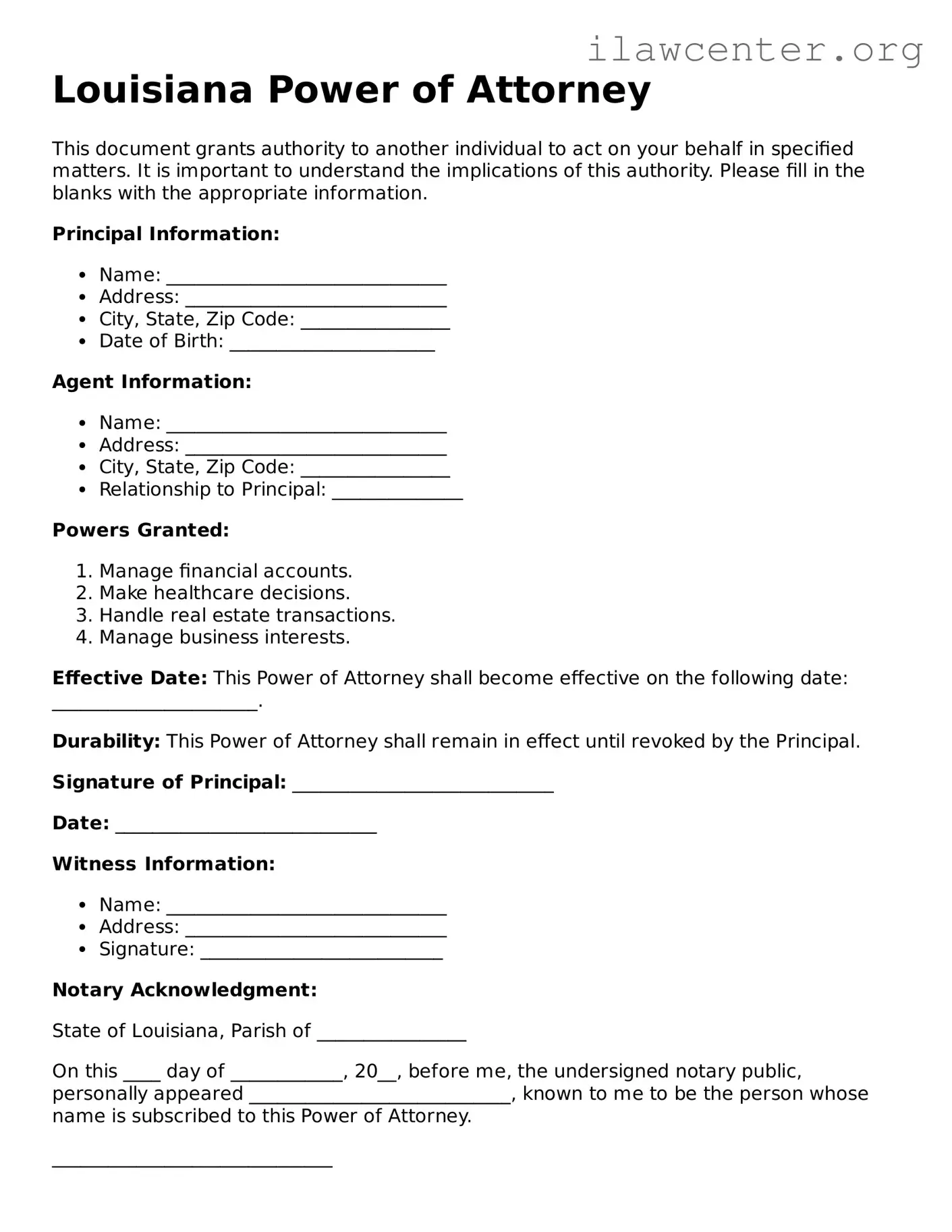
Louisiana Power of Attorney

This document grants authority to another individual to act on your behalf in specified matters. It is important to understand the implications of this authority. Please fill in the blanks with the appropriate information.

Principal Information:

  • Name: ______________________________
  • Address: ____________________________
  • City, State, Zip Code: ________________
  • Date of Birth: ______________________

Agent Information:

  • Name: ______________________________
  • Address: ____________________________
  • City, State, Zip Code: ________________
  • Relationship to Principal: ______________

Powers Granted:

  1. Manage financial accounts.
  2. Make healthcare decisions.
  3. Handle real estate transactions.
  4. Manage business interests.

Effective Date: This Power of Attorney shall become effective on the following date: ______________________.

Durability: This Power of Attorney shall remain in effect until revoked by the Principal.

Signature of Principal: ____________________________

Date: ____________________________

Witness Information:

  • Name: ______________________________
  • Address: ____________________________
  • Signature: __________________________

Notary Acknowledgment:

State of Louisiana, Parish of ________________

On this ____ day of ____________, 20__, before me, the undersigned notary public, personally appeared ____________________________, known to me to be the person whose name is subscribed to this Power of Attorney.

______________________________

Notary Public Signature

My Commission Expires: _______________

PDF Form Characteristics

Fact Name Details
Definition A Louisiana Power of Attorney form allows an individual (the principal) to designate another person (the agent) to make decisions on their behalf.
Governing Laws This form is governed by the Louisiana Civil Code, specifically Article 2991 and subsequent articles related to mandates.
Types of Authority The form can grant general authority, which covers a wide range of decisions, or specific authority, which limits the agent's powers to particular tasks.
Durability A Power of Attorney can be durable, meaning it remains effective even if the principal becomes incapacitated, unless stated otherwise.
Revocation The principal can revoke the Power of Attorney at any time, as long as they are mentally competent to do so.

Instructions on Utilizing Louisiana Power of Attorney

After obtaining the Louisiana Power of Attorney form, you will need to complete it with accurate information. This document allows you to designate someone to act on your behalf in various matters. Follow these steps to ensure the form is filled out correctly.

  1. Begin by entering the date at the top of the form.
  2. Provide your full name and address in the designated section.
  3. Identify the person you are appointing as your agent. Include their full name and address.
  4. Clearly specify the powers you are granting to your agent. This may include financial decisions, legal matters, or healthcare decisions.
  5. Indicate whether the Power of Attorney is effective immediately or if it will become effective at a later date.
  6. Include any specific instructions or limitations regarding the authority of your agent.
  7. Sign the form in the presence of a notary public. Ensure that the notary signs and stamps the document as required.
  8. Provide copies of the completed form to your agent and any relevant institutions or individuals.

Important Facts about Louisiana Power of Attorney

What is a Power of Attorney in Louisiana?

A Power of Attorney (POA) in Louisiana is a legal document that allows one person, known as the principal, to grant another person, called the agent or attorney-in-fact, the authority to act on their behalf. This can include making financial decisions, managing property, or handling legal matters. It is a vital tool for ensuring that someone you trust can manage your affairs if you are unable to do so yourself.

What types of Power of Attorney are available in Louisiana?

In Louisiana, there are several types of Power of Attorney. The most common include: 1. General Power of Attorney: This grants broad authority to the agent to act in a variety of matters. 2. Limited Power of Attorney: This restricts the agent's authority to specific tasks or situations. 3. Durable Power of Attorney: This remains effective even if the principal becomes incapacitated. 4. Springing Power of Attorney: This only takes effect upon the occurrence of a specified event, such as the principal's incapacity.

How do I create a Power of Attorney in Louisiana?

To create a Power of Attorney in Louisiana, you must draft the document, clearly outlining the powers you wish to grant to your agent. It is important to include your name, the name of your agent, and any specific powers you wish to grant. The document must be signed by you in the presence of a notary public and two witnesses. This ensures that the POA is legally valid and recognized.

Can I revoke a Power of Attorney in Louisiana?

Yes, you can revoke a Power of Attorney in Louisiana at any time, as long as you are mentally competent. To do this, you should create a written revocation document, sign it, and notify your agent and any relevant institutions or individuals that may have relied on the original POA. It is advisable to keep a copy of the revocation for your records.

What happens if my agent cannot serve or is unable to act?

If your agent is unable to serve or act on your behalf, you may have the option to designate an alternate agent in your Power of Attorney document. If no alternate is named, or if the agent is unable to fulfill their duties, you may need to seek legal assistance to appoint a new agent or to address the situation.

Is a Power of Attorney valid if I move to another state?

A Power of Attorney created in Louisiana may be valid in another state, but this can depend on the laws of that state. It is advisable to check the specific requirements of the state you are moving to, as some states may have different rules regarding the recognition of out-of-state Powers of Attorney. Consulting with a local attorney can provide clarity on this matter.

Can a Power of Attorney be used for healthcare decisions in Louisiana?

Yes, in Louisiana, you can create a separate document known as a Healthcare Power of Attorney, which specifically grants your agent the authority to make medical decisions on your behalf if you become incapacitated. This document is distinct from a financial Power of Attorney and should clearly outline your healthcare preferences and the powers you wish to grant to your agent.

What should I consider when choosing an agent for my Power of Attorney?

When selecting an agent for your Power of Attorney, it is crucial to choose someone you trust implicitly. Consider their ability to handle financial or legal matters responsibly. Think about their availability and willingness to take on this responsibility. It may also be beneficial to discuss your wishes and expectations with them beforehand to ensure they are comfortable with the role.
Common mistakes

Filling out a Power of Attorney (POA) form in Louisiana can be a straightforward process, but many individuals make common mistakes that can lead to complications. Understanding these pitfalls is essential for ensuring that the document serves its intended purpose without unnecessary delays or legal issues.

One frequent error is failing to specify the powers granted to the agent. The form should clearly outline what authority the agent has. Without this clarity, the agent may not be able to act effectively on behalf of the principal. It’s crucial to detail whether the agent can manage financial affairs, make healthcare decisions, or handle real estate transactions.

Another common mistake is neglecting to date the document. A POA should always include the date of execution. If the date is missing, it may raise questions about the validity of the document, especially if it needs to be used at a later time. Proper dating helps establish a clear timeline for the authority granted.

Many individuals also overlook the importance of signatures. Both the principal and the agent must sign the document for it to be valid. Additionally, having witnesses or a notary public present during the signing can add an extra layer of protection and legitimacy. Failing to secure these signatures may render the POA ineffective.

Another mistake involves not considering the need for alternate agents. Life is unpredictable, and circumstances can change. If the primary agent is unable or unwilling to serve, having an alternate agent designated can ensure that the principal's wishes are still honored. This foresight can prevent complications down the line.

People often forget to provide clear identification for both the principal and the agent. Including full names, addresses, and other identifying information helps prevent any confusion regarding the parties involved. This detail is essential for ensuring that the document is executed correctly and recognized by institutions.

Additionally, some individuals may not fully understand the implications of granting a POA. It is vital to have open discussions with the designated agent about their responsibilities and the scope of their authority. Misunderstandings can lead to conflicts or misuse of the power granted.

Another error is failing to keep copies of the completed document. Once the POA is executed, it is important to distribute copies to the agent, relevant family members, and any institutions that may need to reference it. Keeping track of these copies ensures that the document is accessible when needed.

People sometimes use outdated forms or templates found online without verifying their accuracy. Laws can change, and using an outdated form may lead to legal issues. Always ensure that the most current version of the Louisiana Power of Attorney form is being used to avoid complications.

Finally, many individuals do not review the document periodically. Life circumstances change, and so do the needs of the principal. Regularly reviewing and updating the POA can help ensure that it continues to reflect the principal’s current wishes and circumstances. This proactive approach can prevent confusion and potential disputes in the future.

Documents used along the form

When creating a Power of Attorney in Louisiana, several other forms and documents may be necessary to ensure that all legal and financial matters are properly addressed. Below is a list of commonly used documents that complement the Power of Attorney form.

  • Durable Power of Attorney: This document remains effective even if the principal becomes incapacitated. It allows the agent to continue making decisions on behalf of the principal during periods of incapacity.
  • Living Will: A living will outlines an individual's wishes regarding medical treatment in situations where they cannot communicate their preferences. It is crucial for healthcare decisions.
  • Health Care Proxy: This document designates a specific person to make healthcare decisions for an individual if they are unable to do so themselves. It works in conjunction with a living will.
  • Financial Power of Attorney: Similar to the general Power of Attorney, this document specifically grants authority to manage financial matters, such as banking and investments, on behalf of the principal.
  • Will: A will outlines how a person's assets will be distributed upon their death. It may also designate guardians for minor children and can be an important part of overall estate planning.
  • Trust Documents: Trusts are used to manage assets during a person’s lifetime and after death. They can help avoid probate and provide for specific distributions of assets to beneficiaries.

These documents work together to create a comprehensive plan for managing personal, financial, and medical decisions. It is important to consider each of these forms when establishing a Power of Attorney to ensure that all aspects of an individual's wishes are respected and upheld.

Similar forms

The Power of Attorney (POA) form is a crucial legal document that allows one person to act on behalf of another in various matters. While the POA serves its unique purpose, several other documents share similarities in function and intent. Below are six documents that are comparable to the Power of Attorney form:

  • Living Will: A living will outlines a person's preferences for medical treatment in situations where they cannot communicate their wishes. Like a POA, it allows individuals to express their desires regarding health care decisions.
  • Healthcare Proxy: This document designates someone to make medical decisions for an individual if they become incapacitated. Similar to a POA, it empowers another person to act in the best interest of the individual regarding health-related matters.
  • Durable Power of Attorney: This is a specific type of POA that remains effective even if the principal becomes incapacitated. Both documents grant authority to another person, but the durable version ensures continuity in decision-making during critical times.
  • Financial Power of Attorney: This document specifically focuses on financial matters, allowing someone to manage another person's finances. While the general POA can cover various areas, the financial POA is tailored for economic decisions.
  • Trust Document: A trust allows a person to transfer assets to a trustee who manages them for the benefit of beneficiaries. Both trusts and POAs involve delegating authority, though trusts primarily focus on asset management and distribution.
  • Guardian Appointment: This legal document appoints a guardian for a minor or incapacitated adult. Similar to a POA, it designates someone to make decisions on behalf of another, ensuring their well-being and protection.

Dos and Don'ts

Filling out a Power of Attorney form in Louisiana is an important task that requires careful consideration. Here are some essential dos and don'ts to keep in mind.

  • Do ensure you understand the powers you are granting.
  • Do choose a trustworthy agent who will act in your best interest.
  • Do clearly specify the powers you wish to grant in the document.
  • Do sign the document in front of a notary public and witnesses, if required.
  • Do keep a copy of the signed document for your records.
  • Don't rush through the process without reading the form carefully.
  • Don't grant powers to someone you do not fully trust.
  • Don't assume the form is legally valid without proper signatures.
  • Don't forget to update the document if your circumstances change.

By following these guidelines, you can help ensure that your Power of Attorney accurately reflects your wishes and protects your interests.

Misconceptions

Many people hold misconceptions about the Louisiana Power of Attorney form. Understanding the facts can help individuals make informed decisions regarding their legal rights and responsibilities. Below are five common misconceptions along with clarifications.

  1. Misconception 1: The Power of Attorney is only for financial matters.

    This is not true. While a Power of Attorney can be used for financial decisions, it can also grant authority over healthcare decisions, property management, and other personal matters.

  2. Misconception 2: A Power of Attorney is permanent and cannot be revoked.

    In reality, a Power of Attorney can be revoked at any time by the principal, as long as they are mentally competent. This allows individuals to maintain control over their decisions.

  3. Misconception 3: Anyone can be appointed as an agent.

    This is partially correct. While individuals can choose almost anyone as their agent, it is advisable to select someone trustworthy and capable of handling the responsibilities.

  4. Misconception 4: The Power of Attorney is only necessary for the elderly.

    This misconception overlooks the fact that anyone can benefit from having a Power of Attorney. Unexpected events, such as accidents or sudden illness, can happen to anyone, regardless of age.

  5. Misconception 5: A Power of Attorney is the same as a will.

    This is incorrect. A Power of Attorney is effective during a person's lifetime and ceases upon their death, while a will takes effect only after death and governs the distribution of assets.

Key takeaways

Filling out and using the Louisiana Power of Attorney form is an important step in ensuring your financial and legal matters are handled according to your wishes. Here are some key takeaways to keep in mind:

  • Choose Your Agent Wisely: The person you designate as your agent should be trustworthy and capable of making decisions on your behalf.
  • Specify Powers Clearly: Clearly outline the powers you are granting. This could include managing finances, making healthcare decisions, or handling real estate transactions.
  • Understand the Limitations: Be aware that the Power of Attorney can be limited in scope. It’s important to know what your agent can and cannot do.
  • Revocation is Possible: You can revoke the Power of Attorney at any time, as long as you are mentally competent. Ensure that any revocation is documented properly.