Attorney-Verified  Prenuptial Agreement Document for Louisiana

Attorney-Verified Prenuptial Agreement Document for Louisiana

A Louisiana Prenuptial Agreement form is a legal document that outlines the financial and property arrangements between partners before marriage. This agreement helps protect individual assets and clarify financial responsibilities during the marriage and in the event of a divorce. To start creating your prenuptial agreement, fill out the form by clicking the button below.

Article Guide

When couples decide to marry, they often consider the future and the potential challenges that may arise during their relationship. A Louisiana Prenuptial Agreement can serve as a vital tool in this regard, providing clarity and protection for both parties. This legal document outlines how assets and debts will be managed and divided in the event of a divorce or separation. It can address various aspects, including property rights, spousal support, and the management of finances, ensuring that both partners have a clear understanding of their rights and responsibilities. Importantly, a prenuptial agreement must be created voluntarily and with full disclosure of each party's financial situation. By taking the time to establish this agreement before tying the knot, couples can foster open communication about financial matters, reduce potential conflicts, and pave the way for a more secure and harmonious future together.

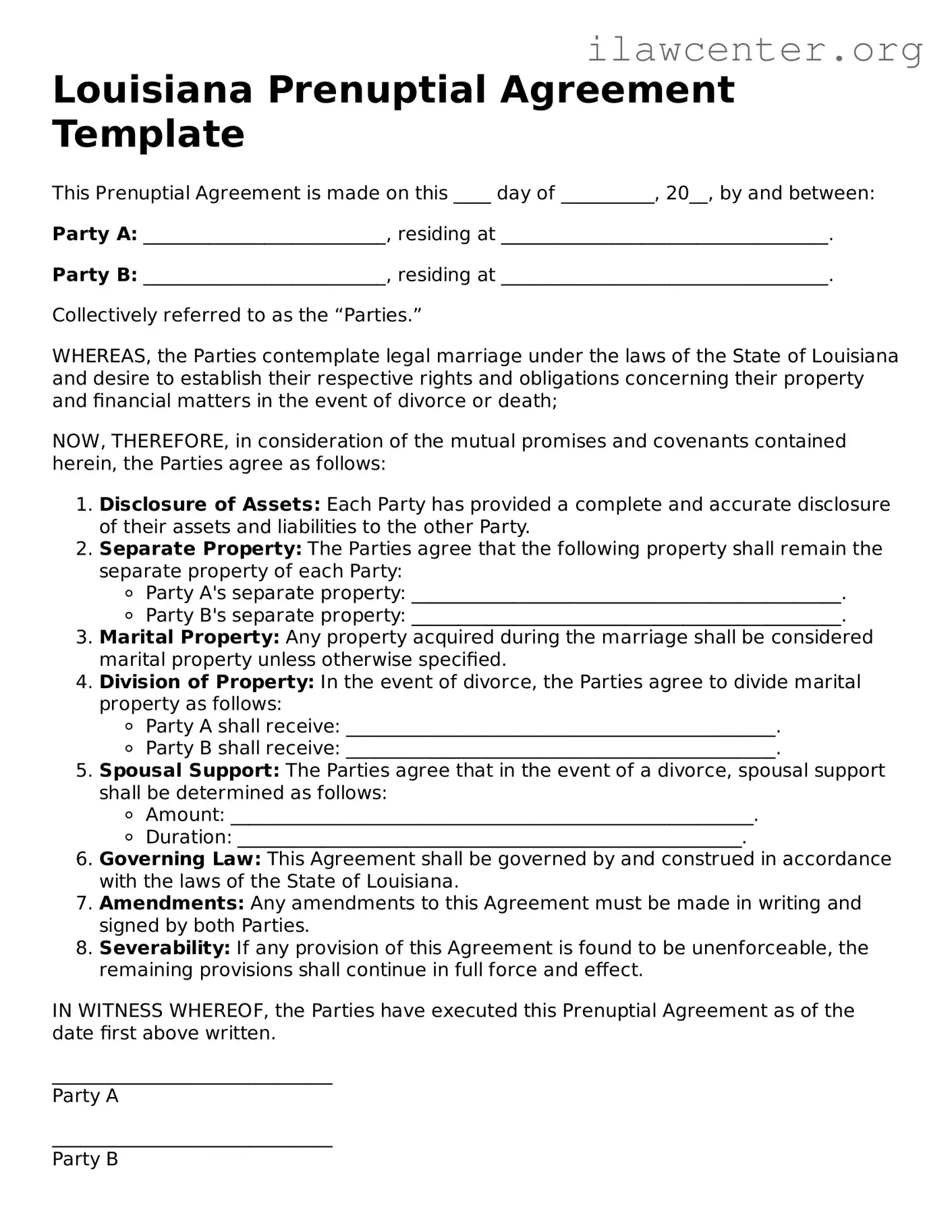
Louisiana Prenuptial Agreement Preview

Louisiana Prenuptial Agreement Template

This Prenuptial Agreement is made on this ____ day of __________, 20__, by and between:

Party A: __________________________, residing at ___________________________________.

Party B: __________________________, residing at ___________________________________.

Collectively referred to as the “Parties.”

WHEREAS, the Parties contemplate legal marriage under the laws of the State of Louisiana and desire to establish their respective rights and obligations concerning their property and financial matters in the event of divorce or death;

NOW, THEREFORE, in consideration of the mutual promises and covenants contained herein, the Parties agree as follows:

  1. Disclosure of Assets: Each Party has provided a complete and accurate disclosure of their assets and liabilities to the other Party.
  2. Separate Property: The Parties agree that the following property shall remain the separate property of each Party:
    • Party A's separate property: ______________________________________________.
    • Party B's separate property: ______________________________________________.
  3. Marital Property: Any property acquired during the marriage shall be considered marital property unless otherwise specified.
  4. Division of Property: In the event of divorce, the Parties agree to divide marital property as follows:
    • Party A shall receive: ______________________________________________.
    • Party B shall receive: ______________________________________________.
  5. Spousal Support: The Parties agree that in the event of a divorce, spousal support shall be determined as follows:
    • Amount: ________________________________________________________.
    • Duration: ______________________________________________________.
  6. Governing Law: This Agreement shall be governed by and construed in accordance with the laws of the State of Louisiana.
  7. Amendments: Any amendments to this Agreement must be made in writing and signed by both Parties.
  8. Severability: If any provision of this Agreement is found to be unenforceable, the remaining provisions shall continue in full force and effect.

IN WITNESS WHEREOF, the Parties have executed this Prenuptial Agreement as of the date first above written.

______________________________
Party A

______________________________
Party B

______________________________
Witness

______________________________
Witness

PDF Form Characteristics

Fact Name Description
Governing Law Louisiana prenuptial agreements are governed by the Louisiana Civil Code, specifically Articles 2325 to 2329.
Written Requirement For a prenuptial agreement to be valid in Louisiana, it must be in writing and signed by both parties.
Full Disclosure Both parties are required to provide a full and fair disclosure of their assets and debts prior to signing the agreement.
Enforceability Louisiana courts will enforce prenuptial agreements as long as they are not deemed unconscionable or signed under duress.
Modification and Revocation Agreements can be modified or revoked by mutual consent, but changes must also be in writing and signed by both parties.

Instructions on Utilizing Louisiana Prenuptial Agreement

Filling out a Louisiana Prenuptial Agreement form is a straightforward process. You will need to provide specific information about both parties and their assets. Follow these steps to ensure you complete the form accurately.

  1. Title the Document: At the top of the form, write "Prenuptial Agreement" to clearly indicate the purpose of the document.
  2. Identify the Parties: Write the full names of both individuals entering the agreement. Include their addresses and any relevant personal details.
  3. State the Purpose: Clearly outline the intent of the agreement. This may include asset protection, debt management, or any other relevant reasons.
  4. List Assets: Itemize all assets owned by each party. Include property, bank accounts, investments, and any other significant possessions.
  5. Detail Debts: Disclose any debts held by either party. Be transparent about loans, credit cards, and other financial obligations.
  6. Specify Terms: Clearly state how assets and debts will be managed during the marriage and in the event of a divorce.
  7. Include Signatures: Both parties must sign the agreement. Include the date of signing and consider having it notarized for added legal validity.
  8. Consult an Attorney: While optional, it’s wise to have a legal professional review the document to ensure it meets all legal requirements.

Once you have completed the form, both parties should keep a signed copy for their records. This agreement can provide clarity and security for both individuals as they enter into marriage.

Important Facts about Louisiana Prenuptial Agreement

What is a prenuptial agreement in Louisiana?

A prenuptial agreement, often called a prenup, is a legal contract created by two individuals before they get married. This document outlines how assets and debts will be handled in the event of a divorce or separation. In Louisiana, a prenup can help clarify financial responsibilities and protect individual assets, ensuring that both parties understand their rights and obligations from the start of the marriage.

Why should I consider a prenuptial agreement?

Considering a prenuptial agreement can be beneficial for various reasons. It allows couples to discuss financial matters openly and can protect personal assets acquired before marriage. A prenup can also define how to manage property and debts during the marriage, potentially reducing conflicts in the future. Additionally, it can provide peace of mind, knowing that both parties have agreed on important financial issues.

What should be included in a Louisiana prenuptial agreement?

A Louisiana prenuptial agreement typically includes details about each party's assets, debts, and income. It may outline how property will be divided in case of divorce, as well as how spousal support will be handled. Other considerations might include inheritance rights and provisions for children from previous relationships. It's essential to ensure that the agreement is comprehensive and tailored to the couple's specific situation.

Are prenuptial agreements enforceable in Louisiana?

Yes, prenuptial agreements are generally enforceable in Louisiana, provided they meet certain legal requirements. Both parties must enter into the agreement voluntarily and with a clear understanding of its terms. It is also crucial that the agreement is in writing and signed by both parties. If these conditions are met, the court is likely to uphold the prenup during divorce proceedings.

Can a prenuptial agreement be modified after marriage?

Yes, a prenuptial agreement can be modified after marriage. However, any changes must be made in writing and signed by both parties to be valid. This flexibility allows couples to adapt their agreement as their circumstances change, such as acquiring new assets or having children. Regularly reviewing and updating the prenup can help ensure that it continues to reflect the couple's current situation.

Do I need a lawyer to create a prenuptial agreement in Louisiana?

While it is not legally required to have a lawyer when creating a prenuptial agreement in Louisiana, it is highly recommended. A lawyer can provide valuable guidance, ensuring that the agreement complies with state laws and adequately protects both parties' interests. Having legal representation can also help prevent misunderstandings and disputes down the line.

How long before the wedding should we create a prenuptial agreement?

It is advisable to create a prenuptial agreement well in advance of the wedding. This allows both parties ample time to discuss and negotiate the terms without feeling rushed. Ideally, couples should start the process at least a few months before the wedding date. This timeline helps ensure that both individuals fully understand the agreement and can make informed decisions.

What happens if we don't have a prenuptial agreement?

If a couple does not have a prenuptial agreement, Louisiana's community property laws will govern the division of assets and debts in the event of a divorce. This means that most property acquired during the marriage will be considered jointly owned, regardless of who earned or purchased it. Without a prenup, couples may face challenges in determining how to fairly divide their assets, which can lead to disputes and complications during divorce proceedings.
Common mistakes

Filling out a Louisiana Prenuptial Agreement form can be a straightforward process, but many people make mistakes that could lead to complications down the line. One common mistake is failing to fully disclose assets. Both parties must provide a complete picture of their financial situation. If one partner omits significant assets, it can lead to trust issues and potential legal disputes later on.

Another frequent error is not specifying how debts will be handled. Many couples focus solely on assets, but it’s equally important to address liabilities. If debts are not clearly outlined, one partner may end up responsible for the other’s financial obligations, which can create tension and conflict.

Additionally, some individuals overlook the importance of legal advice. While it may seem tempting to fill out the form independently, consulting with a legal professional can provide valuable insights. An attorney can help ensure that the agreement is fair, legally sound, and tailored to the couple’s specific needs.

Finally, people often forget to review and update the agreement regularly. Life changes, such as the birth of a child or a significant change in financial status, can affect the relevance of the prenuptial agreement. Regularly revisiting the document can help ensure that it continues to reflect the couple's current situation and intentions.

Documents used along the form

When preparing for marriage, many couples consider a prenuptial agreement to outline their financial arrangements and protect their individual interests. However, this agreement often works best in conjunction with several other important documents. Here are four commonly used forms that can complement a Louisiana Prenuptial Agreement.

  • Financial Disclosure Statement: This document provides a comprehensive overview of each party's assets, liabilities, income, and expenses. Full transparency in financial matters can help both partners make informed decisions and negotiate terms fairly.
  • Postnuptial Agreement: Similar to a prenuptial agreement, a postnuptial agreement is executed after marriage. It can address changes in financial circumstances or clarify asset distribution as the couple's life evolves.
  • Marital Settlement Agreement: This agreement comes into play during divorce proceedings. It outlines the division of property, debts, and other financial responsibilities, helping to streamline the process and reduce conflict.
  • Will or Trust Document: While not directly related to the prenuptial agreement, having a will or trust is crucial for estate planning. These documents dictate how assets will be distributed upon death, ensuring that both partners' wishes are honored.

Each of these documents plays a vital role in establishing clear expectations and protecting the interests of both partners. By considering these forms alongside a prenuptial agreement, couples can create a solid foundation for their marriage and future financial stability.

Similar forms

  • Postnuptial Agreement: Similar to a prenuptial agreement, a postnuptial agreement is created after marriage. It outlines the division of assets and responsibilities in the event of a divorce or separation, ensuring both parties have a clear understanding of their rights.
  • Separation Agreement: This document is used when a couple decides to live apart. A separation agreement details the terms of the separation, including asset division, child custody, and support obligations, much like a prenuptial agreement prepares couples for potential future disputes.
  • Divorce Settlement Agreement: A divorce settlement agreement is finalized during the divorce process. It addresses the distribution of property, debts, and other responsibilities, similar to how a prenuptial agreement anticipates these issues before marriage.
  • Co-Habitation Agreement: For couples living together without marriage, a co-habitation agreement serves a similar purpose as a prenuptial agreement. It outlines financial responsibilities and property rights, providing clarity and protection for both parties.
  • Marital Property Agreement: This type of agreement specifies how property acquired during the marriage will be handled. Like a prenuptial agreement, it aims to prevent disputes over property rights in case of divorce or separation.

Dos and Don'ts

When filling out a Louisiana Prenuptial Agreement form, it’s important to approach the process with care and consideration. Here’s a helpful list of things to do and avoid to ensure that your agreement is effective and valid.

Things You Should Do:

  • Consult with a qualified attorney who specializes in family law.
  • Be honest about your financial situation, including assets and debts.
  • Discuss the agreement openly with your partner to ensure mutual understanding.
  • Include specific terms regarding property division and financial responsibilities.
  • Sign the agreement well in advance of your wedding to avoid any claims of coercion.

Things You Shouldn't Do:

  • Don’t rush through the process; take your time to understand all terms.
  • Avoid using vague language that could lead to misunderstandings.
  • Do not hide assets or debts; full disclosure is essential.
  • Don’t forget to update the agreement if your financial situation changes significantly.
  • Never sign the agreement without fully understanding its implications.

By following these guidelines, you can help ensure that your prenuptial agreement serves its purpose and protects both parties involved. Open communication and transparency are key components in this process.

Misconceptions

Many people have misunderstandings about prenuptial agreements, especially in Louisiana. Here are ten common misconceptions:

  1. Prenuptial agreements are only for the wealthy. Many couples, regardless of their financial status, can benefit from a prenup. It provides clarity and protection for both parties.
  2. Prenuptial agreements are only for divorce. A prenup can also outline financial responsibilities during the marriage, not just in the event of a divorce.
  3. Prenups are not legally binding in Louisiana. When properly drafted and executed, prenuptial agreements are enforceable in Louisiana courts.
  4. Only one spouse needs a lawyer to create a prenup. Both parties should have independent legal representation to ensure fairness and understanding of the agreement.
  5. Prenuptial agreements are difficult to enforce. If the agreement is fair and both parties entered into it voluntarily, it is likely to be upheld in court.
  6. Prenups can cover child custody and support. Louisiana law does not allow prenuptial agreements to dictate child custody or support arrangements.
  7. Prenuptial agreements are permanent and cannot be changed. Couples can modify or revoke their prenup at any time with mutual consent.
  8. Signing a prenup means you expect to get divorced. A prenup is a proactive step that can strengthen a marriage by addressing financial issues upfront.
  9. Prenups are only necessary for second marriages. First-time marriages can also benefit from the clarity and protection a prenup offers.
  10. All assets must be disclosed in a prenup. While it is advisable to disclose assets, failure to do so may not invalidate the agreement if both parties acted in good faith.

Understanding these misconceptions can help couples make informed decisions about prenuptial agreements in Louisiana.

Key takeaways

When considering a prenuptial agreement in Louisiana, it is crucial to understand the process and implications. Here are key takeaways to keep in mind:

  • Purpose of the Agreement: A prenuptial agreement outlines how assets and debts will be handled in the event of a divorce or separation.
  • Full Disclosure Required: Both parties must fully disclose their financial situations, including assets, debts, and income, to ensure fairness.
  • Voluntary Signing: Each party should enter into the agreement voluntarily, without any pressure or coercion from the other party.
  • Legal Representation: It is advisable for both parties to seek independent legal advice to understand their rights and obligations.
  • Written Document: The agreement must be in writing and signed by both parties to be enforceable.
  • Notarization: While notarization is not required, having the agreement notarized can add an extra layer of validity.
  • Review and Update: Couples should review the agreement periodically and update it as necessary, especially after significant life changes.
  • State Laws: Familiarize yourself with Louisiana laws regarding prenuptial agreements, as they may differ from other states.
  • Consideration of Future Changes: The agreement can include provisions for future changes in circumstances, such as the birth of children or changes in income.

By keeping these takeaways in mind, individuals can create a comprehensive and effective prenuptial agreement that protects both parties' interests.