Attorney-Verified  Promissory Note Document for Louisiana

Attorney-Verified Promissory Note Document for Louisiana

A Louisiana Promissory Note is a written promise to pay a specified amount of money to a lender at a designated time. This legal document outlines the terms of the loan, including interest rates and repayment schedules, ensuring clarity for both parties involved. To get started on your own Promissory Note, fill out the form by clicking the button below.

Article Guide

In Louisiana, a Promissory Note serves as a vital document in financial transactions, providing a clear agreement between a borrower and a lender. This form outlines the terms of a loan, including the principal amount, interest rate, and repayment schedule. It is essential for both parties to understand their obligations, as the note creates a legal commitment to repay the borrowed funds. The document typically specifies the consequences of default, ensuring that both parties are aware of the potential risks involved. By using a Louisiana Promissory Note, individuals can establish a formal record of the loan agreement, which can help prevent misunderstandings and disputes in the future. This form is not only a tool for securing loans but also a means of fostering trust and accountability in financial dealings.

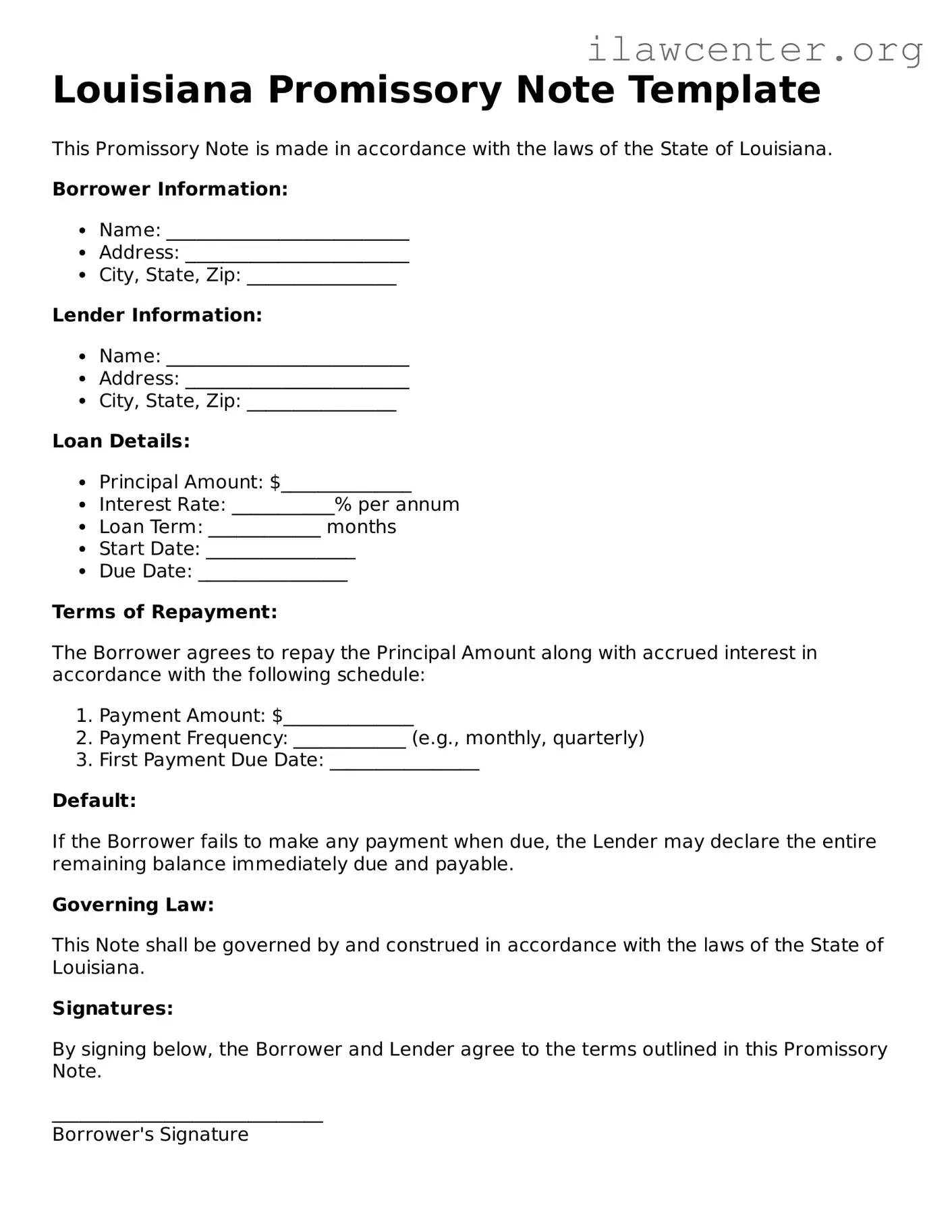
Louisiana Promissory Note Preview

Louisiana Promissory Note Template

This Promissory Note is made in accordance with the laws of the State of Louisiana.

Borrower Information:

  • Name: __________________________
  • Address: ________________________
  • City, State, Zip: ________________

Lender Information:

  • Name: __________________________
  • Address: ________________________
  • City, State, Zip: ________________

Loan Details:

  • Principal Amount: $______________
  • Interest Rate: ___________% per annum
  • Loan Term: ____________ months
  • Start Date: ________________
  • Due Date: ________________

Terms of Repayment:

The Borrower agrees to repay the Principal Amount along with accrued interest in accordance with the following schedule:

  1. Payment Amount: $______________
  2. Payment Frequency: ____________ (e.g., monthly, quarterly)
  3. First Payment Due Date: ________________

Default:

If the Borrower fails to make any payment when due, the Lender may declare the entire remaining balance immediately due and payable.

Governing Law:

This Note shall be governed by and construed in accordance with the laws of the State of Louisiana.

Signatures:

By signing below, the Borrower and Lender agree to the terms outlined in this Promissory Note.

_____________________________
Borrower's Signature

_____________________________
Lender's Signature

Date: ________________

PDF Form Characteristics

Fact Name Description
Definition A promissory note is a written promise to pay a specified amount of money to a designated person at a defined time.
Governing Law In Louisiana, promissory notes are governed by the Louisiana Civil Code, particularly Articles 3134 to 3154.
Parties Involved The note involves two primary parties: the maker (borrower) and the payee (lender).
Interest Rate Promissory notes can specify an interest rate, which must comply with Louisiana usury laws.
Payment Terms Payment terms should clearly outline the due date, frequency of payments, and any grace periods.
Security Some promissory notes may be secured by collateral, which provides the lender with additional protection.
Default Provisions The note should include terms detailing what constitutes a default and the remedies available to the lender.
Transferability Promissory notes in Louisiana can typically be transferred or assigned to another party unless otherwise stated.
Signatures For the note to be enforceable, it must be signed by the maker, and a witness signature is recommended.
Legal Enforceability As a legally binding contract, a properly executed promissory note is enforceable in a court of law.

Instructions on Utilizing Louisiana Promissory Note

Once you have the Louisiana Promissory Note form in front of you, it’s time to fill it out carefully. Make sure to have all necessary information at hand, including details about the borrower, lender, and the loan terms. Following the steps below will help ensure that you complete the form accurately.

  1. Begin by entering the date at the top of the form. This is the date when the note is created.
  2. Next, fill in the name and address of the borrower. Ensure that the information is correct and clearly written.
  3. Then, provide the name and address of the lender. This is the person or entity providing the loan.
  4. Specify the principal amount being borrowed. This is the total amount that the borrower agrees to pay back.
  5. Indicate the interest rate. If there is no interest, you can write "0%."
  6. Detail the repayment schedule. State how often payments will be made, such as weekly or monthly.
  7. Include the due date for the final payment. This is when the borrower must pay off the entire loan.
  8. Sign and date the form. The borrower should sign, and if applicable, the lender should also sign.
  9. Finally, make a copy of the completed form for both parties. Keep it for your records.

After completing the form, ensure both parties understand the terms outlined. It’s a good practice to review the document together before finalizing. This way, any questions can be addressed immediately, and both parties can proceed with confidence.

Important Facts about Louisiana Promissory Note

What is a Louisiana Promissory Note?

A Louisiana Promissory Note is a legal document that outlines a borrower's promise to repay a specific amount of money to a lender under agreed-upon terms. This document serves as a formal record of the loan and includes details such as the loan amount, interest rate, repayment schedule, and any penalties for late payment.

Who uses a Promissory Note in Louisiana?

Individuals, businesses, and financial institutions commonly use Promissory Notes in Louisiana. For example, a family member lending money to a relative may utilize a Promissory Note to clarify the terms of the loan. Similarly, businesses may issue notes to secure funding from investors or banks.

What information should be included in a Louisiana Promissory Note?

A complete Promissory Note should include the following information: the names and addresses of the borrower and lender, the principal amount of the loan, the interest rate (if applicable), the repayment schedule, and any conditions or terms related to default. It may also specify whether the note is secured or unsecured.

Is a Promissory Note legally binding in Louisiana?

Yes, a Promissory Note is legally binding in Louisiana, provided that it meets certain requirements. Both parties must agree to the terms, and the document should be signed by the borrower. Additionally, it is advisable to have the document notarized to strengthen its enforceability.

What happens if the borrower defaults on the Promissory Note?

If the borrower defaults, meaning they fail to make payments as agreed, the lender has the right to take legal action. This may involve filing a lawsuit to recover the owed amount or seeking to collect through other means, such as garnishing wages or placing a lien on the borrower's property.

Can a Promissory Note be modified after it is signed?

Yes, a Promissory Note can be modified, but both parties must agree to the changes. It is essential to document any modifications in writing and have both parties sign the amended agreement to avoid future disputes.

Do I need a lawyer to create a Promissory Note in Louisiana?

While it is not legally required to hire a lawyer to create a Promissory Note, consulting with one can be beneficial. A lawyer can help ensure that the document complies with Louisiana laws and adequately protects the interests of both parties.

Are there different types of Promissory Notes in Louisiana?

Yes, there are various types of Promissory Notes, including secured and unsecured notes. A secured note is backed by collateral, such as property or assets, while an unsecured note does not have collateral backing it. Each type has different implications for both the borrower and lender.

How can I ensure my Promissory Note is enforceable?

To ensure enforceability, make sure the Promissory Note is clear and detailed. Include all necessary information, have both parties sign it, and consider notarization. Keeping a copy of the signed document and any communication related to the loan can also be helpful in case of disputes.

Where can I find a template for a Louisiana Promissory Note?

Templates for Louisiana Promissory Notes can be found online through legal websites, or you may obtain one from a local office supply store. It is essential to customize the template to fit your specific situation and ensure compliance with Louisiana law.
Common mistakes

When filling out the Louisiana Promissory Note form, many individuals make common mistakes that can lead to confusion or legal issues down the line. Understanding these pitfalls can help ensure that the document serves its intended purpose effectively.

One frequent error is failing to include all parties' names. It’s essential to clearly identify both the borrower and the lender. Omitting a name or using nicknames instead of legal names can create ambiguity and complicate enforcement of the note.

Another mistake is neglecting to specify the loan amount clearly. While it may seem straightforward, writing the amount in both numerical and written form can prevent misunderstandings. A simple typo in the numbers can lead to significant discrepancies.

People often overlook the interest rate section. If the note includes interest, it must be stated explicitly. Not specifying whether the interest is simple or compounded can lead to disputes over repayment terms.

Additionally, many fail to include payment terms. It’s crucial to outline how and when payments will be made. This includes specifying whether payments are monthly, quarterly, or on another schedule. Without clear terms, both parties may have different expectations.

Another common oversight is not including a due date. A promissory note should clearly indicate when the loan is expected to be repaid in full. This helps avoid confusion and establishes a timeline for both parties.

Some individuals forget to address default conditions. It’s important to outline what happens if the borrower fails to make payments. Including this information can protect the lender and clarify the consequences for the borrower.

People sometimes fail to sign the document properly. Both parties must sign the note for it to be legally binding. In some cases, witnesses or notarization may also be required, depending on the situation.

Another mistake is not keeping copies of the signed note. After completing the form, both parties should retain a copy for their records. This ensures that everyone has access to the same information should any disputes arise.

Finally, many individuals do not review the note thoroughly before signing. Taking the time to read through the entire document can help catch any errors or unclear terms. It’s always wise to double-check everything to avoid future complications.

Documents used along the form

When dealing with a Louisiana Promissory Note, several other documents may be necessary to ensure that the transaction is clear and legally binding. These documents help outline the terms of the loan, provide security for the lender, and confirm the borrower's obligations. Below is a list of commonly used forms that accompany a Promissory Note.

  • Loan Agreement: This document details the terms and conditions of the loan, including the interest rate, repayment schedule, and any fees associated with the loan. It serves as a comprehensive guide for both parties.
  • Security Agreement: If the loan is secured by collateral, this agreement outlines the specific assets pledged as security. It protects the lender's interests in case of default.
  • Guaranty Agreement: In this document, a third party agrees to repay the loan if the borrower defaults. This adds an extra layer of security for the lender.
  • Disclosure Statement: This form provides essential information about the loan, including the total cost, interest rates, and any potential fees. It ensures transparency between the lender and borrower.
  • Amortization Schedule: This schedule breaks down the repayment of the loan into regular payments over time, showing how much of each payment goes toward principal and interest.
  • Loan Payment Receipt: After a payment is made, this receipt serves as proof of payment. It is important for both parties to keep accurate records of transactions.
  • Default Notice: Should the borrower fail to meet their obligations, this document formally notifies them of the default and outlines the consequences, including potential legal action.
  • Release of Lien: Once the loan is paid off, this document releases any claims the lender had on the collateral. It is crucial for the borrower to receive this to clear their title.

Each of these documents plays a vital role in the lending process, ensuring clarity and protection for both the lender and borrower. Having them in place can help prevent misunderstandings and provide a clear path for resolving any issues that may arise during the loan term.

Similar forms

A Promissory Note is a financial document that outlines a borrower's promise to repay a specified amount of money to a lender under agreed-upon terms. Several other documents share similarities with the Promissory Note, each serving a unique purpose in financial transactions. Below is a list of nine documents that are comparable to a Promissory Note:

  • Loan Agreement: This document details the terms of a loan, including the amount borrowed, interest rates, and repayment schedule, much like a Promissory Note.
  • Mortgage: A mortgage secures a loan with real property. It includes a promise to repay, similar to a Promissory Note, but also specifies the collateral involved.
  • Security Agreement: This document outlines the collateral that secures a loan. Like a Promissory Note, it establishes the borrower's obligation to repay the debt.
  • Installment Agreement: An installment agreement allows for payments to be made over time, mirroring the repayment structure found in a Promissory Note.
  • Letter of Credit: This document guarantees payment to a seller by a bank, similar to how a Promissory Note guarantees repayment to a lender.
  • IOU (I Owe You): An informal acknowledgment of debt, an IOU reflects the borrower's promise to repay, akin to a Promissory Note.
  • Loan Commitment Letter: This letter outlines the lender's commitment to provide a loan, detailing terms similar to those found in a Promissory Note.
  • Credit Agreement: A credit agreement sets the terms for borrowing, including repayment obligations, much like a Promissory Note.
  • Debt Settlement Agreement: This document outlines the terms for settling a debt, including payment plans, which can resemble the repayment terms in a Promissory Note.

Understanding these documents can help clarify the financial obligations and rights involved in various lending scenarios. Each document serves its purpose while maintaining the core concept of a promise to repay a debt.

Dos and Don'ts

When filling out the Louisiana Promissory Note form, it is essential to follow specific guidelines to ensure accuracy and compliance. Below is a list of things you should and shouldn't do.

  • Do read the entire form carefully before starting.
  • Do provide accurate information regarding the borrower and lender.
  • Do clearly state the loan amount and interest rate.
  • Do specify the repayment schedule in detail.
  • Don't leave any required fields blank.
  • Don't use ambiguous language that could lead to misunderstandings.

By adhering to these guidelines, you can help ensure that the Promissory Note is completed correctly and serves its intended purpose.

Misconceptions

When dealing with the Louisiana Promissory Note form, several misconceptions can arise. Understanding the truth behind these misconceptions can help ensure that individuals use the form correctly and effectively. Here’s a list of seven common misconceptions:

  1. Promissory notes are only for large loans. Many people believe that promissory notes are only necessary for significant amounts of money. In reality, they can be used for any loan amount, regardless of size.

  2. A promissory note must be notarized to be valid. While notarization can add an extra layer of authenticity, it is not a requirement for a promissory note to be legally binding in Louisiana.

  3. All promissory notes are the same. Each state has its own laws governing promissory notes. The Louisiana Promissory Note form has specific requirements that may differ from those in other states.

  4. Only banks can issue promissory notes. This is false. Individuals, businesses, or any entity can create and issue a promissory note as long as it meets the legal criteria.

  5. Once signed, a promissory note cannot be changed. While it’s true that changes can complicate matters, parties involved can agree to modify the terms of the note if both sides consent.

  6. Promissory notes do not require repayment terms. In fact, a clear repayment schedule is essential. This includes the amount due, interest rates, and due dates to avoid misunderstandings.

  7. Legal action cannot be taken for unpaid promissory notes. On the contrary, if the borrower fails to repay the loan as agreed, the lender has the right to pursue legal action to recover the owed amount.

By dispelling these misconceptions, individuals can better navigate the process of creating and utilizing a Louisiana Promissory Note. Understanding the facts is crucial for ensuring that all parties involved are protected and informed.

Key takeaways

When filling out and using the Louisiana Promissory Note form, consider the following key takeaways:

  1. Identify the Parties: Clearly state the names and addresses of both the borrower and the lender. This ensures that all parties are properly identified.
  2. Specify the Loan Amount: Indicate the exact amount of money being borrowed. This figure should be precise to avoid any confusion later.
  3. Outline the Interest Rate: If applicable, include the interest rate. This should be clearly defined, whether it is fixed or variable.
  4. Set the Repayment Terms: Detail how and when the borrower will repay the loan. Include the payment schedule, such as monthly or quarterly payments.
  5. Include Late Fees: If there are penalties for late payments, specify these fees in the note. This helps to enforce accountability.
  6. State the Maturity Date: Clearly indicate when the loan must be fully repaid. This is crucial for both parties to understand their obligations.
  7. Consider Collateral: If the loan is secured by collateral, describe the collateral in detail. This provides security for the lender.
  8. Signatures Required: Ensure that both the borrower and lender sign the document. Witness signatures may also be required for added validity.
  9. Keep Copies: After completing the form, make copies for both parties. This ensures that everyone has a record of the agreement.

These key points will help ensure that the Louisiana Promissory Note is filled out correctly and serves its intended purpose.