Attorney-Verified  Residential Lease Agreement Document for Louisiana

Attorney-Verified Residential Lease Agreement Document for Louisiana

The Louisiana Residential Lease Agreement is a legal document that outlines the terms and conditions between a landlord and tenant for renting a residential property in Louisiana. This form serves to protect the rights of both parties and ensures clarity in the rental arrangement. Ready to get started? Fill out the form by clicking the button below.

Article Guide

The Louisiana Residential Lease Agreement form is a crucial document that outlines the terms and conditions governing the rental of residential property in Louisiana. This agreement serves as a binding contract between landlords and tenants, detailing essential aspects such as the duration of the lease, rental payment amounts, and security deposit requirements. It also specifies the responsibilities of both parties, including maintenance obligations and rules regarding property use. By clearly defining these elements, the form helps to prevent misunderstandings and disputes, ensuring a smoother rental experience. Additionally, it may include clauses related to early termination, renewal options, and procedures for handling repairs or damages. Understanding the components of this agreement is vital for both landlords and tenants to protect their rights and interests throughout the rental period.

Louisiana Residential Lease Agreement Preview

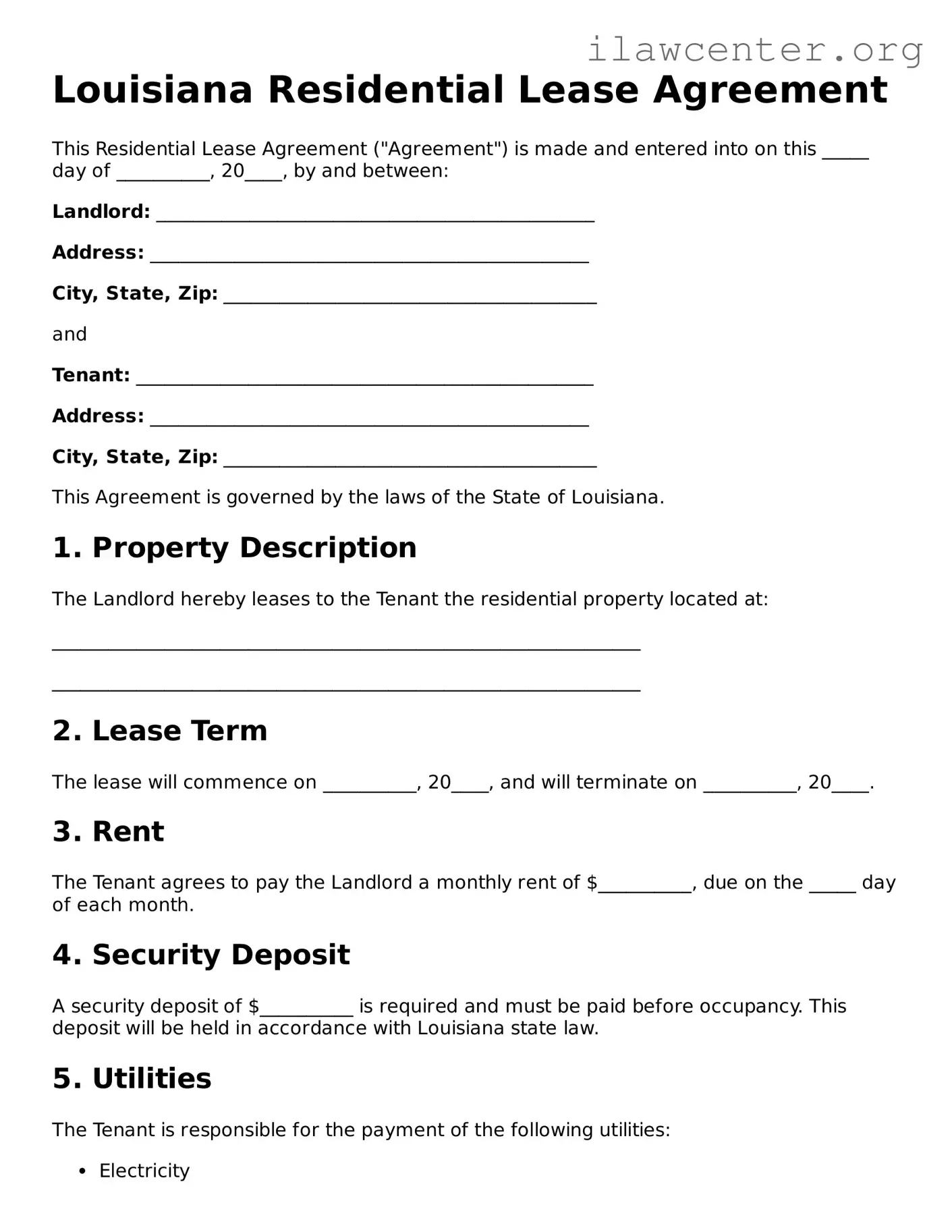
Louisiana Residential Lease Agreement

This Residential Lease Agreement ("Agreement") is made and entered into on this _____ day of __________, 20____, by and between:

Landlord: _______________________________________________

Address: _______________________________________________

City, State, Zip: ________________________________________

and

Tenant: _________________________________________________

Address: _______________________________________________

City, State, Zip: ________________________________________

This Agreement is governed by the laws of the State of Louisiana.

1. Property Description

The Landlord hereby leases to the Tenant the residential property located at:

_______________________________________________________________

_______________________________________________________________

2. Lease Term

The lease will commence on __________, 20____, and will terminate on __________, 20____.

3. Rent

The Tenant agrees to pay the Landlord a monthly rent of $__________, due on the _____ day of each month.

4. Security Deposit

A security deposit of $__________ is required and must be paid before occupancy. This deposit will be held in accordance with Louisiana state law.

5. Utilities

The Tenant is responsible for the payment of the following utilities:

  • Electricity
  • Water
  • Gas
  • Internet
  • Cable

6. Maintenance and Repairs

The Tenant agrees to maintain the premises in a clean and sanitary condition. Any repairs needed must be reported to the Landlord promptly.

7. Pets

Pets are allowed / not allowed (circle one). If allowed, the Tenant agrees to pay a non-refundable pet deposit of $__________.

8. Termination

Either party may terminate this Agreement by providing written notice at least _____ days prior to the intended termination date.

9. Governing Law

This Agreement shall be governed by and construed in accordance with the laws of the State of Louisiana.

10. Signatures

By signing below, both parties agree to the terms and conditions outlined in this Agreement.

Landlord Signature: ___________________________ Date: ____________

Tenant Signature: ____________________________ Date: ____________

PDF Form Characteristics

Fact Name Description
Governing Law The Louisiana Residential Lease Agreement is governed by the Louisiana Civil Code, particularly Title 9, which covers leases and rental agreements.
Parties Involved The agreement involves at least two parties: the landlord (lessor) and the tenant (lessee).
Property Description The lease must clearly describe the rental property, including its address and any specific details that identify it.
Lease Term The lease should specify the duration of the rental period, whether it is month-to-month, yearly, or for a fixed term.
Rent Amount The document must state the amount of rent due, the due date, and acceptable payment methods.
Security Deposit The agreement should outline the amount of the security deposit, the conditions for its return, and any deductions that may be made.
Maintenance Responsibilities Responsibilities for maintenance and repairs should be clearly defined, indicating what the landlord and tenant are each responsible for.
Termination Conditions Conditions under which the lease may be terminated by either party should be included, along with any required notice periods.
Additional Clauses Any additional terms, such as pet policies or subletting rules, can be included in the lease to address specific needs.

Instructions on Utilizing Louisiana Residential Lease Agreement

Completing the Louisiana Residential Lease Agreement form is an important step in establishing a clear understanding between landlords and tenants. Following the steps outlined below will help ensure that all necessary information is accurately provided, creating a solid foundation for the rental relationship.

  1. Read the entire form carefully. Familiarize yourself with each section to understand what information is required.
  2. Fill in the landlord's information. This includes the name and contact details of the property owner or management company.
  3. Provide tenant information. List the names and contact details of all tenants who will be living in the rental property.
  4. Specify the rental property address. Clearly indicate the full address of the property being leased.
  5. Determine the lease term. Indicate whether the lease is for a fixed term or month-to-month, and specify the start and end dates if applicable.
  6. Outline the rent amount. Clearly state the monthly rent amount and the due date for payments.
  7. Detail the security deposit. Specify the amount of the security deposit and any conditions for its return.
  8. Include additional terms. If there are any specific rules or additional agreements, be sure to include them in the appropriate section.
  9. Sign and date the agreement. Both the landlord and all tenants must sign and date the form to make it legally binding.
  10. Make copies. Ensure that all parties receive a signed copy of the completed agreement for their records.

Important Facts about Louisiana Residential Lease Agreement

What is a Louisiana Residential Lease Agreement?

A Louisiana Residential Lease Agreement is a legally binding contract between a landlord and a tenant. It outlines the terms under which the tenant can occupy a residential property. This document typically includes details such as the rental amount, duration of the lease, security deposit requirements, and the responsibilities of both parties. It serves to protect the rights of both the landlord and the tenant, ensuring clarity in the rental arrangement.

What are the key components of this lease agreement?

Key components of a Louisiana Residential Lease Agreement include the names of the parties involved, the property address, the lease term, rent payment details, security deposit information, maintenance responsibilities, and any rules or regulations that apply to the property. It may also specify conditions for terminating the lease, subletting, and handling disputes. Each section is important to ensure both parties understand their obligations.

How long is a typical lease term in Louisiana?

In Louisiana, lease terms can vary widely. Most residential leases are typically for a duration of one year, but shorter or longer terms are also common. Month-to-month leases are another option, providing flexibility for both landlords and tenants. It’s essential to clearly define the lease term in the agreement to avoid any misunderstandings.

What happens if the tenant wants to break the lease early?

If a tenant wishes to break the lease early, they should first review the lease agreement for any specific terms regarding early termination. Many agreements include a clause that outlines the penalties or fees associated with breaking the lease. It’s advisable for the tenant to communicate openly with the landlord, as they may reach a mutual agreement that could include finding a replacement tenant.

Is a security deposit required?

Yes, a security deposit is typically required in Louisiana. The amount is usually equivalent to one month’s rent, but it can vary based on the landlord’s policies. This deposit serves as protection for the landlord against potential damages or unpaid rent. The lease agreement should specify the amount, how it will be held, and the conditions under which it may be withheld after the tenant moves out.

Can a landlord evict a tenant without notice?

No, a landlord cannot evict a tenant without proper notice. Louisiana law requires landlords to provide written notice before initiating eviction proceedings. The notice period varies depending on the reason for eviction, such as non-payment of rent or lease violations. It’s crucial for landlords to follow the legal process to avoid complications and ensure that the eviction is enforceable.

Common mistakes

Filling out the Louisiana Residential Lease Agreement form requires careful attention to detail. One common mistake is not providing complete information for all parties involved. Both the landlord and tenant must include their full names and contact information. Omitting this information can lead to confusion and disputes later on.

Another frequent error is neglecting to specify the rental term. It's essential to indicate whether the lease is for a fixed term or month-to-month. This clarity helps both parties understand their obligations and the duration of the agreement.

Many people forget to outline the rent amount and payment details clearly. The lease should state the total rent due, the due date, and acceptable payment methods. This information prevents misunderstandings about when and how rent should be paid.

Some individuals fail to include information about security deposits. The lease should specify the amount of the deposit, the conditions for its return, and any deductions that may apply. This protects the tenant’s rights and ensures the landlord follows the law.

Another mistake is not addressing maintenance responsibilities. The agreement should clarify who is responsible for repairs and maintenance. This helps avoid disputes over who should handle issues that arise during the lease term.

People often overlook the inclusion of pet policies. If pets are allowed, the lease should specify any restrictions, such as breed or size limitations. If pets are not permitted, this should be clearly stated to prevent future conflicts.

Not including the rules regarding subletting can lead to complications. The lease should outline whether subletting is allowed and under what conditions. This ensures that both parties understand their rights regarding the rental property.

Another common error is failing to sign and date the lease. Both parties must sign the agreement for it to be legally binding. Without signatures, the lease may not hold up in court if disputes arise.

Finally, some individuals do not keep a copy of the signed lease. It is crucial for both landlords and tenants to retain a copy of the agreement for their records. This document serves as a reference point in case of any future disagreements.

Documents used along the form

When entering into a rental agreement in Louisiana, several other forms and documents often accompany the Residential Lease Agreement. These documents help clarify the terms of the lease and protect the rights of both landlords and tenants. Below is a list of commonly used forms.

  • Rental Application: This form collects information about potential tenants, including their rental history, employment details, and personal references. It helps landlords assess the suitability of applicants.
  • Move-In/Move-Out Checklist: This checklist documents the condition of the property before the tenant moves in and after they move out. It helps prevent disputes over security deposits by providing a clear record of any damages or issues.
  • Security Deposit Receipt: This document acknowledges the receipt of the security deposit from the tenant. It specifies the amount collected and outlines the conditions under which it may be withheld at the end of the lease.
  • Pet Agreement: If pets are allowed, this agreement outlines the rules and responsibilities related to pet ownership within the rental property. It may include additional fees and requirements for pet care.
  • Lease Addendum: This document modifies the original lease agreement to include additional terms or conditions. It can address specific situations like subleasing, maintenance responsibilities, or changes in rent.

These forms and documents play an essential role in the rental process. They ensure that both parties understand their rights and responsibilities, fostering a smoother landlord-tenant relationship.

Similar forms

  • Rental Application: This document is used by landlords to screen potential tenants. It collects information such as employment history, credit score, and rental history, similar to how a lease outlines terms and conditions for tenancy.

  • Lease Addendum: An addendum modifies or adds specific terms to the original lease agreement. It serves to clarify rules or responsibilities, much like how a lease sets forth the expectations for both parties.

  • Month-to-Month Rental Agreement: This agreement allows for a flexible rental arrangement without a fixed term. It shares similarities with a lease by detailing the rights and responsibilities of both landlord and tenant.

  • Sublease Agreement: A sublease permits a tenant to rent out their leased property to another person. It mirrors the lease by specifying terms, duration, and obligations of all parties involved.

  • Eviction Notice: This document is issued when a landlord seeks to terminate a lease due to violations. While it serves a different purpose, it is still tied to the lease agreement and outlines the consequences of breaking lease terms.

  • Security Deposit Receipt: This receipt documents the amount of the security deposit paid by the tenant. It is related to the lease as it often outlines conditions for return, similar to how a lease details financial responsibilities.

  • Property Condition Report: This report documents the state of the property before a tenant moves in. It is similar to a lease in that it sets expectations for property maintenance and condition during the tenancy.

  • Termination Notice: A termination notice informs a tenant or landlord that the lease will not be renewed. It relates to the lease by outlining the process and timeline for ending the rental agreement.

  • House Rules Document: This document outlines specific rules for living in a rental property. It complements the lease by providing additional guidelines that tenants must follow during their tenancy.

  • Lease Renewal Agreement: This agreement extends the terms of the original lease for another period. It is similar to the lease as it reiterates the rights and responsibilities of both parties for the new term.

Dos and Don'ts

When filling out the Louisiana Residential Lease Agreement form, it's important to be careful and thorough. Here are some things to keep in mind:

  • Do read the entire lease agreement before filling it out. Understanding the terms is crucial.
  • Do provide accurate information. Ensure that all names, addresses, and dates are correct.
  • Do sign and date the lease agreement. An unsigned lease may not be enforceable.
  • Do keep a copy for your records. This will help if any disputes arise in the future.
  • Don't leave any blank spaces. Fill in all required fields to avoid confusion later.
  • Don't rush through the form. Take your time to avoid mistakes.
  • Don't ignore the rules about pets or alterations. Know what is allowed before signing.
  • Don't forget to check for additional fees. Be aware of any costs beyond the rent.

Misconceptions

When it comes to the Louisiana Residential Lease Agreement, there are several misconceptions that can lead to confusion for both landlords and tenants. Understanding these misconceptions can help ensure a smoother leasing experience.

  • Misconception 1: The lease must be in writing to be enforceable.
  • While it is always advisable to have a written lease for clarity, verbal agreements can also be legally binding in Louisiana. However, proving the terms of a verbal agreement can be challenging.

  • Misconception 2: All lease agreements must follow the same terms.
  • Lease agreements can vary widely based on the preferences of the landlord and the needs of the tenant. Louisiana law allows for flexibility in terms, as long as they comply with state regulations.

  • Misconception 3: Tenants cannot negotiate lease terms.
  • Tenants have the right to negotiate terms of the lease, such as rent amount, security deposit, and maintenance responsibilities. Open communication can lead to a mutually beneficial agreement.

  • Misconception 4: A security deposit is always required.
  • While many landlords do require a security deposit, it is not a legal requirement in Louisiana. Some landlords may choose to forgo this practice, depending on their policies.

  • Misconception 5: Lease agreements automatically renew.
  • Not all lease agreements automatically renew at the end of the lease term. It is important to review the lease for any renewal clauses and understand what actions are required to continue the tenancy.

Key takeaways

When filling out and using the Louisiana Residential Lease Agreement form, keep these key takeaways in mind:

  • Accuracy is crucial. Ensure all information is correct, including names, addresses, and dates. Mistakes can lead to misunderstandings.
  • Understand your responsibilities. Both landlords and tenants should be aware of their obligations under the lease. This includes maintenance, payment schedules, and rules regarding property use.
  • Review the terms thoroughly. Before signing, read through the entire agreement. Pay attention to clauses about security deposits, lease duration, and termination procedures.
  • Document everything. Keep a copy of the signed lease for your records. This can be helpful in resolving disputes or clarifying responsibilities later.