Attorney-Verified  Small Estate Affidavit Document for Louisiana

Attorney-Verified Small Estate Affidavit Document for Louisiana

The Louisiana Small Estate Affidavit is a legal document that allows individuals to settle the estate of a deceased person without going through the formal probate process, provided the estate meets certain criteria. This form simplifies the transfer of assets, making it easier for heirs to claim what they are entitled to. For those navigating this process, filling out the form is a crucial step; click the button below to get started.

Article Guide

The Louisiana Small Estate Affidavit is an essential tool for individuals dealing with the estate of a deceased person, particularly when the estate's total value falls below a certain threshold. This form streamlines the process of transferring assets without the need for a lengthy probate procedure, making it accessible for families during a challenging time. By utilizing this affidavit, heirs can claim property and assets such as bank accounts, vehicles, and personal belongings without the burden of formal probate court proceedings. The affidavit must be completed and signed by the heirs, affirming their relationship to the deceased and the value of the estate. Additionally, it requires the inclusion of specific information, such as the deceased's date of death and a list of assets, which helps to establish the estate's eligibility for this simplified process. Understanding the requirements and implications of the Small Estate Affidavit can empower families to navigate their loved one's estate with greater ease and confidence.

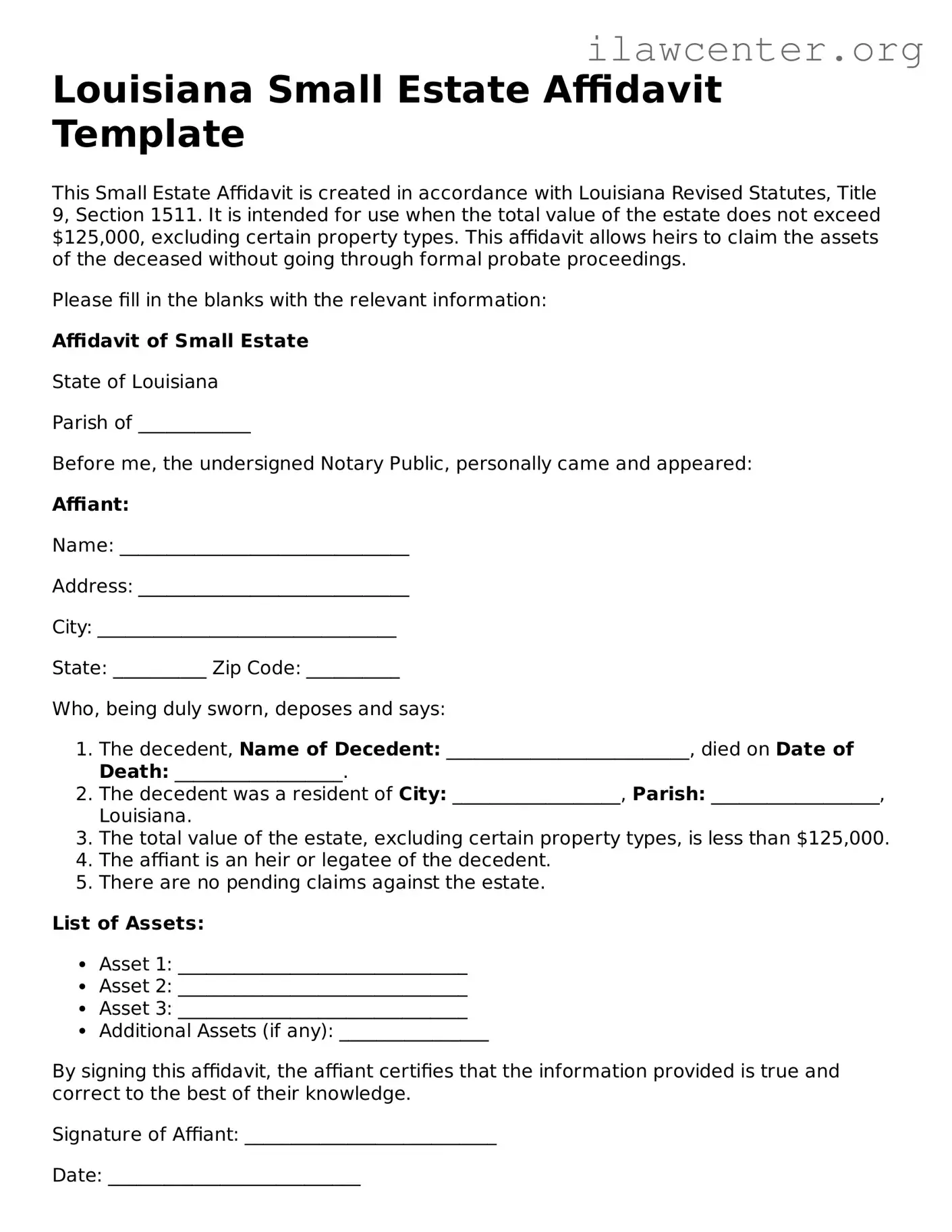
Louisiana Small Estate Affidavit Preview

Louisiana Small Estate Affidavit Template

This Small Estate Affidavit is created in accordance with Louisiana Revised Statutes, Title 9, Section 1511. It is intended for use when the total value of the estate does not exceed $125,000, excluding certain property types. This affidavit allows heirs to claim the assets of the deceased without going through formal probate proceedings.

Please fill in the blanks with the relevant information:

Affidavit of Small Estate

State of Louisiana

Parish of ____________

Before me, the undersigned Notary Public, personally came and appeared:

Affiant:

Name: _______________________________

Address: _____________________________

City: ________________________________

State: __________ Zip Code: __________

Who, being duly sworn, deposes and says:

  1. The decedent, Name of Decedent: __________________________, died on Date of Death: __________________.
  2. The decedent was a resident of City: __________________, Parish: __________________, Louisiana.
  3. The total value of the estate, excluding certain property types, is less than $125,000.
  4. The affiant is an heir or legatee of the decedent.
  5. There are no pending claims against the estate.

List of Assets:

  • Asset 1: _______________________________
  • Asset 2: _______________________________
  • Asset 3: _______________________________
  • Additional Assets (if any): ________________

By signing this affidavit, the affiant certifies that the information provided is true and correct to the best of their knowledge.

Signature of Affiant: ___________________________

Date: ___________________________

Sworn to and subscribed before me this ____ day of ____________, 20___.

______________________________

Notary Public

My Commission Expires: ________________________

PDF Form Characteristics

Fact Name Description
Purpose The Louisiana Small Estate Affidavit is used to simplify the process of transferring property from a deceased person's estate when the total value is below a certain threshold.
Governing Law This form is governed by Louisiana Revised Statutes, specifically R.S. 9:2442, which outlines the requirements and procedures for small estate proceedings.
Eligibility To use this affidavit, the estate must not exceed $125,000 in total value, excluding certain types of property like real estate.
Filing Process The completed affidavit must be filed with the local probate court, along with any required supporting documents, to facilitate the transfer of assets.

Instructions on Utilizing Louisiana Small Estate Affidavit

After gathering the necessary information and documentation, you are ready to complete the Louisiana Small Estate Affidavit form. This form allows for the transfer of certain assets without the need for formal probate proceedings. Ensure you have all required details before starting the process.

  1. Obtain the Louisiana Small Estate Affidavit form. You can find it online or at your local courthouse.
  2. Begin by filling in the decedent's full name, date of death, and last known address in the designated sections.
  3. Provide the names and addresses of all heirs, including their relationship to the decedent.
  4. List the assets that are part of the small estate. Include descriptions, values, and any relevant account numbers.
  5. Indicate whether there are any outstanding debts or claims against the estate.
  6. Sign the affidavit in the presence of a notary public. Ensure that the notary signs and stamps the document as well.
  7. Make copies of the completed affidavit for your records and for the heirs involved.
  8. File the original affidavit with the appropriate court in the parish where the decedent resided.

Important Facts about Louisiana Small Estate Affidavit

What is a Louisiana Small Estate Affidavit?

The Louisiana Small Estate Affidavit is a legal document that allows heirs to claim the assets of a deceased person without going through the formal probate process. This affidavit simplifies the transfer of property and assets when the total value is below a certain threshold, making it easier for heirs to access what they are entitled to.

Who can use the Small Estate Affidavit?

The Small Estate Affidavit can be used by heirs or legatees of the deceased individual. Typically, these are family members such as a spouse, children, or other relatives. To qualify, the total value of the estate must fall below the limit set by Louisiana law.

What is the value limit for using the Small Estate Affidavit?

As of the latest updates, the total value of the estate must not exceed $125,000. This amount includes all assets owned by the deceased, excluding certain types of property, such as real estate held in joint tenancy or assets that pass by beneficiary designation.

How do I complete the Small Estate Affidavit?

To complete the Small Estate Affidavit, gather necessary information about the deceased, including their full name, date of death, and a list of assets. The form requires details about each heir and their relationship to the deceased. Once completed, the affidavit must be signed in front of a notary public.

Is a court appearance required to use the Small Estate Affidavit?

No court appearance is necessary when using the Small Estate Affidavit. This process is designed to be straightforward, allowing heirs to transfer assets without the complexities of formal probate. However, it is advisable to consult with a legal professional to ensure compliance with all requirements.

What types of assets can be transferred using the Small Estate Affidavit?

Assets that can be transferred include bank accounts, personal property, and vehicles. Real estate is generally excluded unless it is specifically exempt under Louisiana law. It is important to verify which assets qualify before proceeding.

Are there any fees associated with filing the Small Estate Affidavit?

While there are no court fees for using the Small Estate Affidavit, there may be costs associated with notarization and any necessary asset transfers. Additionally, some institutions may have their own requirements or fees for releasing assets based on the affidavit.

How long does it take to process a Small Estate Affidavit?

The processing time can vary depending on the institution holding the assets. Generally, once the affidavit is submitted, it may take a few days to a few weeks for the heirs to receive access to the assets. Communication with the relevant institutions can help expedite the process.

Can the Small Estate Affidavit be contested?

What should I do if the estate exceeds the Small Estate Affidavit limit?

If the estate's value exceeds the Small Estate Affidavit limit, the heirs will need to pursue formal probate proceedings. This process involves filing a petition with the court and may require legal representation. It is essential to understand the probate process and prepare for the additional steps involved.
Common mistakes

Filling out the Louisiana Small Estate Affidavit form can be a straightforward process, but mistakes are common. One frequent error occurs when individuals fail to provide accurate information about the deceased. The form requires specific details, such as the full name and date of death. Omitting or incorrectly entering this information can lead to delays or even rejection of the affidavit.

Another common mistake is neglecting to include all necessary assets. The Small Estate Affidavit is intended for estates with a total value below a certain threshold. However, individuals sometimes overlook certain assets, such as bank accounts or personal property. This omission can complicate the process and may result in legal challenges.

Additionally, individuals often misinterpret the requirements for signatures. The form must be signed by the affiant, who is typically an heir or a designated representative. Failing to have the correct person sign the affidavit can invalidate the document. In some cases, witnesses may also be required, depending on the specific circumstances surrounding the estate.

Finally, many people underestimate the importance of notarization. The Louisiana Small Estate Affidavit must be notarized to be considered valid. Individuals may forget this crucial step or assume that a signature alone is sufficient. Without proper notarization, the affidavit cannot be used to transfer assets, which defeats its purpose.

Documents used along the form

When dealing with the Louisiana Small Estate Affidavit, several other forms and documents may be necessary to ensure a smooth process. These documents help clarify ownership, verify identity, and facilitate the transfer of assets. Below are five key forms often used alongside the Small Estate Affidavit.

  • Death Certificate: This document serves as proof of the deceased's passing. It is essential for initiating the estate settlement process.
  • Affidavit of Heirship: This form identifies the legal heirs of the deceased. It can help establish who is entitled to inherit the estate.
  • Will (if applicable): If the deceased left a will, it must be presented. The will outlines how the deceased intended to distribute their assets.
  • Bank Statements: Recent bank statements may be required to identify the deceased's assets and verify account balances.
  • Property Deeds: These documents prove ownership of real estate. They are crucial for transferring property to the rightful heirs.

Gathering these documents can expedite the process and help avoid complications. Ensure all forms are completed accurately to facilitate a smoother estate settlement.

Similar forms

The Small Estate Affidavit is a valuable tool for individuals dealing with the estate of a deceased person. It simplifies the process of transferring property without going through the lengthy probate process. However, there are other documents that share similarities with the Small Estate Affidavit. Here are four such documents:

  • Will: A will outlines how a person's assets should be distributed after their death. Like the Small Estate Affidavit, it provides direction for the transfer of property, but it typically requires probate to be validated.
  • Trust: A trust allows individuals to manage their assets during their lifetime and specify how they should be distributed after death. Similar to the Small Estate Affidavit, a trust can bypass probate, facilitating a smoother transfer of assets.
  • Affidavit of Heirship: This document establishes the heirs of a deceased person. Like the Small Estate Affidavit, it serves as a sworn statement to help transfer property, particularly when no will exists.
  • Transfer on Death Deed: This deed allows property owners to designate beneficiaries who will receive the property upon their death. Similar to the Small Estate Affidavit, it enables the transfer of property outside of probate, providing a straightforward path for asset distribution.

Understanding these documents can empower individuals to make informed decisions during a challenging time. Each serves a unique purpose but shares the common goal of easing the transfer of assets after a loved one’s passing.

Dos and Don'ts

When completing the Louisiana Small Estate Affidavit form, it is important to follow certain guidelines to ensure the process goes smoothly. Below are some recommended practices and common pitfalls to avoid.

  • Do read the instructions carefully before starting the form.
  • Do provide accurate and complete information about the deceased and the estate.
  • Do ensure that all required signatures are obtained.
  • Do check for any specific local requirements that may apply.
  • Don't leave any sections of the form blank unless instructed to do so.
  • Don't submit the form without reviewing it for errors or omissions.

By adhering to these guidelines, individuals can help facilitate the processing of the Small Estate Affidavit in Louisiana.

Misconceptions

The Louisiana Small Estate Affidavit form is a useful tool for settling the estates of individuals who have passed away, particularly when the estate's total value is below a certain threshold. However, several misconceptions about this form can lead to confusion. Below are six common misunderstandings regarding the Louisiana Small Estate Affidavit:

  • Only heirs can use the Small Estate Affidavit. This is not entirely true. While heirs often use the affidavit, any individual who has a legitimate interest in the estate can file it, provided they meet the necessary criteria.
  • The Small Estate Affidavit can be used for any type of asset. This misconception overlooks the fact that the affidavit is typically limited to certain assets. It generally applies to personal property, not real estate or other types of property that may require different legal processes.
  • Filing a Small Estate Affidavit avoids all legal processes. While this form simplifies the process, it does not eliminate all legal requirements. For example, debts and taxes still need to be settled before the estate can be fully distributed.
  • The Small Estate Affidavit can be filed at any time. There is a specific time frame in which the affidavit must be filed after the death of the individual. Waiting too long may complicate the process or make it impossible to use this option.
  • All states have the same Small Estate Affidavit rules. Each state has its own laws and regulations governing small estates. The rules in Louisiana may differ significantly from those in other states, making it important to understand local laws.
  • Once filed, the Small Estate Affidavit is irreversible. This is a misunderstanding. If new information comes to light or if the situation changes, it may be possible to amend or challenge the affidavit, depending on the circumstances.

Understanding these misconceptions can help individuals navigate the process of settling an estate more effectively. It is always advisable to seek guidance from a knowledgeable professional when dealing with estate matters.

Key takeaways

Filling out and using the Louisiana Small Estate Affidavit can be a straightforward process, but it’s essential to understand the key aspects to ensure everything is handled correctly. Here are some important takeaways:

  • The Small Estate Affidavit is designed for estates with a total value of less than $125,000, excluding certain assets.
  • To use this affidavit, you must be an heir or legatee of the deceased individual.
  • Gather all necessary documents, including the death certificate and proof of your relationship to the deceased.
  • Complete the affidavit accurately, providing details such as the decedent's name, date of death, and a description of the property.
  • Sign the affidavit in front of a notary public to ensure its validity.
  • After notarization, the affidavit should be filed with the appropriate court or recorder’s office.
  • Using the affidavit allows heirs to claim assets without going through formal probate, saving time and money.
  • Be aware that creditors may still have a claim against the estate, even when using the Small Estate Affidavit.
  • It is advisable to consult with a legal professional if there are disputes among heirs or complex assets involved.
  • Keep copies of the affidavit and all related documents for your records and future reference.

Understanding these points can help streamline the process and ensure that all legal requirements are met effectively.