Material Safety Sheet PDF Template

Material Safety Sheet PDF Template

The Material Safety Data Sheet (MSDS) is a crucial document that provides detailed information about the properties of a chemical product. It includes essential data regarding hazards, handling, storage, and emergency measures, ensuring safety for both users and the environment. Understanding and properly filling out this form is vital for compliance and safety; click the button below to get started.

Article Guide

The Material Safety Data Sheet (MSDS) is a crucial document that provides essential information about hazardous substances. This form is divided into 16 sections, each detailing different aspects of a chemical product. The first section identifies the chemical product and the manufacturer, including contact information and emergency telephone numbers. Following this, the composition section outlines the hazardous ingredients, their concentrations, and relevant safety data. Hazards are clearly identified in section three, which highlights potential health effects and emergency overview. First aid measures, fire fighting protocols, and accidental release procedures are covered in subsequent sections, ensuring that users know how to respond in various situations. Handling and storage guidelines, exposure control measures, and personal protective equipment recommendations are also included to promote safe usage. The physical and chemical properties of the substance are detailed, alongside its stability and reactivity information. Toxicological data, ecological impact, and disposal considerations are addressed in later sections, providing a comprehensive view of the product’s risks and environmental effects. Finally, regulatory information ensures compliance with safety standards. Overall, the MSDS serves as a vital resource for anyone working with or around hazardous materials.

Material Safety Sheet Preview

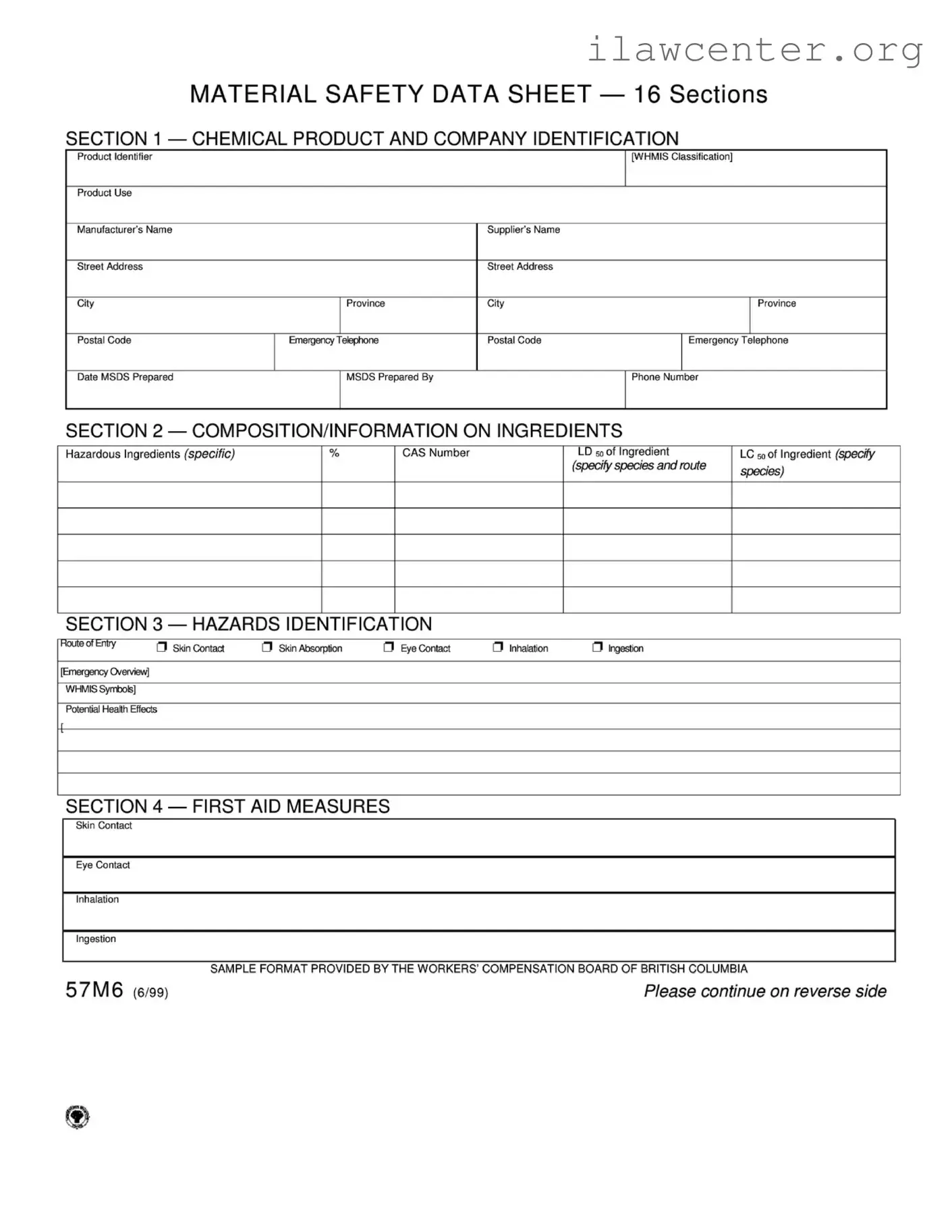
MATERIAL SAFETY DATA SHEET — 16 Sections

SECTION 1 — CHEMICAL PRODUCT AND COMPANY IDENTIFICATION


Product Identifier


[WHMIS Classification]


Product Use


Manufacturer's Name


Supplier’s Name


Street Address


Street Address


City

Province

City


Province

Postal Code

Emergency Telephone

Postal Code

Emergency Telephone

Date MSDS Prepared

MSDS Prepared By

Phone Number


SECTION 2 — COMPOSITION/INFORMATION ON INGREDIENTS


Hazardous Ingredients (specific)

%

CAS Number

LD so of Ingredient

LC so of Ingredient (specify


(specify species and route

species)


SECTION 3 — HAZARDS IDENTIFICA1RON

О Skin Contact

П Skin Absorption

П Eye Contact

П Inhalation

П Ingestion

[Emergency Overview]

WHMIS Symbols]

Potential Health Effects

4--------------------

SECTION 4 — FIRST AID MEASURES

5 7 M 6 (6/99)

Please continue on reverse side

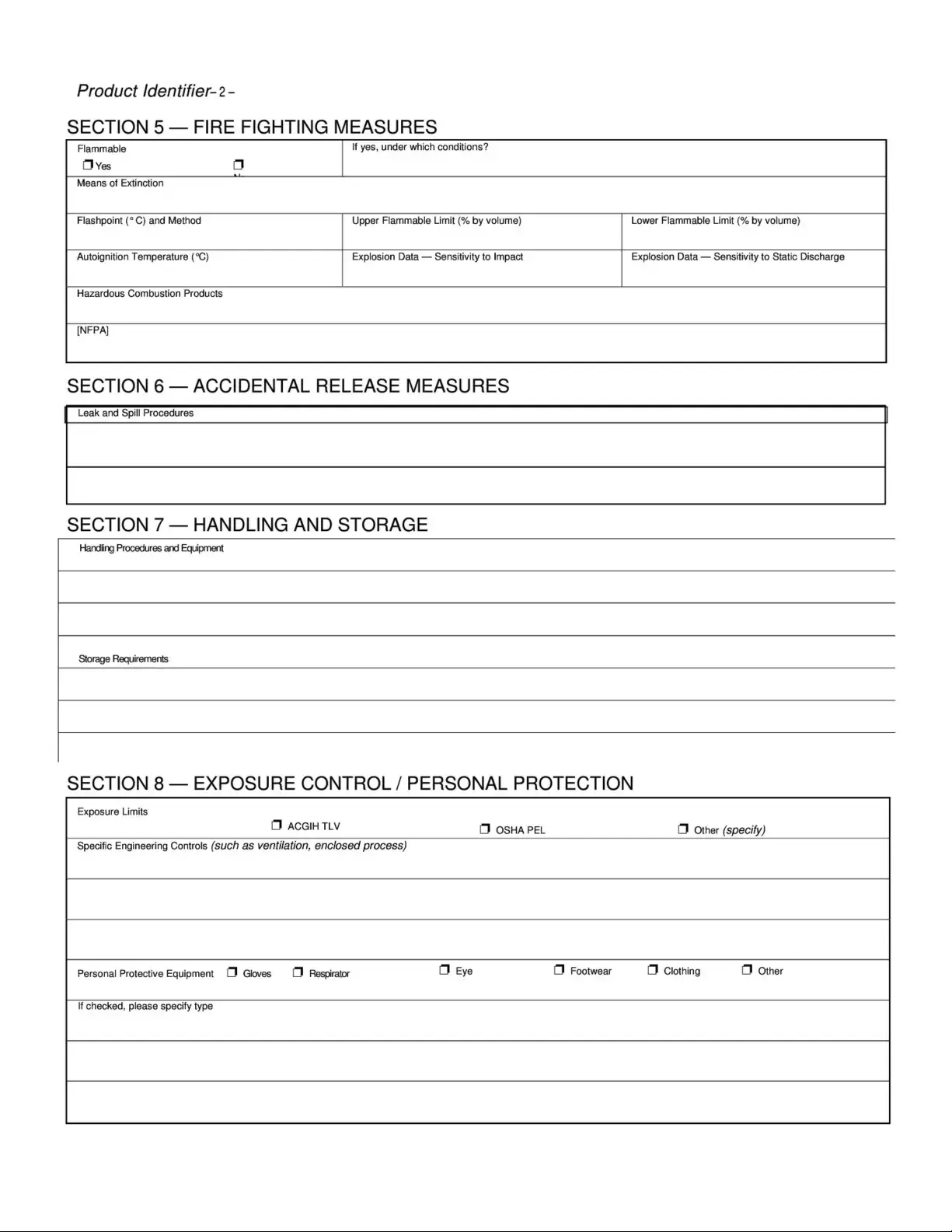
Product ldentifier-2-

SECTION 5 — FIRE FIGHTING MEASURES

Flammable

If yes, under which conditions?


Yes


Means of Extinction


Flashpoint (°C) and Method

Upper Flammable Limit (% by volume)

Lower Flammable Limit (% by volume)

Autoignition Temperature (°C)

Explosion Data — Sensitivity to Impact

Explosion Data — Sensitivity to Static Discharge

Hazardous Combustion Products


[NFPA]


SECTION 6 — ACCIDENTAL RELEASE MEASURES

Leak and Spill Procedures

SECTION 7 — HANDLING AND STORAGE

SECTION 8 — EXPOSURE CONTROL / PERSONAL PROTECTION

Exposure Limits

ACGIH TLV

0SHA pEL

Д Other (Specify)

Specific Engineering Controls (such as ventilation, enclosed process)

Personal Protective Equipment

Gloves

Respirator

Eye

Footwear

Clothing

Other

If checked, please specify type

Product Identifiers -

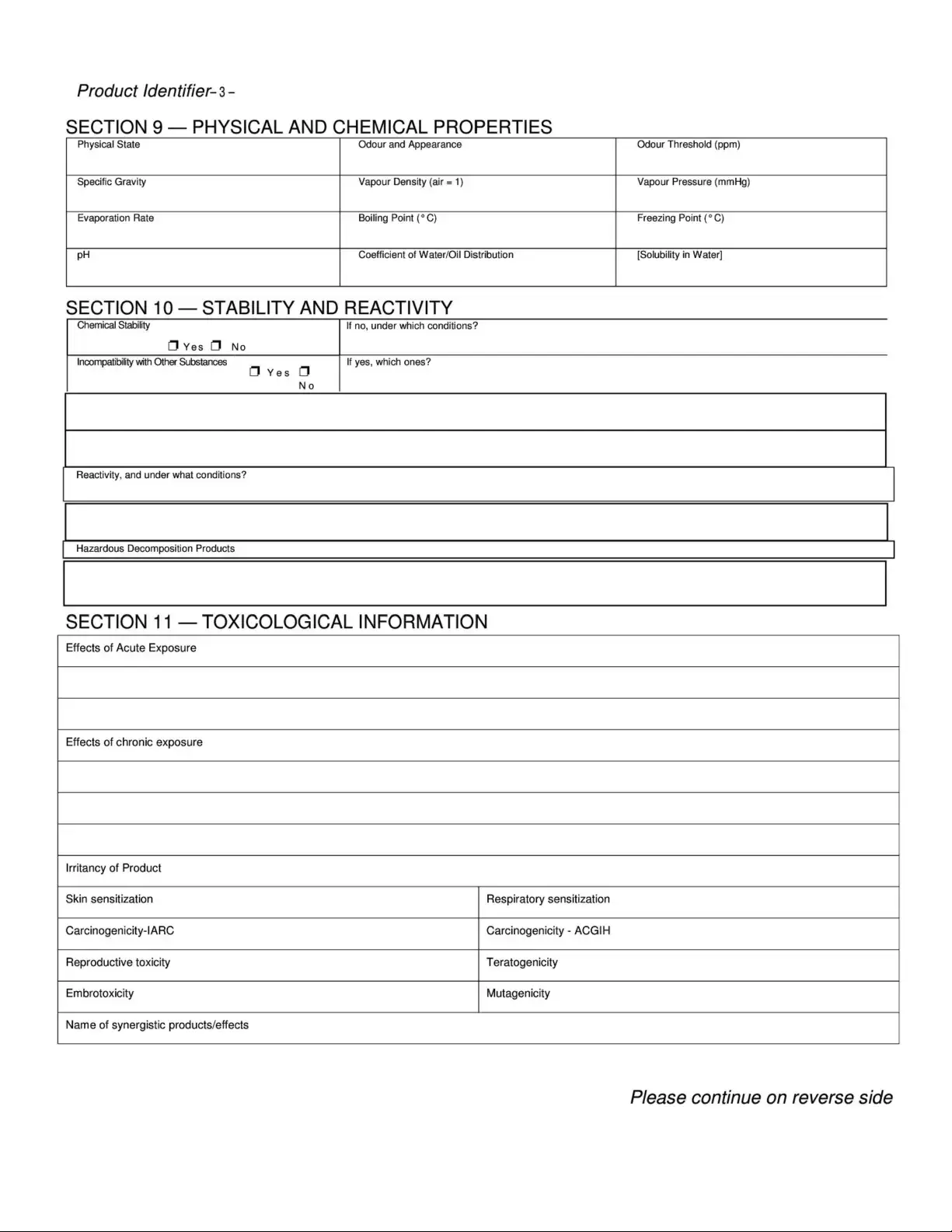
SECTION 9 — PHYSICAL AND CHEMICAL PROPERTIES

Physical State

Odour and Appearance

Odour Threshold (ppm)

Specific Gravity

Vapour Density (air = 1)

Vapour Pressure (mmHg)

Evaporation Rate

Boiling Point (°C)

Freezing Point (°C)

pH

Coefficient of Water/Oil Distribution

[Solubility in Water]

SECTION 10 — STABILITY AND REACTIVITY

Chemical Stability

If no, under which conditions?

О Yes П No

Incompatibility with Other Substances

If yes, which ones?


Yes


N о

Reactivity, and under what conditions?

Hazardous Decomposition Products

|

SECTION 11 — TOXICOLOGICAL INFORMATION

Effects of Acute Exposure

Effects of chronic exposure

Irritancy of Product


Skin sensitization

Respiratory sensitization

Carcinogenicity-IARC

Carcinogenicity - ACGIH

Reproductive toxicity

Teratogenicity

Embrotoxicity

Mutagenicity

Name of synergistic products/effects


Please continue on reverse side

Product Identifier- 4-

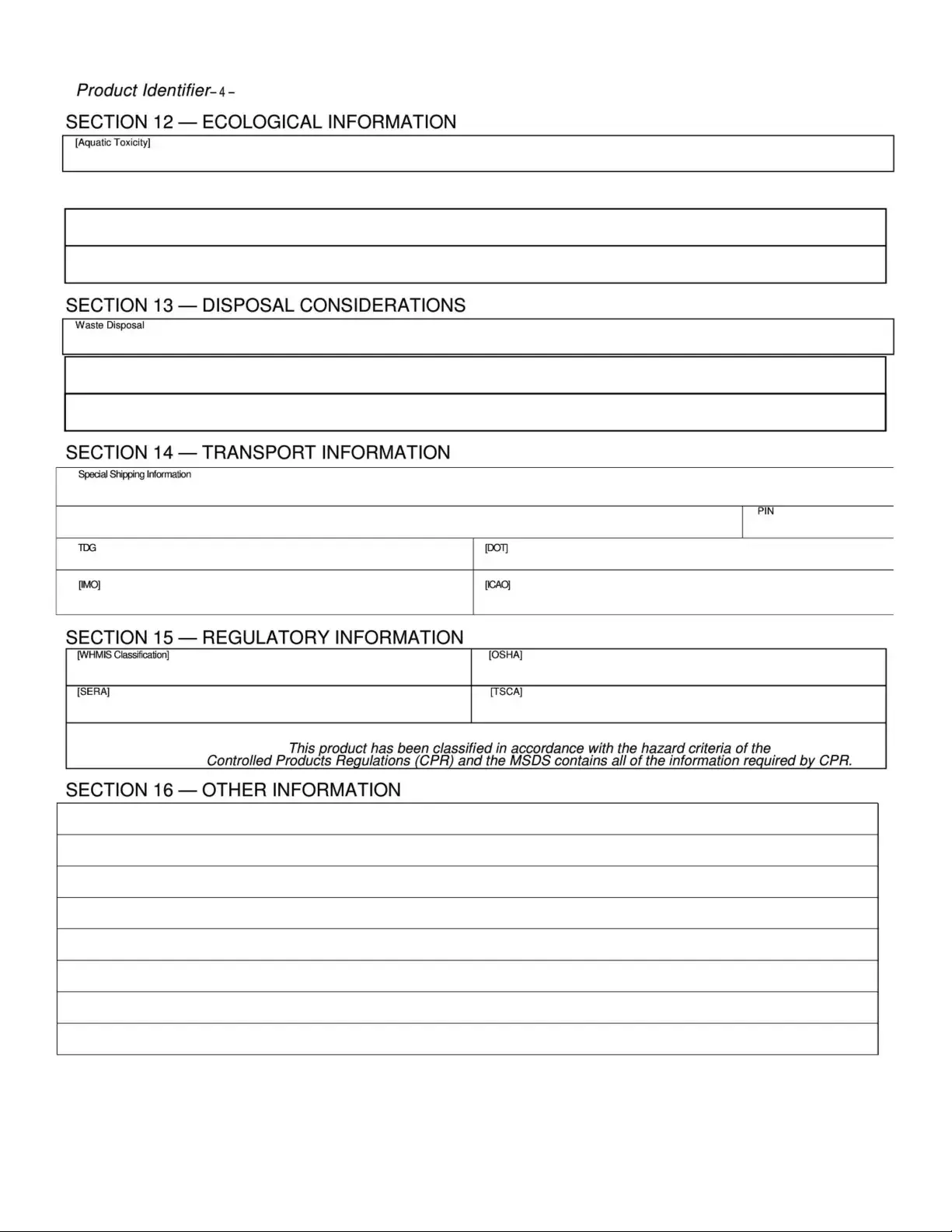
SECTION 12 — ECOLOGICAL INFORMATION

[Aquatic Toxicity]

SECTION 13 — DISPOSAL CONSIDERATIONS

Waste Disposal

SECTION 14 —TRANSPORT INFORMATION

Special Shipping Information

TOG

[IMO]

PIN

[DOT]

[CAO]

SECTION 15 — REGULATORY INFORMATION

[WHMIS Classification]

[OSHA]

[SERA]

[TSCA]

This product has been classified in accordance with the hazard criteria of the

Controlled Products Regulations (CPR) and the MSDS contains all of the information required by CPR.

SECTION 16 —OTHER INFORMATION

File Properties

Fact Name Description
Purpose The Material Safety Data Sheet (MSDS) provides essential information about the properties of a chemical product. It helps ensure safe handling, storage, and emergency response.
16 Sections An MSDS typically contains 16 sections, covering everything from product identification to disposal considerations. Each section provides specific information critical for safety.
Regulatory Compliance In the U.S., the Occupational Safety and Health Administration (OSHA) governs the requirements for MSDS under the Hazard Communication Standard (HCS). Compliance is mandatory for employers.
Emergency Information Sections of the MSDS include emergency contact numbers and first aid measures. This information is vital for quick response during an incident.
State-Specific Forms Some states may have additional requirements for MSDS, such as the California Proposition 65, which mandates specific labeling for hazardous substances.

Instructions on Utilizing Material Safety Sheet

Filling out a Material Safety Data Sheet (MSDS) is essential for ensuring safety in the workplace. This form provides critical information about chemical products, including their hazards, handling instructions, and emergency measures. Follow these steps to accurately complete the MSDS form.

  1. Section 1: Chemical Product and Company Identification
    • Enter the product identifier and its use.
    • Provide the manufacturer's name, street address, city, postal code, and province.
    • Fill in the date the MSDS was prepared and the WHMIS classification.
    • Include the emergency telephone number for the manufacturer.
    • List the supplier's name, street address, city, postal code, province, and emergency telephone number.
    • Indicate who prepared the MSDS and their phone number.
  2. Section 2: Composition/Information on Ingredients
    • Identify hazardous ingredients, their percentages, CAS numbers, and LD50 values.
    • Specify the LC50 of each ingredient and the species involved.
  3. Section 3: Hazards Identification
    • Check applicable boxes for hazards such as skin contact, eye contact, inhalation, and ingestion.
    • Provide a brief overview of potential health effects and WHMIS symbols.
  4. Section 4: First Aid Measures
    • Detail first aid measures for each type of exposure listed in Section 3.
  5. Section 5: Fire Fighting Measures
    • Indicate if the product is flammable and describe means of extinction.
    • Record the flashpoint, autoignition temperature, and hazardous combustion products.
    • Provide upper and lower flammable limits and explosion data.
  6. Section 6: Accidental Release Measures
    • Outline procedures for leaks and spills.
  7. Section 7: Handling and Storage
    • Describe safe handling and storage practices for the product.
  8. Section 8: Exposure Control/Personal Protection
    • List exposure limits and any specific engineering controls needed.
    • Detail personal protective equipment required, such as gloves, respirators, and clothing.
  9. Section 9: Physical and Chemical Properties
    • Provide information on physical state, specific gravity, pH, odor, boiling point, and other properties.
  10. Section 10: Stability and Reactivity
    • Indicate the stability of the product and any reactivity hazards.
  11. Section 11: Toxicological Information
    • Summarize effects of acute and chronic exposure, irritancy, and any carcinogenicity or reproductive toxicity.
  12. Section 12: Ecological Information
    • Detail any aquatic toxicity information.
  13. Section 13: Disposal Considerations
    • Provide guidelines for waste disposal.
  14. Section 14: Transport Information
    • List any special shipping information, including PIN and relevant transport regulations.
  15. Section 15: Regulatory Information
    • Include information regarding WHMIS classification and other regulatory compliance.
  16. Section 16: Other Information
    • Provide any additional relevant information.

Important Facts about Material Safety Sheet

What is a Material Safety Data Sheet (MSDS)?

A Material Safety Data Sheet is a document that provides detailed information about a chemical product. It includes information on the product's properties, hazards, handling, storage, and emergency measures. The MSDS is essential for ensuring safety in workplaces that use or handle hazardous materials.

What information is included in an MSDS?

An MSDS typically contains 16 sections, including details about the chemical product, its composition, hazards, first aid measures, fire fighting measures, accidental release procedures, handling and storage guidelines, exposure controls, physical and chemical properties, stability and reactivity, toxicological information, ecological information, disposal considerations, transport information, regulatory information, and other relevant details.

Who is responsible for preparing an MSDS?

The manufacturer or supplier of the chemical product is responsible for preparing the MSDS. They must ensure that the information is accurate and complies with regulatory requirements. The MSDS should be readily available to employees and emergency responders who may handle the product.

How often should an MSDS be updated?

An MSDS should be updated whenever there are significant changes to the product, such as new hazards, changes in composition, or new regulatory requirements. It is recommended to review and update the MSDS at least every three years to ensure it remains current and accurate.

What should I do if I have an emergency involving a chemical listed on an MSDS?

If an emergency occurs, refer to the MSDS for first aid measures and emergency procedures specific to the chemical. Follow the instructions carefully and seek medical attention if necessary. Additionally, contact emergency services and provide them with the MSDS for detailed information about the chemical involved.

How can I access an MSDS for a specific product?

MSDSs are typically available through the manufacturer or supplier of the product. Many companies provide MSDSs on their websites, or you can request a copy directly from them. Additionally, workplaces that use hazardous materials are required to maintain a library of MSDSs for all chemicals on-site.

What is the importance of the hazard identification section in an MSDS?

The hazard identification section outlines potential health effects and hazards associated with the chemical. This information is crucial for understanding how to handle the product safely and what precautions to take. It helps workers recognize risks and implement appropriate safety measures to prevent accidents and injuries.

Are there any regulatory requirements for MSDSs?

Yes, there are regulatory requirements for MSDSs in the United States. The Occupational Safety and Health Administration (OSHA) mandates that employers provide access to MSDSs for hazardous chemicals in the workplace. The MSDS must be compliant with the Hazard Communication Standard (HCS) to ensure that all necessary information is included and easily understood.

Common mistakes

Filling out a Material Safety Data Sheet (MSDS) can be a complex task. Mistakes can lead to misunderstandings about the product's safety and handling. One common error is failing to include the product identifier. This is crucial for identifying the chemical and ensuring that the right safety measures are taken.

Another mistake is not providing accurate hazardous ingredients information. Each ingredient should be listed with its correct percentage and CAS number. Inaccurate data can result in inadequate safety precautions being implemented.

People often overlook the importance of detailing the emergency telephone numbers. This information should be clear and accessible. In an emergency, having the right contact can be vital for ensuring prompt assistance.

In Section 4, which covers first aid measures, some individuals fail to specify the appropriate responses for different types of exposure. Clear instructions are necessary to guide responders in case of an incident.

Another frequent oversight is in the fire fighting measures section. Not indicating whether the product is flammable or providing its flashpoint can lead to dangerous situations. Understanding the fire hazards is essential for safe handling.

People sometimes neglect to include personal protective equipment recommendations. It is important to specify what safety gear should be used, such as gloves or respirators, to protect individuals from exposure.

In Section 10, the stability and reactivity information is often incomplete. This section should clearly state any conditions that could lead to hazardous reactions. Missing this information can create safety risks during storage and use.

Lastly, individuals may forget to include details on waste disposal considerations. Proper disposal methods are crucial for environmental safety. Without this information, users may inadvertently dispose of materials inappropriately.

Documents used along the form

The Material Safety Data Sheet (MSDS) is an essential document that provides information about the hazards of a chemical product and the necessary safety precautions. Alongside the MSDS, several other forms and documents are often utilized to ensure compliance with safety regulations and to promote a safe working environment. Below is a list of these documents, each briefly described for clarity.

  • Safety Data Sheet (SDS): Similar to the MSDS, the SDS provides comprehensive information about a chemical's properties, hazards, handling, and emergency measures. It is formatted according to the Globally Harmonized System (GHS) and is intended for easy understanding and use.
  • Labeling Requirements: This document outlines the necessary labels for hazardous materials, including symbols, signal words, and precautionary statements. Proper labeling is crucial for ensuring that workers are aware of the risks associated with the chemicals they handle.
  • Hazard Communication Program: This program details how a company communicates information about hazardous chemicals to employees. It includes training requirements, labeling, and access to safety data sheets.
  • Incident Report Form: In the event of an accident or exposure, this form is used to document the details of the incident. It helps in analyzing the cause and preventing future occurrences.
  • Personal Protective Equipment (PPE) Assessment: This assessment identifies the appropriate PPE needed when working with specific chemicals. It includes guidelines on the type of gloves, masks, and clothing required for safe handling.
  • Emergency Response Plan: This plan outlines the procedures to follow in case of an emergency involving hazardous materials. It includes evacuation routes, emergency contacts, and first aid measures.
  • Training Records: Documentation of employee training related to hazardous materials and safety protocols. Keeping these records helps ensure compliance and demonstrates that employees are adequately prepared to handle chemicals safely.
  • Waste Disposal Guidelines: This document provides instructions for the safe disposal of hazardous waste generated from chemical use. It ensures compliance with environmental regulations and promotes safety in waste management.
  • Regulatory Compliance Checklist: A checklist that helps ensure all safety regulations and standards are being met. It includes items related to OSHA, EPA, and other relevant agencies.

Utilizing these documents alongside the Material Safety Data Sheet can greatly enhance workplace safety and regulatory compliance. Proper documentation and adherence to safety protocols protect not only employees but also the environment and the community at large.

Similar forms

  • Safety Data Sheet (SDS): The SDS is similar to the Material Safety Data Sheet (MSDS) in that it provides detailed information about the properties of a chemical product. Both documents include sections on hazards, handling, and emergency measures, ensuring that users are informed about potential risks and safe usage.
  • Product Data Sheet (PDS): A PDS outlines the specifications and performance characteristics of a product. While it focuses more on technical details, like applications and performance, it shares the goal of providing essential information to users, similar to the MSDS.
  • Labeling Requirements: Chemical labels provide essential information about the hazards of a substance, similar to the MSDS. Both serve to inform users about risks and necessary precautions, ensuring safety in handling and usage.
  • Emergency Response Guide (ERG): The ERG offers guidance on how to respond to chemical emergencies. Like the MSDS, it emphasizes safety and provides critical information to first responders and individuals in the vicinity of a hazardous material.
  • Environmental Impact Assessment (EIA): An EIA evaluates the potential environmental effects of a project or substance. While it focuses on ecological implications, it shares the MSDS's objective of ensuring safety and compliance with regulations, particularly regarding hazardous materials.

Dos and Don'ts

When filling out a Material Safety Data Sheet (MSDS), it is crucial to ensure accuracy and clarity. Here are some essential dos and don'ts to keep in mind:

  • Do provide complete and accurate information about the chemical product and its manufacturer.
  • Do include all hazardous ingredients, specifying their concentrations and CAS numbers.
  • Do describe potential health effects clearly, ensuring that anyone reading the MSDS can understand the risks.
  • Do update the MSDS regularly to reflect any changes in the product or regulations.
  • Don't omit any required sections, as each part of the MSDS serves an important purpose.
  • Don't use technical jargon that may confuse readers; aim for straightforward language.

By following these guidelines, you can help ensure that the MSDS serves its vital role in promoting safety and awareness regarding hazardous materials.

Misconceptions

Misconceptions about Material Safety Data Sheets (MSDS) can lead to misunderstandings regarding safety practices and compliance. Here are nine common misconceptions, along with clarifications to help address them.

  • MSDS and Safety Data Sheet (SDS) are the same. Many people use these terms interchangeably, but they are not identical. The SDS is the updated version of the MSDS, aligning with the Globally Harmonized System (GHS) of Classification and Labeling of Chemicals.
  • All MSDS contain the same information. This is false. While MSDS documents are required to follow a standard format, the content can vary significantly depending on the chemical and manufacturer. Each MSDS provides specific details relevant to that particular substance.
  • MSDS are only for hazardous materials. Some believe that MSDS are only necessary for dangerous chemicals. However, even non-hazardous materials may have an MSDS to provide information on safe handling and potential risks.
  • MSDS are only needed for industrial settings. This misconception overlooks the fact that MSDS are also essential in laboratories, educational institutions, and even households where chemicals are present. Everyone who handles chemicals should have access to the relevant MSDS.
  • Once an MSDS is created, it never changes. In reality, MSDS should be updated regularly to reflect new safety data or changes in regulations. Users must ensure they have the most current version.
  • Reading the MSDS is optional. Some individuals may think that reviewing the MSDS is not necessary. This is a dangerous assumption. Understanding the information in the MSDS is critical for safe handling and emergency response.
  • MSDS are only for employees. This is misleading. MSDS should be accessible to anyone who may come into contact with the chemical, including visitors, contractors, and emergency responders.
  • All sections of the MSDS are equally important. While all sections contain valuable information, some may be more relevant depending on the context. For example, first aid measures may be critical in an emergency, while disposal considerations are essential for compliance.
  • MSDS are only a legal requirement. While compliance is a factor, the primary purpose of an MSDS is to promote safety and health. Understanding the risks associated with chemicals helps prevent accidents and protect individuals.

Addressing these misconceptions is crucial for ensuring safety in environments where chemicals are used. It is imperative that individuals take the time to familiarize themselves with the MSDS relevant to their work or activities.

Key takeaways

When filling out and utilizing the Material Safety Data Sheet (MSDS), it is essential to understand its structure and purpose. The following key takeaways provide guidance for effective use:

  • Comprehensive Identification: Ensure that all sections, particularly Section 1, are accurately completed. This includes the product identifier, manufacturer details, and emergency contact information.
  • Ingredient Awareness: Section 2 requires a clear listing of hazardous ingredients, their concentrations, and relevant CAS numbers. Understanding these components is crucial for assessing risks.
  • Health and Safety Precautions: Sections 3 through 8 outline potential hazards and necessary safety measures. Familiarity with first aid measures and personal protective equipment is vital for ensuring safety during handling.
  • Regulatory Compliance: The final sections provide information on regulatory classifications and disposal considerations. Adhering to these guidelines is necessary for legal compliance and environmental protection.