Fillable Maternity Leave Letter of Intent Document

Fillable Maternity Leave Letter of Intent Document

The Maternity Leave Letter of Intent form is a crucial document that informs your employer of your intention to take maternity leave. This form outlines your expected leave dates and provides essential information to ensure a smooth transition during your absence. If you’re preparing for this important life event, consider filling out the form by clicking the button below.

Article Guide

Maternity leave is a significant aspect of employee rights and benefits, designed to support new parents during a crucial time. The Maternity Leave Letter of Intent form serves as an essential tool for employees planning to take maternity leave. This form typically outlines the employee's intent to take leave, specifying the anticipated start and end dates. It also allows for the inclusion of any relevant details regarding the employee's current workload and how responsibilities will be managed in their absence. By submitting this letter, employees initiate the formal process of securing their maternity leave, ensuring that both the employer and the employee have a clear understanding of expectations and timelines. Additionally, the form may provide space for discussing any necessary accommodations or adjustments, fostering a collaborative approach to the transition. Understanding the components and importance of this form can help employees navigate their rights and responsibilities effectively, ultimately contributing to a smoother maternity leave experience.

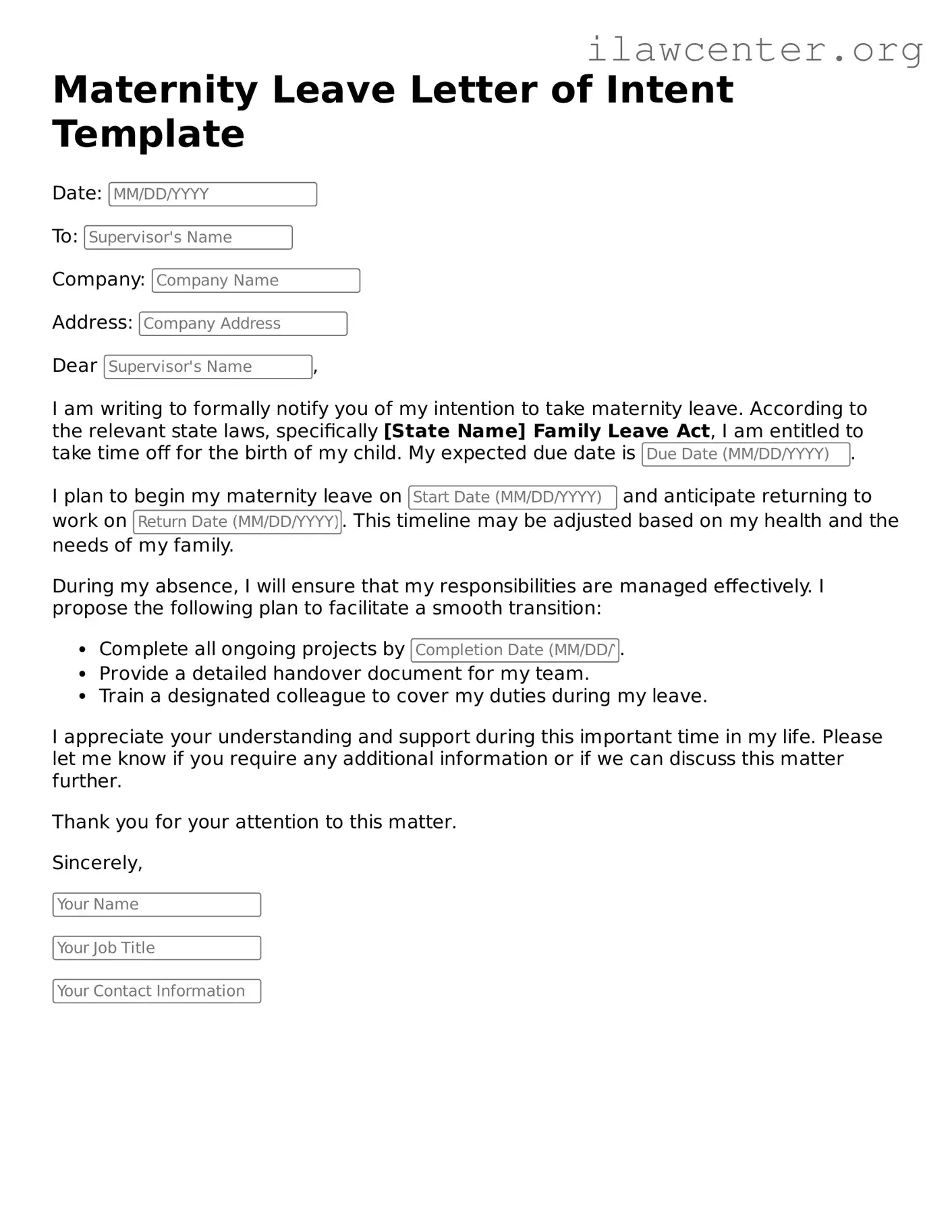
Maternity Leave Letter of Intent Preview

Maternity Leave Letter of Intent Template

Date:

To:

Company:

Address:

Dear ,

I am writing to formally notify you of my intention to take maternity leave. According to the relevant state laws, specifically [State Name] Family Leave Act, I am entitled to take time off for the birth of my child. My expected due date is .

I plan to begin my maternity leave on and anticipate returning to work on . This timeline may be adjusted based on my health and the needs of my family.

During my absence, I will ensure that my responsibilities are managed effectively. I propose the following plan to facilitate a smooth transition:

  • Complete all ongoing projects by .
  • Provide a detailed handover document for my team.
  • Train a designated colleague to cover my duties during my leave.

I appreciate your understanding and support during this important time in my life. Please let me know if you require any additional information or if we can discuss this matter further.

Thank you for your attention to this matter.

Sincerely,

PDF Form Characteristics

Fact Name Details
Purpose The Maternity Leave Letter of Intent form is used to formally notify an employer of an employee's intention to take maternity leave.
Timing It is recommended to submit the letter at least 30 days before the intended leave start date to ensure proper planning.
State-Specific Laws In California, the California Family Rights Act (CFRA) governs maternity leave. In New York, the Paid Family Leave (PFL) law applies.
Required Information The form typically requires the employee's name, expected leave dates, and any relevant medical documentation.

Instructions on Utilizing Maternity Leave Letter of Intent

Once you have the Maternity Leave Letter of Intent form ready, it is essential to complete it accurately to ensure a smooth process. Following these steps will help you fill out the form correctly and prepare for your upcoming maternity leave.

  1. Begin by entering your full name at the top of the form.
  2. Provide your employee identification number or Social Security number, if required.
  3. Fill in your job title and department to clarify your position within the organization.
  4. Indicate the expected start date of your maternity leave.
  5. Specify the anticipated return date after your leave concludes.
  6. Include any additional comments or information that may be relevant to your leave.
  7. Review the form for any errors or missing information before submission.
  8. Sign and date the form at the bottom to validate your request.

After completing the form, submit it to your supervisor or human resources department as per your organization's guidelines. This will initiate the necessary steps for processing your maternity leave request.

Important Facts about Maternity Leave Letter of Intent

What is the Maternity Leave Letter of Intent form?

The Maternity Leave Letter of Intent form is a document that employees use to formally notify their employer of their intention to take maternity leave. This form helps ensure that both the employee and employer are aligned on the leave dates and any necessary arrangements during the leave period.

Who needs to fill out the Maternity Leave Letter of Intent form?

Any employee planning to take maternity leave should complete this form. It is important for employees to communicate their plans clearly to their employer to facilitate a smooth transition and to ensure that their rights and benefits are protected during their absence.

When should I submit the Maternity Leave Letter of Intent form?

It is recommended to submit the form as early as possible, ideally at least 30 days before the anticipated start of maternity leave. Early submission allows for adequate planning and adjustments within the workplace, ensuring that responsibilities are managed effectively during your absence.

What information is required on the form?

The form typically requires your name, position, expected due date, and the planned start and end dates of your maternity leave. Additional details may include any requests for flexible work arrangements or information about your workload during your absence.

Will my maternity leave be paid or unpaid?

The payment status of maternity leave varies based on company policy, state laws, and individual circumstances. Some employers offer paid maternity leave, while others may provide unpaid leave. It is essential to review your employer's maternity leave policy and discuss any questions with your HR department.

Can I change my maternity leave dates after submitting the form?

Yes, changes to your maternity leave dates can be made, but it is important to communicate these changes as soon as possible. Notify your employer in writing to ensure that they can accommodate your new plans and adjust any necessary arrangements accordingly.

What happens if I do not submit the Maternity Leave Letter of Intent form?

Failing to submit the form may lead to misunderstandings regarding your leave. It could also affect your eligibility for maternity leave benefits. To protect your rights and ensure that your leave is properly documented, it is crucial to complete and submit the form as required by your employer's policy.

Is there any support available if I have questions about the form?

Yes, support is available. Employees can reach out to their HR department for assistance with the Maternity Leave Letter of Intent form. HR representatives can provide guidance on how to fill out the form correctly and clarify any questions regarding maternity leave policies.

What should I do if I encounter issues with my maternity leave request?

If issues arise regarding your maternity leave request, it is advisable to communicate directly with your supervisor or HR representative. Open dialogue can help resolve any concerns or misunderstandings. If necessary, consider reviewing your employee handbook or relevant company policies for additional guidance.
Common mistakes

Filling out the Maternity Leave Letter of Intent form can be a straightforward process, but several common mistakes can lead to complications. One frequent error is failing to provide adequate notice. Employers typically require a specific timeframe for notice before maternity leave begins. If an employee submits the form too late, it may not allow sufficient time for the employer to make necessary adjustments, which can create stress for both parties.

Another common mistake involves incomplete information. It is crucial to fill out all required fields accurately. Missing details such as the expected due date or the intended start and end dates of the leave can lead to delays in processing the request. Employers need this information to plan for coverage and ensure that the employee's role is managed effectively during their absence.

Additionally, some individuals overlook the importance of checking their company’s specific policies regarding maternity leave. Each organization may have different guidelines and requirements. Not aligning the request with these policies can result in misunderstandings or even a denial of the leave. It is essential to review the employee handbook or consult with HR before submitting the form.

Lastly, many people forget to keep a copy of the submitted form. Documentation is key in any employment-related matter. Having a record of the request can serve as proof in case of any disputes or questions that arise later. It is advisable to maintain a personal copy for future reference and to follow up with the employer to confirm receipt.

Documents used along the form

When preparing for maternity leave, submitting a Letter of Intent is just one step in the process. Several other forms and documents may be required to ensure a smooth transition. Below is a list of common documents that often accompany the Maternity Leave Letter of Intent. Each plays a vital role in communicating your needs and ensuring compliance with company policies and legal requirements.

  • Maternity Leave Policy Document: This outlines the specific policies and procedures your employer has in place regarding maternity leave. It details eligibility, duration, and any necessary documentation.
  • Medical Certification: A note from your healthcare provider may be needed to confirm your pregnancy and estimated due date. This document supports your request for maternity leave.
  • Leave of Absence Request Form: Some employers require a formal request form to be filled out. This document typically includes your planned start and end dates for leave.
  • Short-Term Disability Claim Form: If you plan to apply for short-term disability benefits during your maternity leave, this form will be necessary. It usually requires information about your medical condition and treatment.
  • Return to Work Agreement: This document outlines the terms and conditions of your return to work after maternity leave. It may include any adjustments or accommodations needed.
  • Employee Benefits Enrollment/Change Form: If your maternity leave affects your health insurance or other benefits, you may need to fill out this form to update your coverage.
  • Childcare Leave Request Form: If you plan to take additional time off for childcare after your maternity leave, this form will help you formally request that time.
  • Communication Plan: A simple document outlining how and when you will communicate with your employer during your leave can be beneficial. It sets clear expectations for both parties.

Being well-prepared with these documents can help ease the transition into maternity leave. Each form serves a specific purpose, ensuring that both you and your employer are on the same page. Taking the time to understand and gather these documents can lead to a smoother experience during this significant life event.

Similar forms

  • Parental Leave Request Form: This document is used by employees to formally request time off for the birth or adoption of a child, similar to the maternity leave letter in its purpose of notifying the employer about the need for leave.
  • Medical Leave Request Form: Like the maternity leave letter, this form is utilized to request time off due to medical reasons, ensuring that the employer is aware of the employee's health-related absence.
  • Family Leave Act Request Form: This document is related to the Family and Medical Leave Act (FMLA) and allows employees to apply for leave for family-related issues, paralleling the maternity leave letter in its focus on family care.
  • Leave of Absence Form: Employees use this form to request an extended period away from work for various reasons, including maternity, making it similar in its intent to secure time off.
  • Short-Term Disability Claim Form: This form is often used by employees who need to take leave due to health issues, including complications from pregnancy, aligning with the maternity leave letter's aim to address time off for maternity reasons.
  • Employee Absence Notification: This document serves as a preliminary notice to an employer about an employee's absence, similar to the maternity leave letter which formally communicates the need for maternity leave.
  • Return to Work Form: After maternity leave, employees may need to submit this form to confirm their readiness to return to work, which complements the maternity leave letter by addressing the transition back to work.
  • Childcare Leave Application: This document allows employees to request time off specifically for childcare purposes, similar to the maternity leave letter in that it focuses on family responsibilities and care.

Dos and Don'ts

When filling out a Maternity Leave Letter of Intent form, it is essential to approach the task with care and attention to detail. Here are ten important dos and don'ts to consider:

  • Do check your company’s maternity leave policy before filling out the form.
  • Do provide accurate dates for your expected leave and return.
  • Do communicate with your supervisor about your plans prior to submitting the form.
  • Do include any necessary documentation, such as a doctor's note if required.
  • Do keep a copy of the completed form for your records.
  • Don't wait until the last minute to submit your letter.
  • Don't include personal or irrelevant information that doesn’t pertain to your leave.
  • Don't assume that verbal communication is sufficient; always provide a written notice.
  • Don't forget to sign and date the form before submission.
  • Don't ignore any follow-up requests from your HR department regarding your leave.

By adhering to these guidelines, you can ensure a smoother process as you prepare for your maternity leave.

Misconceptions

When it comes to maternity leave, many people have misunderstandings about the Maternity Leave Letter of Intent form. Here are seven common misconceptions:

  • It is mandatory to submit the form. Some believe that submitting the Letter of Intent is a legal requirement. In reality, while it is often encouraged, it is not always mandatory.
  • All employers have the same form. Many think that there is a standard form used by all companies. However, different employers may have their own versions or requirements for maternity leave documentation.
  • The form guarantees maternity leave approval. Some assume that submitting the form automatically secures maternity leave. Approval depends on company policies and eligibility criteria.
  • You must submit the form immediately upon pregnancy confirmation. Many believe that the form must be filled out as soon as pregnancy is confirmed. While early notification is beneficial, it is not always required to do so immediately.
  • The form is only for full-time employees. Some think that only full-time employees can use the Letter of Intent. In fact, part-time employees may also be eligible for maternity leave and can submit the form.
  • There is a specific format that must be followed. Many feel that the Letter of Intent must adhere to a strict format. While it should include key information, there is often flexibility in how it is presented.
  • Submitting the form affects job security. Some worry that requesting maternity leave could jeopardize their job. However, most laws protect employees from discrimination based on pregnancy and maternity leave requests.

Understanding these misconceptions can help individuals navigate the maternity leave process more effectively. Clear communication with employers is essential for a smooth transition during this important time.

Key takeaways

When preparing to fill out and use the Maternity Leave Letter of Intent form, several important considerations can help ensure a smooth process. Here are key takeaways:

  • Understand the Purpose: The form serves as a formal notification to your employer about your intention to take maternity leave.
  • Check Company Policy: Review your employer’s maternity leave policy to understand your rights and obligations.
  • Provide Necessary Details: Include essential information such as your expected due date and the intended start and end dates of your leave.
  • Submit Early: Aim to submit the letter as early as possible to allow for planning and adjustments in the workplace.
  • Maintain Professional Tone: Keep the letter professional and concise, expressing gratitude for the support from your employer.
  • Follow Up: After submission, follow up with your supervisor or HR to confirm receipt and discuss any next steps.
  • Keep a Copy: Retain a copy of the letter for your records to reference in future discussions.