Mc 030 PDF Template

Mc 030 PDF Template

The MC-030 form is a legal document used in California courts for declarations made by attorneys or parties without attorneys. It includes essential information such as names, addresses, and case details, ensuring that all parties are properly identified in court proceedings. If you need to fill out this form, click the button below to get started.

Article Guide

The MC-030 form plays a crucial role in the California legal system, particularly for individuals navigating court proceedings without an attorney. This form allows a party to declare important information, ensuring that the court has all necessary details for a case. Key elements include the names and contact information of the parties involved, such as the plaintiff or petitioner and the defendant or respondent. It also requires the declaration of truthfulness under penalty of perjury, emphasizing the importance of honesty in legal matters. The form is designed for optional use, making it accessible for those who may not have formal legal representation. Furthermore, it provides a space for signatures, reinforcing the accountability of the declarant. Understanding the MC-030 form is essential for anyone involved in a legal case in California, as it streamlines communication with the court and helps maintain the integrity of the judicial process.

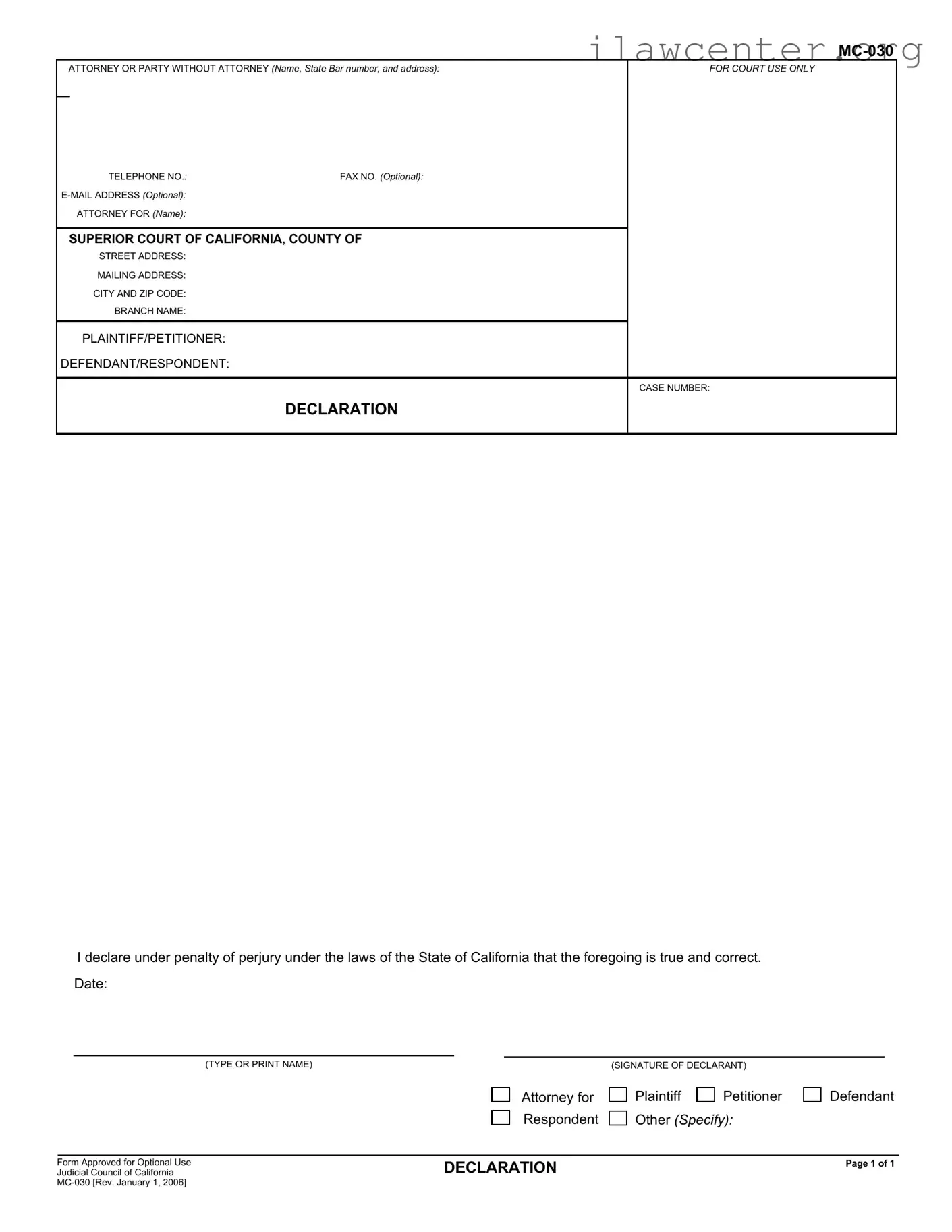
Mc 030 Preview

Form Approved for Optional Use
Judicial Council of California
MC-030 [Rev. January 1, 2006]
DECLARATION
Plaintiff
Other (Specify):
Defendant
Attorney for
Date:
(SIGNATURE OF DECLARANT)
(TYPE OR PRINT NAME)
I declare under penalty of perjury under the laws of the State of California that the foregoing is true and correct.
MC-030
FOR COURT USE ONLYATTORNEY OR PARTY WITHOUT ATTORNEY (Name, State Bar number, and address):
TELEPHONE NO.: FAX NO. (Optional):
E-MAIL ADDRESS (Optional):
ATTORNEY FOR (Name):
SUPERIOR COURT OF CALIFORNIA, COUNTY OF
STREET ADDRESS:
MAILING ADDRESS:
CITY AND ZIP CODE:
BRANCH NAME:
PLAINTIFF/PETITIONER:
DEFENDANT/RESPONDENT:
DECLARATION
CASE NUMBER:
Petitioner
Respondent
Page 1 of 1

File Properties

Fact Name Description
Form Purpose The MC-030 form is used by attorneys or parties representing themselves in court to declare information relevant to a case.
Governing Law This form is governed by the California Rules of Court and is designed for use in California state courts.
Optional Information Sections for fax number and email address are optional, allowing for flexibility in communication methods.
Declaration Requirement Signers must declare under penalty of perjury that the information provided is true and correct, ensuring accountability.

Instructions on Utilizing Mc 030

Filling out the MC-030 form is a straightforward process that requires attention to detail. This form is essential for providing necessary information to the court. Once completed, it will need to be submitted according to the guidelines provided by the court.

  1. At the top of the form, enter your name, state bar number, and address in the section labeled ATTORNEY OR PARTY WITHOUT ATTORNEY.
  2. Provide your telephone number. If you have a fax number or email address, include those in the optional fields.
  3. Specify who you are representing by filling in the ATTORNEY FOR section with the name of the party.
  4. Fill in the SUPERIOR COURT OF CALIFORNIA, COUNTY OF section with the appropriate county name.
  5. Enter the street address and mailing address of the court in the designated areas.
  6. Complete the CITY AND ZIP CODE section with the relevant information.
  7. Indicate the branch name of the court if applicable.
  8. Fill in the names of the plaintiff/petitioner and defendant/respondent in their respective sections.
  9. Write the case number in the designated area.
  10. In the declaration section, type or print your name and then sign the form to confirm that the information is true and correct.
  11. Finally, indicate your role by checking the appropriate box, such as Attorney for Plaintiff, Petitioner, Defendant, or Respondent.

Important Facts about Mc 030

What is the purpose of the MC-030 form?

The MC-030 form serves as a declaration for individuals involved in a legal case in California. It allows a party, whether represented by an attorney or acting on their own, to submit a sworn statement to the court. This declaration can be used to affirm the truthfulness of information provided in legal documents or to support a motion or other court action. It is important for ensuring that all statements made in the legal process are accurate and truthful, as false declarations can lead to serious legal consequences.

Who needs to fill out the MC-030 form?

This form is typically filled out by attorneys or parties who are representing themselves in court. If you are a plaintiff, petitioner, defendant, or respondent in a case, you may need to complete this form to provide a formal declaration to the court. It is essential for anyone involved in a legal proceeding who needs to affirm the validity of their statements or claims. The form can be used in various types of cases, including civil, family, and criminal matters.

What information is required on the MC-030 form?

The MC-030 form requires several key pieces of information. First, you must provide your name, address, and contact details, including a phone number and optional email address. If you are represented by an attorney, their name and state bar number must also be included. Additionally, you need to specify the role you are playing in the case, such as plaintiff, defendant, or respondent. Finally, you must sign and date the declaration, confirming that the information provided is true and correct under penalty of perjury.

Is the MC-030 form mandatory for all court cases?

No, the MC-030 form is not mandatory for every court case. It is an optional form approved for use by the Judicial Council of California. However, it is highly recommended when a party needs to make a formal declaration to support their case. Using the MC-030 can enhance the credibility of your statements and ensure that the court has a clear understanding of your position. Parties should consider the specific requirements of their case and consult with legal counsel if needed.

Common mistakes

Filling out the MC-030 form can seem straightforward, but many individuals make common mistakes that can lead to delays or complications in their legal proceedings. Understanding these pitfalls can help ensure that your form is completed correctly and efficiently.

One frequent error is neglecting to provide complete contact information. The form requires a name, address, and phone number. Omitting any of these details can hinder communication with the court. Always double-check that your information is accurate and up-to-date.

Another mistake involves failing to specify the role of the declarant. The form asks whether the individual is an attorney, plaintiff, defendant, or another party. Misidentifying oneself can lead to confusion regarding who is responsible for the declaration, which may complicate the case.

Many people also forget to sign the declaration. A signature is crucial because it verifies that the information provided is true and correct under penalty of perjury. Without a signature, the form may be deemed incomplete, resulting in additional delays.

Inaccurate case numbers are another common issue. Each case has a unique identifier, and entering the wrong number can lead to misfiling or miscommunication with the court. Always verify the case number before submitting the form.

Some individuals overlook the importance of clarity in their printed name. If the name is difficult to read, it may create confusion about the identity of the declarant. Clear handwriting or typing can help avoid this issue.

Additionally, people often forget to include optional contact information, such as an email address or fax number. While these fields are not mandatory, providing them can facilitate quicker communication with the court.

Another mistake is not using the correct version of the form. Forms can be updated, and using an outdated version may lead to complications. Always check for the most recent version before filling it out.

Lastly, individuals sometimes fail to review their forms before submission. Taking a moment to go over the completed form can help catch any errors or omissions that could cause problems later. A thorough review is a simple yet effective way to ensure accuracy.

By being aware of these common mistakes, individuals can improve their chances of submitting a complete and correct MC-030 form. Attention to detail can make a significant difference in the legal process.

Documents used along the form

The MC-030 form, known as the Declaration form, is commonly utilized in California courts to provide a sworn statement of facts. In many legal proceedings, this form is accompanied by several other documents that serve different purposes. Below is a list of six additional forms and documents frequently used alongside the MC-030 form.

  • MC-001: Request for Order - This form is used to request a court order regarding various matters, such as child custody, support, or property division. It outlines the specific requests being made and the reasons behind them.
  • MC-020: Notice of Motion - This document notifies all parties involved in a case about a motion that will be presented in court. It includes the date, time, and location of the hearing, as well as the nature of the motion.
  • MC-025: Proof of Service - This form serves as evidence that documents have been properly delivered to the involved parties. It details who received the documents, when, and how they were served.
  • MC-040: Declaration of Service - Similar to the Proof of Service, this declaration provides a sworn statement confirming that service of documents was completed. It may include additional details about the circumstances of the service.
  • MC-050: Application for Waiver of Court Fees - Individuals who cannot afford court fees may use this application to request a waiver. It requires disclosure of financial information to determine eligibility.
  • MC-060: Notice of Change of Address - This form is used to inform the court and other parties of a change in the address of a party involved in the case. It ensures that all communications are directed to the correct location.

Each of these documents plays a critical role in the legal process, ensuring that all parties are informed and that the court has the necessary information to make decisions. Understanding the purpose of each form can help individuals navigate their legal proceedings more effectively.

Similar forms

The MC-030 form is a declaration form used in California courts. It serves as a way for individuals to provide a sworn statement under penalty of perjury. There are several other documents that share similarities with the MC-030 form. Here’s a list of ten documents that are comparable:

  • MC-001: Request for Order - This form allows a party to request a court order and includes a declaration section similar to the MC-030.
  • MC-002: Notice of Motion - Like the MC-030, this document requires a declaration to support the motion being filed.
  • MC-003: Proof of Service - This form includes a declaration confirming that legal documents were properly served, similar in purpose to the MC-030.
  • MC-004: Declaration of Disclosure - This document requires parties to declare their financial information, much like the sworn statement in the MC-030.
  • MC-005: Declaration for Default or Uncontested Dissolution - This form includes a declaration confirming the status of a case, similar to the MC-030's declaration requirements.
  • MC-006: Declaration of Service - This document verifies that service was completed, requiring a declaration similar to the MC-030.
  • MC-007: Application for Waiver of Court Fees - This form includes a declaration regarding the applicant’s financial status, akin to the MC-030's declaration.
  • MC-008: Declaration in Support of Attorney Fees - This document requires a declaration to support a request for attorney fees, similar to the sworn statement in the MC-030.
  • MC-009: Declaration of Minor's Counsel - This form is used in cases involving minors and includes a declaration, much like the MC-030.
  • MC-010: Declaration of Guardian Ad Litem - This document includes a declaration regarding the representation of a minor or incapacitated person, similar in structure to the MC-030.

Each of these documents incorporates a declaration component, emphasizing the importance of sworn statements in legal proceedings. They all require the individual to affirm the truthfulness of their statements, which is a key feature of the MC-030 form.

Dos and Don'ts

When filling out the MC-030 form, it's important to get it right. Here are some things to keep in mind:

  • Do type or print your name clearly.
  • Don't leave any required fields blank.
  • Do double-check your contact information for accuracy.
  • Don't forget to sign the declaration.
  • Do ensure you are using the latest version of the form.
  • Don't submit the form without making a copy for your records.

Misconceptions

Here are four common misconceptions about the MC-030 form:

  • It is only for attorneys. Many believe the MC-030 form is exclusively for attorneys. In reality, it can also be used by individuals representing themselves in court.
  • It's mandatory for all court cases. Some think that filing the MC-030 is required in every case. However, it is only necessary when a party needs to submit a declaration under penalty of perjury.
  • It must be filed with every document. There’s a misconception that the MC-030 must accompany every court document. In truth, it is only needed when a declaration is being made, not for all filings.
  • Filing it guarantees a favorable outcome. Many assume that submitting the MC-030 will lead to a favorable judgment. The form is simply a declaration; it does not influence the court's decision.

Key takeaways

When filling out and using the MC-030 form, consider the following key takeaways:

  • The MC-030 form is used for declarations in legal proceedings in California.
  • Accurate information is crucial. Ensure that all fields, such as names and addresses, are filled out correctly.
  • Include your contact information, including telephone number and optional fax or email address, to facilitate communication.
  • Sign the form to validate your declaration. A signature is required to confirm the truthfulness of the information provided.
  • Understand that this form is subject to penalties for false declarations under California law.
  • Keep a copy of the completed form for your records, as it may be needed for future reference or proceedings.