Md Inspection Report PDF Template

Md Inspection Report PDF Template

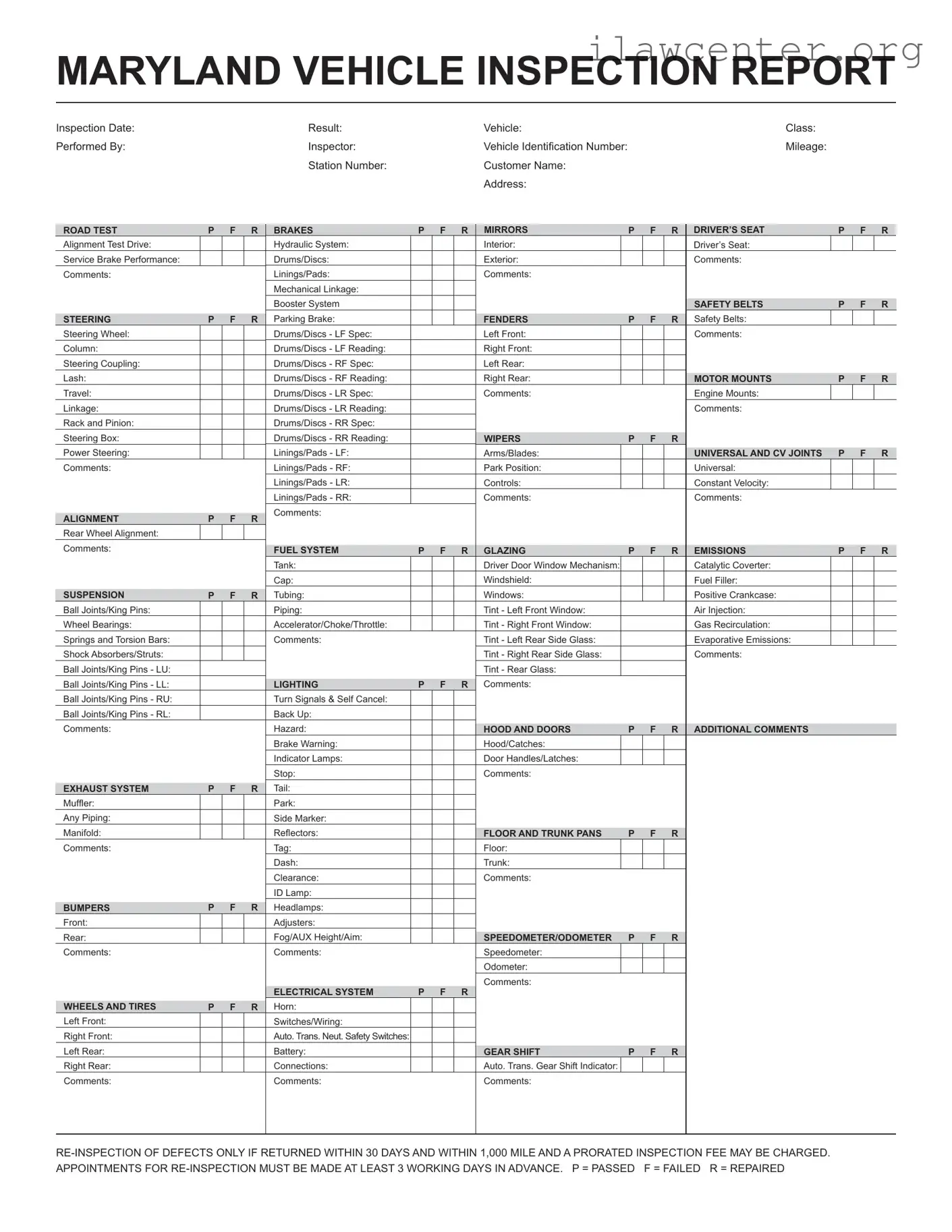
The Maryland Vehicle Inspection Report is a crucial document that outlines the results of a vehicle's safety inspection. This report includes details such as the inspection date, vehicle identification number, and the performance of various safety features. To ensure your vehicle meets state regulations, fill out the form by clicking the button below.

Article Guide

The Maryland Vehicle Inspection Report is a comprehensive document that serves as a critical tool for ensuring vehicle safety and compliance with state regulations. This form captures essential details, including the inspection date, vehicle identification number, and the inspector's information. It evaluates various components of the vehicle, such as the braking system, steering, suspension, and emissions, categorizing each aspect as passed, failed, or repaired. The report also includes sections for comments, allowing inspectors to provide additional insights or recommendations. Specific tests, such as the alignment test drive and hydraulic system check, are integral to assessing the vehicle's overall performance. Furthermore, the form addresses safety features, including seat belts and lighting, ensuring that all vehicles on Maryland roads meet safety standards. With a clear structure and detailed categories, the Maryland Vehicle Inspection Report not only aids in the inspection process but also promotes safer driving conditions for everyone.

Md Inspection Report Preview

Shock Absorbers/Struts:
Manifold:
MARYLAND VEHICLE INSPECTION REPORT
Vehicle:
Customer Name:
Inspection Date: Result:
Vehicle Identifi cation Number:
Address:
Performed By:
Inspector:
Class:
Mileage:
ROAD TEST
SUSPENSION
PFR
Alignment Test Drive:
Service Brake Performance:
Power Steering:
Linkage:
Steering Wheel:
Steering Box:
Wheel Bearings:
Ball Joints/King Pins - LL:
Lash:
Steering Coupling:
Comments:
Comments:
Comments:
Comments:
Comments:
Rack and Pinion:
Column:
Springs and Torsion Bars:
Ball Joints/King Pins - RU:
Travel:
Ball Joints/King Pins:
Ball Joints/King Pins - LU:
Muffl er:
Any Piping:
Ball Joints/King Pins - RL:
Rear Wheel Alignment:
STEERING
ALIGNMENT
EXHAUST SYSTEM
Rear:
Comments:
Front:
BUMPERS
Station Number:
Parking Brake:
Connections:
Exterior:
Fog/AUX Height/Aim:
Accelerator/Choke/Throttle:
Right Rear:
Right Front:
Cap:
WHEELS AND TIRES
Piping:
Left Rear:
Tubing:
Left Front:
Tank:
Comments:
Comments:
Comments:
Comments:
Comments:
LIGHTING
Park:
Drums/Discs - RF Reading:
Dash:
Drums/Discs - RR Reading:
Brake Warning:
Refl ectors:
Drums/Discs - LR Reading:
Back Up:
Adjusters:
Linings/Pads - RR:
ID Lamp:
Linings/Pads - RF:
Stop:
Drums/Discs - LF Reading:
Side Marker:
Drums/Discs - LR Spec:
Clearance:
Linings/Pads - LF:
Indicator Lamps:
Drums/Discs - LF Spec:
Tag:
Drums/Discs - RR Spec:
Hazard:
Turn Signals & Self Cancel:
Headlamps:
Linings/Pads - LR:
Tail:
Drums/Discs - RF Spec:
Auto. Trans. Neut. Safety Switches:
Horn:
Switches/Wiring:
Battery:
Interior:
FUEL SYSTEM
MIRRORS
ELECTRICAL SYSTEM
Hydraulic System:
Booster System
Linings/Pads:
Comments:
Drums/Discs:
Mechanical Linkage:
BRAKES
Tint - Rear Glass:
Driver’s Seat:
Windows:
Door Handles/Latches:
Auto. Trans. Gear Shift Indicator:
Odometer:
Evaporative Emissions:
Trunk:
Engine Mounts:
Safety Belts:
Constant Velocity:
Controls:
Right Rear:
Comments:
Comments:
Comments:
Comments:
Comments:
Comments:
Comments:
Comments:
Comments:
Comments:
Comments:
Comments:
Right Front:
Left Front:
Left Rear:
Tint - Left Front Window:
Tint - Left Rear Side Glass:
Tint - Right Front Window:
Tint - Right Rear Side Glass:
Park Position:
Arms/Blades:
GLAZING
DRIVER’S SEAT
Speedometer:
Gas Recirculation:
Catalytic Coverter:
Floor:
Universal:
Driver Door Window Mechanism:
Positive Crankcase:
Hood/Catches:
Fuel Filler:
Windshield:
Air Injection:
FENDERS
WIPERS
HOOD AND DOORS
FLOOR AND TRUNK PANS
GEAR SHIFT
SPEEDOMETER/ODOMETER
SAFETY BELTS
MOTOR MOUNTS
UNIVERSAL AND CV JOINTS
EMISSIONS
ADDITIONAL COMMENTS
RE-INSPECTION OF DEFECTS ONLY IF RETURNED WITHIN 30 DAYS AND WITHIN 1,000 MILE AND A PRORATED INSPECTION FEE MAY BE CHARGED.
APPOINTMENTS FOR RE-INSPECTION MUST BE MADE AT LEAST 3 WORKING DAYS IN ADVANCE. P = PASSED F = FAILED R = REPAIRED
P
P
P
P
P
P
F
F
F
F
F
F
R
R
R
R
R
R
P
P
P
F
F
F
R
R
R
PPP
P
P
P
P
P
P
P
P
P
P
P
FFF
F
F
F
F
F
F
F
F
F
F
F
RRR
R
R
R
R
R
R
R
R
R
R
R

File Properties

Fact Name Details
Inspection Requirement Maryland law requires a vehicle inspection report for all vehicles registered in the state before they can be sold or transferred.
Inspection Components The report assesses various vehicle components, including brakes, lights, and emissions systems, ensuring compliance with safety standards.
Inspection Results Each component is marked as Passed (P), Failed (F), or Repaired (R), providing a clear status of the vehicle's condition.
Re-inspection Policy If a vehicle fails inspection, it can be re-inspected within 30 days and 1,000 miles, subject to a prorated inspection fee.
Appointment Requirement Appointments for re-inspection must be made at least 3 working days in advance to ensure proper scheduling.

Instructions on Utilizing Md Inspection Report

Filling out the Maryland Vehicle Inspection Report form is a straightforward process. This document is essential for recording the results of a vehicle inspection. Once completed, the form will provide a comprehensive overview of the vehicle's condition, which can be crucial for both the inspector and the vehicle owner.

  1. Start by entering the Inspection Date at the top of the form.
  2. Indicate the Result of the inspection by marking either Passed (P), Failed (F), or Repaired (R).
  3. Fill in the details of the vehicle under Vehicle, including the Class and Vehicle Identification Number.
  4. Record the Mileage and Station Number.
  5. Write the Customer Name and their Address.
  6. Proceed to the various inspection categories, such as Brakes, Mirrors, and Driver’s Seat. For each item, mark P, F, or R as appropriate.
  7. Continue through the list, checking items like Safety Belts, Steering, and Wipers, marking the results accordingly.
  8. For each inspection category, provide Comments where necessary to clarify the condition or any issues found.
  9. Complete sections on the Fuel System, Suspension, Lighting, and other systems, ensuring all items are marked and commented on as needed.
  10. Fill out the Electrical System and Wheels and Tires sections, again marking the results and providing comments.
  11. Once all sections are filled out, review the form for completeness and accuracy.
  12. Finally, sign the form under Performed By and include the Inspector's name.

Important Facts about Md Inspection Report

What is the Maryland Vehicle Inspection Report form used for?

The Maryland Vehicle Inspection Report form is utilized to document the results of a vehicle inspection. This inspection assesses various components of the vehicle to ensure they meet safety and emissions standards set by the state. The form includes details such as the inspection date, vehicle identification number, and the inspector’s information, along with a checklist of items that are evaluated during the inspection.

How can I interpret the results on the inspection report?

The inspection report uses a simple grading system with three possible outcomes for each inspected item: P for Passed, F for Failed, and R for Repaired. If an item is marked as "P," it indicates that the component is functioning properly. An "F" means the item did not meet the required standards, while "R" indicates that repairs have been made to the item. Review the comments section for additional details on any issues found during the inspection.

What should I do if my vehicle fails the inspection?

If your vehicle fails the inspection, you will need to address the issues listed on the report. Repairs should be completed before you can schedule a re-inspection. Remember, you must return for re-inspection within 30 days and within 1,000 miles of the original inspection. A prorated inspection fee may apply. It’s advisable to make an appointment for re-inspection at least three working days in advance.

Can I appeal the results of my vehicle inspection?

Common mistakes

Filling out the Maryland Vehicle Inspection Report form can seem straightforward, but many individuals make common mistakes that can lead to confusion or delays. One frequent error is failing to provide complete information in the designated fields. For instance, omitting details such as the Vehicle Identification Number or the Inspector’s name can create issues later on. Every piece of information matters, and incomplete forms may require a return visit to the inspection station.

Another mistake often seen is the incorrect marking of inspection results. When marking whether a component has passed, failed, or been repaired, clarity is crucial. Some inspectors may use unclear symbols or abbreviations that could be misinterpreted. It's essential to use the designated letters (P, F, R) consistently and legibly. This ensures that anyone reviewing the report can easily understand the vehicle's condition.

Many people also neglect to provide comments where necessary. The comments section is an opportunity to explain any failures or repairs in detail. Without these notes, the report may lack context, leaving future inspectors or mechanics guessing about the vehicle's history. Providing thorough comments can significantly enhance communication regarding the vehicle's condition.

Another common oversight is failing to double-check the mileage recorded on the form. The mileage can affect the vehicle's eligibility for certain inspections or warranties. Accurate mileage is not just a formality; it can impact the vehicle's service records and the owner's responsibilities.

In addition, some individuals forget to sign the report. A signature confirms that the inspection has been completed and that the information provided is accurate. Without a signature, the report may be considered incomplete, leading to potential disputes or delays in processing.

It's also important to ensure that all sections of the form are filled out. Some may leave sections blank, thinking they are not applicable. However, every section should be addressed, even if the answer is “not applicable.” This shows diligence and helps avoid any assumptions or misunderstandings about the vehicle's condition.

Another mistake involves misplacing the report after completion. Once the inspection is finished, it is vital to keep the report in a safe place. Losing the report can complicate matters, especially if proof of inspection is required for registration or sale of the vehicle.

Lastly, many people overlook the importance of making an appointment for any necessary re-inspections. The form clearly states that appointments must be made at least three working days in advance. Failing to do so can result in additional delays and frustration, especially if the vehicle requires urgent attention.

Documents used along the form

The Maryland Vehicle Inspection Report is a crucial document for assessing vehicle safety and compliance. Alongside this report, several other forms and documents are commonly utilized to ensure a thorough inspection process. Here are six of those documents:

  • Vehicle Registration Document: This document proves the vehicle's ownership and is necessary for verification during the inspection. It contains details such as the owner's name, vehicle identification number (VIN), and registration status.
  • Title Certificate: The title certificate indicates the legal ownership of the vehicle. It is essential for confirming that the vehicle is not stolen and has a clear title before inspection.
  • Insurance Card: An active insurance card is required to ensure that the vehicle is covered under a valid insurance policy. This document provides proof of insurance and helps protect against liability during the inspection process.
  • Emission Test Certificate: If applicable, this certificate demonstrates that the vehicle has passed emissions testing. It is often required for registration and ensures compliance with environmental regulations.
  • Repair Orders or Receipts: These documents provide evidence of any recent repairs or maintenance performed on the vehicle. They can help inspectors understand the vehicle's condition and history.
  • Maintenance Records: A log of regular maintenance activities can offer insights into the vehicle's upkeep. This document helps inspectors assess whether the vehicle has been properly maintained over time.

Having these documents ready can streamline the inspection process and ensure that all necessary information is available for a thorough evaluation. Proper documentation plays a key role in maintaining vehicle safety and compliance.

Similar forms

The Maryland Vehicle Inspection Report (MVIR) is an essential document used to assess the safety and functionality of vehicles. Several other documents serve similar purposes in vehicle inspections and safety assessments. Here’s a list of eight documents that share similarities with the MVIR:

  • Vehicle Safety Inspection Report: This report evaluates a vehicle's compliance with safety regulations, similar to the MVIR, focusing on critical components like brakes and lights.
  • Pre-Purchase Inspection Report: Often conducted before buying a used vehicle, this report provides a detailed analysis of the vehicle's condition, akin to the thorough checks in the MVIR.
  • Emissions Test Report: This document assesses a vehicle's emissions output, ensuring it meets environmental standards, paralleling the emissions section of the MVIR.
  • Accident Damage Assessment Report: After an accident, this report details any damages and necessary repairs, similar to the MVIR's focus on vehicle functionality and safety.
  • Annual Vehicle Inspection Report: Required in some states, this report is conducted yearly to ensure ongoing vehicle safety, much like the periodic checks performed in the MVIR.
  • Service Record: This document tracks maintenance and repairs over time, providing a history that can influence the findings of an inspection report like the MVIR.
  • Warranty Inspection Report: Conducted to determine if a vehicle qualifies for warranty coverage, this report examines similar components as the MVIR, focusing on safety and performance.
  • Fleet Inspection Report: Used by businesses with multiple vehicles, this report assesses the condition of each vehicle in a fleet, similar to how the MVIR evaluates individual vehicles.

Each of these documents plays a crucial role in ensuring vehicle safety and compliance, just like the Maryland Vehicle Inspection Report.

Dos and Don'ts

When filling out the Maryland Vehicle Inspection Report form, it is crucial to approach the task with care and attention to detail. Here are some important guidelines to follow:

  • Do ensure accuracy. Double-check all vehicle information, including the Vehicle Identification Number and mileage, to prevent errors.
  • Do use clear and legible handwriting. If filling out the form by hand, ensure that your writing is easy to read to avoid misunderstandings.
  • Do provide detailed comments. When noting issues or repairs, include specific details to help the next inspector understand the vehicle's condition.
  • Do follow the inspection checklist. Complete each section methodically to ensure that no aspect of the vehicle is overlooked.
  • Don't rush through the process. Take your time to ensure that every item is thoroughly checked and documented.
  • Don't leave sections blank. If a section is not applicable, mark it clearly instead of skipping it to avoid confusion.

By adhering to these guidelines, you can help ensure that the inspection report is both comprehensive and accurate, ultimately contributing to the safety and reliability of the vehicle.

Misconceptions

  • Misconception 1: The Md Inspection Report is only for new vehicles.

    This is not true. The inspection report applies to all vehicles, regardless of age. Every vehicle must undergo inspection to ensure it meets safety and emissions standards.

  • Misconception 2: A passing inspection means the vehicle is in perfect condition.

    A passing inspection indicates that the vehicle meets minimum safety and emissions requirements at the time of inspection. It does not guarantee that no future issues will arise.

  • Misconception 3: Inspections are optional for vehicles registered in Maryland.

    In Maryland, vehicle inspections are mandatory for all vehicles before they can be registered. This requirement helps ensure road safety for all drivers.

  • Misconception 4: The inspection report is only for the mechanic’s records.

    The inspection report is also a critical document for vehicle owners. It provides essential information about the vehicle's condition and any necessary repairs.

  • Misconception 5: All inspection stations follow the same procedures.

    While all stations must adhere to state regulations, the specific procedures and thoroughness of inspections may vary from one station to another. It’s important to choose a reputable station.

  • Misconception 6: You can ignore minor failures listed on the inspection report.

    Even minor failures should not be ignored. They can lead to more significant issues over time and may affect the vehicle's safety and performance.

  • Misconception 7: Re-inspections are free if the vehicle fails.

    Re-inspections may incur a prorated fee. If the vehicle is returned for re-inspection within 30 days and 1,000 miles, this fee is applicable, so it’s wise to be prepared for additional costs.

Key takeaways

When filling out and using the Maryland Vehicle Inspection Report form, there are several important points to keep in mind. Here are some key takeaways to ensure the process goes smoothly:

  • Complete All Sections: Make sure every section of the form is filled out accurately. This includes details like the inspection date, vehicle identification number, and mileage.
  • Use Clear Markings: Indicate the status of each inspection item using the designated codes: P for Passed, F for Failed, and R for Repaired. This clarity helps in understanding the vehicle's condition at a glance.
  • Document Comments: Provide comments for any items that fail or require repair. These notes are crucial for future reference and for the customer to understand what issues need addressing.
  • Schedule Re-Inspections: If a vehicle needs to be re-inspected, remember that it must be returned within 30 days and within 1,000 miles. Appointments for re-inspection should be made at least three working days in advance.
  • Stay Informed About Fees: Be aware that a prorated inspection fee may apply for re-inspections. Make sure customers understand this policy to avoid confusion later.
  • Provide Clear Instructions: After completing the inspection, ensure that customers receive clear instructions on any necessary repairs and the next steps in the process.

By following these guidelines, you can help ensure that the Maryland Vehicle Inspection process is efficient and transparent for both inspectors and vehicle owners.