Fillable Media Release Document

Fillable Media Release Document

A Media Release form is a legal document that allows individuals or organizations to give permission for their name, image, or likeness to be used in various media. This form is essential for protecting both parties involved, ensuring that everyone understands how the media will use the provided content. If you need to grant permission, consider filling out the form by clicking the button below.

Article Guide

The Media Release form serves as an essential tool for individuals and organizations looking to manage their public image and control the dissemination of their likeness or voice in various media formats. This document typically outlines the permissions granted by the individual to the entity using their image or voice, ensuring that all parties understand the scope of use. Major aspects of the form include the identification of the parties involved, the specific rights being granted, and any limitations or conditions attached to the use of the media. Additionally, it often addresses the duration of the permission and whether any compensation will be provided. By clearly defining these elements, the Media Release form helps to protect the rights of individuals while allowing organizations to utilize content for promotional or informational purposes. Understanding this form is crucial for anyone involved in media production, marketing, or public relations, as it establishes a mutual agreement that safeguards both the creator's and the subject's interests.

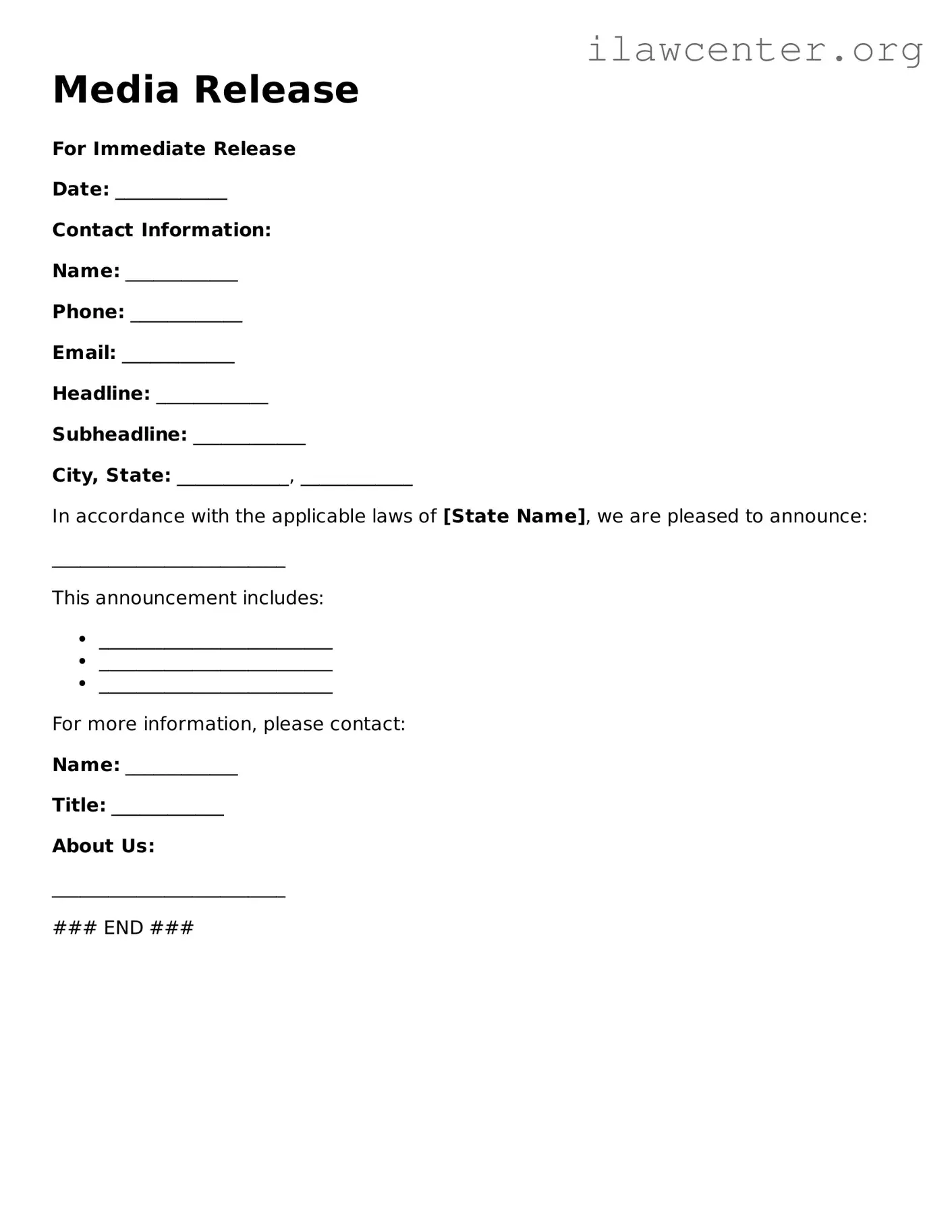
Media Release Preview

Media Release

For Immediate Release

Date: ____________

Contact Information:

Name: ____________

Phone: ____________

Email: ____________

Headline: ____________

Subheadline: ____________

City, State: ____________, ____________

In accordance with the applicable laws of [State Name], we are pleased to announce:

_________________________

This announcement includes:

  • _________________________
  • _________________________
  • _________________________

For more information, please contact:

Name: ____________

Title: ____________

About Us:

_________________________

### END ###

PDF Form Characteristics

Fact Name Details
Purpose The Media Release form allows individuals to grant permission for their image or voice to be used in various media formats.
Consent Requirement Obtaining consent is essential before using someone's likeness in promotional materials or media.
Duration of Consent The consent provided in a Media Release form is typically valid indefinitely unless stated otherwise.
Revocation Individuals can revoke their consent, but this may not apply retroactively to materials already published.
State-Specific Laws Different states have unique laws governing media releases. For instance, California's Civil Code Section 3344 provides specific guidelines.
Minors When dealing with minors, parental or guardian consent is required to execute a Media Release form.
Commercial Use Media Releases are often required for commercial use of images or recordings to protect against potential legal issues.

Instructions on Utilizing Media Release

Once you have the Media Release form in hand, you are ready to proceed with filling it out. This form is essential for ensuring that all parties understand the permissions and rights regarding media usage. Follow these steps carefully to complete the form accurately.

  1. Begin by entering your name in the designated field. Make sure to spell it correctly.
  2. Next, provide your contact information, including your phone number and email address.
  3. In the section labeled "Date," write the current date when you are filling out the form.
  4. Identify the project or event related to the media release. Be specific to avoid any confusion.
  5. Read through the terms and conditions carefully. This is crucial for understanding what you are agreeing to.
  6. Sign the form in the designated signature area. Your signature confirms your consent.
  7. Finally, print your name below your signature to ensure clarity.

After completing these steps, review the form for any errors or omissions before submitting it. This will help ensure a smooth process moving forward.

Important Facts about Media Release

What is a Media Release form?

A Media Release form is a legal document that grants permission for an individual or organization to use a person's image, voice, or likeness in various media formats. This can include photographs, videos, interviews, or any other form of content. By signing this form, the individual acknowledges that they understand how their likeness may be used and relinquishes any rights to compensation for the use of that media. This form is often utilized in settings such as events, promotions, or marketing campaigns where visual representation is key.

When should I use a Media Release form?

You should consider using a Media Release form whenever you plan to capture or use images or videos of individuals for commercial purposes. This includes advertising, social media promotions, educational materials, or any public-facing content. It is particularly important in professional settings, such as photo shoots or events, where you want to ensure that everyone involved is aware of and agrees to the potential use of their likeness. Additionally, obtaining a signed release protects you legally and helps avoid disputes regarding image usage in the future.

Do I need consent from all individuals in a photo or video?

Yes, it is essential to obtain consent from all individuals who can be identified in a photo or video. This includes not only the main subjects but also any bystanders who may be recognizable. If you plan to use the media for commercial purposes, having a signed Media Release form from each identifiable person is crucial. If minors are involved, consent must be obtained from a parent or legal guardian. This practice helps ensure that everyone’s rights are respected and that you are legally protected in your media usage.

Can a Media Release form be revoked after it is signed?

Generally, once a Media Release form is signed, it cannot be revoked without mutual agreement. However, the specifics can depend on the terms outlined in the form itself. Some releases may include clauses that allow for withdrawal under certain conditions. It’s important to read the document carefully before signing and to clarify any points of concern. If a situation arises where an individual wishes to revoke their consent, it is advisable to consult legal counsel to understand the implications and to navigate the process appropriately.
Common mistakes

Filling out a Media Release form can seem straightforward, but many people make common mistakes that can lead to complications down the line. One frequent error is neglecting to provide complete contact information. It’s essential to include not just a name, but also an email address and phone number. This ensures that anyone needing to follow up can easily reach you.

Another mistake is failing to specify the scope of the media release. Some individuals simply check a box without understanding what it entails. It’s crucial to clarify whether the release applies to photographs, videos, or both. This detail can prevent misunderstandings about how your image or story may be used.

People often overlook the importance of reviewing the terms and conditions associated with the release. Skimming through the fine print can lead to unexpected consequences. Take the time to read and understand what rights you are granting and for how long. This knowledge protects your interests and ensures you are comfortable with the agreement.

In addition, many forget to include a date on the Media Release form. A date is vital as it establishes when the release was signed. Without this, it may be challenging to determine the validity of the agreement later on. Always make sure to add the date clearly.

Another common oversight is not getting the signatures of all necessary parties. If multiple individuals are involved, each must sign the release to avoid any potential disputes. Ensure that everyone who needs to agree to the terms does so before submitting the form.

People also sometimes fail to keep a copy of the completed Media Release. After signing, it’s wise to retain a copy for your records. This can serve as proof of your consent and the terms agreed upon should any questions arise in the future.

Moreover, some individuals may forget to ask questions if they are unclear about any part of the form. If something doesn’t make sense, seeking clarification is crucial. Ignoring confusion can lead to signing an agreement that doesn’t align with your expectations.

Finally, a mistake often made is not considering the implications of the media release on personal privacy. Understand how your images or stories may be shared and used. Assess whether you are comfortable with this level of exposure before signing. Protecting your personal information should always be a priority.

Documents used along the form

The Media Release form is an important document used to grant permission for the use of an individual's likeness, voice, or other personal attributes in various media. Along with this form, several other documents often accompany it to ensure proper management of rights and responsibilities. Here’s a list of those documents:

  • Consent Form: This document is used to obtain explicit permission from individuals before their information or images are used. It outlines what the individual is consenting to and helps protect their rights.
  • Model Release: A model release is specifically for photographers and videographers. It secures the right to use a person's image in promotional materials or publications.
  • Contract Agreement: This document details the terms of the engagement between parties. It outlines obligations, rights, and any compensation involved, ensuring everyone is on the same page.
  • Liability Waiver: A liability waiver protects the party using the media by releasing them from legal responsibility in case of claims related to the use of the media.
  • Non-Disclosure Agreement (NDA): An NDA is used to protect confidential information. It prevents the sharing of sensitive information that may arise during the project.
  • Release of Liability: This document releases one party from liability for any injuries or damages that may occur during the project. It is crucial for protecting against unforeseen incidents.
  • Copyright Assignment: This form transfers ownership of copyright from one party to another. It ensures that the creator of the media relinquishes their rights to the work as agreed upon.

Using these documents in conjunction with the Media Release form helps to create a clear understanding between all parties involved. Proper documentation is essential for protecting rights and ensuring smooth collaboration.

Similar forms

The Media Release form is a key document in various situations where permission is needed to use someone's likeness, voice, or other personal attributes. Here are seven documents that share similarities with the Media Release form:

  • Photo Release Form: This document allows photographers to use images of individuals for commercial purposes. Like the Media Release, it grants permission for specific uses of a person's image.
  • Video Release Form: Similar to the Media Release, this form permits the use of a person’s likeness in video recordings. It specifies how the footage can be used and protects against unauthorized use.
  • Testimonial Release Form: This document is used when someone provides a testimonial that may be published. It ensures that the individual agrees to the use of their words and name, much like a Media Release does for visual media.
  • Talent Release Form: This form is utilized in film and television production. It grants permission for the use of an actor's performance. It parallels the Media Release in terms of granting rights for distribution.
  • Sound Recording Release Form: This document allows the use of someone's voice in audio recordings. It is similar to the Media Release as it seeks consent for the use of personal attributes in a specific medium.
  • Social Media Release Form: This form is used when individuals agree to share their content on social media platforms. It is akin to the Media Release, as it addresses the use of personal information and images online.
  • Advertising Release Form: This document grants permission for the use of an individual's image or voice in advertising campaigns. It functions similarly to the Media Release by protecting the rights of the individual while allowing for promotional use.

Dos and Don'ts

When filling out a Media Release form, it is important to approach the task with care and attention. Here are some guidelines to follow:

  • Do read the entire form carefully before filling it out. Understanding the terms is crucial.
  • Do provide accurate and complete information. This ensures that your release is valid and effective.
  • Do sign and date the form where required. Your signature confirms your consent.
  • Do keep a copy of the completed form for your records. This can be helpful for future reference.
  • Don't leave any required fields blank. Incomplete forms may be rejected.
  • Don't use ambiguous language. Clarity is essential in a Media Release.
  • Don't forget to check for spelling and grammatical errors. Professionalism matters.
  • Don't submit the form without reviewing it one last time. A final check can catch mistakes.

Misconceptions

Understanding the Media Release form is crucial for anyone involved in media production or public relations. However, several misconceptions can lead to confusion. Here are six common misconceptions about the Media Release form:

  1. It is only for professional photographers. Many people believe that only photographers need a Media Release form. In reality, anyone capturing images or videos of individuals for promotional or commercial use should obtain a release.
  2. It is not legally binding. Some think that a Media Release form is just a formality. In fact, when properly executed, it is a legally binding document that grants permission to use someone's likeness.
  3. It covers all uses of the media. A common misconception is that a Media Release form grants unlimited rights to use the media. However, the scope of use should be clearly defined in the form to avoid misunderstandings.
  4. It is only necessary for minors. While it is true that special considerations are needed when minors are involved, adults also require a Media Release form to protect their rights.
  5. Once signed, it cannot be revoked. Some believe that signing a Media Release form is permanent. However, individuals may have the right to revoke their consent under certain circumstances, depending on the terms outlined in the form.
  6. It is not necessary for social media posts. Many assume that posting on social media does not require a Media Release. In fact, using someone's likeness for promotional purposes on social media can necessitate a release.

Being aware of these misconceptions can help ensure that all parties understand their rights and responsibilities when it comes to media usage.

Key takeaways

When filling out and using a Media Release form, it is essential to understand its purpose and implications. Here are key takeaways to consider:

  1. Purpose of the Form: The Media Release form grants permission to use an individual's likeness, voice, or other identifiable attributes in various media.
  2. Clarity is Key: Ensure that all sections of the form are completed clearly to avoid misunderstandings.
  3. Scope of Use: The form should specify how the media will be used, whether for promotional purposes, educational content, or other applications.
  4. Consider Compensation: Determine if there will be any compensation for the use of the media, and clearly outline this in the form.
  5. Revocation Rights: Understand that individuals may have the right to revoke their consent under certain circumstances, depending on state laws.
  6. Age Considerations: If the subject is a minor, a parent or guardian must sign the form, providing consent on their behalf.
  7. Duration of Use: Specify the duration for which the media can be used, whether it is a one-time event or ongoing.
  8. Legal Review: Consider having the form reviewed by a legal professional to ensure compliance with applicable laws.
  9. Record Keeping: Keep a signed copy of the Media Release form for your records, as it serves as proof of consent.

By understanding these key aspects, individuals and organizations can effectively navigate the process of using a Media Release form.