Fillable Medical School Letter of Intent Document

Fillable Medical School Letter of Intent Document

The Medical School Letter of Intent form is a crucial document that aspiring medical students submit to express their genuine interest in a particular medical school. This form serves not only as a formal declaration of intent but also as an opportunity for applicants to highlight their qualifications and commitment. Ready to take the next step in your medical school journey? Fill out the form by clicking the button below.

Article Guide

The Medical School Letter of Intent form plays a crucial role in the application process for aspiring medical students. This form serves as a formal way for applicants to express their strong interest in a particular medical school, indicating that it is their top choice. It allows candidates to highlight their qualifications, experiences, and motivations for pursuing a career in medicine. Additionally, the letter provides an opportunity to communicate any updates to their application, such as new achievements or relevant experiences that have occurred since submitting their primary application. By carefully crafting this letter, applicants can demonstrate their commitment to the institution and potentially enhance their chances of admission. Understanding the key components of the Letter of Intent, including tone, content, and timing, is essential for any prospective medical student aiming to make a lasting impression on the admissions committee.

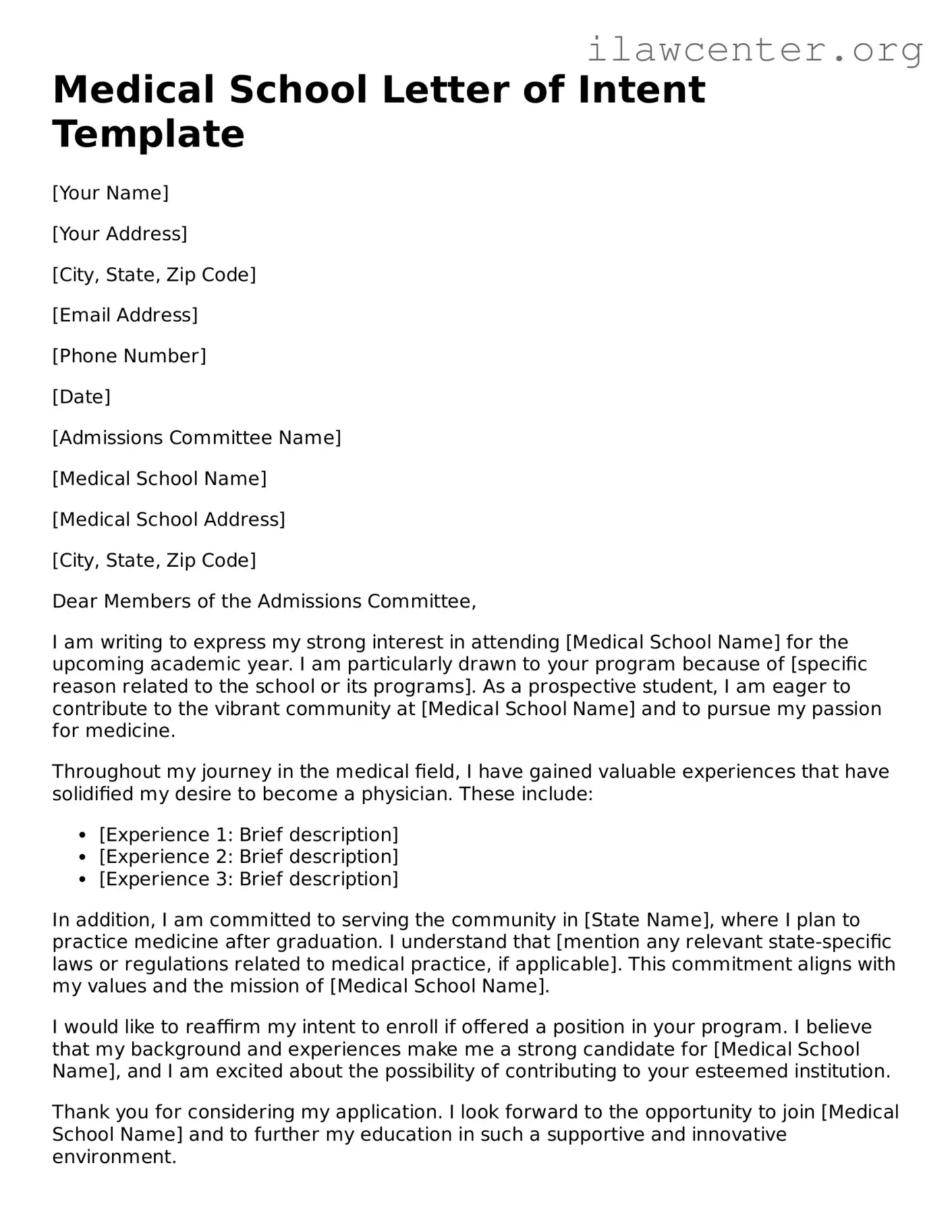
Medical School Letter of Intent Preview

Medical School Letter of Intent Template

[Your Name]

[Your Address]

[City, State, Zip Code]

[Email Address]

[Phone Number]

[Date]

[Admissions Committee Name]

[Medical School Name]

[Medical School Address]

[City, State, Zip Code]

Dear Members of the Admissions Committee,

I am writing to express my strong interest in attending [Medical School Name] for the upcoming academic year. I am particularly drawn to your program because of [specific reason related to the school or its programs]. As a prospective student, I am eager to contribute to the vibrant community at [Medical School Name] and to pursue my passion for medicine.

Throughout my journey in the medical field, I have gained valuable experiences that have solidified my desire to become a physician. These include:

  • [Experience 1: Brief description]
  • [Experience 2: Brief description]
  • [Experience 3: Brief description]

In addition, I am committed to serving the community in [State Name], where I plan to practice medicine after graduation. I understand that [mention any relevant state-specific laws or regulations related to medical practice, if applicable]. This commitment aligns with my values and the mission of [Medical School Name].

I would like to reaffirm my intent to enroll if offered a position in your program. I believe that my background and experiences make me a strong candidate for [Medical School Name], and I am excited about the possibility of contributing to your esteemed institution.

Thank you for considering my application. I look forward to the opportunity to join [Medical School Name] and to further my education in such a supportive and innovative environment.

Sincerely,

[Your Name]

PDF Form Characteristics

Fact Name Description
Purpose The Medical School Letter of Intent form is used by applicants to express their strong interest in a specific medical school and their commitment to attend if accepted.
Submission Timing Applicants typically submit the letter after receiving an interview invitation or following an interview, reinforcing their enthusiasm for the program.
State-Specific Forms Some states may have unique requirements or forms. It is important to check the specific medical school’s admissions guidelines for any additional documentation.
Governing Laws The governing laws for the Medical School Letter of Intent may vary by state, often guided by educational regulations and admissions policies set forth by the respective medical school.

Instructions on Utilizing Medical School Letter of Intent

After receiving the Medical School Letter of Intent form, you will need to complete it carefully. This form is an important part of your application process, and it allows you to express your commitment to a specific medical school. Follow these steps to fill out the form correctly.

  1. Read the instructions provided with the form. Make sure you understand what is required.
  2. Gather your personal information. This includes your full name, contact details, and any identification numbers required by the school.
  3. Write a clear statement of intent. Explain why you are interested in this particular medical school and how it aligns with your career goals.
  4. Highlight your qualifications. Include any relevant experiences, achievements, or skills that make you a strong candidate.
  5. Review the form for any additional sections or questions that need to be answered.
  6. Proofread your statement for spelling and grammar errors. A well-written letter reflects your professionalism.
  7. Submit the form according to the school’s guidelines. This may involve mailing it or submitting it electronically.

Important Facts about Medical School Letter of Intent

What is a Medical School Letter of Intent?

A Medical School Letter of Intent is a formal document that a prospective medical student sends to a medical school to express their strong interest in attending that particular institution. It conveys the applicant's commitment and enthusiasm, especially if they have been placed on a waitlist or are awaiting a decision.

When should I submit my Letter of Intent?

It is best to submit your Letter of Intent as soon as you have decided that a specific medical school is your top choice. This is often done after receiving an interview invitation or being waitlisted. Timeliness is key, as you want to ensure that the admissions committee considers your letter before making final decisions.

What should I include in my Letter of Intent?

Your Letter of Intent should include a clear statement of your interest in the school, reasons why you believe it is the right fit for you, and any relevant experiences that connect you to the school's values or mission. Personal anecdotes can make your letter more compelling. Additionally, you may want to mention any updates on your application, such as new achievements or experiences since your initial submission.

How long should my Letter of Intent be?

Generally, a Letter of Intent should be concise, ideally one page long. Aim for clarity and focus. Admissions committees appreciate brevity, so ensure every sentence adds value and reinforces your commitment to the school.

Is it necessary to send a Letter of Intent if I have already interviewed?

While it is not mandatory, sending a Letter of Intent after an interview can be beneficial. It reinforces your interest and allows you to reiterate why you believe you would be a great fit for the school. This can leave a positive impression on the admissions committee.

Can I send a Letter of Intent to multiple medical schools?

It is generally not advisable to send a Letter of Intent to multiple schools simultaneously. This letter is meant to express your commitment to a specific institution. Sending it to several schools may dilute your message and can be perceived as insincere.

Should I follow up after sending my Letter of Intent?

Following up can be a good idea, but it should be done thoughtfully. Wait a few weeks after sending your letter before reaching out. A polite email to inquire about the status of your application can demonstrate your continued interest without being overly pushy.

Is there a specific format I should follow for my Letter of Intent?

While there is no strict format, a professional tone is essential. Start with a formal greeting, use a clear introduction, and organize your content into paragraphs. Close with a courteous sign-off. Ensure that your letter is free of errors and well-structured.

Will a Letter of Intent guarantee my acceptance?

Unfortunately, a Letter of Intent does not guarantee acceptance. However, it can enhance your application by demonstrating your enthusiasm and commitment. Admissions committees appreciate applicants who show genuine interest in their school, which may positively influence their decision.

Can I update my Letter of Intent if my situation changes?

Yes, if there are significant updates to your application or personal circumstances, you can send an updated Letter of Intent. Make sure to highlight the new information while reiterating your commitment to the school. This can help keep your application fresh in the minds of the admissions committee.
Common mistakes

When filling out the Medical School Letter of Intent form, many applicants make critical mistakes that can undermine their chances of acceptance. One common error is failing to personalize the letter. Admissions committees want to see genuine interest in their specific program. A generic letter that could apply to any school may signal a lack of enthusiasm or commitment.

Another mistake is neglecting to proofread. Spelling and grammatical errors can detract from the professionalism of the letter. A well-written letter reflects attention to detail and dedication. Submitting a letter filled with mistakes can create a negative impression, suggesting that the applicant may not take their medical career seriously.

Additionally, some applicants forget to clearly articulate their reasons for wanting to attend that particular school. This is an opportunity to connect personal experiences, values, and goals with the mission and strengths of the institution. Without this connection, the letter may come across as vague or insincere.

Another common oversight is being too vague about future contributions. Applicants should outline how they plan to contribute to the school community and the field of medicine. Failing to provide specific examples can leave the committee questioning the applicant's commitment and vision.

Lastly, some candidates overlook the importance of following the submission guidelines. Each school may have specific requirements regarding length, format, or content. Ignoring these details can lead to an automatic rejection. Adhering to the guidelines demonstrates respect for the admissions process and showcases the applicant's ability to follow directions.

Documents used along the form

The Medical School Letter of Intent is an important document for applicants who wish to express their strong interest in a specific medical school. Along with this letter, there are several other forms and documents that applicants may need to submit to enhance their application. Below is a list of some of these documents, each serving a distinct purpose in the admissions process.

  • Personal Statement: This document provides a narrative of the applicant's journey, motivations, and experiences that led to their decision to pursue a career in medicine. It allows applicants to showcase their personality and passion for the field.
  • Curriculum Vitae (CV) or Resume: A CV or resume outlines the applicant's educational background, work experience, volunteer activities, and any relevant skills. It serves as a comprehensive summary of the applicant’s qualifications.
  • Letters of Recommendation: These letters are written by individuals who can speak to the applicant's abilities, character, and readiness for medical school. They provide insight into the applicant's strengths and potential as a future physician.
  • Secondary Application: Many medical schools require a secondary application after the primary application is submitted. This document often includes additional essays and questions specific to the institution, allowing the school to further assess the applicant's fit.

These documents collectively provide a well-rounded view of the applicant, highlighting their qualifications and commitment to the medical profession. Each component plays a critical role in the overall evaluation process for medical school admissions.

Similar forms

The Medical School Letter of Intent form shares similarities with several other documents commonly used in academic and professional settings. Below are six documents that have comparable purposes or structures:

  • Application Letter: Like a Letter of Intent, an application letter expresses interest in a specific program or position. It outlines qualifications and motivations, aiming to persuade the reader of the applicant's suitability.
  • Cover Letter: A cover letter accompanies a resume and highlights relevant skills and experiences. It serves a similar purpose by introducing the applicant and making a case for their candidacy.
  • Statement of Purpose: This document details an applicant's academic and professional goals. It parallels the Letter of Intent by focusing on the applicant's aspirations and reasons for choosing a particular institution.
  • Thank You Letter: After an interview or meeting, a thank you letter expresses gratitude. It shares a common goal with the Letter of Intent by reinforcing interest in the opportunity and maintaining communication with the recipient.
  • Acceptance Letter: An acceptance letter confirms a candidate's admission to a program. While it serves a different function, it similarly conveys a decision and the recipient's commitment to the institution.
  • Recommendation Letter: A recommendation letter supports an applicant's candidacy by providing insights from a third party. It aligns with the Letter of Intent by aiming to strengthen the applicant's case through endorsements.

Dos and Don'ts

When filling out the Medical School Letter of Intent form, it's essential to approach the task thoughtfully. Here are ten guidelines to help you navigate the process effectively.

  • Do: Clearly express your intent to attend the school if offered admission.
  • Do: Keep your letter concise, ideally one page in length.
  • Do: Highlight specific reasons for your interest in the school.
  • Do: Mention any recent accomplishments or experiences relevant to your application.
  • Do: Proofread your letter to eliminate any spelling or grammatical errors.
  • Don't: Use a generic template; personalize your letter for the specific school.
  • Don't: Include negative comments about other schools or programs.
  • Don't: Make your letter overly emotional or dramatic.
  • Don't: Submit your letter without confirming the submission guidelines.
  • Don't: Rush the process; take the time to reflect on your motivations and goals.

Following these guidelines can enhance the effectiveness of your Letter of Intent and strengthen your application to medical school.

Misconceptions

Many aspiring medical students have questions about the Medical School Letter of Intent (LOI) form. Misunderstandings can lead to mistakes that might affect their applications. Here are nine common misconceptions about this important document:

  1. It is the same as a personal statement. While both documents showcase a candidate's qualifications and aspirations, the LOI specifically indicates a strong interest in a particular medical school, whereas a personal statement covers broader experiences and motivations for pursuing medicine.

  2. It guarantees admission. Submitting an LOI does not guarantee acceptance into a medical school. It is simply a way to express commitment and enthusiasm for the program.

  3. It should be sent to every school applied to. The LOI should only be sent to the school where you truly wish to attend. Sending it to multiple schools can dilute its impact.

  4. It needs to be lengthy. A concise, well-crafted letter is more effective than a lengthy one. Aim for clarity and focus rather than trying to meet a word count.

  5. It can be sent at any time. Timing matters. The best time to send an LOI is after receiving an interview invitation or during the waitlist period, as it can reinforce your interest at a crucial moment.

  6. It should include new information only. While new accomplishments or experiences can be beneficial, reiterating your enthusiasm for the school and your fit with its mission is equally important.

  7. It is not necessary if I have already interviewed. Even if you have interviewed, an LOI can reaffirm your interest and keep you on the school's radar.

  8. It will be read by the admissions committee. In many cases, the LOI is reviewed by admissions staff rather than committee members. However, it still plays a role in the decision-making process.

  9. It should be overly formal. While professionalism is important, a genuine tone that reflects your personality can make a stronger connection with the reader.

Understanding these misconceptions can help you craft a more effective Medical School Letter of Intent, enhancing your chances of making a positive impression on admissions committees.

Key takeaways

When completing the Medical School Letter of Intent form, consider the following key takeaways:

  • Be clear and concise. State your intentions directly and avoid unnecessary details.
  • Highlight your passion for medicine. Use specific examples to demonstrate your commitment to the field.
  • Express gratitude. Acknowledge the opportunity to apply and thank the admissions committee for their consideration.
  • Follow submission guidelines. Ensure that you adhere to any specific instructions provided by the medical school regarding the format and deadline.