Medication Administration Record Sheet PDF Template

Medication Administration Record Sheet PDF Template

The Medication Administration Record Sheet is a crucial document used to track and manage the administration of medications to patients. It ensures that each dose is recorded accurately, allowing healthcare providers to monitor treatment effectively. To streamline your medication management process, consider filling out the form by clicking the button below.

Article Guide

The Medication Administration Record Sheet is an essential tool in the healthcare setting, designed to ensure that patients receive their medications accurately and on time. This form serves multiple purposes, including tracking medication administration for each consumer, recording the attending physician's name, and noting the specific month and year for reference. The layout of the form allows healthcare providers to log medication details across various hours of the day, making it easy to monitor when each dose should be given. Moreover, it includes important notations, such as "R" for refused medications, "D" for discontinued medications, and "H" for home administration, among others. These notations help in maintaining clear communication among healthcare staff and ensuring that any changes in medication plans are documented promptly. By recording all necessary information at the time of administration, the Medication Administration Record Sheet plays a critical role in patient safety and effective care management.

Medication Administration Record Sheet Preview

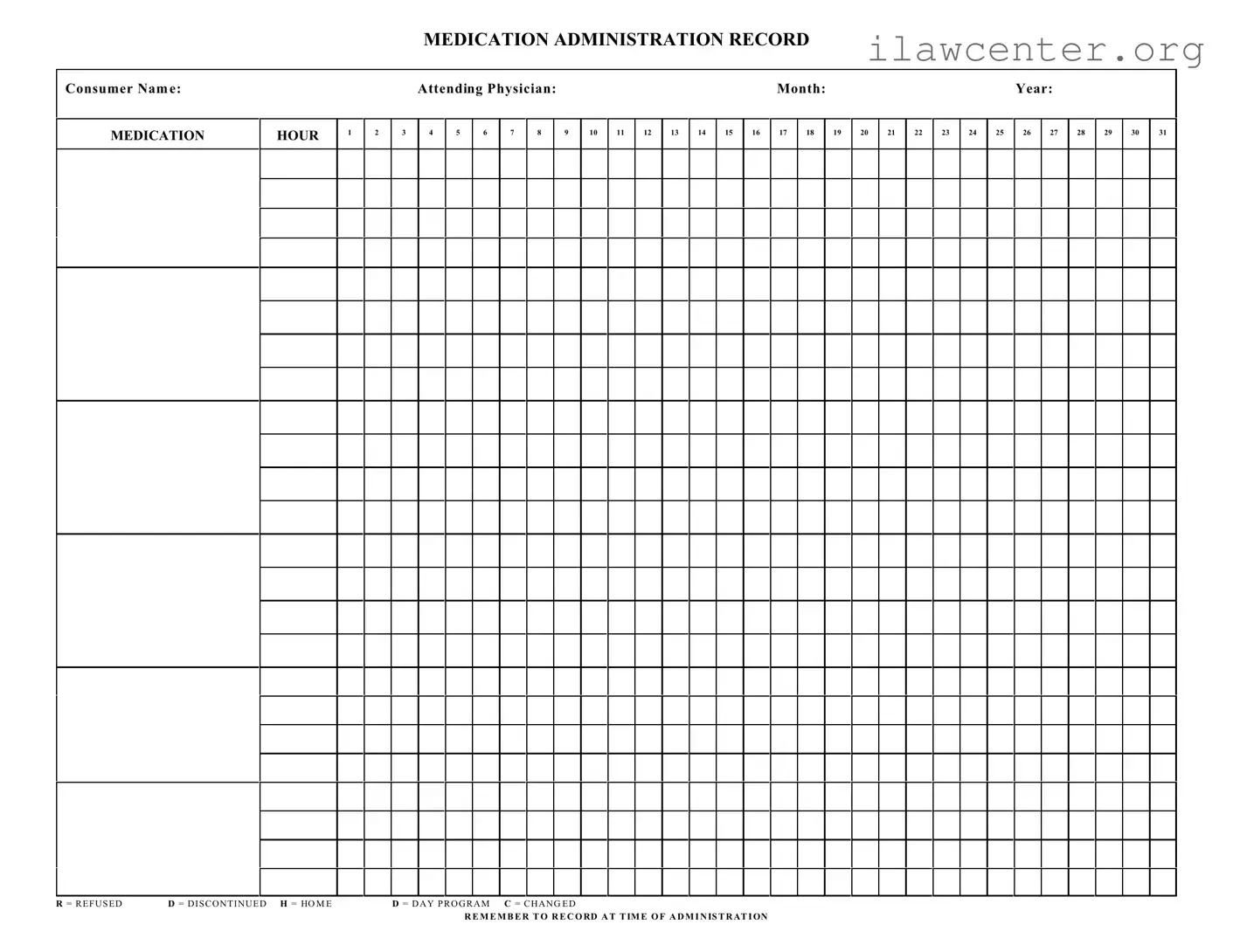
MEDICATION ADMINISTRATION RECORD
Consumer Name: Attending Physician: Month: Year:
MEDICATION HOUR
1 2 3 4 5 6 7 8 9 10 11 12 13 14 15 16 17 18 19 20 21 22 23 24 25 26 27 28 29 30 31
R = REFUSED D = DISCONTINUED H = HOME D = DAY PROGRAM C = CHANG ED
REMEMBER TO RECORD AT TIME OF ADMINISTRATION

File Properties

Fact Name Description
Purpose The Medication Administration Record Sheet is used to document the administration of medications to consumers, ensuring proper tracking and accountability.
Required Information This form requires the consumer's name, attending physician's name, month, year, and a detailed hour-by-hour record of medication administration.
State-Specific Regulations In many states, including California, the use of a Medication Administration Record is governed by the Health and Safety Code, Section 1569.69, which outlines medication management practices.
Abbreviations The form includes specific abbreviations such as R for Refused, D for Discontinued, and H for Home, which help in quickly conveying the status of medication administration.

Instructions on Utilizing Medication Administration Record Sheet

Filling out the Medication Administration Record Sheet form is a straightforward process that ensures accurate tracking of medication administration. Follow these steps to complete the form correctly.

  1. Fill in the Consumer Name: Write the full name of the individual receiving the medication at the top of the form.
  2. Enter the Attending Physician's Name: Below the consumer's name, write the name of the physician overseeing the medication.
  3. Specify the Month and Year: Indicate the month and year during which the medications will be administered.
  4. Mark the Medication Hours: For each hour of medication administration (1-31), write down the appropriate time when the medication should be given.
  5. Document Administration Status: Use the letters provided (R, D, H, M, C) to record the status of each medication at the corresponding hour. Make sure to note if a dose was refused, discontinued, or changed.
  6. Record Time of Administration: Remember to document the exact time each medication was administered in the appropriate column.

After completing the form, ensure that all information is accurate and legible. This record will help maintain a clear history of medication administration for the consumer, which is essential for ongoing care and treatment.

Important Facts about Medication Administration Record Sheet

What is a Medication Administration Record Sheet?

The Medication Administration Record Sheet (MARS) is a tool used to document the administration of medications to consumers. It helps healthcare providers track what medications are given, when they are given, and any changes to the medication regimen. This form is essential for ensuring proper medication management and compliance with treatment plans.

Who should use the Medication Administration Record Sheet?

This form is primarily used by healthcare professionals, such as nurses and caregivers, responsible for administering medications. It is also beneficial for pharmacists and other staff involved in medication management. Consumers and their families may also reference the MARS to stay informed about medication schedules.

What information is required on the Medication Administration Record Sheet?

The MARS requires several key pieces of information, including the consumer's name, the attending physician's name, the month and year, and a detailed list of medications along with their administration times. Additionally, it includes notations for refused medications, discontinued medications, and any changes made to the medication regimen.

How do I record medication administration on the MARS?

To record medication administration, simply enter the time at which each medication is given in the appropriate hour column. If a medication is refused or discontinued, use the designated letters (R for refused, D for discontinued) in the corresponding box. It's important to document these actions promptly to maintain accurate records.

What should I do if a medication is changed?

If a medication is changed, mark the change clearly on the MARS using the letter "C" in the appropriate section. Additionally, ensure that the new medication information is updated on the record to prevent any confusion during future administrations. Clear communication with the healthcare team is crucial in these situations.

Why is it important to record medication administration at the time it occurs?

Recording medication administration at the time it occurs is vital for accuracy and accountability. It helps prevent errors, ensures that consumers receive their medications as prescribed, and provides a clear history of medication management. This practice supports quality care and safety for consumers.

Can I use the Medication Administration Record Sheet for multiple consumers?

No, the MARS should be used for individual consumers only. Each consumer requires their own record to ensure accurate tracking of their specific medications and administration times. Using separate forms helps maintain clarity and prevents mix-ups between different consumers' medication regimens.
Common mistakes

Filling out a Medication Administration Record Sheet form is a critical task that ensures proper medication management for individuals. However, several common mistakes can lead to issues in medication administration. One frequent error is failing to include the consumer's name at the top of the form. Without this essential information, it becomes challenging to track who received which medication, potentially leading to serious errors.

Another mistake often made is neglecting to document the attending physician's name. This information is vital for accountability and for future reference regarding medication prescriptions. Omitting it can create confusion, especially if questions arise about the prescribed treatments.

Inaccurate recording of the medication hour is also a common error. Each hour of administration must be correctly noted to ensure that medications are given at the appropriate times. Misrecording can lead to missed doses or overdoses, which may have significant health implications.

Many individuals also forget to indicate if a medication was refused or discontinued. Marking these statuses is crucial for maintaining an accurate record of what medications have been administered and which have not. Failure to do so can result in unnecessary confusion and potential health risks.

Another issue arises when people do not record medications at the time of administration. Timing is essential in medication management, and delays in recording can lead to inaccuracies in the medication history. This can complicate the care process and affect treatment outcomes.

Some individuals may also overlook the need to update the form if there are changes in the medication regimen. If a medication is altered or a new medication is added, these changes must be reflected on the record sheet to ensure that all caregivers are aware of the current treatment plan.

In addition, it is common for people to misinterpret the abbreviations used on the form. Understanding what each abbreviation stands for is essential for accurate record-keeping. Misunderstandings can lead to incorrect entries, which can have serious consequences for patient care.

Another mistake is failing to check for consistency in the entries. It is important to review the entire record for any discrepancies or missing information. This practice helps ensure that the medication administration process is thorough and reliable.

Finally, neglecting to maintain a clear and legible handwriting can hinder communication among caregivers. If the entries are difficult to read, there is a risk that important information may be misinterpreted or overlooked. Clear documentation is a fundamental aspect of effective medication management.

Documents used along the form

The Medication Administration Record Sheet is a crucial document for tracking medication given to consumers. However, several other forms and documents often accompany it to ensure comprehensive care and compliance. Below is a list of these documents, each serving a specific purpose in the medication administration process.

  • Medication Order Form: This form details the specific medications prescribed by the attending physician, including dosages and administration routes. It serves as the primary instruction for medication administration.
  • Patient Consent Form: Before administering medication, obtaining consent from the patient or their guardian is essential. This form documents that the patient understands the treatment and agrees to it.
  • Allergy and Adverse Reaction Record: This document lists any known allergies or previous adverse reactions the patient has experienced. It helps prevent potentially harmful medication interactions.
  • Medication Inventory Log: This log tracks the stock of medications available at the facility. It ensures that medications are adequately supplied and helps manage expiration dates.
  • Incident Report Form: In case of any medication errors or adverse events, this form documents the incident. It is crucial for identifying patterns and improving safety protocols.
  • Medication Education Record: This form records the information provided to the patient regarding their medications, including potential side effects and how to take them properly.
  • Daily Progress Notes: These notes document the patient's overall condition and response to medications on a daily basis. They are vital for ongoing assessments and treatment adjustments.
  • Care Plan: This document outlines the overall treatment goals and strategies for the patient, including medication management. It helps ensure that all healthcare providers are aligned in their approach.
  • Medication Reconciliation Form: This form is used during transitions of care, such as hospital admissions or discharges, to ensure that all medications are accurately documented and reviewed.

These documents collectively support the safe and effective administration of medications. Each plays a vital role in patient care, ensuring that healthcare providers have the necessary information to make informed decisions.

Similar forms

The Medication Administration Record Sheet (MAR) is a crucial document in healthcare settings. It ensures proper tracking of medication administration. Several other documents serve similar purposes in managing medication and patient care. Below are seven documents that share similarities with the MAR.

  • Medication Reconciliation Form: This document is used to compare a patient's medication orders to all medications the patient has been taking. Like the MAR, it helps prevent medication errors and ensures continuity of care.
  • Patient Medication History Form: This form collects information about all medications a patient has taken. It serves a similar purpose as the MAR by providing a comprehensive view of a patient's medication regimen.
  • Medication Administration Policy: This document outlines the procedures for administering medications. It complements the MAR by establishing guidelines that ensure safe and effective medication delivery.
  • Medication Error Reporting Form: This form is used to document any errors in medication administration. It is similar to the MAR in that it tracks medication-related incidents to improve patient safety.
  • Patient Care Plan: This document details the overall treatment plan for a patient, including medication management. It aligns with the MAR by ensuring that medication administration is part of a comprehensive care strategy.
  • Prescription Order Form: This form is used to prescribe medications to patients. It is similar to the MAR as it initiates the medication administration process that the MAR tracks.
  • Medication Inventory Log: This log tracks the stock of medications available in a facility. It serves a similar function to the MAR by ensuring that medications are available for administration when needed.

Dos and Don'ts

When filling out the Medication Administration Record Sheet form, attention to detail is crucial. Here are some essential do's and don'ts to keep in mind:

  • Do ensure that the consumer's name is clearly written at the top of the form.
  • Do accurately record the time of administration for each medication given.
  • Don't forget to mark any medications that were refused or discontinued using the appropriate codes.
  • Don't leave any blank spaces; every section of the form should be completed to avoid confusion.

Misconceptions

Understanding the Medication Administration Record (MAR) Sheet is essential for ensuring safe and effective medication management. However, several misconceptions exist regarding this important document. Below are ten common misconceptions, along with clarifications to help demystify the MAR Sheet.

  1. The MAR Sheet is only for nurses. Many believe that only nurses use the MAR Sheet. In reality, it is a tool for all healthcare providers involved in medication administration, including pharmacists and physicians.
  2. It is unnecessary to document refusals. Some think that if a patient refuses medication, it does not need to be recorded. However, documenting refusals is crucial for tracking patient compliance and ensuring proper care.
  3. Only medications given in a hospital setting require documentation. This is a common misunderstanding. The MAR Sheet is also used in outpatient settings, assisted living facilities, and home care to ensure accurate medication administration.
  4. The MAR Sheet is a one-time use document. Many people assume that the MAR Sheet is only filled out once. In fact, it is a living document that should be updated regularly to reflect changes in medication orders or patient status.
  5. All medications are recorded on the same page. Some believe that all medications for a patient are listed on a single MAR Sheet. In practice, patients may have multiple MAR Sheets for different types of medications or treatment plans.
  6. It is acceptable to use shorthand or abbreviations. While some may think that using shorthand is efficient, it can lead to misunderstandings. Clear and complete documentation is essential for patient safety.
  7. Only the person administering the medication needs to sign the MAR. This misconception overlooks the importance of collaborative care. Other healthcare providers may also need to sign or initial the MAR to indicate their involvement in the patient's care.
  8. Changes to medication orders do not need to be recorded immediately. Some believe that changes can be documented later. However, timely updates are critical for maintaining accurate records and ensuring patient safety.
  9. The MAR Sheet does not need to be reviewed regularly. Regular review of the MAR Sheet is vital. It helps identify discrepancies, ensures compliance, and facilitates communication among healthcare providers.
  10. Electronic MAR Sheets are infallible. While electronic systems enhance accuracy, they are not without errors. Users must remain vigilant to ensure that all entries are correct and up to date.

By addressing these misconceptions, healthcare providers can improve their understanding of the MAR Sheet and enhance the quality of care provided to patients.

Key takeaways

When filling out and using the Medication Administration Record Sheet form, consider the following key takeaways:

  • Consumer Information: Always start by accurately entering the consumer's name at the top of the form. This ensures clarity and proper identification.
  • Attending Physician: Include the name of the attending physician to maintain a clear line of communication regarding the consumer's care.
  • Date Tracking: Clearly fill in the month and year. This helps in tracking medication administration over time.
  • Medication Hours: Use the designated hour slots to record the times when medications are administered. This is crucial for adherence to the prescribed schedule.
  • Recording Refusals: If a consumer refuses medication, mark it as 'R' for refused. This documentation is important for understanding compliance issues.
  • Discontinuations: If a medication is discontinued, mark it as 'D'. This helps avoid confusion about ongoing treatments.
  • Home and Day Program: Indicate if the consumer is receiving medication at home ('H') or during a day program ('D'). This distinction is vital for care coordination.
  • Change Documentation: If there is a change in medication, use 'C' to note this. Keeping track of changes is essential for effective treatment.
  • Timely Recording: Remember to record the administration of medication at the time it is given. This ensures accurate and reliable documentation.
  • Review Regularly: Regularly review the completed Medication Administration Record Sheet for any discrepancies or patterns that may require attention.