Medication Count Sheet PDF Template

Medication Count Sheet PDF Template

The Medication Count Sheet is a crucial document used in healthcare settings to track medication administration and inventory. It provides a systematic way to record details such as the resident's name, drug strength, and quantities administered and remaining. Ensuring accurate completion of this form is vital for patient safety and compliance, so don’t hesitate to fill it out by clicking the button below.

Article Guide

The Medication Count Sheet is an essential tool in healthcare settings, particularly in facilities that manage multiple medications for residents. This form serves to accurately track the administration and inventory of medications, ensuring that each resident receives the correct dosage at the right time. Key elements of the sheet include the resident's name, the quantity of medication on hand, and the date the medication was started. Additionally, it captures critical information such as the drug strength, staff signatures, and timestamps for each administration. By documenting the quantity administered and the remaining amount, the form provides a clear and organized way to monitor medication usage, which is crucial for patient safety and compliance with healthcare regulations. The Medication Count Sheet not only aids in inventory management but also fosters accountability among staff, making it a vital component of effective medication administration protocols.

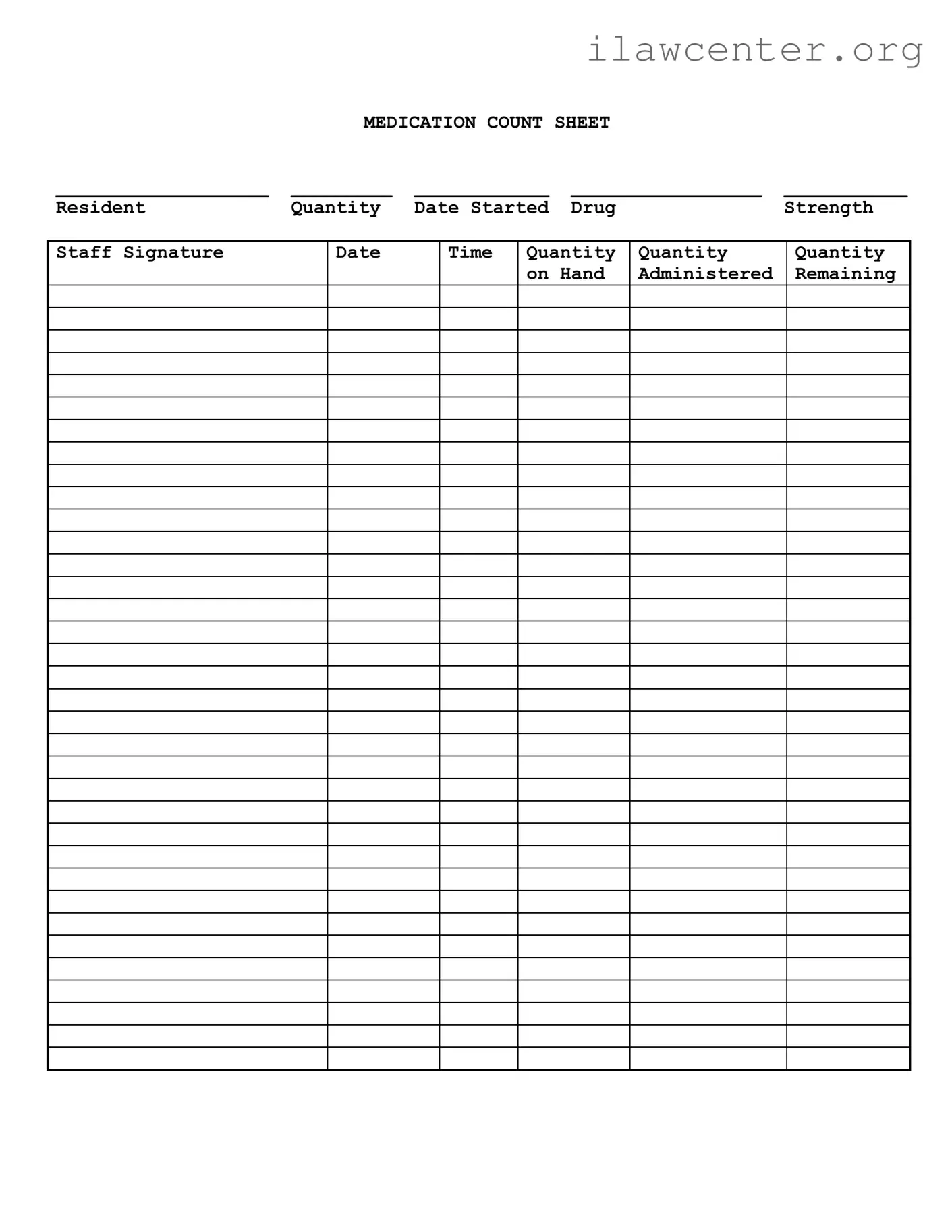
Medication Count Sheet Preview

MEDICATION COUNT SHEET
___________________
_________
____________
_________________
___________
Resident
Quantity
Date Started
Drug
Strength
Staff Signature
Date
Time
Quantity
Administered
Quantity
Remaining

File Properties

Fact Name Description
Purpose The Medication Count Sheet is used to track the administration and inventory of medications for residents in a healthcare facility.
Key Components The form includes fields for resident identification, drug details, quantity administered, and staff signatures, ensuring accountability.
State-Specific Law In California, the use of the Medication Count Sheet is governed by Title 22 of the California Code of Regulations, which mandates proper medication administration records.
Importance of Accuracy Accurate documentation on the Medication Count Sheet is crucial for patient safety and compliance with regulatory standards.

Instructions on Utilizing Medication Count Sheet

After obtaining the Medication Count Sheet form, you will be ready to document the necessary information related to medication administration and inventory. This process ensures accurate tracking of medication for each resident, which is crucial for maintaining safety and compliance within the facility.

  1. Begin by entering the resident's name in the designated space at the top of the form.
  2. Fill in the date that the medication was started in the appropriate section.
  3. Write down the name of the drug being administered in the "Drug" field.
  4. Indicate the strength of the medication in the "Strength" area.
  5. In the "Quantity" section, record the total amount of medication initially provided to the resident.
  6. As medications are administered, note the quantity given in the "Quantity Administered" column.
  7. After each administration, calculate the remaining amount of medication. Enter this number in the "Remaining" column.
  8. Sign the form in the "Staff Signature" section to confirm the administration of medication.
  9. Document the date and time of each administration in the corresponding fields.

Important Facts about Medication Count Sheet

What is the purpose of the Medication Count Sheet?

The Medication Count Sheet is designed to track the administration and inventory of medications for residents in a healthcare setting. It provides a systematic way to record the quantity of medication on hand, the amount administered, and the remaining quantity. This ensures that staff can monitor medication usage accurately, maintain compliance with regulations, and safeguard residents' health by preventing medication errors.

What information is required on the Medication Count Sheet?

Each Medication Count Sheet must include several key pieces of information. This includes the resident's name, the specific medication being administered, the quantity of medication available, the date the medication was started, and its strength. Additionally, staff members must sign and date the form, noting the time of administration and the quantities administered and remaining. This comprehensive documentation helps maintain an accurate record for each resident's medication regimen.

How should staff fill out the Medication Count Sheet?

Staff should fill out the Medication Count Sheet at the time of medication administration. Begin by entering the resident's name and the medication details. Record the quantity on hand before administration. After administering the medication, document the amount given and calculate the remaining quantity. Ensure that all entries are clear and legible. Finally, staff must sign the sheet, including the date and time of administration, to confirm accountability and accuracy.

What should be done if there is a discrepancy in the medication count?

If a discrepancy arises in the medication count, it is crucial to address it immediately. Staff should first double-check the records to confirm the error. If the discrepancy persists, notify a supervisor or the designated healthcare professional right away. An investigation should be initiated to determine the cause of the discrepancy, which may involve reviewing administration records and interviewing staff. Taking prompt action helps ensure the safety of residents and maintain the integrity of medication management practices.

Common mistakes

Filling out the Medication Count Sheet form accurately is crucial for maintaining proper medication management. However, individuals often make several common mistakes. One frequent error is failing to include the resident's name at the top of the form. Without this essential information, tracking medication becomes nearly impossible.

Another common mistake is neglecting to record the date started for each medication. This detail is important for understanding the timeline of treatment and for ensuring that the medication is still appropriate for the resident's condition.

People also often miscalculate the quantity administered. When staff members do not double-check their counts, discrepancies can arise. These errors can lead to serious issues, including overdoses or underdoses.

Additionally, the drug strength may be incorrectly noted. This can happen when staff members are in a hurry or are not familiar with the medication. Accurate documentation of the drug strength is vital for safe administration.

Staff signatures are another area where mistakes occur. Some individuals may forget to sign the form or may sign in the wrong place. Each signature serves as a confirmation of the actions taken, and missing signatures can lead to accountability issues.

Recording the time of administration is often overlooked as well. This information is essential for tracking when medications are given and for ensuring that dosages are spaced appropriately.

People sometimes fail to update the quantity on hand after administering medication. This oversight can create confusion about how much medication remains and can complicate future administrations.

Another mistake involves not properly documenting the remaining quantity after administration. This can lead to discrepancies in inventory and may result in medication shortages or mismanagement.

Lastly, staff may overlook the importance of reviewing the form for completeness before submitting it. A quick review can catch errors that might otherwise go unnoticed, ensuring that the Medication Count Sheet is accurate and reliable.

Documents used along the form

The Medication Count Sheet is an essential tool used in healthcare settings to track the administration and inventory of medications. Alongside this form, several other documents support medication management and ensure compliance with safety protocols. Here are five commonly used forms that complement the Medication Count Sheet:

  • Medication Administration Record (MAR): This document provides a detailed log of medications administered to a patient, including dosage, route, and time of administration. It serves as a critical reference for healthcare providers to monitor medication schedules and ensure proper adherence.
  • Prescription Order Form: This form is used by healthcare providers to prescribe medications to patients. It includes vital information such as the patient's details, medication name, dosage, and duration of treatment, ensuring clear communication between the prescriber and the pharmacy.
  • Incident Report: In the event of a medication error or adverse reaction, an incident report is filed. This document captures the details of the incident, including what occurred, when, and any immediate actions taken. It helps in analyzing errors and improving safety protocols.
  • Controlled Substance Log: This log tracks the use of controlled substances within a facility. It includes information about the quantity received, administered, and remaining, ensuring compliance with regulations surrounding the handling of these medications.
  • Patient Medication Profile: This profile contains comprehensive information about a patient's medication history, allergies, and current prescriptions. It is crucial for healthcare providers to have this information readily available to avoid potential drug interactions and ensure safe prescribing practices.

Using these documents in conjunction with the Medication Count Sheet enhances the overall medication management process. Each form plays a unique role in promoting patient safety, ensuring accurate record-keeping, and facilitating effective communication among healthcare professionals.

Similar forms

  • Medication Administration Record (MAR): Similar to the Medication Count Sheet, the MAR tracks the administration of medications to residents, including details like dosage, time, and staff signature.
  • Inventory Control Sheet: This document helps manage medication inventory levels, similar to the Medication Count Sheet, by recording quantities received, used, and remaining.
  • Controlled Substance Log: This log specifically tracks controlled substances, ensuring compliance with regulations, much like how the Medication Count Sheet monitors medication quantities.
  • Patient Medication Profile: This profile provides a comprehensive overview of a patient’s medications, akin to the Medication Count Sheet, which details specific quantities and administration times.
  • Medication Reconciliation Form: This form compares a patient’s current medications with those prescribed, serving a similar purpose to the Medication Count Sheet in ensuring accuracy in medication management.
  • Incident Report: While focused on documenting medication errors or adverse events, it shares the goal of maintaining safety and accountability, just like the Medication Count Sheet.
  • Prescription Order Form: This form records new medication orders, paralleling the Medication Count Sheet's function of tracking existing medication quantities and administration.

Dos and Don'ts

When filling out the Medication Count Sheet form, accuracy and attention to detail are crucial. Here are some important guidelines to follow:

  • Do ensure all fields are filled out completely, including the resident's name, drug strength, and quantities.
  • Do double-check the quantities administered and remaining to prevent discrepancies.
  • Do sign and date the form after each entry to maintain a clear record of responsibility.
  • Don't leave any fields blank, as this can lead to confusion and potential medication errors.
  • Don't use abbreviations or shorthand that could be misinterpreted by others reviewing the form.

Following these guidelines will help ensure the medication count process is smooth and compliant with necessary standards. Take the time to review your entries carefully.

Misconceptions

Understanding the Medication Count Sheet form is crucial for ensuring accurate medication management. However, several misconceptions can lead to confusion. Below is a list of common misunderstandings about this important document.

  • It is only for nursing staff to use. Many believe that only nurses handle the Medication Count Sheet, but all staff involved in medication administration should be familiar with it to ensure accuracy and accountability.
  • It is only necessary during medication administration. Some think the form is only needed at the time of giving medication. In reality, it should be updated regularly to reflect accurate counts and prevent discrepancies.
  • Any staff member can sign off on the form. There is a misconception that any employee can sign the Medication Count Sheet. In fact, only authorized personnel should be responsible for documenting and signing the form.
  • It is not important to track remaining quantities. Some may underestimate the significance of tracking remaining medication quantities. Accurate counts are essential for preventing medication errors and ensuring patient safety.
  • One mistake can be easily corrected later. It is often thought that errors on the form can be fixed without consequence. However, even minor mistakes can lead to serious issues, so it is vital to be diligent when filling out the sheet.
  • Only prescription medications need to be documented. There is a belief that only prescription drugs require tracking. However, all medications, including over-the-counter ones, should be recorded to maintain a complete medication history.
  • The form is not necessary if medications are administered electronically. Some assume that electronic systems eliminate the need for a physical Medication Count Sheet. In truth, the form serves as an important backup and should be maintained alongside electronic records.
  • Once the medication is administered, the form can be discarded. Many think that the form is no longer needed after administration. However, it should be retained for record-keeping and auditing purposes.
  • It is acceptable to leave blank spaces on the form. Some believe that it is fine to leave sections blank. In reality, every part of the Medication Count Sheet should be completed to ensure clarity and prevent misunderstandings.

By addressing these misconceptions, all staff members can contribute to a safer and more effective medication management process. Understanding the importance of the Medication Count Sheet is essential for providing quality care to residents.

Key takeaways

When filling out and using the Medication Count Sheet form, keep these key points in mind:

  • Accuracy is crucial: Always double-check the information you enter, including drug names and quantities.
  • Document everything: Ensure that each entry is clearly written, including staff signatures and dates.
  • Track changes: If medication quantities change, note the reasons for these adjustments to maintain a clear record.
  • Use consistent terminology: Stick to the names and terms used on the medication packaging to avoid confusion.
  • Regular audits: Schedule routine checks of the Medication Count Sheet to ensure accuracy and compliance.
  • Stay organized: Keep the form in a designated area that is easily accessible to all staff involved in medication administration.
  • Report discrepancies: Immediately address any inconsistencies or errors in the count to prevent potential issues.
  • Train staff: Ensure that all staff members understand how to properly fill out and use the Medication Count Sheet.