Attorney-Verified  Articles of Incorporation Document for Michigan

Attorney-Verified Articles of Incorporation Document for Michigan

The Michigan Articles of Incorporation form is a legal document required to establish a corporation in the state of Michigan. This form outlines key details about the corporation, including its name, purpose, and structure. To ensure your business is properly registered, fill out the form by clicking the button below.

Article Guide

When starting a business in Michigan, one of the first steps you'll need to take is to file the Articles of Incorporation. This essential document serves as the foundation for your corporation, outlining key information about your business structure and purpose. The form requires you to provide details such as the name of your corporation, which must be unique and not easily confused with existing entities. You'll also need to specify the duration of your corporation, whether it's perpetual or for a defined period. Additionally, the Articles of Incorporation will ask for the address of your corporation's registered office and the name of the registered agent who will receive legal documents on behalf of the corporation. Another important aspect is the purpose clause, where you describe the nature of your business activities. Finally, the form may include provisions for the number of shares your corporation is authorized to issue, which is crucial for establishing ownership and investment opportunities. By understanding these components, you can ensure that your Articles of Incorporation are correctly completed and submitted, paving the way for a successful business launch in Michigan.

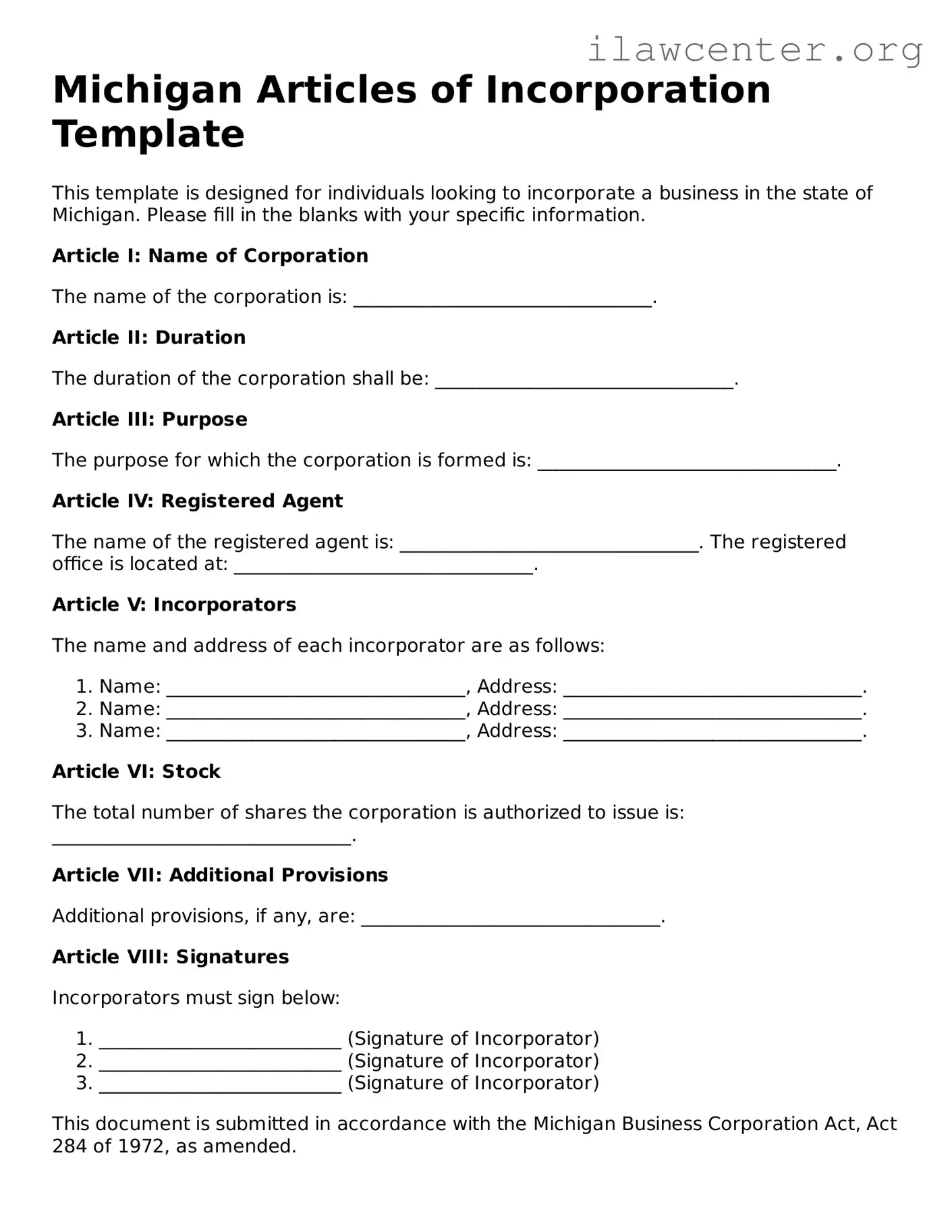
Michigan Articles of Incorporation Preview

Michigan Articles of Incorporation Template

This template is designed for individuals looking to incorporate a business in the state of Michigan. Please fill in the blanks with your specific information.

Article I: Name of Corporation

The name of the corporation is: ________________________________.

Article II: Duration

The duration of the corporation shall be: ________________________________.

Article III: Purpose

The purpose for which the corporation is formed is: ________________________________.

Article IV: Registered Agent

The name of the registered agent is: ________________________________. The registered office is located at: ________________________________.

Article V: Incorporators

The name and address of each incorporator are as follows:

  1. Name: ________________________________, Address: ________________________________.
  2. Name: ________________________________, Address: ________________________________.
  3. Name: ________________________________, Address: ________________________________.

Article VI: Stock

The total number of shares the corporation is authorized to issue is: ________________________________.

Article VII: Additional Provisions

Additional provisions, if any, are: ________________________________.

Article VIII: Signatures

Incorporators must sign below:

  1. __________________________ (Signature of Incorporator)
  2. __________________________ (Signature of Incorporator)
  3. __________________________ (Signature of Incorporator)

This document is submitted in accordance with the Michigan Business Corporation Act, Act 284 of 1972, as amended.

Please ensure that all information is accurate and complete before filing with the appropriate state authorities.

PDF Form Characteristics

Fact Name Details
Governing Law The Michigan Articles of Incorporation are governed by the Michigan Business Corporation Act.
Purpose The form is used to officially create a corporation in the state of Michigan.
Filing Requirement Filing the Articles of Incorporation with the Michigan Department of Licensing and Regulatory Affairs is mandatory.
Information Needed The form requires basic information, such as the corporation's name, purpose, and the address of the registered office.
Registered Agent A registered agent must be designated to receive legal documents on behalf of the corporation.
Incorporators The names and addresses of the incorporators must be included in the Articles of Incorporation.
Duration Corporations can be established with a perpetual duration unless specified otherwise in the form.
Fees A filing fee is required to submit the Articles of Incorporation, and the amount may vary.
Amendments Changes to the Articles of Incorporation can be made by filing an amendment form with the state.

Instructions on Utilizing Michigan Articles of Incorporation

After completing the Michigan Articles of Incorporation form, you will need to submit it to the appropriate state agency. Ensure that all required fees are paid and consider any additional documentation that may be necessary for your specific situation.

  1. Obtain the Michigan Articles of Incorporation form from the Michigan Department of Licensing and Regulatory Affairs (LARA) website or your local office.
  2. Fill in the name of your corporation. Ensure it is unique and complies with Michigan naming requirements.
  3. Provide the purpose of your corporation. Be clear and concise about what your business will do.
  4. List the registered office address. This must be a physical address in Michigan where legal documents can be sent.
  5. Include the name and address of the registered agent. This person or entity will receive legal documents on behalf of the corporation.
  6. Indicate the number of shares your corporation is authorized to issue. Specify the par value of those shares, if applicable.
  7. Provide the names and addresses of the incorporators. These individuals are responsible for filing the Articles of Incorporation.
  8. Sign and date the form. Ensure that all incorporators have signed where required.
  9. Review the completed form for accuracy and completeness.
  10. Submit the form along with the required filing fee to the Michigan Department of Licensing and Regulatory Affairs.

Important Facts about Michigan Articles of Incorporation

What are the Articles of Incorporation in Michigan?

The Articles of Incorporation is a legal document that establishes a corporation in Michigan. It outlines essential details about the corporation, such as its name, purpose, and the address of its registered office. This document is filed with the Michigan Department of Licensing and Regulatory Affairs (LARA) to formally create the corporation as a legal entity.

Who needs to file Articles of Incorporation?

Anyone looking to start a corporation in Michigan must file Articles of Incorporation. This includes individuals or groups who want to create a business that will operate as a corporation. It’s an important step for those wanting to limit personal liability and enjoy the benefits of corporate status.

What information is required in the Articles of Incorporation?

The Articles of Incorporation typically require several key pieces of information. You’ll need to provide the corporation's name, its purpose, the number of shares the corporation is authorized to issue, the address of the registered office, and the names and addresses of the incorporators. This information helps define the corporation's structure and operational framework.

How much does it cost to file Articles of Incorporation in Michigan?

The filing fee for the Articles of Incorporation in Michigan can vary. As of the latest information, the fee is generally around $50, but it’s always best to check the Michigan Department of Licensing and Regulatory Affairs website for the most current fee schedule. Additional costs may apply if you choose expedited processing or other services.

How long does it take to process the Articles of Incorporation?

Processing times can vary based on the volume of applications received. Typically, you can expect the processing to take anywhere from a few days to a few weeks. If you need your documents processed quickly, consider requesting expedited service, which is available for an additional fee.

Can I file Articles of Incorporation online?

Yes, Michigan allows for online filing of the Articles of Incorporation. This can be a convenient option, as it saves time and simplifies the process. You can complete the necessary forms and submit them through the Michigan Department of Licensing and Regulatory Affairs website.

What happens after I file the Articles of Incorporation?

Once your Articles of Incorporation are filed and approved, your corporation is officially formed. You will receive a certificate of incorporation, which serves as proof of your corporation's existence. After that, you should focus on setting up your business operations, including obtaining any necessary licenses and permits.

Do I need a lawyer to file Articles of Incorporation?

While it’s not required to have a lawyer to file Articles of Incorporation, many people find it helpful to consult one, especially if they have questions about the process or specific requirements. If you feel confident navigating the forms and understand the implications of incorporating, you can certainly handle it on your own.

What is the difference between Articles of Incorporation and Bylaws?

The Articles of Incorporation and Bylaws serve different purposes. The Articles of Incorporation establish the corporation's existence and outline basic information about it. In contrast, Bylaws are internal rules that govern how the corporation will operate, including details about meetings, voting procedures, and the roles of officers. Both documents are essential for a well-functioning corporation.
Common mistakes

Filling out the Michigan Articles of Incorporation form can be a straightforward process, but many individuals make common mistakes that can delay or complicate their business formation. One frequent error is failing to choose an appropriate name for the corporation. The name must be unique and not already in use by another entity in Michigan. Many applicants overlook this requirement, leading to unnecessary rejections and the need to start over.

Another common mistake involves the designation of the registered agent. The registered agent must be a person or business entity authorized to conduct business in Michigan. Some individuals mistakenly list an unqualified person or fail to provide a complete address. This can create issues with receiving important legal documents and notifications.

Additionally, people often neglect to specify the purpose of the corporation clearly. While the form allows for a general purpose, being vague can lead to complications later on. A well-defined purpose helps clarify the corporation's activities and can be beneficial for compliance with state regulations.

Moreover, many applicants do not pay attention to the number of shares they intend to issue. It's crucial to indicate both the number of shares and their par value, if applicable. Omitting this information can lead to delays, as the state requires this data for proper classification of the corporation.

Another frequent oversight is the failure to include the names and addresses of the initial directors. This section is vital, as it provides transparency about who is responsible for managing the corporation. Incomplete or incorrect information can result in administrative headaches down the line.

People also sometimes forget to sign the form. A signature is not just a formality; it confirms that the information provided is accurate and that the individual is authorized to submit the application. Without a signature, the state will not process the form.

Additionally, applicants may neglect to include the correct filing fee. Each corporation type may have different fees associated with its formation. Ensuring the correct payment is included is essential to avoid delays or rejections due to insufficient funds.

Finally, many individuals fail to double-check their work before submission. Errors in spelling, incorrect information, or missing sections can lead to significant delays. Taking the time to review the form thoroughly can save applicants from unnecessary complications and ensure a smoother incorporation process.

Documents used along the form

When you're starting a business in Michigan, filing your Articles of Incorporation is just the beginning. There are several other important documents and forms that you may need to complete to ensure your business is set up properly. Here’s a quick overview of some of these essential documents.

  • Bylaws: This document outlines the rules and procedures for running your corporation. It covers everything from how meetings are conducted to the responsibilities of directors and officers.
  • Initial Report: Some states require an initial report to be filed shortly after incorporation. This document provides basic information about your corporation, including its address and the names of its officers.
  • Employer Identification Number (EIN): Obtaining an EIN from the IRS is crucial for tax purposes. This unique number identifies your business and is necessary for hiring employees and opening a business bank account.
  • Operating Agreement: While more common in LLCs, an operating agreement can also be beneficial for corporations. It details the management structure and operational procedures, helping to prevent disputes among owners.
  • Business Licenses and Permits: Depending on your industry and location, you may need various licenses or permits to legally operate. Research local and state requirements to ensure compliance.
  • Shareholder Agreement: If your corporation has multiple shareholders, this document is vital. It outlines the rights and responsibilities of shareholders and the procedures for buying or selling shares.

Understanding these documents will help you navigate the complexities of starting your business in Michigan. Each plays a vital role in ensuring your corporation operates smoothly and in compliance with the law. Take the time to familiarize yourself with them, and you'll be well on your way to a successful venture.

Similar forms

  • Bylaws: Bylaws outline the internal rules and procedures for the management of a corporation. Like the Articles of Incorporation, they establish how the organization will operate but focus more on governance rather than creation.
  • Operating Agreement: This document is similar to the Articles of Incorporation but is specifically for Limited Liability Companies (LLCs). It details the management structure and operating procedures of the LLC, just as the Articles define the structure of a corporation.
  • Certificate of Formation: Often used interchangeably with Articles of Incorporation, this document is required to legally create a corporation in some states. It serves the same purpose by providing essential details about the company.
  • Partnership Agreement: This document outlines the terms of a partnership, similar to how Articles of Incorporation outline the structure of a corporation. It defines roles, responsibilities, and profit-sharing among partners.
  • Business License: A business license grants permission to operate legally within a specific jurisdiction. While the Articles of Incorporation establish a corporation's existence, a business license allows it to function within the community.
  • Employer Identification Number (EIN): An EIN is required for tax purposes and is similar to the Articles of Incorporation in that it is essential for the legal operation of a business. It identifies the business to the IRS.
  • Shareholder Agreement: This document governs the relationship between shareholders in a corporation. It complements the Articles of Incorporation by detailing rights and responsibilities, similar to how the Articles outline the basic structure.
  • Annual Report: Corporations are often required to file annual reports to maintain good standing. This document updates the state on the corporation's status, similar to how the Articles of Incorporation provide foundational information at the outset.
  • Franchise Agreement: For businesses operating under a franchise model, this agreement outlines the terms between the franchisor and franchisee. It serves a similar purpose to the Articles of Incorporation by establishing a legal framework for business operations.
  • Nonprofit Articles of Incorporation: Similar to standard Articles of Incorporation, this document is specifically designed for nonprofit organizations. It outlines the purpose and structure of the nonprofit, ensuring compliance with state laws.

Dos and Don'ts

When filling out the Michigan Articles of Incorporation form, it’s important to approach the task with care. Here’s a list of ten essential dos and don’ts to ensure a smooth process.

  • Do ensure that you have a unique name for your corporation that complies with Michigan naming requirements.
  • Do provide a clear and concise purpose for your corporation.
  • Do include the registered agent's name and address accurately.
  • Do specify the number of shares your corporation is authorized to issue.
  • Do review the form thoroughly for any errors before submission.
  • Don't use a name that is too similar to an existing corporation in Michigan.
  • Don't forget to include the incorporator's signature and date.
  • Don't leave any required fields blank; this can delay the processing of your application.
  • Don't overlook the filing fee; ensure payment is included with your submission.
  • Don't rush through the process; take your time to ensure accuracy.

Following these guidelines can help streamline the incorporation process in Michigan. Being thorough and attentive to detail will set a solid foundation for your new business venture.

Misconceptions

Understanding the Michigan Articles of Incorporation form is crucial for anyone looking to start a business in the state. However, several misconceptions can lead to confusion. Here are eight common misconceptions about this important document:

  1. All businesses must file Articles of Incorporation. Many people believe that every type of business, including sole proprietorships and partnerships, must file Articles of Incorporation. In reality, only corporations are required to do so.
  2. Filing Articles of Incorporation guarantees business success. Some assume that simply filing this form will ensure their business thrives. While it's an important step, success depends on various factors, including market demand, management, and operational execution.
  3. Once filed, Articles of Incorporation cannot be changed. Many think that the information in the Articles is set in stone. However, amendments can be made if necessary, allowing businesses to adapt as they grow.
  4. The Articles of Incorporation are the same as a business license. This is a common misunderstanding. The Articles establish the corporation's existence, while a business license is a separate requirement that permits the business to operate legally.
  5. You can file Articles of Incorporation at any time. Some believe there are no time constraints for filing. However, filing should occur before conducting business activities to ensure legal protections and compliance.
  6. All information in the Articles is confidential. Many assume that the details provided are private. In fact, Articles of Incorporation are public documents, and anyone can access them.
  7. Only lawyers can file Articles of Incorporation. While legal assistance can be beneficial, it is not mandatory. Many business owners successfully complete the form themselves, provided they understand the requirements.
  8. Filing fees are the same for all types of corporations. There is a misconception that all corporations pay the same fee. In reality, fees can vary based on the type of corporation and specific circumstances.

By clarifying these misconceptions, individuals can better navigate the process of incorporating their businesses in Michigan, ensuring they take the necessary steps toward success.

Key takeaways

When filling out and using the Michigan Articles of Incorporation form, several important considerations come into play. Below are key takeaways to keep in mind:

  1. Eligibility: Ensure that the business entity meets the eligibility requirements for incorporation in Michigan.
  2. Filing Purpose: Clearly state the purpose of the corporation. This helps define the business's scope.
  3. Name Requirements: The corporation's name must be unique and not similar to existing entities. Include "Corporation," "Incorporated," or "Limited" in the name.
  4. Registered Agent: Designate a registered agent who will receive legal documents on behalf of the corporation. This agent must have a physical address in Michigan.
  5. Incorporator Information: Provide the names and addresses of the incorporators. These individuals are responsible for filing the Articles of Incorporation.
  6. Stock Information: If the corporation will issue stock, specify the total number of shares and their par value.
  7. Duration: Indicate whether the corporation is established for a specific duration or perpetually.
  8. Filing Fees: Be aware of the filing fees associated with submitting the Articles of Incorporation. Fees may vary based on the type of corporation.
  9. Submission Method: The form can be submitted online, by mail, or in person. Choose the method that best suits your needs.
  10. Review and Confirmation: After submission, review the confirmation to ensure that the Articles of Incorporation have been processed correctly.

These takeaways provide a solid foundation for successfully completing and utilizing the Michigan Articles of Incorporation form.