Attorney-Verified  Cease and Desist Letter Document for Michigan

Attorney-Verified Cease and Desist Letter Document for Michigan

A Cease and Desist Letter is a formal request demanding that an individual or organization stop engaging in a specific activity that is deemed harmful or unlawful. In Michigan, this letter serves as a critical tool for protecting one’s rights and interests, often acting as a precursor to legal action. Understanding how to properly fill out this form can empower you to take control of a challenging situation.

Ready to take the next step? Fill out the form by clicking the button below.

Article Guide

In the realm of legal communications, the Michigan Cease and Desist Letter form serves as a vital tool for individuals and businesses seeking to address unwanted actions or behaviors. This form is designed to formally notify the recipient of their alleged misconduct, whether it involves copyright infringement, harassment, or other unlawful activities. By utilizing this letter, the sender can assert their rights and request that the recipient cease the offending behavior immediately. The structure of the form typically includes essential components such as the sender's contact information, a clear statement of the grievance, and a demand for action. Additionally, it often outlines the potential consequences if the recipient fails to comply. Crafting an effective Cease and Desist Letter is crucial, as it not only communicates the seriousness of the situation but also establishes a record of the sender's intent to resolve the matter amicably before pursuing further legal action. Understanding the nuances of this form can empower individuals and businesses to protect their interests and navigate disputes more effectively.

Michigan Cease and Desist Letter Preview

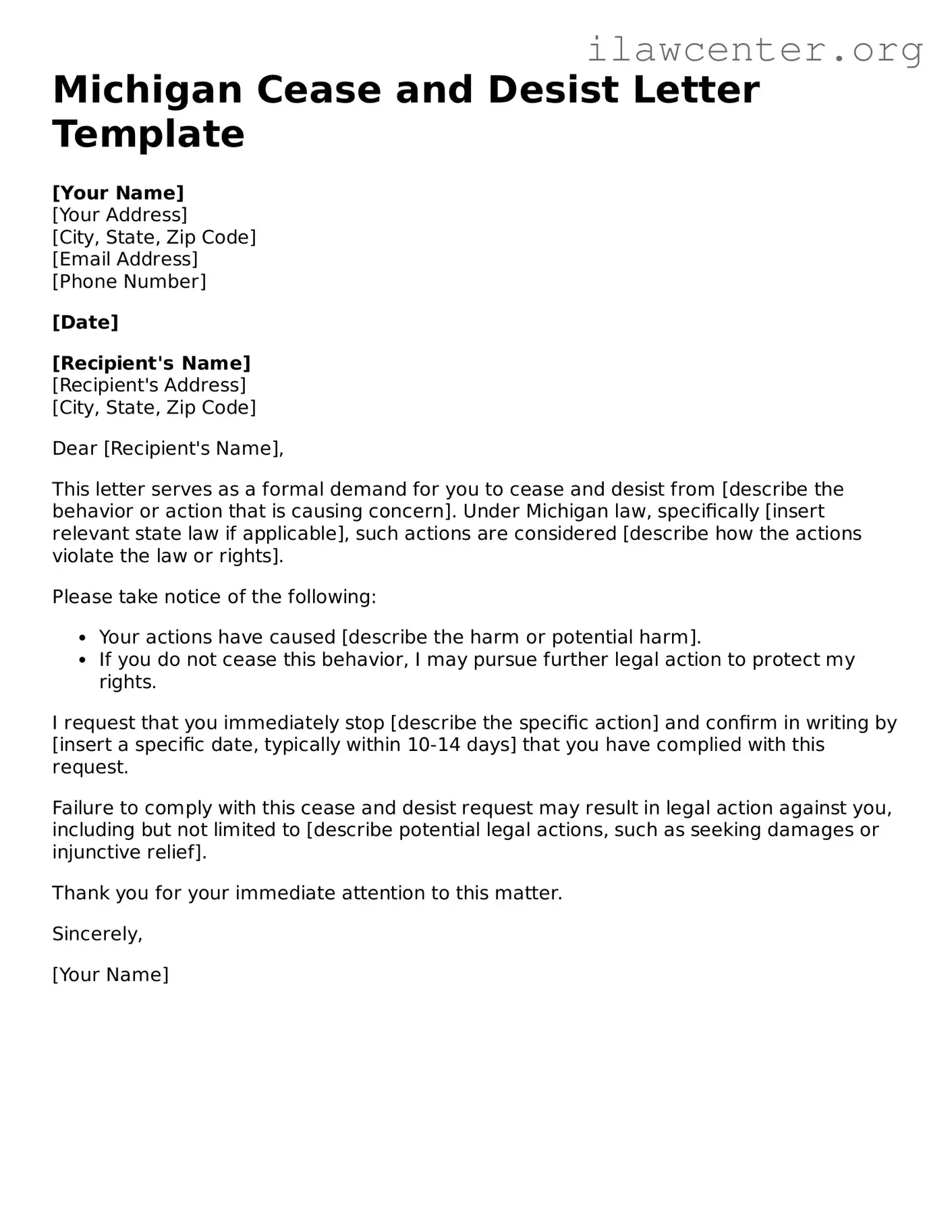
Michigan Cease and Desist Letter Template

[Your Name]
[Your Address]
[City, State, Zip Code]
[Email Address]
[Phone Number]

[Date]

[Recipient's Name]
[Recipient's Address]
[City, State, Zip Code]

Dear [Recipient's Name],

This letter serves as a formal demand for you to cease and desist from [describe the behavior or action that is causing concern]. Under Michigan law, specifically [insert relevant state law if applicable], such actions are considered [describe how the actions violate the law or rights].

Please take notice of the following:

  • Your actions have caused [describe the harm or potential harm].
  • If you do not cease this behavior, I may pursue further legal action to protect my rights.

I request that you immediately stop [describe the specific action] and confirm in writing by [insert a specific date, typically within 10-14 days] that you have complied with this request.

Failure to comply with this cease and desist request may result in legal action against you, including but not limited to [describe potential legal actions, such as seeking damages or injunctive relief].

Thank you for your immediate attention to this matter.

Sincerely,

[Your Name]

PDF Form Characteristics

Fact Name Details
Purpose A Cease and Desist Letter is used to formally request that an individual or entity stop a specified action.
Governing Law Michigan law governs the use and enforcement of Cease and Desist Letters.
Format The letter should be clear and concise, outlining the specific behavior to be stopped.
Recipient The letter can be addressed to individuals, businesses, or organizations involved in the unwanted action.
Delivery Method It is recommended to send the letter via certified mail to ensure delivery and provide proof.
Legal Standing While a Cease and Desist Letter is not a legally binding document, it serves as a formal warning.
Follow-Up Actions If the recipient does not comply, further legal action may be pursued, including filing a lawsuit.

Instructions on Utilizing Michigan Cease and Desist Letter

After completing the Michigan Cease and Desist Letter form, you will need to send it to the appropriate party. Ensure that you keep a copy for your records. You may also want to consider sending it via certified mail to confirm receipt.

  1. Begin by obtaining the Michigan Cease and Desist Letter form from a reliable source.
  2. Fill in your name and address at the top of the form. This should be your contact information.
  3. Next, enter the date on which you are completing the form.
  4. Provide the name and address of the person or entity you are sending the letter to.
  5. Clearly state the reason for the cease and desist request in the designated section. Be specific about the actions you want them to stop.
  6. If applicable, include any relevant details or evidence that supports your request.
  7. Sign the form at the bottom, ensuring that you date your signature.
  8. Make a copy of the completed form for your records before sending it.

Important Facts about Michigan Cease and Desist Letter

What is a Michigan Cease and Desist Letter?

A Michigan Cease and Desist Letter is a formal document used to request that an individual or organization stop a specific action that is believed to be unlawful or harmful. This letter serves as a warning, outlining the behavior that needs to be discontinued and may include a request for a response by a certain date. It can be an important step in resolving disputes without resorting to legal action.

Who can use a Cease and Desist Letter in Michigan?

Any individual or business in Michigan can use a Cease and Desist Letter. It is often utilized by those who feel their rights are being violated, such as in cases of harassment, copyright infringement, or defamation. The letter can be sent by the affected party directly or through an attorney, depending on the situation and the desired level of formality.

What should be included in a Cease and Desist Letter?

A Cease and Desist Letter should clearly identify the sender and recipient, specify the behavior that is being challenged, and provide a detailed explanation of why that behavior is problematic. It's also helpful to include any relevant laws or regulations that support your claim. Additionally, the letter should state what actions you want the recipient to take, such as stopping the behavior or providing a written response.

What happens if the recipient ignores the Cease and Desist Letter?

If the recipient ignores the Cease and Desist Letter, the sender may choose to take further action. This could involve seeking legal advice or pursuing a lawsuit, depending on the circumstances. Ignoring the letter does not eliminate the recipient's potential legal liability. It’s important to document all communications and actions taken, as this information may be useful if the matter escalates.

Common mistakes

When filling out the Michigan Cease and Desist Letter form, individuals often make several common mistakes that can hinder the effectiveness of their request. One frequent error is failing to clearly identify the recipient. It is crucial to include the full name and address of the person or entity you are addressing. Without this information, the letter may not reach the intended party, rendering it ineffective.

Another mistake is not providing a detailed description of the behavior or action that is being contested. Simply stating that someone is engaging in undesirable behavior is not enough. The letter should include specific examples and context. This clarity helps the recipient understand the issue and the urgency of the request.

People often overlook the importance of including a deadline for compliance. A vague or missing timeline can lead to confusion. By specifying a clear date by which the recipient must cease the activity, you create a sense of urgency and a clear expectation for action.

Additionally, some individuals forget to sign the letter. A signature adds a personal touch and lends credibility to the document. Without a signature, the recipient may question the legitimacy of the request. This small detail can make a significant difference in how the letter is perceived.

Another common oversight is neglecting to keep a copy of the letter for personal records. Documenting your correspondence is essential. This record can serve as evidence if further action is needed later. It’s wise to retain a copy, along with any proof of delivery.

Lastly, many people fail to consider the tone of the letter. While it is important to be firm, it is equally vital to remain professional. An overly aggressive tone can escalate the situation rather than resolve it. Striking the right balance can lead to a more favorable outcome.

Documents used along the form

A Michigan Cease and Desist Letter is a formal request to stop certain actions that may be harmful or illegal. It is often used in various legal contexts, and several other documents can complement its effectiveness. Below is a list of related forms and documents that may be utilized alongside a Cease and Desist Letter.

  • Demand Letter: This document outlines a specific request for action, such as payment or compliance, and serves as a formal notification of a claim or grievance.
  • Notice of Violation: This is used to formally inform an individual or entity that they are in violation of a law or agreement, providing details about the infraction.
  • Settlement Agreement: A legally binding document that outlines the terms agreed upon by parties to resolve a dispute, often following a cease and desist request.
  • Affidavit: A written statement confirmed by oath or affirmation, often used to provide evidence in legal matters related to the claims made in the cease and desist letter.
  • Response Letter: This document is prepared by the recipient of the cease and desist letter, addressing the allegations and providing their perspective on the matter.
  • Legal Complaint: If the matter escalates, a legal complaint may be filed in court, detailing the grievances and seeking judicial intervention.

Utilizing these documents in conjunction with a Michigan Cease and Desist Letter can enhance the clarity and effectiveness of your communication. Each form serves a specific purpose and can help in resolving disputes more efficiently.

Similar forms

  • Demand Letter: A demand letter requests a specific action or remedy from another party. Like a cease and desist letter, it aims to resolve a dispute without resorting to litigation.
  • Settlement Agreement: This document outlines the terms agreed upon by parties to resolve a dispute. It often includes a cease and desist clause to prevent further issues.
  • Notice of Violation: This document notifies a party of their non-compliance with a rule or law. Similar to a cease and desist letter, it serves to inform and prompt corrective action.
  • Formal Complaint: A formal complaint is filed with a court or agency to initiate legal proceedings. It may include requests for the other party to cease specific actions, akin to a cease and desist letter.
  • Injunction: An injunction is a court order that requires a party to stop a specific action. This legal remedy is similar in purpose to a cease and desist letter, which seeks voluntary compliance.
  • Affidavit: An affidavit is a sworn statement used to support a claim or assertion. While it serves a different function, it can accompany a cease and desist letter to provide evidence of the issue at hand.

Dos and Don'ts

When filling out the Michigan Cease and Desist Letter form, it is essential to follow specific guidelines to ensure your submission is effective. Here are four things you should and shouldn't do:

  • Do: Clearly state the reason for the cease and desist request.
  • Do: Provide accurate contact information for yourself and the recipient.
  • Don't: Use vague language or generalizations in your letter.
  • Don't: Forget to keep a copy of the letter for your records.

Misconceptions

Misconceptions about the Michigan Cease and Desist Letter form can lead to misunderstandings about its purpose and effectiveness. Below is a list of ten common misconceptions, along with explanations to clarify each point.

  1. A cease and desist letter is a legally binding document.

    This is not true. A cease and desist letter is generally considered a formal request to stop certain activities. It does not have the force of law unless it is followed by legal action.

  2. Sending a cease and desist letter guarantees compliance.

    While it serves as a warning, there is no guarantee that the recipient will comply. Compliance depends on various factors, including the recipient's willingness to negotiate or contest the claims.

  3. Only lawyers can draft a cease and desist letter.

    Although legal expertise can enhance the letter's effectiveness, individuals can draft their own letters. However, consulting a lawyer may provide valuable insights.

  4. A cease and desist letter is only for copyright infringement.

    This misconception overlooks the letter's broader applications. It can address issues such as defamation, trademark infringement, and harassment, among others.

  5. Once a cease and desist letter is sent, legal action is inevitable.

    Sending the letter does not automatically lead to a lawsuit. It may serve as a first step in resolving a dispute without further escalation.

  6. Cease and desist letters are only effective in Michigan.

    While this form is specific to Michigan, similar letters can be used in other states. The principles underlying cease and desist letters are generally applicable nationwide.

  7. All cease and desist letters must be formal and lengthy.

    While some letters are detailed, brevity can also be effective. A clear and concise letter can convey the necessary message without unnecessary complexity.

  8. Receiving a cease and desist letter means you are guilty of wrongdoing.

    Receiving such a letter does not imply guilt. It merely indicates that someone believes you are engaging in conduct that violates their rights.

  9. Cease and desist letters are only for individuals.

    Businesses can also receive and send cease and desist letters. In fact, they are commonly used in commercial disputes.

  10. Once a cease and desist letter is ignored, the sender has no further options.

    Ignoring the letter does not close the door on further action. The sender may still pursue legal remedies, including filing a lawsuit if necessary.

Key takeaways

When it comes to filling out and using the Michigan Cease and Desist Letter form, there are several important points to consider. Understanding these can help ensure that your letter is effective and legally sound.

  • Clarity is Key: Clearly state the behavior or action you want to stop. Vague language can lead to misunderstandings.
  • Identify the Parties: Include the full names and addresses of both the sender and the recipient. This helps establish who is involved in the matter.
  • Provide Evidence: If possible, include specific examples or evidence of the behavior you are addressing. This strengthens your position.
  • Specify Consequences: Clearly outline what will happen if the recipient does not comply with your request. This could include legal action.
  • Keep It Professional: Maintain a respectful tone throughout the letter. Avoid aggressive language that could escalate the situation.
  • Consult Legal Advice: If you're unsure about the content or implications of the letter, consider seeking legal advice to ensure your rights are protected.