



Michigan Complaint Divorce PDF Template

Michigan Complaint Divorce PDF Template

The Michigan Complaint Divorce form is a legal document filed by one spouse to initiate the divorce process in Michigan. This form outlines the details of the marriage, including residency requirements, separation dates, and any children involved. Completing this form accurately is crucial for ensuring a smooth divorce process, so consider filling it out by clicking the button below.

Article Guide

The Michigan Complaint Divorce form serves as a crucial document for individuals seeking to dissolve their marriage within the state. It is essential for both parties to provide detailed information, including their names, addresses, and contact numbers, as well as those of their respective attorneys. This form requires confirmation that no other legal actions are pending that could affect the divorce proceedings. Both spouses must have been residents of Michigan for a minimum of 180 days and of the county in which they are filing for at least 10 days. The form also captures vital statistics about the couple, such as their marriage details and any minor children involved. Specific sections address child custody and support arrangements, ensuring that the welfare of children is prioritized. Additionally, the form outlines the couple's property and debt situation, indicating whether a Property Settlement Agreement will be necessary. Ultimately, the form concludes with a request for the court to dissolve the marriage and approve any agreements made regarding property and custody, thereby paving the way for a legal resolution to the marriage. Understanding the components of this form is vital for anyone navigating the divorce process in Michigan.

Michigan Complaint Divorce Preview

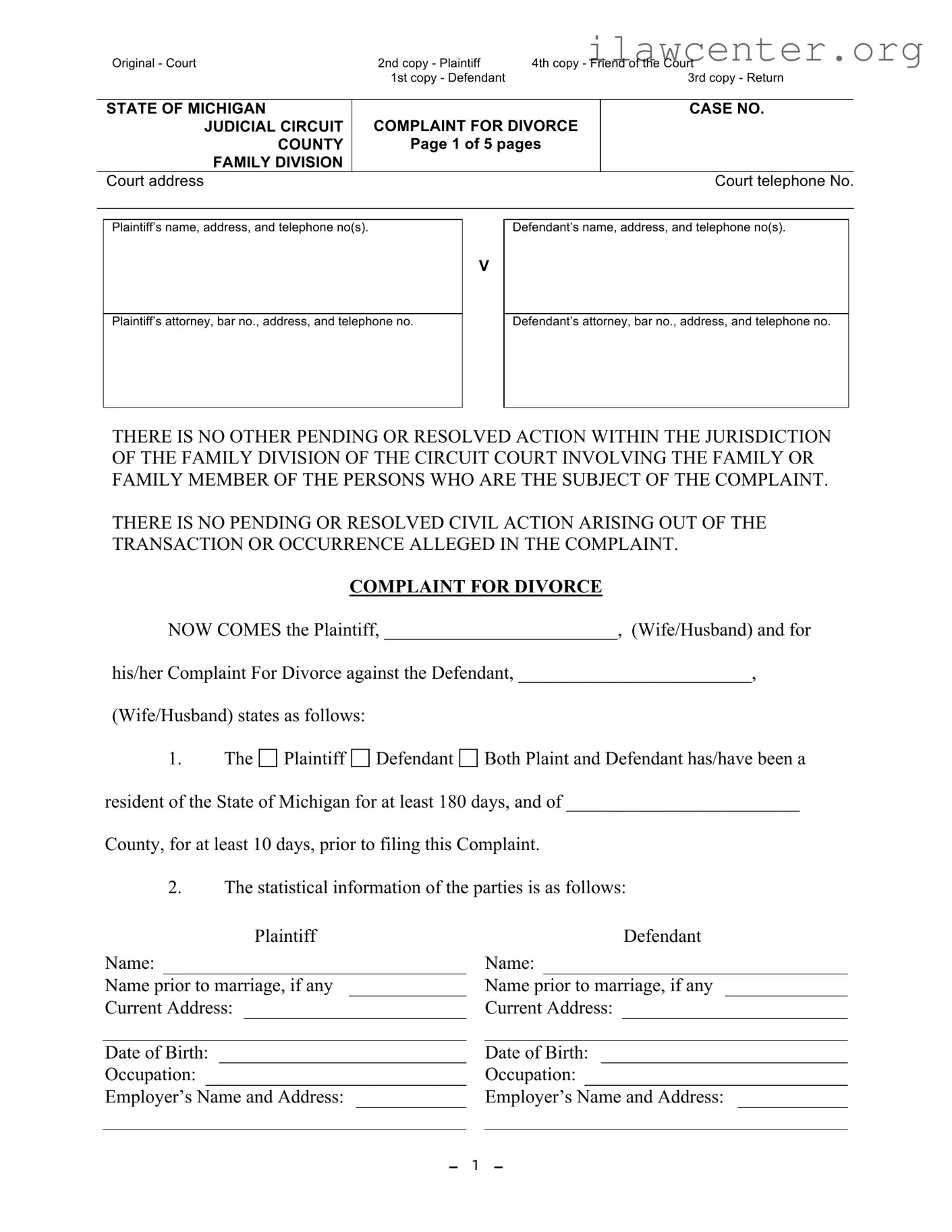
Original - Court 2nd copy - Plaintiff 4th copy - Friend of the Court
1st copy - Defendant 3rd copy - Return
-
1
-
STATE OF MICHIGAN CASE NO.
JUDICIAL CIRCUIT
COUNTY
FAMILY DIVISION
COMPLAINT FOR DIVORCE
Page 1 of 5 pages
Court address
Court telephone no.
Court telephone No.
Plaintiff’s name, address, and telephone no(s).
V
Defendant’s name, address, and telephone no(s).
Plaintiff’s attorney, bar no., address, and telephone no.
Defendant’s attorney, bar no., address, and telephone no.
THERE IS NO OTHER PENDING OR RESOLVED ACTION WITHIN THE JURISDICTION
OF THE FAMILY DIVISION OF THE CIRCUIT COURT INVOLVING THE FAMILY OR
FAMILY MEMBER OF THE PERSONS WHO ARE THE SUBJECT OF THE COMPLAINT.
THERE IS NO PENDING OR RESOLVED CIVIL ACTION ARISING OUT OF THE
TRANSACTION OR OCCURRENCE ALLEGED IN THE COMPLAINT.
COMPLAINT FOR DIVORCE
NOW COMES the Plaintiff, _________________________, (Wife/Husband) and for
his/her Complaint For Divorce against the Defendant, _________________________,
(Wife/Husband) states as follows:
1. The Plaintiff Defendant Both Plaint and Defendant has/have been a
resident of the State of Michigan for at least 180 days, and of _________________________
County, for at least 10 days, prior to filing this Complaint.
2. The statistical information of the parties is as follows:
Plaintiff Defendant
Name:
Name:
Name prior to marriage, if any
Current Address:
Current Address:
Date of Birth:
Date of Birth:
Occupation:
Occupation:
Employer’s Name and Address:
- 2 -
STATE OF MICHIGAN
CASE NO.
JUDICIAL CIRCUIT
COUNTY
FAMILY DIVISION
COMPLAINT FOR DIVORCE
Page 2 of 5 pages
Court address
Court telephone no.
Court telephone no.
Plaintiff
V
Defendant
3. On the ______ day of __________, the Plaintiff, _________________________,
was legally married to the Defendant, _________________________, in the County of
_______________. The Wife’s maiden name was _________________________.
4. The Plaintiff, _________________________, and the Defendant,
_________________________, lived and co-habited together as Husband and Wife until on or
about ____________________ , on which date they separated.
5. The parties have do not have property to be divided.
6. There are _______ minor children of said marriage:
Name
Date of Birth
Social Security Number
7. Pursuant to MCL 722.1209, Plaintiff states:
a. The children presently reside with _________________________ at
_________________________ and for the last five years have resided with
_________________________ at _________________________.
b. I have have not participated as a party or witness or in another
capacity, in another child custody proceeding concerning the children.
c. I know do not know of a proceeding that could affect the current
child custody proceeding, including a proceeding for enforcement or a
COMPLAINT FOR DIVORCE
CASE NO.
- 3 -
STATE OF MICHIGAN
JUDICIAL CIRCUIT
COUNTY
FAMILY DIVISION
Page 3 of 5 pages
Court address
Court telephone no.
Court telephone no.
Plaintiff
V
Defendant
proceeding relating to domestic violence, a protective order, termination of parental rights, or
adoption.
d. I know do not know of any person who is not a party to this child
custody proceeding and has physical custody of the children or claims rights of legal custody or
physical custody of , or parenting time with, the children.
8. There has been a breakdown in the marriage relationship to the extent that the
objects of matrimony have been destroyed, and there remains no reasonable likelihood that the
parties' marriage can be preserved.
9. The parties own and possess, jointly and individually, miscellaneous household
effects, household goods, furniture, fixtures, motor vehicles, real and personal property. The
parties will execute a Property Settlement Agreement resolving all property and debt issues of
the Parties, dispensing with the necessity of the Court making a division of the parties’ assets and
debts.
10. All issues regarding the care and custody of the parties’ minor children, including
issues of support and visitation, will be resolved by the Separation and Property Settlement
Agreement to be executed by the parties.
WHEREFORE, the Plaintiff prays that:
A. The marriage between the Plaintiff and the Defendant be dissolved and that a
divorce from the bonds of matrimony be adjudged, according to the statute in such case made
- 4 -
STATE OF MICHIGAN
CASE NO.
JUDICIAL CIRCUIT
COUNTY
FAMILY DIVISION
COMPLAINT FOR DIVORCE
Page 4 of 5 pages
Court address
Court telephone no.
Court telephone no.
Plaintiff
V
Defendant
and provided;
B. That the Property Settlement Agreement be approved by the Court;
C. That wife be restored her maiden name of ________________,
or
No restoration of name is requested;
D. The Plaintiff be granted such other or further relief as this Court may deem just
and equitable.
Dated: ____________________ ____________________________________
Plaintiff Signature
Address
City, State Zip
Phone
Plaintiff
Defendant
Name:
Name:
Name prior to marriage, if any
Current Address:
Current Address:
Date of Birth:
Date of Birth:
Occupation:
Occupation:
Employer’s Name and Address:
- 5 -
STATE OF MICHIGAN
CASE NO.
JUDICIAL CIRCUIT
COUNTY
FAMILY DIVISION
COMPLAINT FOR DIVORCE
Page 5 of 5 pages
Court address
Court telephone no.
Court telephone no.
Plaintiff
V
Defendant
STATE OF MICHIGAN
)
)ss.
County of ____________________
)
On this ______ day of _________________________ , 20______, before me, a Notary
Public, in and for said County, personally appeared _________________________, to me known
to be the same person described in and who executed the foregoing Complaint for Divorce and
who acknowledged the same to be his/her free act and deed, and that the same is true on his/her
knowledge, except to those matters therein stated to be on information and belief, and he/she
believes the same to be true.
_____________________________
Notary Public
My Commission Expires: ____________________

File Properties

Fact Name Description
Governing Law The Michigan Complaint for Divorce form is governed by the Michigan Compiled Laws (MCL) 552.6 and MCL 722.1209.
Residency Requirement The Plaintiff and Defendant must have been residents of Michigan for at least 180 days and of the county for at least 10 days before filing.
Copies Required The form requires multiple copies: Original for the court, one for the Plaintiff, one for the Defendant, one for the Friend of the Court, and one for return.
Children Information The form includes sections for detailing any minor children, including their names, birth dates, and living arrangements.
Property Division The form allows parties to state whether they have property to divide and indicates that a Property Settlement Agreement may be executed.
Breakdown of Marriage The Plaintiff must assert that the marriage has irretrievably broken down, indicating no reasonable likelihood of reconciliation.
Name Restoration The form provides an option for the wife to request the restoration of her maiden name as part of the divorce proceedings.
Notarization Requirement A notarization is required for the form, affirming the identity of the person filing and the authenticity of the document.
Additional Relief The Plaintiff can request additional relief that the court may deem just and equitable, beyond the dissolution of marriage.

Instructions on Utilizing Michigan Complaint Divorce

Filling out the Michigan Complaint Divorce form is a crucial step in initiating your divorce process. Once you complete the form, you'll be ready to file it with the appropriate court. This will set in motion the legal proceedings necessary to dissolve your marriage.

  1. Begin by entering the court address and court telephone number at the top of the form.
  2. Fill in the case number if you have one; if not, leave it blank for the court to assign.
  3. Enter the plaintiff’s name, address, and telephone number.
  4. Next, provide the defendant’s name, address, and telephone number.
  5. If applicable, fill in the details for the plaintiff’s attorney, including their bar number, address, and telephone number.
  6. Do the same for the defendant’s attorney if there is one.
  7. Confirm that there are no other pending or resolved actions involving the family by checking the appropriate boxes.
  8. In the section titled COMPLAINT FOR DIVORCE, state the name of the plaintiff and defendant, indicating who is the husband and who is the wife.
  9. Indicate your residency status by marking whether the plaintiff and defendant have lived in Michigan for at least 180 days and in the county for at least 10 days.
  10. Provide the statistical information for both parties, including names, addresses, dates of birth, occupations, and employers.
  11. Document the date and location of the marriage, including the wife's maiden name.
  12. State the date of separation.
  13. Indicate whether there is property to be divided or not.
  14. If there are minor children involved, list their names, dates of birth, and Social Security numbers.
  15. Complete the section regarding child custody, including where the children currently reside and any previous custody proceedings.
  16. Describe the breakdown of the marriage and confirm that there is no reasonable likelihood of reconciliation.
  17. Outline how property and custody issues will be handled, mentioning the Property Settlement Agreement.
  18. In the WHEREFORE section, state the desired outcomes, including the dissolution of marriage and any requests for name restoration.
  19. Sign and date the form at the bottom.
  20. Finally, arrange for a Notary Public to acknowledge your signature and complete the notary section.

Important Facts about Michigan Complaint Divorce

What is the Michigan Complaint Divorce form?

The Michigan Complaint Divorce form is a legal document used to initiate the divorce process in Michigan. It outlines the details of the marriage, including the names and addresses of both parties, the date of marriage, and any children involved. This form is filed with the court to officially request a divorce and includes information about property division and custody arrangements if applicable.

Who needs to fill out the Complaint Divorce form?

The form must be filled out by the Plaintiff, who is the person initiating the divorce. This individual must have been a resident of Michigan for at least 180 days and a resident of the county where the complaint is filed for at least 10 days. The Defendant, or the other spouse, will also be named in the form, but they do not fill it out. It is important that the Plaintiff provides accurate and complete information to ensure the process moves smoothly.

What information is required on the form?

Several key pieces of information are required on the form. The Plaintiff must provide their name, address, and contact information, along with the same details for the Defendant. Additionally, the form asks for the date of marriage, the date of separation, and information about any minor children from the marriage. If there are any assets or debts, these should also be disclosed. The Plaintiff may also indicate whether they are seeking to restore a maiden name as part of the divorce.

What happens after the form is filed?

Once the Complaint Divorce form is filed with the court, the Defendant will be served with a copy of the complaint. They will then have a specified amount of time to respond. If both parties agree on the terms of the divorce, such as property division and child custody, they can work together to finalize the agreement. If there are disputes, a court hearing may be scheduled to resolve these issues. The process can vary in length depending on the complexity of the case and whether both parties are cooperative.

Do I need an attorney to file the Complaint Divorce form?

While it is not legally required to have an attorney to file the Complaint Divorce form, it is highly recommended. An attorney can provide guidance on completing the form accurately and help navigate the legal process. They can also represent your interests in court, especially if there are disputes regarding property or child custody. If you choose to file without an attorney, it is crucial to understand the legal implications of your choices and ensure all necessary information is included in the form.

Common mistakes

Filling out the Michigan Complaint Divorce form can be a complex process, and many individuals make common mistakes that can delay proceedings or lead to complications. One frequent error is failing to provide complete and accurate information about the parties involved. Each section must be filled out thoroughly, including the names, addresses, and contact information of both the plaintiff and defendant. Omitting even a single detail can result in unnecessary delays.

Another mistake involves incorrect residency declarations. The form requires both parties to confirm their residency in Michigan for at least 180 days and in the county for at least 10 days prior to filing. Misstating these residency requirements can lead to jurisdictional issues, potentially causing the court to dismiss the case.

Many individuals also overlook the importance of specifying the date of marriage and the date of separation. These dates are crucial for establishing the timeline of the marriage and determining relevant legal issues. Inaccuracies in these dates can complicate matters related to property division and child custody.

Failing to address the existence of minor children is another common oversight. The form requires detailed information about any children from the marriage, including their names and dates of birth. Neglecting to provide this information can hinder the court's ability to make informed decisions regarding custody and support.

Additionally, individuals often misunderstand the section regarding property division. It is essential to clearly state whether there is property to be divided. Misrepresenting the status of property can lead to disputes later on and may affect the court's decisions regarding asset distribution.

Another frequent error is the incorrect completion of the child custody section. The form asks whether the parties have participated in any previous child custody proceedings. Failing to answer this question accurately can create complications and may affect the court's view of the current custody arrangement.

People sometimes forget to include the necessary signatures. The form requires the plaintiff's signature, and if there is an attorney involved, their information must also be provided. Missing signatures can result in the court rejecting the form outright.

Some individuals fail to indicate whether they are requesting a name change as part of the divorce. This decision should be clearly articulated in the appropriate section of the form to avoid confusion during proceedings.

Lastly, individuals often neglect to review the entire form for clarity and accuracy before submission. Errors can be easily overlooked, but a thorough review can help catch mistakes that may otherwise lead to delays or complications in the divorce process.

Documents used along the form

When filing for divorce in Michigan, several other forms and documents may accompany the Complaint for Divorce. Each document serves a specific purpose in the divorce process, ensuring that all necessary information is provided to the court. Below is a list of common forms used alongside the Complaint for Divorce.

  • Summons: This document notifies the defendant that a divorce action has been initiated against them. It provides essential information about the case and outlines the defendant's rights and responsibilities.
  • Affidavit of Service: After serving the summons and complaint to the defendant, this form confirms that the defendant received the documents. It is crucial for proving that the court has jurisdiction over the defendant.
  • Child Custody and Parenting Time Order: If children are involved, this document outlines the custody arrangements and visitation rights. It is important for ensuring the well-being of the children during and after the divorce process.
  • Property Settlement Agreement: This agreement details how the couple's assets and debts will be divided. It helps to resolve financial matters without requiring court intervention.
  • Financial Disclosure Statement: Both parties must complete this form to provide a complete picture of their financial situation. It includes income, expenses, assets, and debts, aiding the court in making informed decisions.
  • Motion for Temporary Orders: This motion requests immediate relief from the court regarding child custody, support, or other urgent matters while the divorce is pending.
  • Notice of Hearing: This document informs all parties involved of the date and time of court hearings related to the divorce. It ensures that everyone has the opportunity to attend and participate.
  • Judgment of Divorce: This final document is issued by the court once the divorce is granted. It outlines the terms of the divorce, including custody, support, and property division.

These documents play a vital role in the divorce process in Michigan. Each one addresses specific aspects of the case, ensuring that both parties' rights are protected and that the court has the necessary information to make fair decisions.

Similar forms

The Michigan Complaint Divorce form shares similarities with several other legal documents commonly used in family law. Below are five such documents, each highlighting a specific similarity:

  • Petition for Child Custody: Like the Complaint for Divorce, this document initiates a legal process. It outlines the parties involved, their relationship, and the issues at hand, particularly concerning the custody of minor children.
  • Separation Agreement: This document, similar to the Complaint for Divorce, addresses the division of assets and responsibilities between spouses. Both forms aim to provide a clear understanding of each party's rights and obligations.
  • Motion for Support: Just as the Complaint for Divorce requests the court's intervention to dissolve a marriage, a Motion for Support seeks the court's assistance in determining financial support obligations. Both documents require detailed financial information from the parties.
  • Petition for Name Change: This document allows an individual to request a change of name, often after a divorce. Similar to the Complaint for Divorce, it requires personal information and is filed with the court to formalize the request.
  • Final Judgment of Divorce: This document concludes the divorce process, much like the Complaint for Divorce initiates it. Both forms require detailed information about the parties and any children, along with the agreements reached during the divorce proceedings.

Dos and Don'ts

When filling out the Michigan Complaint Divorce form, attention to detail is essential. Here are ten important dos and don'ts to consider:

  • Do ensure all names are spelled correctly, including maiden names.
  • Do provide accurate addresses and contact information for both parties.
  • Do specify the date of marriage and the date of separation clearly.
  • Do check that you have met residency requirements before filing.
  • Do include all minor children’s information if applicable.
  • Don't leave any sections blank; incomplete forms can delay the process.
  • Don't forget to sign the document before submission.
  • Don't submit the form without making copies for your records.
  • Don't provide false information; this can lead to legal consequences.
  • Don't overlook the need for a notary if required for your signature.

Following these guidelines can help streamline the process and reduce potential complications. Take your time and review each section carefully before submission.

Misconceptions

Here are six common misconceptions about the Michigan Complaint Divorce form:

  • Filing is only for one spouse. Many believe that only one spouse needs to file the Complaint for Divorce. In reality, both parties are involved in the process, even if only one initiates the filing.
  • Residency requirements are flexible. Some think that residency requirements can be ignored. However, at least one spouse must have lived in Michigan for at least 180 days and in the county for 10 days before filing.
  • Property division is automatically handled. A misconception exists that the court will automatically divide property. The form requires the parties to agree on a Property Settlement Agreement to address property and debt issues.
  • Child custody arrangements are decided in the Complaint. Many assume that custody arrangements are finalized when the Complaint is filed. Instead, these issues are typically resolved later through a Separation and Property Settlement Agreement.
  • Notarization is optional. Some believe notarization of the Complaint is not necessary. In fact, the document must be notarized to be valid and accepted by the court.
  • Divorce is guaranteed after filing. There is a common belief that filing the Complaint guarantees a divorce. The court must review the case and make a decision, which may take time and additional steps.

Key takeaways

Filling out the Michigan Complaint Divorce form can be a critical step in the divorce process. Understanding the essential elements will help ensure that you complete it correctly and efficiently. Here are some key takeaways:

  • Residency Requirements: Both spouses must have lived in Michigan for at least 180 days and in the county where you are filing for at least 10 days prior to submitting the form.
  • Accurate Information: Provide accurate details about both parties, including names, addresses, and contact information. This information is crucial for the court to process your case.
  • Marriage Details: Clearly state the date and location of your marriage. This information establishes the legal basis for your divorce.
  • Separation Date: Indicate the date of separation. This helps define the timeline of your marriage and the events leading to the divorce.
  • Property Division: If you have property to divide, be prepared to address it in the form. You may need to execute a Property Settlement Agreement.
  • Child Custody Information: If there are minor children involved, provide their names, dates of birth, and current living arrangements. This information is vital for custody and support considerations.
  • Prior Proceedings: Disclose any previous child custody proceedings. This transparency is necessary for the court to understand the context of your case.
  • Notary Requirement: The form must be signed in front of a notary public. This adds a layer of authenticity to your submission.
  • Final Requests: Clearly state your requests, including the dissolution of marriage and any other specific relief you seek from the court.

Completing this form accurately and thoughtfully can significantly impact the divorce process. Take your time to ensure all sections are filled out correctly, and don’t hesitate to seek assistance if needed.