
Michigan Dch 0838 PDF Template

Michigan Dch 0838 PDF Template

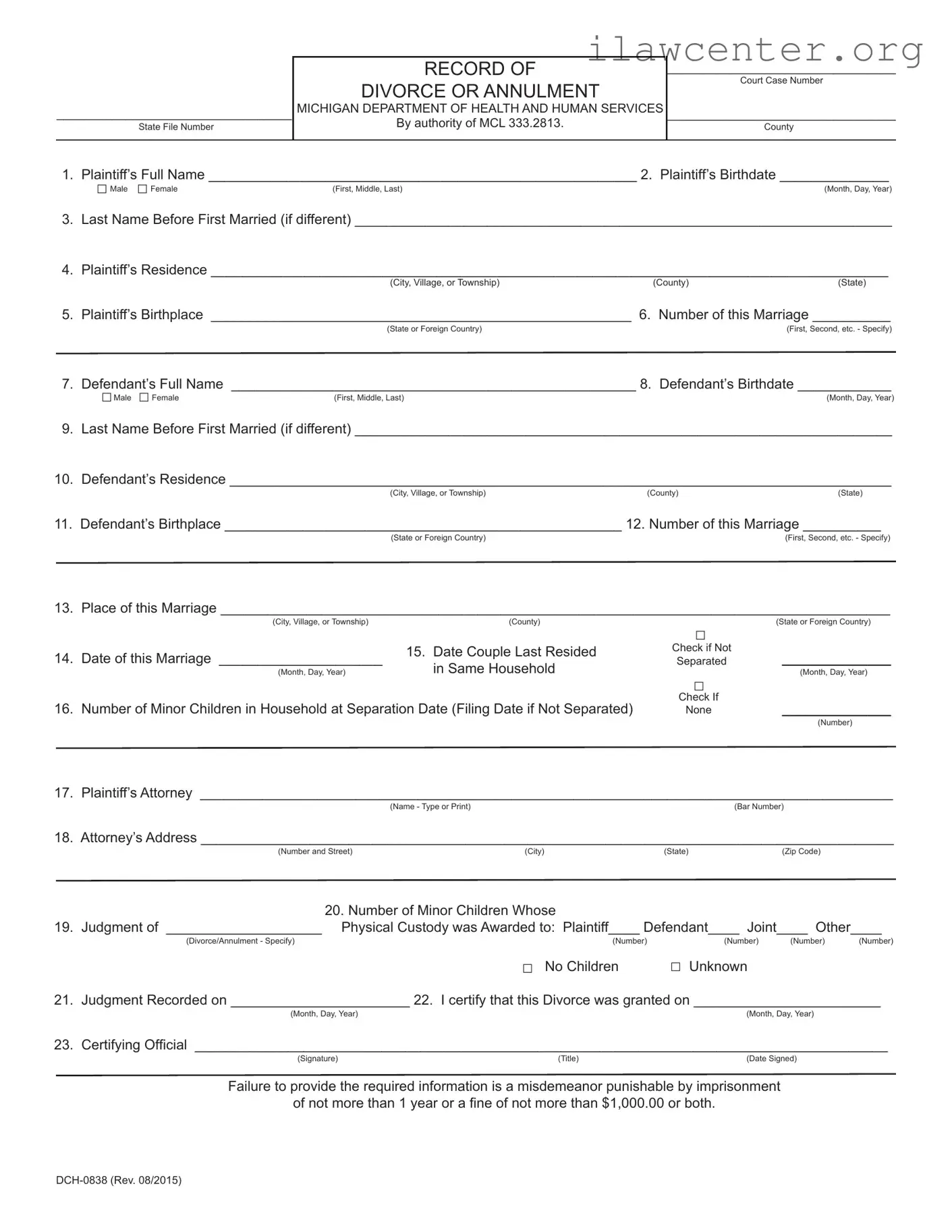
The Michigan DCH 0838 form serves as an official record of divorce or annulment within the state, capturing essential details about the parties involved and the legal proceedings. This form is crucial for both legal documentation and for individuals seeking to finalize their marital status in accordance with state law. To begin the process of completing this form, click the button below.

Article Guide

The Michigan DCH 0838 form serves as an essential document for recording the details of a divorce or annulment within the state. This form is issued by the Michigan Department of Health and Human Services and is governed by the authority of MCL 333.2813. It requires specific information from both parties involved in the divorce, including their full names, birthdates, and residences. Additionally, it captures details about the marriage itself, such as the date and place of the marriage, as well as the number of the marriage for each party. The form also addresses custody arrangements for any minor children involved, ensuring that the court has a clear understanding of the family's situation. Legal representation is noted, along with the attorney's contact information, which facilitates communication throughout the process. The completion of this form is crucial, as failure to provide accurate information can lead to legal penalties. Thus, understanding the Michigan DCH 0838 form is vital for anyone navigating the divorce process in Michigan.

Michigan Dch 0838 Preview

RECORD OF
DIVORCE OR ANNULMENT
MICHIGAN DEPARTMENT OF HEALTH AND HUMAN SERVICES
By authority of MCL 333.2813.
Court Case Number
1. Plaintiff’s Full Name _______________________________________________________ 2. Plaintiff’s Birthdate ______________
Male Female
(First, Middle, Last) (Month, Day, Year)
3. Last Name Before First Married (if different) _____________________________________________________________________
4. Plaintiff’s Residence _______________________________________________________________________________________
(City, Village, or Township) (County) (State)
5. Plaintiff’s Birthplace ______________________________________________________ 6. Number of this Marriage __________
(State or Foreign Country) (First, Second, etc. - Specify)
7. Defendant’s Full Name ____________________________________________________ 8. Defendant’s Birthdate ____________
Male Female
(First, Middle, Last)
(Month, Day, Year)
9. Last Name Before First Married (if different) _____________________________________________________________________
10. Defendant’s Residence _____________________________________________________________________________________
(City, Village, or Township)
(County) (State)
11. Defendant’s Birthplace ___________________________________________________ 12. Number of this Marriage __________
(State or Foreign Country) (First, Second, etc. - Specify)
13. Place of this Marriage ______________________________________________________________________________________
(City, Village, or Township) (County) (State or Foreign Country)
14. Date of this Marriage _____________________ ______________
(Month, Day, Year)
(Month, Day, Year)
16. Number of Minor Children in Household at Separation Date (Filing Date if Not Separated) ______________
(Number)
17. Plaintiff’s Attorney _________________________________________________________________________________________
(Name - Type or Print) (Bar Number)
18. Attorney’s Address _________________________________________________________________________________________
(Number and Street) (City) (State) (Zip Code)
20. Number of Minor Children Whose
19. Judgment of ____________________ Physical Custody was Awarded to: Plaintiff____ Defendant____ Joint____ Other____
(Divorce/Annulment - Specify) (Number) (Number) (Number) (Number)
No Children Unknown
21. Judgment Recorded on _______________________ 22. I certify that this Divorce was granted on ________________________
(Month, Day, Year) (Month, Day, Year)

(Signature) (Title) (Date Signed)
__________________________________
State File Number
Check If
None
Failure to provide the required information is a misdemeanor punishable by imprisonment

DCH-0838 (Rev. 08/2015)
15. Date Couple Last Resided
in Same Household
Check if Not
Separated
_________________________________
_________________________________
County

File Properties

Fact Name Details
Form Purpose The Michigan DCH-0838 form is used to record a divorce or annulment in the state of Michigan.
Governing Law This form is governed by Michigan Compiled Laws (MCL) 333.2813.
Filing Requirement Completion and submission of this form is mandatory after a divorce or annulment is granted.
Information Required The form collects personal details about both the plaintiff and defendant, including names, birthdates, and residences.
Minor Children The form asks for information regarding any minor children in the household at the time of separation.
Penalties for Non-compliance Failure to provide the required information may result in a misdemeanor charge, with potential penalties including imprisonment or fines.

Instructions on Utilizing Michigan Dch 0838

After obtaining the Michigan DCH-0838 form, individuals will need to complete it accurately to ensure proper processing. This form requires personal information about both parties involved in the divorce or annulment, as well as details regarding the marriage itself. Careful attention to each section is essential to avoid delays.

  1. Obtain the Michigan DCH-0838 form from the appropriate source.
  2. Fill in the State File Number at the top of the form.
  3. Enter the Court Case Number in the designated space.
  4. Indicate the County where the case is filed.
  5. Provide the Plaintiff’s Full Name (First, Middle, Last).
  6. Input the Plaintiff’s Birthdate in the format (Month, Day, Year).
  7. Check the box for Plaintiff’s Gender (Male or Female).
  8. List the Last Name Before First Married if different from the current name.
  9. Fill in the Plaintiff’s Residence (City, Village, or Township, County, State).
  10. State the Plaintiff’s Birthplace.
  11. Indicate the Number of this Marriage (First, Second, etc.).
  12. Provide the Defendant’s Full Name (First, Middle, Last).
  13. Input the Defendant’s Birthdate in the format (Month, Day, Year).
  14. Check the box for Defendant’s Gender (Male or Female).
  15. List the Last Name Before First Married if different from the current name.
  16. Fill in the Defendant’s Residence (City, Village, or Township, County, State).
  17. State the Defendant’s Birthplace.
  18. Indicate the Number of this Marriage (First, Second, etc.).
  19. Provide the Place of this Marriage (City, Village, or Township, County, State or Foreign Country).
  20. Input the Date of this Marriage in the format (Month, Day, Year).
  21. Fill in the Date Couple Last Resided in Same Household (Month, Day, Year) and check the box if not separated.
  22. Indicate the Number of Minor Children in Household at Separation Date (or filing date if not separated).
  23. Provide the Plaintiff’s Attorney Name and Bar Number.
  24. Fill in the Attorney’s Address (Number and Street, City, State, Zip Code).
  25. Indicate the Judgment of Divorce/Annulment and the number of minor children whose physical custody was awarded to the Plaintiff, Defendant, or Joint.
  26. Provide the Judgment Recorded on (Month, Day, Year).
  27. Certify the divorce by entering the date it was granted (Month, Day, Year).
  28. Sign the form as the Certifying Official and include your title and date signed.

Important Facts about Michigan Dch 0838

What is the Michigan DCH-0838 form?

The Michigan DCH-0838 form is a record of divorce or annulment, required by the Michigan Department of Health and Human Services. It collects essential information about the divorce or annulment proceedings, including details about both spouses, their marriage, and any minor children involved. This form is crucial for maintaining accurate state records regarding marital status changes.

Who needs to complete the DCH-0838 form?

The form must be completed by the plaintiff, who is the person initiating the divorce or annulment. It is typically filled out by the attorney representing the plaintiff, but in some cases, the plaintiff may fill it out themselves. Both parties’ information is necessary, so it’s essential to have accurate details about the defendant as well.

What information is required on the form?

The DCH-0838 form requires several key pieces of information. This includes the full names and birthdates of both the plaintiff and defendant, their residences, and their birthplaces. Additionally, the form asks for details about the marriage, such as the date and place of the marriage, the number of the marriage, and information about any minor children. Accurate and complete information is vital to ensure the form is processed correctly.

What happens if the form is not completed correctly?

Failure to provide the required information or inaccuracies on the DCH-0838 form can lead to delays in processing the divorce or annulment. In some cases, it may even result in legal consequences. It is important to ensure that all sections are filled out accurately to avoid any issues with the court or state records.

How is the DCH-0838 form submitted?

The completed DCH-0838 form is typically submitted to the court where the divorce or annulment is filed. Depending on local procedures, it may also need to be sent to the Michigan Department of Health and Human Services. It’s advisable to check with the local court for specific submission guidelines to ensure compliance with all requirements.

Is there a fee associated with filing the DCH-0838 form?

While there may not be a direct fee for filing the DCH-0838 form itself, there are often court fees associated with the divorce or annulment process. These fees can vary by county and should be confirmed with the local court. It’s essential to budget for these costs when preparing to file for divorce or annulment.

What should I do if I have questions about the DCH-0838 form?

If you have questions or need assistance with the DCH-0838 form, it’s best to consult with an attorney who specializes in family law. They can provide guidance on how to complete the form correctly and what additional documentation may be needed. Additionally, the local court clerk’s office can be a helpful resource for general questions about the filing process.

Common mistakes

Filling out the Michigan DCH-0838 form can be a daunting task, especially for individuals navigating the complexities of divorce or annulment. One common mistake is failing to provide the correct court case number. This number is essential for the court to track the case accurately. Without it, the processing of the form may be delayed, leading to further complications.

Another frequent error involves the incomplete or inaccurate personal information of the plaintiff and defendant. Individuals often overlook the importance of providing full names, including middle names. Additionally, the birthdates must be filled out correctly. A simple typo can lead to significant issues down the line, especially when verifying identities.

Many people also neglect to indicate their marital status accurately. The form requires the last name before the first marriage, yet some forget to include this crucial detail. This omission can complicate the legal proceedings, as the court may need to request further clarification.

Furthermore, when it comes to the number of marriages, individuals sometimes mistakenly report the wrong sequence. For example, indicating “first” when it is actually the second marriage can create confusion. It is vital to specify whether it is the first, second, or subsequent marriage to ensure the records are accurate.

Another area where errors frequently occur is in the residence information. The form asks for the complete address of both the plaintiff and defendant, including city, county, and state. Incomplete addresses can hinder the court's ability to send notifications or other important documents, leading to further delays in the process.

In addition, individuals often forget to check the box indicating whether the couple has minor children in the household at the time of separation. This information is critical for determining custody arrangements and should not be overlooked.

Moreover, many applicants fail to provide the signature of the certifying official or neglect to include the date it was signed. This step is crucial, as the form is not valid without the appropriate signatures. An unsigned form can lead to rejection and additional legal hurdles.

Lastly, individuals may not realize the importance of double-checking the judgment date and the date the divorce was granted. These dates must align correctly with the court's records. Any discrepancies can lead to complications in the finalization of the divorce or annulment.

In summary, while filling out the Michigan DCH-0838 form may seem straightforward, attention to detail is essential. By avoiding these common mistakes, individuals can help ensure a smoother process as they navigate their legal journey.

Documents used along the form

The Michigan DCH 0838 form is a crucial document used to record a divorce or annulment in the state of Michigan. Along with this form, several other documents may be required to complete the divorce process. Below is a list of commonly associated forms and documents.

  • Judgment of Divorce: This document outlines the court's final decision regarding the divorce. It includes details about asset division, child custody, and support obligations.
  • Parenting Time Order: If minor children are involved, this order specifies the visitation schedule for the non-custodial parent. It ensures that both parents have access to their children while maintaining their best interests.
  • Child Support Order: This form establishes the financial support obligations of the non-custodial parent. It includes the amount to be paid, payment frequency, and any additional provisions related to the child's welfare.
  • Affidavit of Support: This document may be required to confirm the financial support provided to the children. It serves as a sworn statement detailing income and expenses related to child care.

These forms and documents work together with the Michigan DCH 0838 form to ensure a comprehensive legal process during a divorce or annulment. Proper completion and submission of all required documents help facilitate a smoother transition for all parties involved.

Similar forms

The Michigan DCH 0838 form is a crucial document for recording a divorce or annulment in the state. Several other documents share similarities with this form, primarily in their purpose of documenting personal status changes and legal proceedings. Below is a list of nine documents that are comparable to the Michigan DCH 0838 form, highlighting their similarities.

  • Marriage Certificate: This document serves as official proof of marriage, containing information about the couple, similar to how the DCH 0838 records details about the parties involved in a divorce.
  • Divorce Decree: Issued by the court, this decree finalizes the divorce process and includes important details about the marriage, akin to the information captured in the DCH 0838.
  • Child Custody Agreement: This document outlines the custody arrangements for children following a divorce, paralleling the DCH 0838's focus on minor children involved in the separation.
  • Separation Agreement: This legal document details the terms of a couple's separation, similar to how the DCH 0838 records the date of separation and other pertinent information.
  • Affidavit of Support: Often used in immigration cases, this document requires personal information about the sponsor, much like the personal details requested in the DCH 0838.
  • Legal Name Change Petition: This form is used when an individual wishes to change their name legally, documenting personal information in a manner similar to the DCH 0838.
  • Death Certificate: This document records the death of an individual, capturing essential personal information, akin to the DCH 0838’s role in recording a significant life change.
  • Adoption Records: These documents provide details about the adoption process and the individuals involved, paralleling the personal and legal information contained in the DCH 0838.
  • Property Settlement Agreement: This document outlines how property will be divided in a divorce, reflecting the legal considerations addressed in the DCH 0838 regarding marital status changes.

Each of these documents plays a vital role in legal processes that involve significant changes in personal status, similar to the Michigan DCH 0838 form's function in documenting divorces or annulments.

Dos and Don'ts

When filling out the Michigan DCH 0838 form, it is essential to approach the task with care. This document is crucial for recording a divorce or annulment, and accuracy is vital. Here are some important dos and don'ts to keep in mind:

  • Do ensure that all names are spelled correctly. This includes both the plaintiff's and defendant's names.
  • Do provide complete and accurate birthdates for both parties. This information is necessary for legal identification.
  • Do indicate the correct number of this marriage. Specify whether it is the first, second, etc.
  • Do check the boxes for gender accurately. This helps in correctly identifying the parties involved.
  • Don’t leave any fields blank. Every section must be filled out to avoid delays in processing.
  • Don’t forget to sign the form. An unsigned form may be rejected, leading to further complications.
  • Don’t submit the form without reviewing it for errors. A second look can help catch mistakes before submission.

By following these guidelines, you can help ensure that your submission is complete and correct, reducing the likelihood of any issues arising during the processing of your divorce or annulment. Remember, attention to detail is key in legal matters.

Misconceptions

Many people have misunderstandings about the Michigan DCH 0838 form, which is crucial for documenting a divorce or annulment. Here are ten common misconceptions:

  • It is only for divorces. The DCH 0838 form is used for both divorces and annulments, capturing essential details for either process.
  • You can submit it without a court order. This form must be filed after a court has granted a divorce or annulment; it cannot be submitted independently.
  • All information is optional. Many fields are required. Failing to provide necessary information can result in penalties.
  • It is only for Michigan residents. While the form is specific to Michigan, it can also be used by individuals who were married in Michigan, regardless of their current residence.
  • Only one spouse needs to fill it out. Both parties’ information is required, making it essential for both the plaintiff and defendant to provide their details.
  • It is a simple form with no consequences. Incorrect or incomplete submissions can lead to legal repercussions, including fines or imprisonment.
  • It does not require an attorney. While not mandatory, having an attorney can help ensure that the form is filled out correctly and completely.
  • It is only relevant for child custody cases. The DCH 0838 form addresses more than just custody; it documents the entire divorce or annulment process.
  • You can file it anytime after the divorce. There is a specific timeframe for submitting the form after the divorce is finalized, which must be adhered to.
  • It is only for couples without children. The form includes sections for couples with minor children, detailing custody arrangements and other relevant information.

Understanding these misconceptions can help individuals navigate the divorce process more effectively and ensure compliance with state requirements.

Key takeaways

Here are some key takeaways about filling out and using the Michigan DCH 0838 form:

  • Accurate Information: Ensure that all names, dates, and addresses are filled out accurately to avoid delays.
  • Full Names Required: Both the plaintiff and defendant must provide their full names, including any last names before marriage.
  • Birthdates: Include the birthdates for both parties, selecting the appropriate gender option.
  • Marriage Details: Clearly state the place and date of the marriage, as well as the number of the marriage (first, second, etc.).
  • Residency Information: Provide complete residency details for both the plaintiff and defendant, including city, county, and state.
  • Minor Children: Indicate the number of minor children involved and specify custody arrangements as required.
  • Certification: The form must be signed by a certifying official to validate the information and confirm the divorce was granted.

Completing this form accurately is essential for the processing of divorce or annulment records in Michigan.