Attorney-Verified  Deed Document for Michigan

Attorney-Verified Deed Document for Michigan

A Michigan Deed form is a legal document used to transfer ownership of real estate from one party to another. It serves as proof of the transaction and outlines the rights and responsibilities of the parties involved. For those looking to navigate property transfers in Michigan, filling out the form accurately is crucial; start the process by clicking the button below.

Article Guide

The Michigan Deed form is a crucial legal document that facilitates the transfer of property ownership within the state. It serves various purposes, including conveying real estate from one party to another, whether through sale, gift, or inheritance. The form typically includes essential details such as the names of the grantor and grantee, a clear description of the property being transferred, and the signatures of the involved parties. Additionally, it may require notarization to ensure authenticity and compliance with state laws. Understanding the nuances of this form is vital for anyone engaging in property transactions in Michigan, as it not only outlines the terms of the transfer but also protects the rights of both the seller and the buyer. By grasping the key components and requirements of the Michigan Deed form, individuals can navigate the complexities of property ownership with greater confidence and clarity.

Michigan Deed Preview

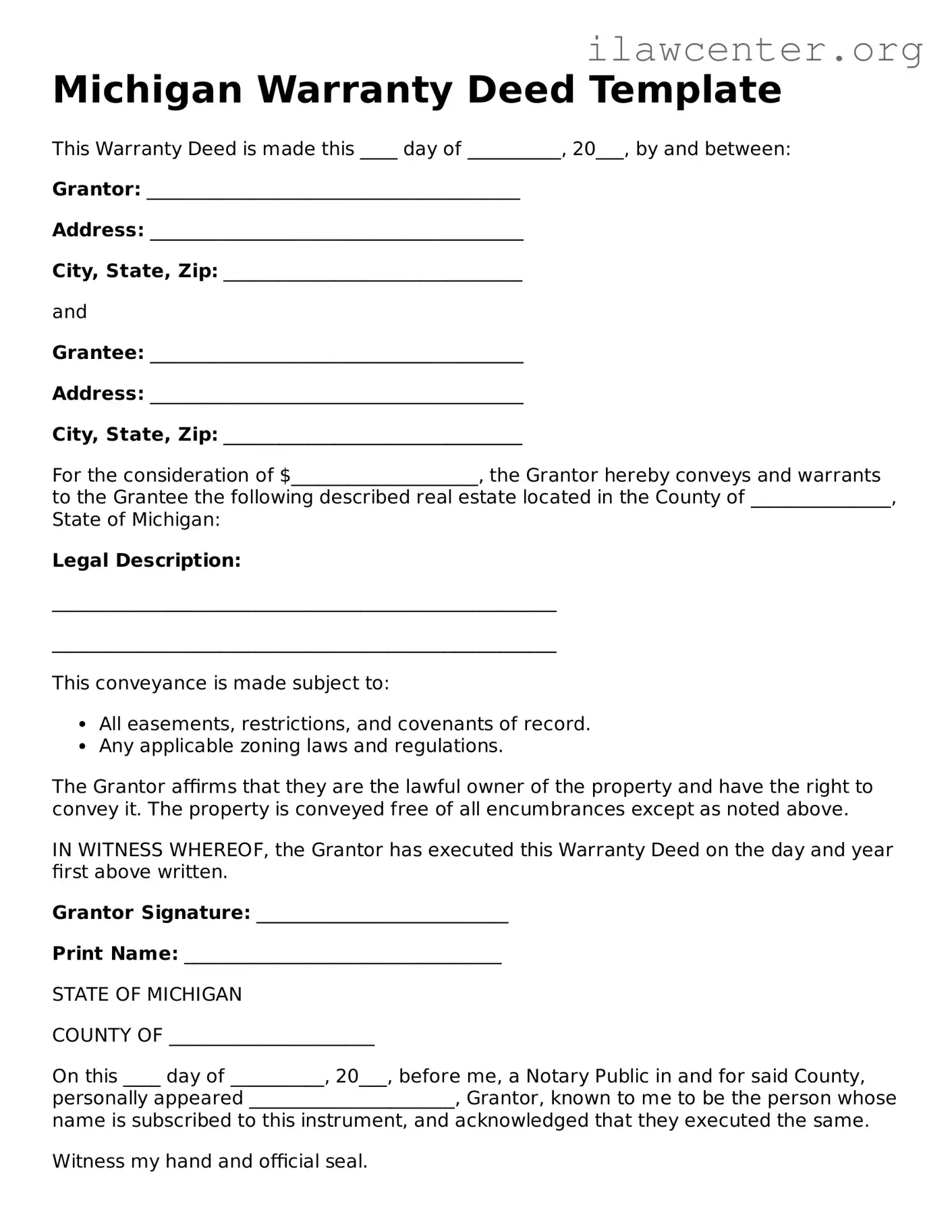
Michigan Warranty Deed Template

This Warranty Deed is made this ____ day of __________, 20___, by and between:

Grantor: ________________________________________

Address: ________________________________________

City, State, Zip: ________________________________

and

Grantee: ________________________________________

Address: ________________________________________

City, State, Zip: ________________________________

For the consideration of $____________________, the Grantor hereby conveys and warrants to the Grantee the following described real estate located in the County of _______________, State of Michigan:

Legal Description:

______________________________________________________

______________________________________________________

This conveyance is made subject to:

  • All easements, restrictions, and covenants of record.
  • Any applicable zoning laws and regulations.

The Grantor affirms that they are the lawful owner of the property and have the right to convey it. The property is conveyed free of all encumbrances except as noted above.

IN WITNESS WHEREOF, the Grantor has executed this Warranty Deed on the day and year first above written.

Grantor Signature: ___________________________

Print Name: __________________________________

STATE OF MICHIGAN

COUNTY OF ______________________

On this ____ day of __________, 20___, before me, a Notary Public in and for said County, personally appeared ______________________, Grantor, known to me to be the person whose name is subscribed to this instrument, and acknowledged that they executed the same.

Witness my hand and official seal.

Notary Public Signature: ______________________

My Commission Expires: ______________________

PDF Form Characteristics

Fact Name Description
Governing Law The Michigan Deed form is governed by the Michigan Compiled Laws, specifically Act 591 of 1996.
Types of Deeds Common types of deeds in Michigan include warranty deeds, quitclaim deeds, and fiduciary deeds.
Signature Requirement The grantor must sign the deed in the presence of a notary public for it to be valid.
Recording To provide public notice, the deed must be recorded with the county register of deeds.
Consideration The deed must state the consideration paid, which is often the purchase price of the property.
Legal Description A legal description of the property being transferred must be included in the deed.

Instructions on Utilizing Michigan Deed

Once you have obtained the Michigan Deed form, the next step is to accurately complete it to ensure a proper transfer of property ownership. The following steps will guide you through the process of filling out the form correctly.

  1. Begin by entering the name of the grantor, which is the person transferring the property. Include the full legal name as it appears on identification documents.
  2. Next, provide the name of the grantee, the individual or entity receiving the property. Again, use the full legal name.
  3. Include the current address of the grantor. This should be a complete address, including street, city, state, and zip code.
  4. Enter the address of the grantee in the same manner as the grantor's address.
  5. Identify the property being transferred. This should include the legal description of the property, which can often be found on previous deeds or tax records.
  6. Specify the date of the transfer. This is the date when the deed is being executed.
  7. Sign the deed in the designated area. The grantor must sign the document in the presence of a notary public.
  8. Have the deed notarized. The notary will verify the identity of the grantor and witness the signing of the document.
  9. Finally, file the completed deed with the appropriate county register of deeds office. This step is crucial for the transfer to be legally recognized.

Important Facts about Michigan Deed

What is a Michigan Deed form?

A Michigan Deed form is a legal document used to transfer ownership of real estate from one party to another within the state of Michigan. This form outlines the details of the property being transferred and the parties involved in the transaction. It is essential for establishing clear title and ownership rights.

What types of deeds are available in Michigan?

In Michigan, several types of deeds can be used, including warranty deeds, quitclaim deeds, and special warranty deeds. A warranty deed provides the highest level of protection for the buyer, ensuring that the seller has clear title to the property. A quitclaim deed transfers whatever interest the seller has in the property without any guarantees. A special warranty deed offers some protection but only for claims that arose during the seller's ownership.

How do I fill out a Michigan Deed form?

Filling out a Michigan Deed form requires careful attention to detail. Start by entering the names of the grantor (the seller) and grantee (the buyer). Then, provide a legal description of the property, which can typically be found in previous deeds or property tax records. Make sure to include the date of the transaction and any necessary signatures. It's advisable to consult a real estate professional or attorney to ensure accuracy.

Do I need to have the deed notarized?

Yes, in Michigan, a deed must be notarized to be valid. This means that the signatures of the grantor and any witnesses must be acknowledged by a notary public. The notarization helps verify the identity of the parties involved and ensures that the document is executed properly.

Where do I file the Michigan Deed form?

The completed Michigan Deed form must be filed with the Register of Deeds in the county where the property is located. This filing is crucial as it makes the transfer of ownership a matter of public record. There may be a filing fee, so it’s wise to check with the local Register of Deeds for specific requirements and costs.

Are there any taxes associated with transferring a deed in Michigan?

Yes, when transferring a deed in Michigan, there may be transfer taxes applicable. The state imposes a real estate transfer tax, which is typically based on the sale price of the property. Additionally, local municipalities may have their own transfer taxes. It’s important to budget for these costs when planning a property transaction.

Can I use a Michigan Deed form for property in another state?

No, a Michigan Deed form is specifically designed for use within Michigan. Each state has its own laws and requirements regarding property transfers, so using a deed form from another state would not be appropriate. If you are dealing with property outside of Michigan, you will need to obtain the correct deed form for that specific state.

What happens if I make a mistake on the deed form?

If there is an error on the Michigan Deed form, it can lead to complications in the transfer of ownership. Depending on the nature of the mistake, you may need to correct it before filing or, in some cases, execute a new deed. It's advisable to review the document thoroughly and consult a professional if you notice any discrepancies to avoid future issues.
Common mistakes

Filling out a Michigan Deed form can be a straightforward process, but there are common mistakes that individuals often make. One frequent error is failing to include the correct names of the grantor and grantee. It is essential that the names match exactly as they appear on official documents. Any discrepancies can lead to complications in the transfer of property.

Another mistake involves the omission of a legal description of the property. This description should be detailed and precise, ensuring that the property can be clearly identified. Relying on vague descriptions can create confusion and may result in legal disputes later on.

People sometimes neglect to include the date of the transaction. This date is crucial as it establishes when the transfer of ownership occurs. Without it, the deed may be considered incomplete, which could affect the validity of the transfer.

Inaccurate property tax identification numbers are also a common issue. Each property in Michigan has a unique tax ID number, and failing to provide the correct one can lead to issues with property taxes and ownership records. It is advisable to double-check this information before submission.

Additionally, individuals often forget to have the deed notarized. A notarized deed provides an extra layer of authenticity and is often required for the deed to be legally recognized. Skipping this step can result in the deed being challenged or deemed invalid.

Finally, many people overlook the need to file the completed deed with the appropriate county register of deeds. Simply filling out the form is not enough; it must be officially recorded to ensure that the property transfer is recognized by local authorities. Failing to file can lead to complications in proving ownership in the future.

Documents used along the form

When completing a property transfer in Michigan, several documents often accompany the Michigan Deed form. Each of these documents serves a specific purpose in the transaction process, ensuring clarity and legal compliance.

  • Property Transfer Affidavit: This document provides the local tax assessor with information about the property transfer. It helps determine the taxable value of the property.
  • Title Insurance Policy: This policy protects the buyer from any disputes regarding property ownership. It ensures that the title is clear and free from liens or other claims.
  • Purchase Agreement: This is the contract between the buyer and seller outlining the terms of the sale, including price, closing date, and any contingencies.
  • Closing Statement: This document details all financial transactions related to the sale, including fees, taxes, and the final purchase price. It is reviewed and signed at closing.
  • Affidavit of Title: This sworn statement confirms the seller's ownership of the property and discloses any encumbrances or claims against it.
  • Mortgage Documents: If the buyer is financing the purchase, these documents outline the terms of the loan, including interest rates and repayment schedules.
  • Warranty Deed: This type of deed guarantees that the seller holds clear title to the property and has the right to sell it. It provides the buyer with protection against future claims.

Understanding these documents can help facilitate a smoother property transfer process in Michigan. Always ensure that all necessary forms are completed accurately and filed appropriately.

Similar forms

The Deed form is a crucial document in real estate and property transactions. It shares similarities with several other legal documents. Here are six documents that are similar to the Deed form:

  • Title Insurance Policy: This document protects against losses from defects in the title. Like a Deed, it confirms ownership of property and ensures that the title is clear.
  • Bill of Sale: Used for transferring ownership of personal property, this document is similar to a Deed in that it serves as proof of transfer from one party to another.
  • Lease Agreement: This document outlines the terms of renting property. It is akin to a Deed because it grants rights to use property, albeit temporarily.
  • Mortgage Agreement: A Mortgage secures a loan with the property as collateral. Both documents involve the transfer of property rights, although a Mortgage also includes repayment terms.
  • Quitclaim Deed: This type of Deed transfers ownership without guarantees. Like a standard Deed, it is used to convey property, but it offers less protection to the buyer.
  • Property Transfer Tax Form: This form is required when property changes hands. It shares similarities with the Deed form in that it documents the transfer and may be necessary for legal recording.

Dos and Don'ts

When filling out the Michigan Deed form, it is important to follow certain guidelines to ensure accuracy and compliance. Below is a list of things you should and shouldn't do.

  • Do double-check the names of all parties involved for correct spelling.
  • Do include the complete legal description of the property.
  • Do sign the deed in the presence of a notary public.
  • Do provide the date of the transaction.
  • Do keep a copy of the completed deed for your records.
  • Don't leave any sections of the form blank unless instructed.
  • Don't use abbreviations for names or addresses.
  • Don't forget to check for any additional requirements specific to your county.
  • Don't submit the deed without the proper filing fee.
  • Don't rush through the process; take your time to ensure everything is accurate.

Misconceptions

Many people have misunderstandings about the Michigan Deed form. Here are some common misconceptions:

  1. All deeds are the same. Different types of deeds serve different purposes. For example, a warranty deed offers more protection than a quitclaim deed.
  2. You don’t need a deed if you have a title. A title shows ownership, but a deed is the legal document that transfers ownership from one person to another.
  3. Only lawyers can prepare a deed. While it's wise to consult a lawyer, individuals can fill out a deed form themselves if they understand the requirements.
  4. Once a deed is signed, it cannot be changed. Deeds can be amended or revoked, but it requires a new deed to be executed.
  5. Recording a deed is optional. While not legally required, recording a deed protects your ownership rights and provides public notice of your ownership.
  6. All signatures must be notarized. In Michigan, only the grantor’s signature needs to be notarized for the deed to be valid.
  7. You can use a deed from another state. Deed forms vary by state. It’s important to use the correct Michigan form to ensure compliance with local laws.
  8. Deeds are only needed for selling property. Deeds are also necessary for transferring property as gifts, inheritance, or other reasons.

Understanding these misconceptions can help you navigate property transactions more confidently.

Key takeaways

Filling out and using a Michigan Deed form is an important process for transferring property ownership. Here are some key takeaways to keep in mind:

  1. Understand the Purpose: A deed is a legal document that conveys ownership of real property from one party to another.
  2. Identify the Type of Deed: Michigan recognizes various types of deeds, including warranty deeds, quitclaim deeds, and more. Choose the one that best suits your needs.
  3. Gather Necessary Information: Collect information about the property, including its legal description, the names of the grantor (seller) and grantee (buyer), and any encumbrances.
  4. Complete the Form Accurately: Fill out the deed form carefully. Errors can lead to complications in the transfer process.
  5. Notarization is Essential: The deed must be signed in the presence of a notary public to be legally valid.
  6. Consider Recording the Deed: After execution, the deed should be recorded with the county register of deeds to protect your ownership rights.
  7. Check for Transfer Taxes: Be aware that transferring property may incur transfer taxes, which need to be paid at the time of recording.
  8. Review Local Laws: Familiarize yourself with local laws and regulations that may affect the deed and property transfer process.
  9. Consult a Professional: If you have any doubts or questions, consider consulting a real estate attorney for guidance.
  10. Keep Copies: After the deed is recorded, keep copies for your records. This documentation is crucial for future reference.

Understanding these key aspects can facilitate a smoother property transfer process in Michigan.